
Peak Oil is You

Donate Bitcoins ;-) or Paypal :-)


Page added on February 5, 2016

The First Warning Sign That Cushing May Be About To Overflow

To be sure, the rumors have been there for a while.
As we first wrote in March of 2015 when it became a topic of conversation, speculation that Cushing may fill, and even overflow, has been around for nearly 10 months.
As we reported then, there were floating predictions that Cushing may top out as soon as the summer of 2015.

In retrospect, these forecasts underestimated just how “stretchy” US commercial storage can be; they also ignored how many millions of barrels could and would be stored at sea even though the contango in recent months had made such storage virtually unprofitable; the recent change in the US oil exporting law helped, and much of the excess inventories were carted off toward Europe which allegedly has more oil excess capacity than the US.
However, as overproduction continues, even the highly adaptive US storage system appears to be reaching its limits. Recall that the primary reason why Goldman envisions $20 oil as a possibility is because US storage capacity will be reached.

Then yesterday, the EIA itself in a blog post took on the topic of soaring inventories.
This is what it said:
Several factors have played a part in pushing U.S. crude oil prices below $30 per barrel (b), including high inventory levels of crude oil, uncertainty about global economic growth, volatility in equity and nonenergy commodity markets, and the potential for additional crude oil supply to enter the market. Crude oil and petroleum product inventories, both domestically and internationally, have been growing since mid-2014 and are above five-year averages for this date.
Although there is still traditional, on-land storage space available, higher inventory levels and expectations for global inventories to continue building in 2016 are lowering crude oil and petroleum product prices for near-term delivery:
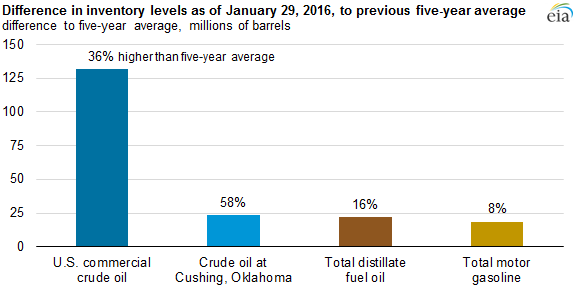
- Total U.S. commercial crude oil inventories as of January 29 were 503 million barrels, 132 million barrels above the 2011-15 January average. This marks the first time that U.S. inventories exceeded 500 million barrels.
- Crude oil inventories at Cushing, Oklahoma, the delivery point for the West Texas Intermediate (WTI) futures contract traded on the New York Mercantile Exchange (Nymex), are 23 million barrels above the five-year average as of January 29.
- Total U.S. distillate inventories (which include heating oil and diesel fuel) are 22 million barrels above the five-year average, and motor gasoline inventories in the United States also recently moved above historical averages.
But it was only today that we got the loudest alarm bell yet, suggesting that an “overflow” of Cushing may all too real in the not too distant future.
According to Reuters, the unprecedented build-up of surplus crude oil supplies in Cushing, Oklahoma, is beginning to cause logistical headaches for companies moving crude between thousands of steel tanks in the nation’s most important storage hub.
For one company, Enterprise Products Partners, which is a large participant in the Cushing market, this means telling at least some counterparties that it is experiencing delays in delivering crude from its tanks, Reuters said citing three sources who were informed of unspecified “terminalling and pump” issues.
Alarm bell #1:
“The sources attributed the disruptions to the unusually high level of oil collecting in Cushing, the delivery point of the CME Group’s U.S. oil futures contract. Stockpiles have risen to a record 62.4 million barrels as of last week, according to the U.S. Energy Information Administration, just 9 million barrels shy of their theoretical limit.”
“It’s hard to move barrels around right now because there’s so much oil (in Cushing),” said one trader.
And if it’s hard now, imagine what will happen in a few weeks let alone months, when 1-2 million barrels in excess production is dumped in Cushing courtesy of the relentless Saudis and Iranians.
For now at least, it’s not a panic: “The delivery delays are unusual but not severe enough to trigger contractual disputes, one source said. Oil traders routinely pump crude in and out of tanks in Cushing in order to settle futures contracts or create particular blends for refiners. Most trades are usually completed within a month’s time.”
However, that is about to change:
The hiccups may be a sign of things to come as traders fear a further increase in stocks at Cushing would test the upper limits of tanks and cause the next leg of an 18-month rout.
Alarm bell #2:
Enterprise owns just 3.3 million barrels of storage capacity in Cushing, small relative to operators like Enbridge Energy Partners with over 20 million barrels. It is not clear how much space the firm may have leased from other owners. But traders say they remain one of the larger players in that market, and first noticed that something was awry when Enterprise began bidding to buy the Feb/March WTI cash roll earlier on Thursday, indicating that they were potentially short barrels for immediate delivery.
The cash roll, which allows traders to roll their long positions forward, traded at larger volumes at negative $1.00 a barrel on Thursday. Those deals raised questions among market participants as the roll does not actively trade outside of the three-day window after the settlement of the front-month futures contract.
To be sure, this is not the first time the roll was negative: a few weeks ago, during the official roll period, it traded at negative $1.95 a barrel.
However, it is becoming increasingly recurring and certainly more acute.
The problem, the sources say, appears to be related to oil volumes being so high in Cushing that there is not enough room to drain existing tanks to blend oil to West Texas Intermediate specifications.
For now, only the smaller firms are affected which is a useful warning sign. Because if and when the large guys like Enbridge get in trouble and are no longer able to store the millions of barrels on location, we won’t learn about it in advance. Instead what we will see is the price of oil suddenly plunging by 5%, 10% or more percent, as attempts to clear and dump excess inventory spread like wildfire across the market.
So for those who are still long oil on hopes of some major supply disruption, or some miraculous surge in demand, consider this a fair warning that very soon things may change.
14 Comments on "The First Warning Sign That Cushing May Be About To Overflow"
geopressure on Fri, 5th Feb 2016 7:34 pm
mark my words:
In a few days/weeks we will start seeing US refineries shutdown due to crude oil shortage, but the US Goivernment will blame the shutdowns on Cyber Attacks or something of that nature…
Obama will claim that the Cyber attacks (or whatever excuse) has caused a back-up in crude inventories & he is going to overflow the US’s Commercial Storage (only on paper) & drive prices down despite oil being so scarce that the refineries cannot even operate…
Everything will be bone dry & Obama will claim that they are overflowing… That’s how this government works…
If you are going to lie, might as well lie big…
Truth Had A Liberal Bias on Fri, 5th Feb 2016 7:58 pm
Whatever it is Cushings is full of it is not something the Gulf refineries want too much of because they are importing crude from other sources overseas to meet their refinery input needs. Mixing light oil and heavy oil may result in a product that resembles the API of WTI but mixing half a barrel of long chain polymer hydrocarbon with half a barrel of short chain polymer hydrocarbon does not result in a barrel of medium chain polymer hydrocarbon. Cushings is full of condensate.
toolpush on Fri, 5th Feb 2016 9:44 pm
That maybe why Brent is trading at a $3 premium to WTI. With unrestricted export that are allowed now, Cushing has a relief valve, that wasn’t as freely available last year.
If Cushing does get too full, the price difference between Brent and WTI will open to make it very conducive to export, whether it be condensate or more traditional oil.
twocats on Sat, 6th Feb 2016 12:28 am
In a few days/weeks we will start seeing US refineries shutdown due to crude oil shortage, but the US Goivernment will blame the shutdowns on Cyber Attacks or something of that nature… [geopressure]
That’s seems like a pretty big conspiracy theory. How many people would need to be involved to pull that off? 9-11, that was a cake walk and anyone that was a liability probably was tied up in the basement of Bldg 7, but manipulating the entire US production and inventory numbers, I don’t know.
shortonoil on Sat, 6th Feb 2016 9:39 am
The Etp Model indicates that the difference between what the world is now producing, and the petroleum that its economy can absorb is about 1.4 Gb/ year. It seems reasonable to assume that what is not being processed is the least valuable of that production. Condensate and LTO would fall into that category as their usefulness in producing fuels is only marginal.
The discussion as to whether the world will be short of storage space for this underutilized production is probably academic at best. 1 Gb constitutes a volume which is represented by a cube that is about 1,800 feet on each side. On a global scale that is a trivial quantity. The primary limiting factor at this stage is most likely the ability of the financial system to continue funding losing operations. The extractive portion of the industry has seen its revenue stream decline by $2.3 trillion per year since June of 2014. Maintaining positive cash flows is only significant as long as those operators can provide the needed collateral to cover the remainder of their full life cycle production costs. How long the financial industry will be willing to accept their declining capital stock as collateral for providing those funds will dictate when large scale shut-ins will begin. That is likely to depend on the financial integrity of the CB themselves.
Precipitous declines in production, and demand appear likely by the end of 2016.
http://www.thehillsgroup.org/
Nony on Sat, 6th Feb 2016 11:04 am
What a silly story.
1. No one is going to overflow a tank on purpose. Why would you do that? Wastes product and costs money to clean up. So just drop this silliness. They can always just refuse the deliveries if they are full. Pipelines would stop, trains would stop, etc.
2. Even the above cessation will not occur because as storage gets tight, the price of storage will go UP, thus naturally reducing inflows to the Cushing region. Displaced oil could move to other storage locations (which are not as flush) or even to offshore.
3. If storage becomes flush, price (of oil itself) tends to drop…clearing the glut over time. You see this in natural gas all the time when we have weather conducive to gluts.
———
I do think the filling of Cushing is interesting (but not dangerous). Would love to see some exploration of the reasons, probably has to do with pipelines or strip or something like that. Little interesting business case, but not a big deal.
twocats on Sat, 6th Feb 2016 11:16 am
Nony,
the article actually walks back some of the hysteria from earlier articles, talking about how long this process is taking. It also states things like this pretty prominently, “For now at least, it’s not a panic: “The delivery delays are unusual but not severe enough to trigger contractual disputes,”
But, one, now you are asking people to spend EVEN MORE money to move their oil all around the country/world finding storage space, and what if they have a contract to be able to store oil at Cushing, who is going to pay? Two, you are going to be testing a lot of overflow valves and meters that may not the most well-maintained as this situation hasn’t happened since what the 80’s? Third, building new tanks is easy, but again, whose going to pay for it?
So yes, a chance of a spill or accident increases significantly if you are a stressed operator scrambling around playing musical tanks while trying to fill orders. Is this issue more important than the one Short is highlighting, No.
rockman on Sat, 6th Feb 2016 11:32 am
Folks should understand that the bulk of the oil at Cushing is not “surplus oil”. Most is oil that is bought from speculators from producers. Yes: it’s oil that has been sold to buyers. Those speculators are storing oil on expectations of selling at a higher price. As oil prices declined it increased the expectations of making big $’s and thus an increase in demand for storage.
The second big group storing oil at Cushing are blenders. Rarely does any refiner crack oil as it comes from the wellhead. Typically they process blended oil with a gravity between 31 and 33 API. The refiners buy Cushing blended oil for the most. But lately some refiners are buying oil directly from producers and having it blended themselves. The Cushing blenders are mixing oils to max their profits in a manner which doesn’t always max the profits for a particular refiner.
Very little of the oil stored in Cushing belongs to the companies that produced it. I’ve worlked for companies for 40 years that have sold hundreds of millions of bbls of oil and none of it was sent to storage by those producing companies. I’ve sold millions of bbls over the last 7 years for my current company and all of it was bought by companies like Plains Resources. They might have sent it to storage, blended it and sold it to refiners. But more likely most of it was sold to other companies. Either way whatever happens to my oil once it leaves my lease is of no concern or even interest to me. And the same could be said of almost all producers. Think of most producers as oil whole sellers. The folks storing oil, blending oil or refining oil are more like retailers.
I realize it can be entertaining to speculate about oil production, transportation, storage and refining. But one needs to understand the complexity of this dynamic to construct any speculation or theory that comes close to the reality of the situation.
rockman on Sat, 6th Feb 2016 3:35 pm
I also point out that while Cushing may be the largest oil storage facility on the planet (let along in the US)it still holds only 22% of all oil currently being held in US storage facilities. Currently 40% of US oil storage capacity is empty. Needless to say not all US oil goes to Cushing. Currently all of the Rockman’s Texas oil production is barged to Lake Charles, La. I suspect much of the oil going into storage rental tanks at Cushing is coming from Canada.
Something else to keep in mind: on any given day US refineries hold about 40 million bbls of oil in storage MORE than the oil being stored at Cushing. Somewhere along the way Cushing storage was spun as THE oil storage dynamic in the country. Obviously the numbers show the weakness of that thinking.
rockman on Sat, 6th Feb 2016 4:05 pm
BTW its nice they show total US oil storage is much higher at 130 million bbls then the 5 year average. It would have been even more informative if they had also pointed out that total US oil storage capacity (not including the 100 million bbls stored in our refineries)was about 240 million bbls. That would help put the 130 millions bbls into a meaningful perspective.
Also BTW all the stats I’ve presented came from the source their number came from so they were also aware of the same facts I’ve presented. They just wanted to hype their agenda…whatever that might be. LOL.
shortonoil on Sun, 7th Feb 2016 7:52 am
“Is this issue more important than the one Short is highlighting, No.”
Many of these types of reports are put out by the same organizations that are trading the futures markets. They are often used to produce short term bounces in those markets which can be used to generate short term fees. Although Goldman has been pounding the $20/barrel drum for some time WTI prices have stubbornly remained in the $30 range. Descriptions of overflowing tanks, and crude soaked oil workers are likely to be more the product of zealot traders than the actual situation. It must be taken into consideration that Goldman’s integrity rating on a 1 to 10 scale is about -3.
marmico on Sun, 7th Feb 2016 8:18 am
Now that the $29.99 on special today ETP model has been falsified in your own words, you are going to keyboard about “zealot traders than actual situation” markets.
Write another algorithm for falsification, fuctard.
rockman on Sun, 7th Feb 2016 10:37 am
Or to simplify Shorty’s post: it’s called market manipulation. In this case the oil futures market. An area that GS is desperate to recover some of the $7 BILLION it recently paid to Mexico to cover its huge mistake playing the 2015 oil futures market with PEMEX.
Hgthhtynhih on Sun, 7th Feb 2016 5:38 pm
Geopressure maybe your gay lovers trump and Cruz will get their way. Totally F!!! Us over