
Peak Oil is You
Donate Bitcoins ;-) or Paypal :-)


Page added on May 24, 2017

The Coming Seneca Cliff of the Automotive Industry: the Converging Effect of Disruptive Technologies and Social Factors
Decades of work in research and development taught me this:
Which I could call “the Golden Rule of Technological Innovation.” There are so many cases of this law at work that it is hard for me to decide where I should start from. Just think of nuclear energy; do you understand what I mean? So, I am always amazed at the naive faith of some people who think that more technology will save us from the trouble created by technology (the most common mistake people make is not to learn from mistakes).
That doesn’t mean that technological research is useless; not at all. R&D can normally generate small but useful improvements to existing processes, which is what it is meant to do. But when you deal with breakthroughs, well, it is another kettle of dynamite sticks; so to say. Most claimed breakthroughs turn out to be scams (cold fusion is a good example) but not all of them. And that leads to the second rule of technological innovation:
You probably know the story of the Polish cavalry charging against the German tanks during WWII. It never happened, but the phrase “fighting tanks with horses” is a good metaphor for what technological breakthroughs can do. Some innovations impose themselves, literally, by marching over the bodies of their dead opponents. And when an innovation becomes a marker of social success, it can do even more than that. Do you remember the role of status symbol that cell phones played in the 1990s?
Cars are an especially good example of how social factors can affect and amplify the effects of innovation. I discussed in a previous post on Cassandra’s Legacy how cars became the prime marker of social status in the West with the 1950s, becoming the bloated and inefficient objects we know today. They had a remarkably effect on society, creating the gigantic suburbs of today’s cities of today where life without a personal car is nearly impossible.
But the great wheel of technological innovation keeps turning and it is soon going to make individual cars as obsolete as it would be wearing coats made of home-tanned bear skins. It is, again, the combination of technological innovation and socioeconomic factors creating a disruptive effect. For one thing, private car ownership is rapidly becoming too expensive for the poor. At the same time, the combination of global position systems (GPS), smartphones, and autonomous driving technologies makes it possible a kind of “transportation on demand” or “transportation as a service” (TAAS) that was unthinkable just a decade ago. Electric cars are especially suitable (although not critically necessary) for this kind of transportation. In this scheme, all you need to do to get a transportation service is to push a button on your smartphone and the vehicle you requested will silently glide in front of you to take you wherever you want. (*)
The combination of these factors is likely to generate an unstoppable and disruptive social phenomenon. Owning a car will be increasing seen as passé, whereas using the latest TAAS gadgetry will be seen as cool. People will scramble to get rid of their obsolete, clumsy, and unfashionable cars and move to TAAS. Then, TAAS can also play the role of social filter: with the ongoing trends of increasing social inequality, the poor will be able to use it only occasionally or not at all. The rich, instead, will use it to show that they can and that they have access to credit. Some TAAS services will be exclusive, just as some hotels and resorts are. Some rich people may still own cars as a hobby, but that wouldn’t change the trend.
To have some idea of what a TAAS-based world can be, you might read Hemingway’s “Movable Feast”, a story set in Paris in the 1920s. There, Hemingway describes how the rich Americans in Paris wouldn’t normally even dream of owning a car (**). Why should they have, while when they could simply ride the local taxis at a price that, for them, was a trifle? It was an early form of TAAS. Most of the Frenchmen living in Paris couldn’t afford that kind of easygoing life and that established an effective social barrier between the haves and the have-nots.
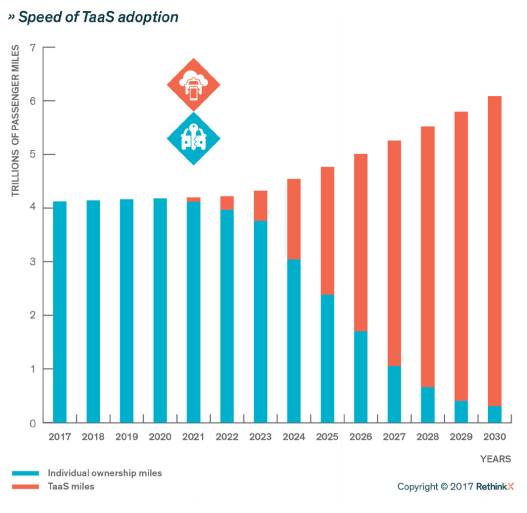
As usual, of course, the future is difficult to predict. But something that we can say about the future is that when changes occur, they occur fast. In this case, the end result of the development of individual TAAS will be the rapid collapse of the automotive industry as we know it: a much smaller number of vehicles will be needed and they won’t need to be of the kind that the present aotumotive industry can produce. This phenomenon has been correctly described by “RethinkX,” even though still within a paradigm of growth. In practice, the transition is likely to be even more rapid and brutal than what the RethinkX team propose. For the automotive industry, there applies the metaphor of “fighting tanks with horses.”
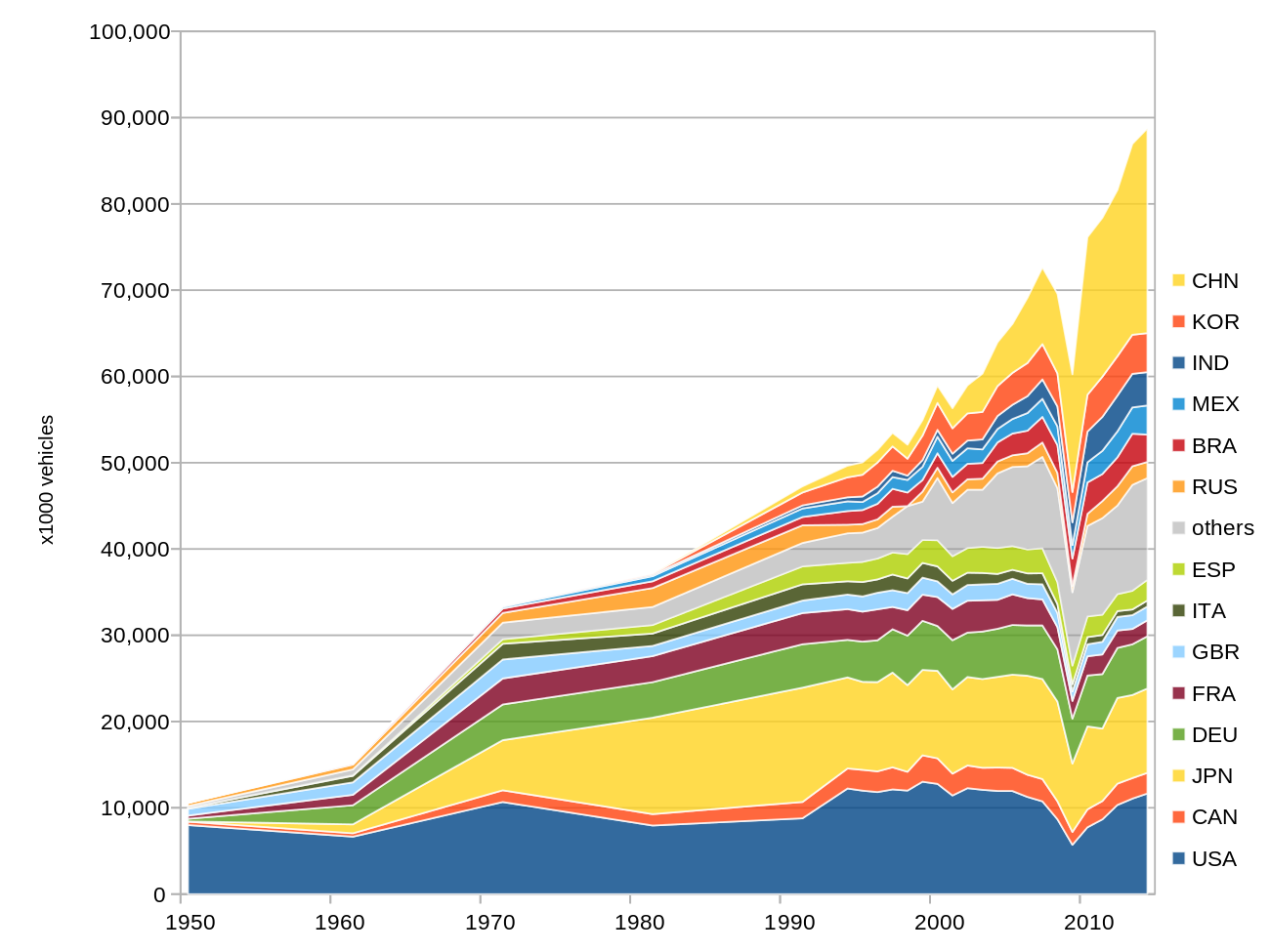
The demise of the automotive industry is an example of what I called the “Seneca Effect.” When some technology or way of life becomes obsolete and unsustainable, it tends to collapse very fast. Look at the data for the world production of motor vehicles, below (image from Wikipedia). We are getting close to producing a hundred million of them per year. If the trend continues, during the next ten years we’ll have produced a further billion of them. Can you imagine that? There is a Seneca Cliff waiting for the automotive industry.
(*) If the trend of increasing inequality continues, autonomous driven cars are not necessary. Human drivers would be inexpensive enough for the minority of rich people who can afford to hire them.
(**) Scott Fitzgerald, the author of “The Great Gatsby” is reported to have owned a car while living in France, but that was mainly an eccentricity.
Cassandra’s legacy by Ugo Bardi
27 Comments on "The Coming Seneca Cliff of the Automotive Industry: the Converging Effect of Disruptive Technologies and Social Factors"
Kenz300 on Wed, 24th May 2017 12:54 pm
The future is electric.
Clean energy production with solar panels / tiles and battery storage.
Clean energy consumption with electric vehicles. No emissions.
A new solar roof, battery storage, an electric car charger and an electric vehicle.
Solar panels are now being projected to have a much longer life than just a few years ago.
Fossil fuels are dead money.
rockman on Wed, 24th May 2017 1:18 pm
Before one starts thinking seriously about US individual car ownership “going off a cliff” they might want to at least wait until it stops increasing. From
https://hedgescompany.com/automotive-market-research-statistics/auto-mailing-lists-and-marketing
Number registered in 2016 261.8 million
Number registered in 2015 257.9 million
Number registered in 2014 252.6 million
Number registered in 2013 248.9 million
Number registered in 2012 248.7 million
But until a decreasing statistical trend begins one is free to invent any future projection they can fantasize since there’s no data to base it upon.
Bob on Wed, 24th May 2017 1:28 pm
There are a few problems with this vision. First, imagine a prankster dumping a box of roofing nails onto an Interstate. Presto, with all the flat tires and automatic cars coming to a dead stop on the road for days. Or, an unhappy employee hacking into the automatic car software system and telling all the cars to go as fast as they can and crash into the first car they find at 100 miles an hour. How about 50 million crashes with 50 million dead and injured all happening in an afternoon. Also, none of the ambulances will be able to get to you. After that, no one will ever ride in a car again.
John Norris on Wed, 24th May 2017 1:35 pm
Rockman, have you seen Tony Seba’s “1900: where’s the car” presentation? By 1913 it became “where’s the horse?”.
I would guess horse ownership was trending upwards up to, and maybe beyond, 1900.
https://www.youtube.com/watch?v=Kxryv2XrnqM
Dennis Coyne on Wed, 24th May 2017 3:27 pm
Hi Rockman,
The growth in registered vehicles was 4%/year from 1960 to 1975 in the US. From 2000 to 2015 the rate was 0.7%/year. It does not take a lot of imagination to see this peaking and then declining in the next 10 to 20 years.
See
https://www.fhwa.dot.gov/policyinformation/statistics/2015/
Section 6.2.1.
Ghung on Wed, 24th May 2017 3:40 pm
“You probably know the story of the Polish cavalry charging against the German tanks during WWII. It never happened, but the phrase “fighting tanks with horses” is a good metaphor for what technological breakthroughs can do. Some innovations impose themselves, literally, by marching over the bodies of their dead opponents.”
I do remember seeing pictures of the Germans retreating past their stalled tanks, using horses to pull carts full of their wounded.
I expect humans will be using horses and other animals long after they’ve exhausted the resources to support their industrial age party, if they survive their industrial age party.
eugene on Wed, 24th May 2017 3:41 pm
I remember when it was ethanol to the rescue. Since then it’s been this or that. The most recent, obviously, is electric cars. Not only that it’s a massive fleet of electric cars droning endlessly on just waiting for a phone call to direct one to your door. More and more, I’m reminded of some atheist in a fox hole frantically preying for some god to come save his sorry ass in the face of an enemy charge. Then I think of 1.5 million new mouths a week. I think of electing an aging adolescent to save us from the approaching disaster. I may well be an aging coot in the woods but things appear to be a bit more than frantic right now.
Anonymouse on Wed, 24th May 2017 6:11 pm
Rockerman, as, usual, cant see past the leaking oil drums stacked in his front yard. It does not matter how many oil burners get ‘sold’, and I use the term sold lightly, because we all know, or should know, there is a sub-prime car loan bubble, mostly centered in the united snakes of dumerika waiting to blow up in your faces. Professor Bardi even explicitly informed his readers, and you rockerman, that more and more people are getting slowly priced out of private car ownership. (That would be the poor he was referring too in case in you are still confused).
Even one of you favorite amerikan propaganda rags, jewberg cant avoid mentioning it.
https://www.bloomberg.com/news/articles/2017-03-10/u-s-subprime-auto-loan-losses-reach-highest-level-since-crisis
These ‘sub-prime’ car loans are about the only thing keeping those numbers you quote so (artificially). inflated.
Context, and facts matter rockerman. Get with the rest of the program. Not just the ‘were burning more oil than ever-all is well’ narrative you love to flog as often as possible. Im sure at some point prior to the sub-prime home loan meltdown, there were plenty of real estate rockermans out there, telling you the skys the limit in real estate too, look at all those great numbers we are seeing….
JuanP on Wed, 24th May 2017 6:20 pm
I agree with Rockman and Ghung. For the time being the number of cars continue to grow as Rockman correctly points out. And, horses will replace ICE cars, not electric cars or jet packs as Ghung points out. Bicycles and our feet will grow in importance, too.
Davy on Wed, 24th May 2017 7:00 pm
Cars are why we are collapsing ever so slowly. They are a way of life without a future. They are here until we fall apart because we now are unable to do without them. EV’s and AV’s are interesting technology but one that points to an apex of civilization near a precipice. These things happen as civilizations overreach. This technology is just another example of overreach. It may work for a time but likely not long. The costs and the complexity will be their undoing. The smart thing now would be to go in the other direction to the less complex and slow travel. Our behavior needs to be centered on less travel and more local living. This is not what is being advertised by the status quo. EV’s and AV’s will just be more driving not less. The status quo is all about “more” disguised as “more with less” from dubious efficiency.
I hope I am wrong and all this techno optimism is real and has traction. I would love for my kids to live in a clean and green world of comfort. All this optimism does not add up for me and no one is proving a civilization transformation is in the works. I am seeing a lot of fake green and little if any real green. Nothing about cars is green. EV’s and AV’s are not green and those who act like they are fake. Cars got us here but they can’t get us back. That bridge has been crossed and is no longer open. The road ahead stops at a cliff of our own making.
Sissyfuss on Wed, 24th May 2017 7:03 pm
Eugene, from one aging old coot in the woods to another, whatever you do don’t leave the woods. You’ll thank me later.
onlooker on Wed, 24th May 2017 7:13 pm
The cliff is no longer menacing our Industrial civilization but our very existence. As destabilizing and catastrophic the end of Industrial civilization will be, its continuation will be even worse in the final analysis for us and much of life on Earth. It is now about maintaining an Earth which can support life. Industrial civilization is already doomed
rockman on Wed, 24th May 2017 9:56 pm
Dennis – “From 2000 to 2015 the rate (of increasing sales) was 0.7%/year.”. Mucho thanks, buddy, for supporting my position that “they might want to at least wait until it stops increasing.”. LOL.
Cloggie on Thu, 25th May 2017 3:43 am
The electric self-driving vehicle will come for the simple reason that it dramatically lowers the per mile travelling cost. Every individual car will travel far more miles than a privately owned car, so the cost per mile is reduced accordingly. Furthermore do e-vehicles require less maintenance than petrol cars. Social benefits are that people who can’t afford a car, still have access to transport, especially for those people living in remote areas with little or no public transport.
Oh and car driving is going to be boring. Driving will be according to the speed limits and much more prudent than the average road rowdy is accustomed to. And the low budget travelers will have to accept (potentially irritating) co-passengers. The future of driving: staring at your e-gadget.
Anonymouse on Thu, 25th May 2017 5:19 am
LoL, robo-cars will dramatically lower CPM huh? Got any actual proof, you know, evidence for that assertion?
Dont worry, Ill answer that one for you. You dont. You have nothing. Not one shred of proof, or real world data of any kind you can point to that anything like outcome will ever materialize. I know your fellow robo-car evangelicals all make the same claims (that is not proof btw). Besides, CPM is a very narrow and not useful metric for determining overall costs, but you know that already.
I had a diesel truck once, very low CPM, best I ever owned. It was still expensive to buy, and maintain, and still imposed a ton of externalized costs just like all the other ‘cars’, but if I ignored all its other costs, it was easily the best CPM (km) I ever owned, my bike excepted. And yes, moron, electric or not, cars will continue to impose all kinds of externalities all the same. Externalities that you can pretend dont exist or happen, by only talking about cost-per-mile. And shouldn’t that be cost-per-KM clogged-fraud? Or do they still use imperial over there in Israel clogged-toilet?
CIA-MOLE on Thu, 25th May 2017 8:29 am
I don’t know how people will service electric cars. I imagine they would have more electronics but the mechanical component is still there. I’m not sure Tesla is going about training new mechanics, setting up post production parts distribution, training sales people, developing new tools for diagnostic and service..
It seems there’s a lot of work going into starting and selling entirely new technology.
joe on Thu, 25th May 2017 8:42 am
Because the service cost of an electric motor should be very low especially if you never over use the electric motor. Few parts means low service cost. The only real issue to deal with is whether or not the software should be public, right now it’s not, and therefore few people can hack it etc, other security issues would be prudent like a driving car must be offline to prevent active hacking etc. The real issue with electric cars is not whether or not they are green, cause they are not, it’s whether or not they are cheap, and that is a serious grey area.
Cloggie on Thu, 25th May 2017 8:58 am
I had a diesel truck once, very low CPM, best I ever owned.
The freak and affirmative action clown from Toronto and apparently a low-skilled diesel trucker “cancer monkey”, is using ever more provocative language, just like that other moron from Canada and no I don’t mean GregT. So do you want to debate in neutral language or do you prefer the rough treatment? It is up to you.
On topic again:
https://cleantechnica.com/2013/09/27/tesla-model-s-almost-maintenance-free/
The Tesla Model S Is Almost Maintenance Free
makati1 on Thu, 25th May 2017 9:08 am
I laugh my ass off at you techies that dream of an electronic future replacing FF. Tesla is a joke. All of Musk’s ideas are financial failures. The age of Tech is dying. The world will not last long enough for it to have any future. Wait and see.
Westexasfanclub on Thu, 25th May 2017 9:47 am
Of course nobody can proof something that lays in the future. You can only do so after it comes into existence. That’s simple logic.
But there exist strong arguments, that self driving electric cars for many people are more economic than ownership.
Especially for people who don’t commute on a daily base and don’t depend on a car for their job. That’s simple logic, too.
A third example of simple logic: In an aging society the number of those people is growing fast because more and more are retiring from their work.
Dave Thompson on Thu, 25th May 2017 3:04 pm
The biggest maintenance on electric V’s is the cost of the loan and the battery replacement that still makes them more expensive than Liquid FF V’s.
rockman on Fri, 26th May 2017 8:00 am
WestTexas – “But there exist strong arguments, that self driving electric cars for many people are more economic than ownership.” Same question I asked someone else: how many do you know that bought a vehicle because it was the least expensive transportation option? If the vast majority of those drivers didn’t let economics dictate their choice why would we expect such a radical change by so many?
Predicting “many” is the same as saying “some”.
pointer on Fri, 26th May 2017 12:41 pm
Technology is one of our thriving religions. Through innovation shall we be saved.
pointer on Fri, 26th May 2017 12:44 pm
@rockman: In response to “how many do you know that bought a vehicle because it was the least expensive transportation option”
Spot on. Car ownership is another of our thriving religions. We’re not giving it up easily. And we don’t think about it rationally.
onlooker on Fri, 26th May 2017 12:45 pm
“And the people bowed and prayed to the Neon God they made”
Hello on Fri, 26th May 2017 12:49 pm
>>>> The electric self-driving vehicle will come for the simple reason that it dramatically lowers the per mile travelling cost
Probably not so much. Dramatically lowering the cost would mean the passenger can be fully productive during the ride, working his job. However most riders will simply do nothing in a self driving car, so they can just as well drive the car.
>>>> Every individual car will travel far more miles than a privately owned car, so the cost per mile is reduced accordingly
probably not so much because wear and tear is proportional to miles driven, not proportional to the age of the car. E.g a Los Angeles taxi cab reaches its end of life after 2 years of service, whereas a privately owned car can easily last 10 years.
Davy on Fri, 26th May 2017 1:09 pm
“The electric self-driving vehicle”
A niche and yet to be proven technology. It may make sense in some places but for the most part it will not be practical as the right application and the right cost everywhere. Human behaviors will not embrace it in many cases. I don’t want to be driven around that way. Places where taxies are significant I can see it. Dense urban areas that also have mass transit will be good locations for this. Most place just don’t have the right stuff to justify all the extra expense. Technos see that magic “more with less” of techno efficiency but the reality is the total cost of these vehicles will make them uncompetitive in many applications when their limited benefits are compared. Many technos always forget cost. If cost was not an issue why do we have poor people? Why aren’t there solar panels on every house? With society going increasingly to a rich poor divide this points to a reality that many who will never be able to afford the use of EvAv’s. It will be a rich man’s toy in rich urban areas.