
Peak Oil is You

Donate Bitcoins ;-) or Paypal :-)


Page added on November 2, 2010

The coming liquid fuel crisis
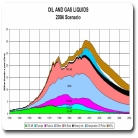
We face a liquid fuel crisis in two to five years. That was the stark message from an international conference on peak oil in Washington DC that I attended last month.
It will be far worse than the 1973 and 1979 oil shocks that induced panic, disorientation and insecurity. Back then stock market declines followed big hikes in fuel prices. This time we can expect ever-rising fuel prices accompanied by annually deepening recession, increasing inflation and unemployment, and a decline in world trade.
Last time, the crises resolved themselves as oil production and trade were resumed. This time, there will not be enough oil to resume business as usual. Despite a decrease in demand from OECD countries, overall demand continues to rise as global population climbs inexorably from 6.8 towards 9.2 billion and newly emerging economies expect their share of the global resource pie. Come 2015, however, we can anticipate a significant increase in the price of oil as global production starts its inevitable decline. Production of regular or conventional oil has already peaked while supplies of unconventional oil – heavy, deepwater and Arctic oil – will peak within a few years.
“We’re drillin’ three miles down in the Gulf of Mexico because of peak oil,” drawled Jim Baldauf, former Texan oilman and organiser of the conference. “We’re scrapin’ the bottom of the barrel, so to speak. We have to drill twice as deep at twice the cost to get half what we’re used to.”
The recent Deepwater Horizon spill in the Gulf was a rude awakening to those who thought drilling for unconventional oil was going to be easy. And it’s not cheap to produce oil from unconventional sources – the price needs to be $100 a barrel to make it worthwhile. But as Chris Skrebowski , a leading expert on global oil supply, asked: “Can we afford this price? Where is the price that allows everyone to be employed? Europe already has 10 per cent unemployment.”
Like it or not, $100 a barrel is what we can expect, or worse. Another leading oil analyst Jeff Rubin laid it on the line: “We can expect triple-digit oil next year.”
A peak in oil production does not mean the end of oil, nor indeed of energy supplies. But oil is the energy source that all others are measured against. The coming oil crisis is largely a crisis in transportation since oil products power 95 per cent of land transport. Skrebowski felt that only when we take oil out of transport could we hope to see a solution. Otherwise, as Rubin notes: “We have to get off the road”.
Anthony Perl, author of Transport Revolutions, said we will see a major redesign of our transport within 10 years. In order to survive this “mother of all energy crises”, we need to fast track mobility systems that can perform without oil. The most promising developments are electric motors replacing the internal combustion engine; greater use of rail and water replacing road and air; and greater use of collectively managed travel.
A lot of solutions are already out there, according to Perl, for example, high speed rail (HSR) for up to 500 miles (800 kms) though this will soon increase to 1000 miles (1600kms). China is currently building 12,000 miles of HSR that will double the world’s capacity and in turn reduce the price by 50per cent. “Sky sail” technology can reduce a sh
The coming liquid fuel crisis
By Jenny Goldie – posted Tuesday, 2 November 2010 Sign Up for free e-mail updates!
We face a liquid fuel crisis in two to five years. That was the stark message from an international conference on peak oil in Washington DC that I attended last month.
It will be far worse than the 1973 and 1979 oil shocks that induced panic, disorientation and insecurity. Back then stock market declines followed big hikes in fuel prices. This time we can expect ever-rising fuel prices accompanied by annually deepening recession, increasing inflation and unemployment, and a decline in world trade.
Last time, the crises resolved themselves as oil production and trade were resumed. This time, there will not be enough oil to resume business as usual. Despite a decrease in demand from OECD countries, overall demand continues to rise as global population climbs inexorably from 6.8 towards 9.2 billion and newly emerging economies expect their share of the global resource pie. Come 2015, however, we can anticipate a significant increase in the price of oil as global production starts its inevitable decline. Production of regular or conventional oil has already peaked while supplies of unconventional oil – heavy, deepwater and Arctic oil – will peak within a few years.
Advertisement
“We’re drillin’ three miles down in the Gulf of Mexico because of peak oil,” drawled Jim Baldauf, former Texan oilman and organiser of the conference. “We’re scrapin’ the bottom of the barrel, so to speak. We have to drill twice as deep at twice the cost to get half what we’re used to.”
The recent Deepwater Horizon spill in the Gulf was a rude awakening to those who thought drilling for unconventional oil was going to be easy. And it’s not cheap to produce oil from unconventional sources – the price needs to be $100 a barrel to make it worthwhile. But as Chris Skrebowski , a leading expert on global oil supply, asked: “Can we afford this price? Where is the price that allows everyone to be employed? Europe already has 10 per cent unemployment.”
Like it or not, $100 a barrel is what we can expect, or worse. Another leading oil analyst Jeff Rubin laid it on the line: “We can expect triple-digit oil next year.”
A peak in oil production does not mean the end of oil, nor indeed of energy supplies. But oil is the energy source that all others are measured against. The coming oil crisis is largely a crisis in transportation since oil products power 95 per cent of land transport. Skrebowski felt that only when we take oil out of transport could we hope to see a solution. Otherwise, as Rubin notes: “We have to get off the road”.
Anthony Perl, author of Transport Revolutions, said we will see a major redesign of our transport within 10 years. In order to survive this “mother of all energy crises”, we need to fast track mobility systems that can perform without oil. The most promising developments are electric motors replacing the internal combustion engine; greater use of rail and water replacing road and air; and greater use of collectively managed travel.
A lot of solutions are already out there, according to Perl, for example, high speed rail (HSR) for up to 500 miles (800 kms) though this will soon increase to 1000 miles (1600kms). China is currently building 12,000 miles of HSR that will double the world’s capacity and in turn reduce the price by 50per cent. “Sky sail” technology can reduce a ship’s oil use by 50-80 per cent. Electric railways are already a proven technology – the Trans-Siberian is a case in point.
Advertisement
Planes and trucks, however, which cannot run at scale without oil will see the most radical changes. New priorities, new skills and new priorities are needed. We need a Transportation Redevelopment Agency, according to Perl, that will anticipate future technologies and modes of transport; develop strategies for deploying those modes; and determine how to fund them.
What then is the future of air transport? Charles Schlumberger, principal air transport specialist at the World Bank, noted that oil is already the biggest cost for airlines. Nevertheless, the air industry is looking at significant fleet replacement, especially in the Asia-Pacific. Air transport has been a catalyst for world economic development and is a crucial part of trade, globalization and foreign investment. Thus if air transport shrinks because of oil prices, it will have a significant impact and accelerate recession.
Australia imports 40 per cent of its oil. We are not immune from the coming oil crunch. Perhaps it was apocryphal, but the story goes that Opposition leader Tony Abbott was overheard saying to an adviser at the beginning of the year: “Peak Oil? Do we know about Peak Oil?”
2 Comments on "The coming liquid fuel crisis"
KenZ300 on Wed, 3rd Nov 2010 12:32 am
Will biofuels and electric vehicles ramp up fast enough to prevent economic disaster?
Simon in BC on Wed, 3rd Nov 2010 2:50 am
“biofuels and electric vehicles” are not a solution but part of the problem.
The energy returned on energy invested for bio-fuels is barely more than 2 to 1 vs 10 to 1 for oil. And most of the energy required to produce the bio-fuels and their fertilizer and pesticides will come from oil which will become even more expensive further reducing the economic viability of bio-fuels. And of course bio-fuels will have to compete with food crops for soil and water which are already over used.
Electric cars that carry their charge in a multi-thousand pound rare earth and metal batter are not the solution to anything as all those billions of tons of source material for all those billions of new batteries have to be mined and transported and processed by – conventional oil. And those rare earths and metals themselves are close to peaking.
Sorry, no valid solution offered here, just more problems.