
Peak Oil is You

Donate Bitcoins ;-) or Paypal :-)


Page added on October 19, 2017

The Approaching US Energy-Economic Crisis

I was recently asked to give a talk called, “The Approaching US Energy-Economic Crisis.” In other words, how might the United States encounter problems that lead to a crisis? As we will see, many of the problems that could lead to a crisis (such as increased wage disparity and difficulty in collecting enough taxes) are issues that we are already beginning to encounter.
In this talk, I first discuss the connection between energy and the economy. Without this connection, it doesn’t make sense to talk about a crisis arising with respect to energy and the economy. I then discuss seven issues that could lead to a US energy-economic crisis.
Economic Growth Is Closely Tied to Energy Consumption
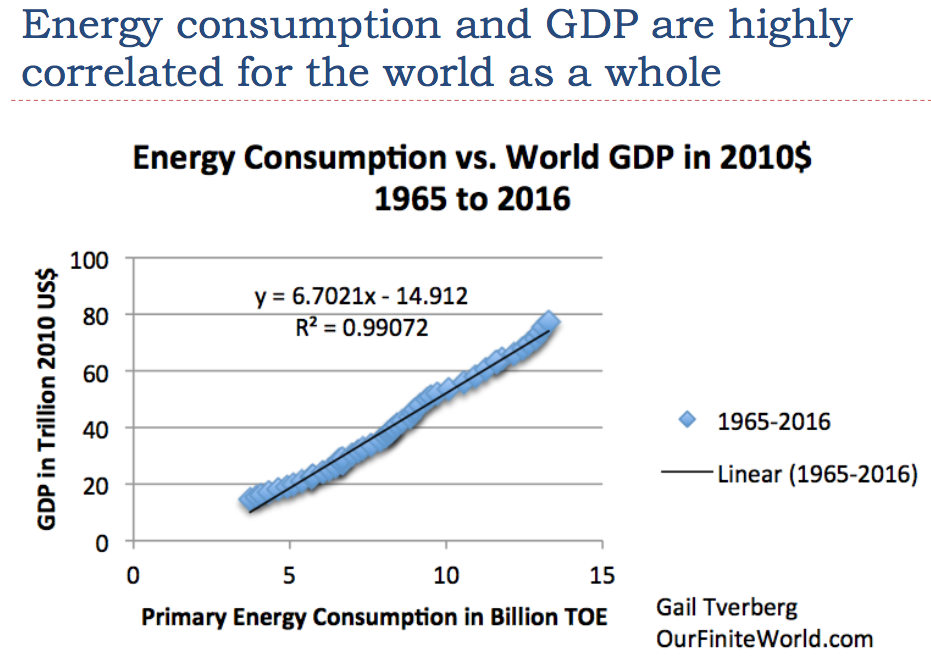
If we look at world data, it is clear that there is a close tie between energy consumption and economic growth.
Slide 2
On an individual country basis, there can be the belief that we have reached a new situation where a particular country doesn’t really need growing energy supply for economic growth.

Slide 3
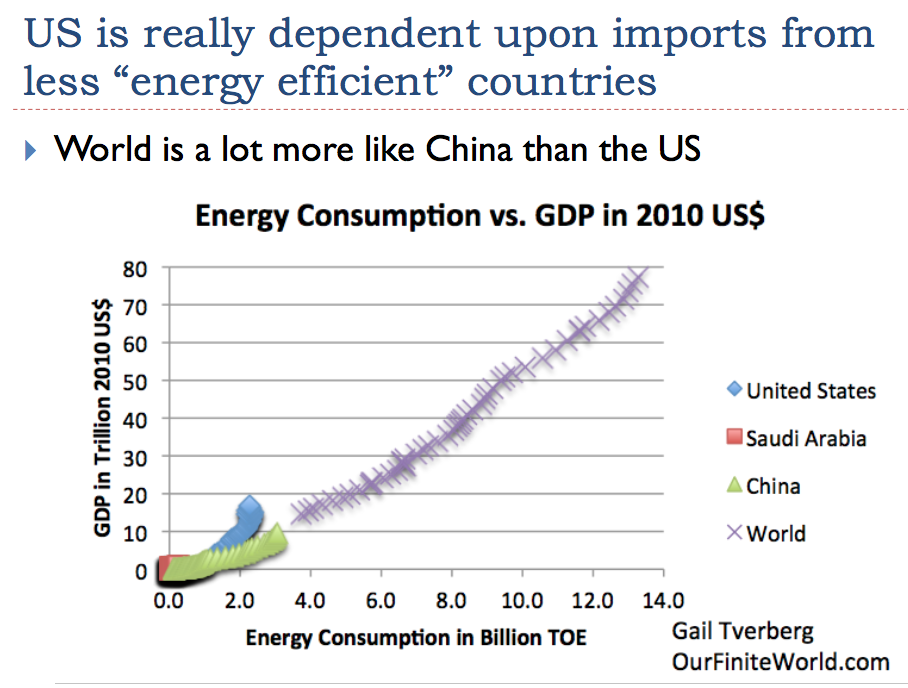
For example, on Slide 3, the recent nearly vertical line for the US suggests that the US economy can grow with almost no increase in annual energy consumption. This rather strange situation arises because the standard calculation misses energy embodied in imported goods. Thus, if the United States wants to outsource a great deal of its manufacturing to China, the energy consumption used in making these goods will appear in China’s data, not in the United States’ data. This makes the country that has outsourced manufacturing look very good, both with respect to energy consumption and CO2 emissions.
Buying imported crude oil from elsewhere (such as Saudi Arabia) is also helpful in keeping down energy consumption, because it takes energy of various types to extract oil. If oil extraction takes place in Saudi Arabia, using steel pipes from China, the energy used in extraction will appear in the data of China and Saudi Arabia. Neither China nor Saudi Arabia obtains as much economic growth, relative to its energy expenditures, as does the US. In order to make sense of what is happening, we need to look at the world total.
Slide 4
We see that the pattern of world energy consumption growth follows a pattern not terribly different from that of China. Its growth is not “straight up.” It does take growing energy supply to create additional goods and services. We are getting a little more efficient in this process over time, but energy is very much needed in many areas of the economy:
- By businesses, to create goods, such as food, and services, such as vacation travel;
- By governments, to create roads, schools, and other public services;
- By individual citizens, to cook food, to heat homes, and for transportation.
The World Economy Is Organized Based on the Laws of Physics
There are many self-organized systems that seem to grow of their own accord in the presence of available energy supplies (that is, in thermodynamically open systems). Plants and animals are examples of growing self-organized systems. Hurricanes, ecosystems, and stars are also such systems. Economies also seem to be such systems. The name given to such a system is a dissipative system.
Slide 5 – Source: http://www.rinusroelofs.nl/structure/davinci-sticks/gallery/gallery-01.html
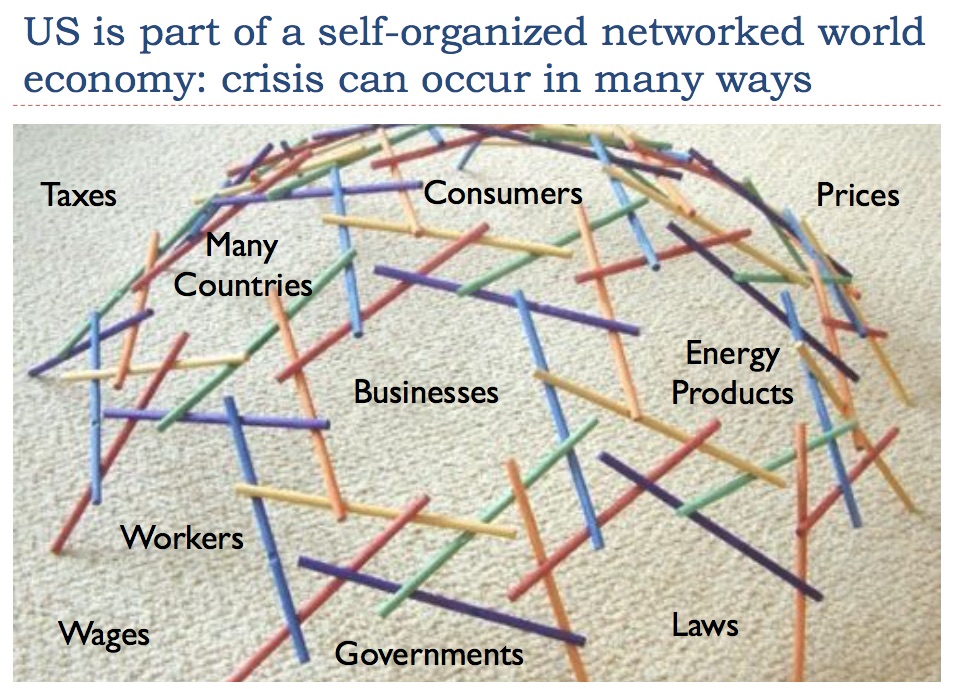
I visualize the world economy as being somewhat like a child’s building toy. It consists of many different elements, a few of which are listed on Slide 5. An economy is self-organized in that new businesses are formed when some entrepreneur sees an opportunity. Consumers decide which product to buy based on which product best serves their needs and based on price. Governments decide on changes to laws and tax levels, depending upon how the economy is functioning at a given time.
This system gradually grows over time, as more businesses and customers are added. As new products and new businesses are added, products and businesses that are no longer needed are taken away. For example, when the private passenger automobile was invented, there was no longer a need to feed and house a large number of horses to be used for transportation purposes. Thus, the system self-organized to eliminate the services needed to care for the many horses used for transportation.
Even if we wanted to get rid of cars and go back to horses, we really could not do so now. In some sense, the structure shown on Slide 5 is hollow, because prior capabilities that are no longer needed tend to disappear. The hollow nature of the economy makes it almost impossible to go backward if we somehow lose our existing capabilities–not enough oil, or an electricity problem, or an international trade problem, or a financial problem. Instead, we will need to build new systems that will function in the new context: depleted resources, a very high population level, high pollution levels, and degraded soils. The existing self-organized system is likely to collapse back to only the part that can be sustained.
Slide 6
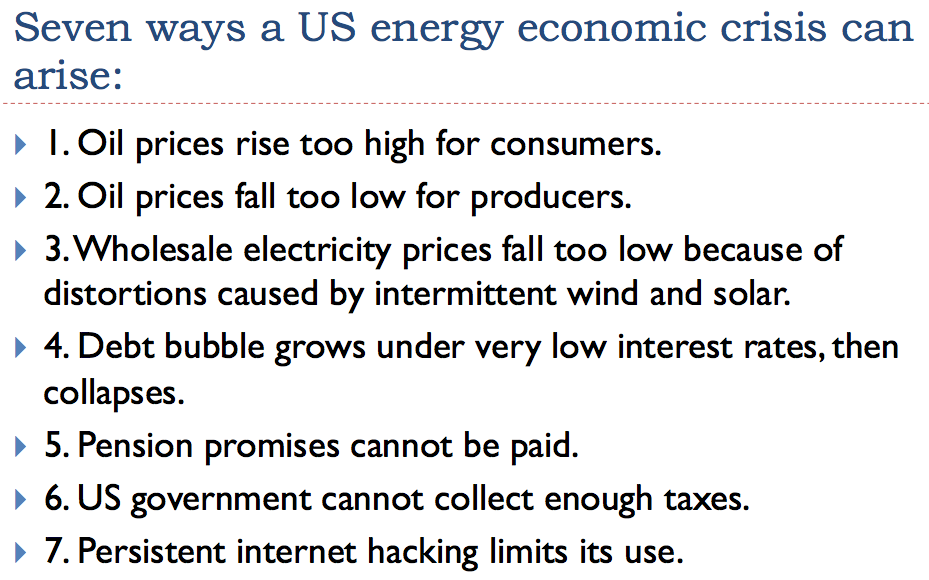
Slide 6 is a preview of where this presentation is headed.
Slide 7
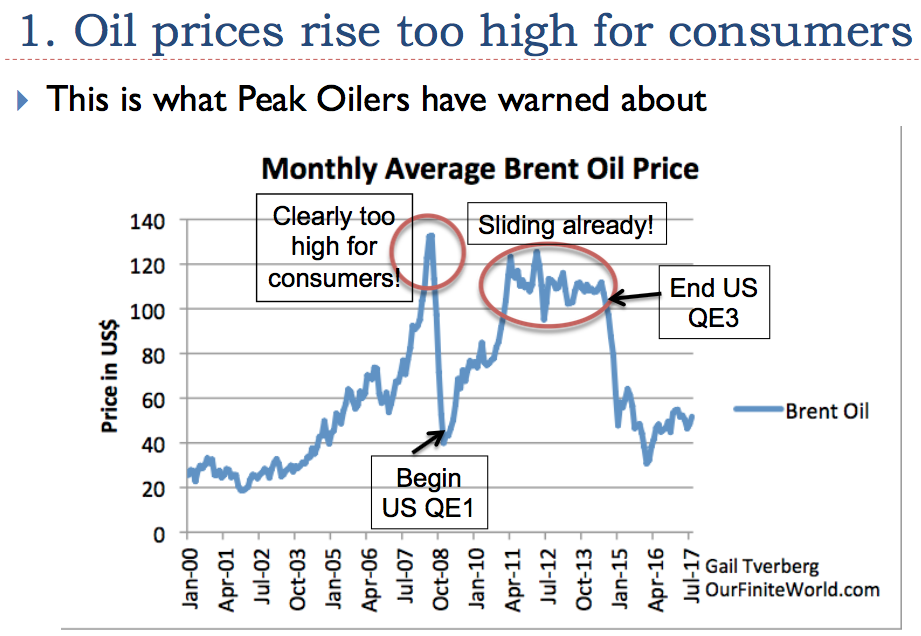
Slide 7 describes the issue most people are concerned about: oil prices will rise too high for consumers. In fact, we clearly have had problems with high prices in the recent past. The high prices in 2007 and early 2008 seem to have punctured the debt bubble that existed at that time, as I discuss in an academic article, Oil Supply Limits and the Continuing Financial Crisis.
Shortly before oil prices started to turn back up again in late 2008, the United States instituted a policy of Quantitative Easing (QE), in an attempt to bring interest rates down and thus encourage more debt. Additional debt at low interest rates can “pump up” the economy in several different ways:
[1] Some of this low interest debt can be used by governments to provide funding for unemployment benefits and projects such as road building.
[2] Some of this low interest debt can be used by businesses to open new factories, and thus hire more workers.
[3] Some of this low interest debt can be used by individual citizens to purchase a home, a car, or a college education.
It is the pumping up of the economy with low interest debt that seems to stimulate the economy in a way that raises oil prices. When the US discontinued its third and last phase of QE in late 2014 (shown as “End US QE3” in Slide 7), the pumping up action began to disappear, and oil prices again fell.
Slide 8
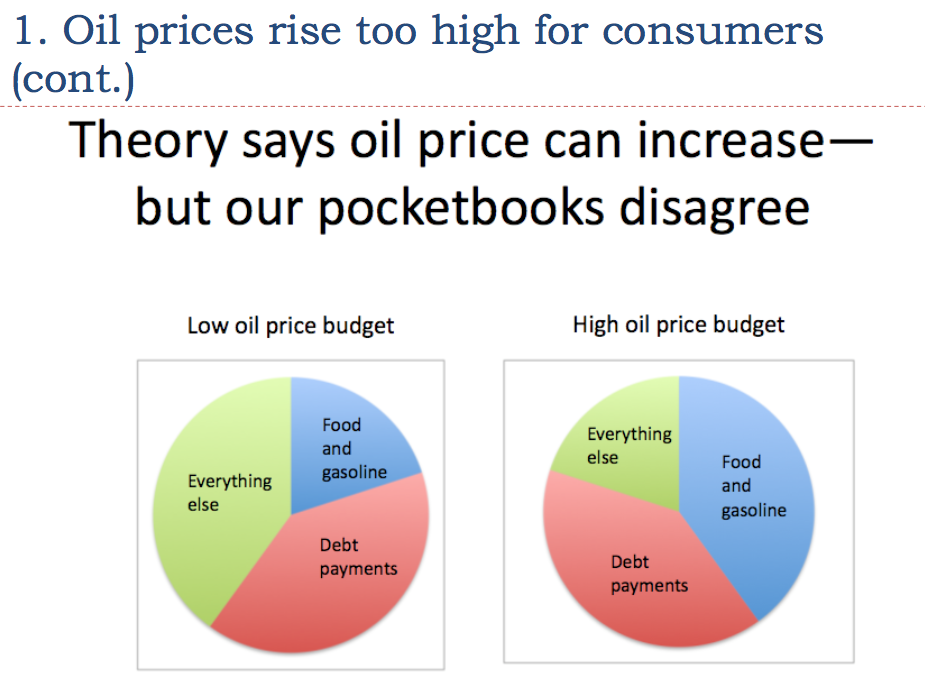
The figure in Slide 8 may seem a little exaggerated, but I wanted to make a point. Our wages can roughly be divided into three pieces:
[1] Essential goods whose prices are very much influenced by the price of oil, such as food and gasoline. Besides food and gasoline, the cost of replacing a road, particularly with asphalt, very much depends on the price of oil. Higher costs for roads will be reflected in taxes that we are required to pay. Almost any kind of product that is shipped is affected by the price of oil, because oil is the usual transport fuel. Oil is typically used in the extraction of metal ores, so the price of metals used in making cars, appliances, and other goods is affected by the price of oil. Thus, an oil price increase indirectly leads to inflation in the cost of a wide range of essential goods and services.
To make matters worse, fluctuations in the price of oil can be very large. Between 2000 and 2008, we saw monthly average oil price fluctuate from under $20 per barrel to over $130 per barrel. Thus, while the growth in the food and gasoline segment is somewhat exaggerated, the impact of price changes is much larger than a person might expect, looking only at the impact of higher gasoline prices for a consumer’s vehicle.
[2] Repayment of loans, such as mortgage payments and auto payments. Loan repayments of these types tend to make up a large portion of most people’s spending. If people don’t own their own home, they have rent payments to make. These rent payments are in some ways similar to loan payments, because they indirectly cover the cost of someone else’s mortgage. These costs tend to be fixed, even if the price of oil goes up.
[3] Everything else. These are the non-essential items that we cut back on when budgets are too tight. Examples include charitable contributions, visits to restaurants, and vacation trips.
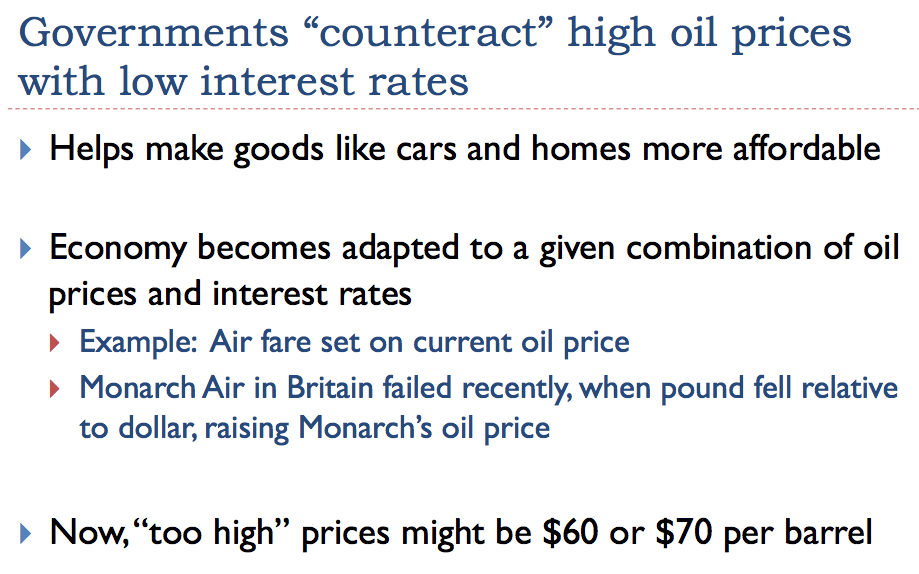
Looking at Slide 8, it becomes clear that if a government wants to “counteract” high oil prices, it needs to lower interest rates. This will tend to make car payments, mortgage payments, educational loans, and even rents somewhat more affordable, at least for people whose loans are affected by the new low interest rates. Often, homeowners are allowed to refinance, to take advantage of the new lower interest rates.
The plan this year is to raise, rather than lower, interest rates. Needless to say, this has the opposite effect; it tends to reduce the size of the “everything else” segment of our income. This effect tends to be recessionary.
Slide 9
Monarch Air is a British airline that failed recently. It boasted very low fares. One of the problems leading to its failure was a falling pound relative to the US dollar, raising both the price of oil and the price of new airplanes.
Today, the price that oil producers need, including adequate funds for (a) reinvestment and (b) the high taxes that governments need to continue their programs, is likely $100 per barrel or more. Such a price would likely cause recession, because purchases in the “Everything Else” category on Slide 8 would be squeezed.
Slide 10
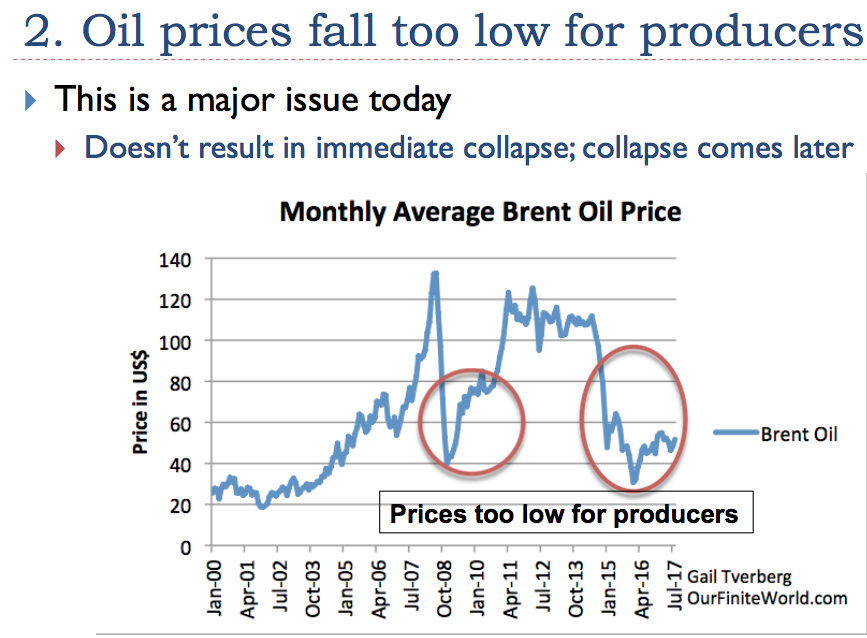
Most people don’t think about the possibility of oil prices falling too low for producers, but this is a major problem today. When prices are too low, oil companies need to borrow money to continue to operate. They are likely to cut back on developing new extraction sites. With low prices, the tax revenue that the governments of oil-exporting countries are able to collect tends to fall too low, leading to cutbacks in government programs and a need for more debt. Saudi Arabia is running into this difficulty.
The problems that arise from low oil prices can be hidden for quite a while, because investors are likely to see the low prices as a great opportunity. They think, “Surely, oil prices will rise again.” So investors are eager to buy more shares of stock, and banks are willing to issue more debt. At some point, the situation becomes unsustainable, and no more loans are offered.
It has now been about three years since prices fell to a level that is clearly too low for oil producers. It cannot be many more years before something has to “break.” Venezuela is an oil exporter that cannot collect enough revenue from oil exports to afford needed goods, such as food. Other oil exporters may eventually encounter similar problems.
Slide 11
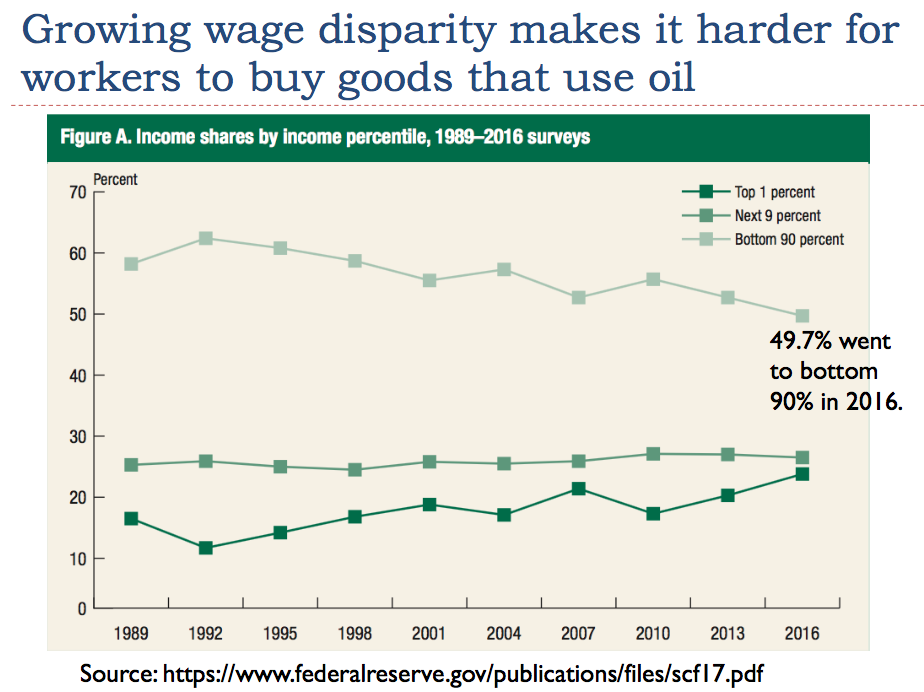
A major reason for falling oil prices is growing wage disparity and the resulting loss in purchasing power for the bottom 90% of workers. In the United States, the bottom 90% obtained about 62% of total income as recently as 1992. In a 2016 Federal Reserve survey, only 49.7% of total income went to the bottom 90%.
The reason why wage disparity is important is because the wealthiest 1% (or even the wealthiest 10%) can’t purchase very much of the goods created using oil. The wealthiest 1% can’t eat very much more food than everyone else. They can only drive one car at a time. In order to have adequate demand for oil, the bottom 90% must have adequate purchasing power for goods such as homes and cars. If young people live with their parents longer, and aren’t able to afford homes, this holds down demand for oil. So does transferring manufacturing to countries where wages are so low that few people can afford cars and other manufactured goods.
Slide 12
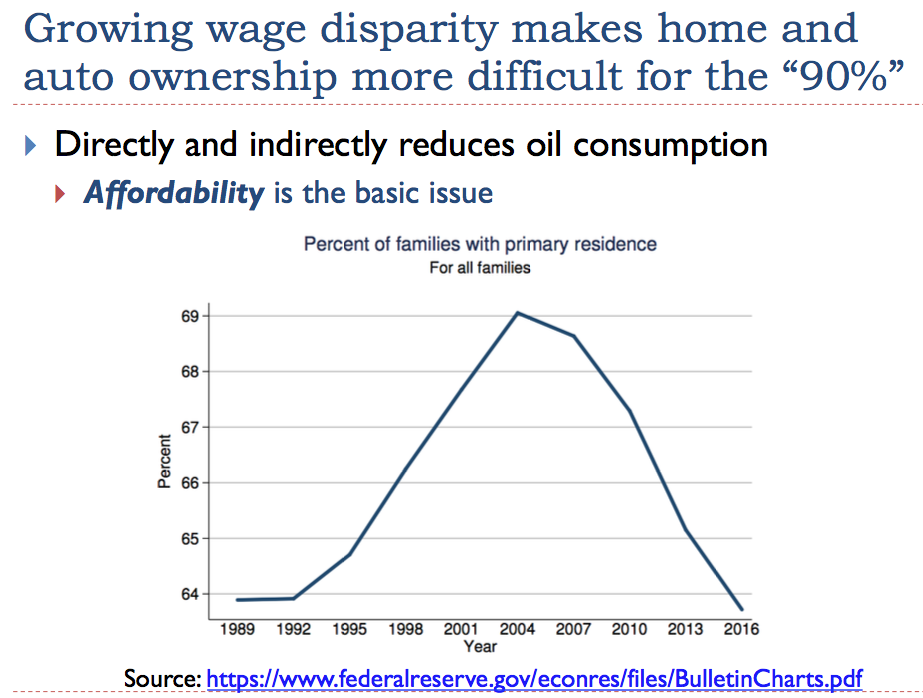
Slide 12 shows the Federal Reserve’s graph of the share of families who own (as opposed to rent) their primary residence. There has been a drop in homeownership from 69% in 2004 to less than 64% in 2016. This is a period when wage disparity has been increasing.
Slide 13
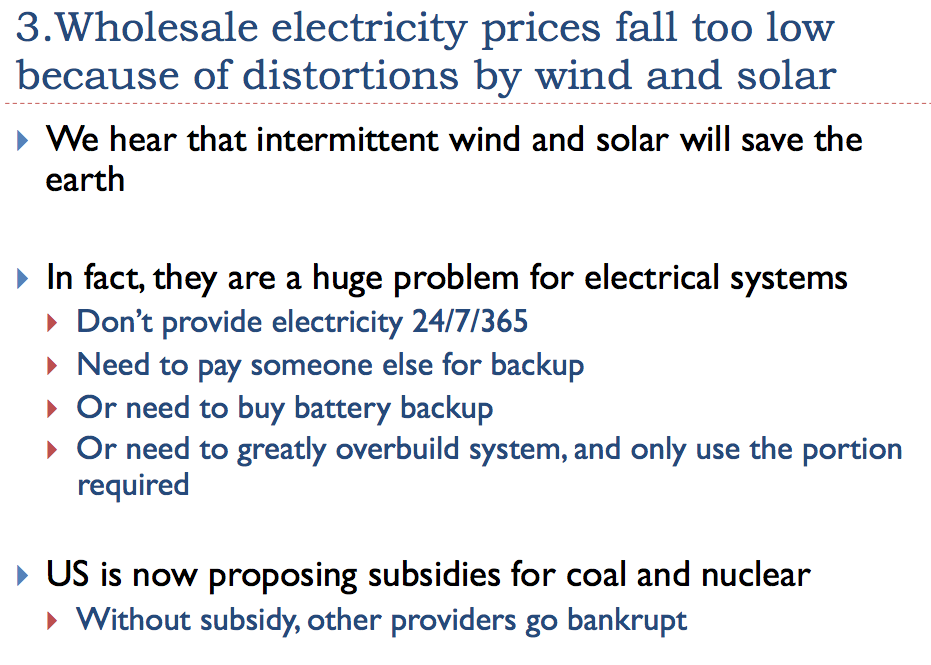
Wind and solar are intermittent sources of electricity. They work adequately well in applications where intermittency is no problem, such as charging a cell phone that has a battery, or powering a desalination plant that is not expected to operate around the clock. Most analyses of the benefit of wind and solar are suitable only for these limited situations, because they omit any estimate of the cost of mitigating intermittency.
Intermittency becomes a major problem when wind and solar are added to the electric grid. Wholesale electricity prices may drop to very low levels when both wind and solar electricity are available. At times, prices may become negative. Electricity generation that is designed to be used most of the time (such as coal, nuclear, and even some types of natural gas generation) cannot survive without subsidies to offset the artificially low prices the system produces. The need for subsidies for backup electricity providers is really an indirect cost of adding intermittent types of electricity to the grid, but today’s pricing does not reflect this.
A different workaround for intermittency is to add a large amount of battery backup or other type of storage. In theory, batteries could be used to store electricity generated in the summer for use in the winter, when heating needs are greatest.
Another approach to intermittency is to greatly overbuild intermittent renewables, with the idea of using only that portion of electricity generation that is really needed at any point in time. Yet another approach is adding extra (lightly used) long distance transmission, to try to smooth out fluctuations.
Any of these approaches tends to be expensive. Academic papers estimating the benefit of wind and solar nearly always overlook the cost of mitigating intermittency. Thus, they suggest wind and solar can be solutions, when, in fact, their high cost is likely to lead to the same damaging economic effects as high oil prices. (See Slide 8.)
Slide 14
The dotted line on Slide 14 shows the downward trend in German wholesale electricity prices, as more and more intermittent electricity has been added to the grid. At the same time, total residential electricity prices have risen to higher and higher levels. The countries with the greatest use of wind and solar tend to have the highest retail rates, as shown in Figure 1 below (not in presentation).
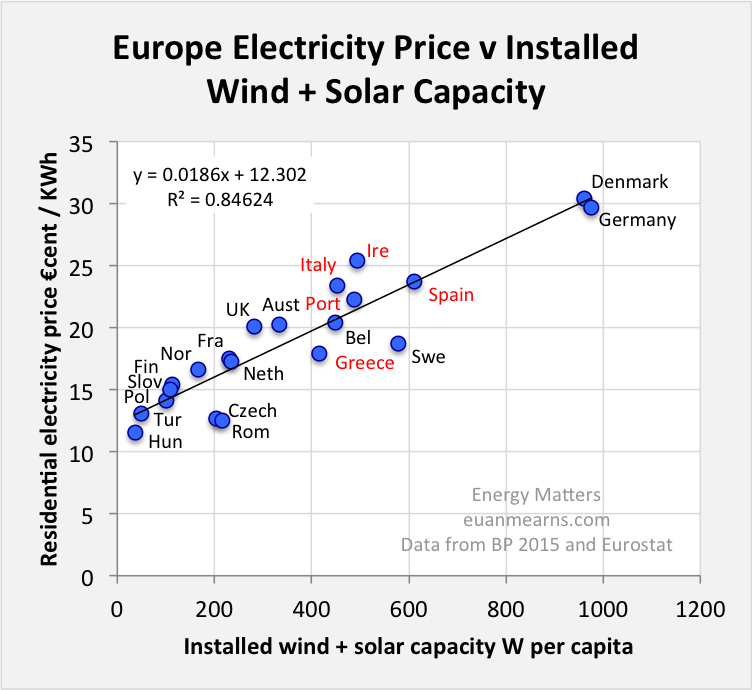
Figure 1. Figure by Euan Mearns showing relationship between installed wind + solar capacity and European electricity rates. Source Energy Matters. (Image not part of presentation.)
Slide 15
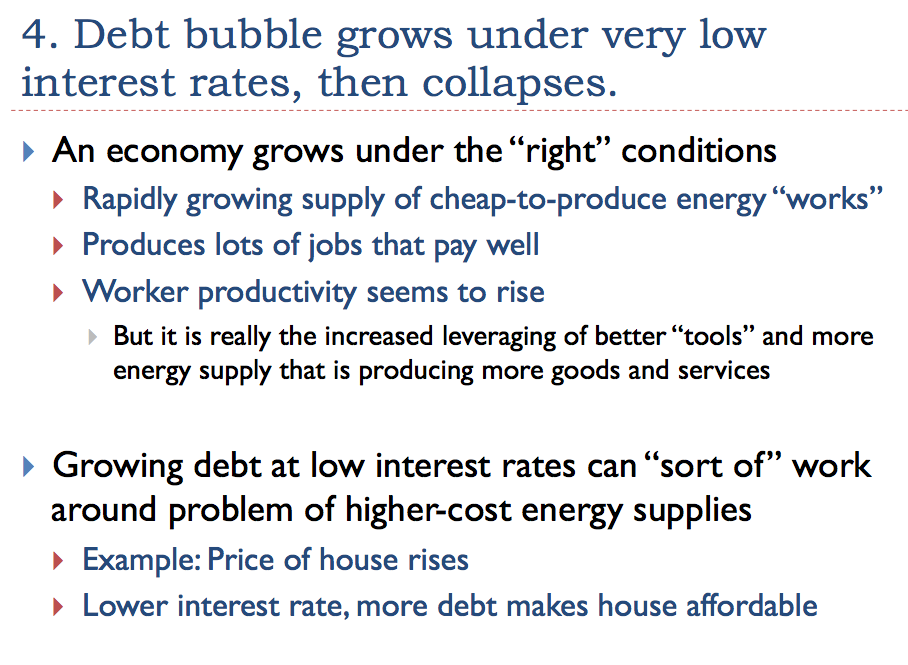
As we discussed earlier, the “standard” workaround for high oil prices is low interest rates, because of the relationship shown in Slide 8. At some point, however, interest rates fall about as low as they can go.
Slide 16
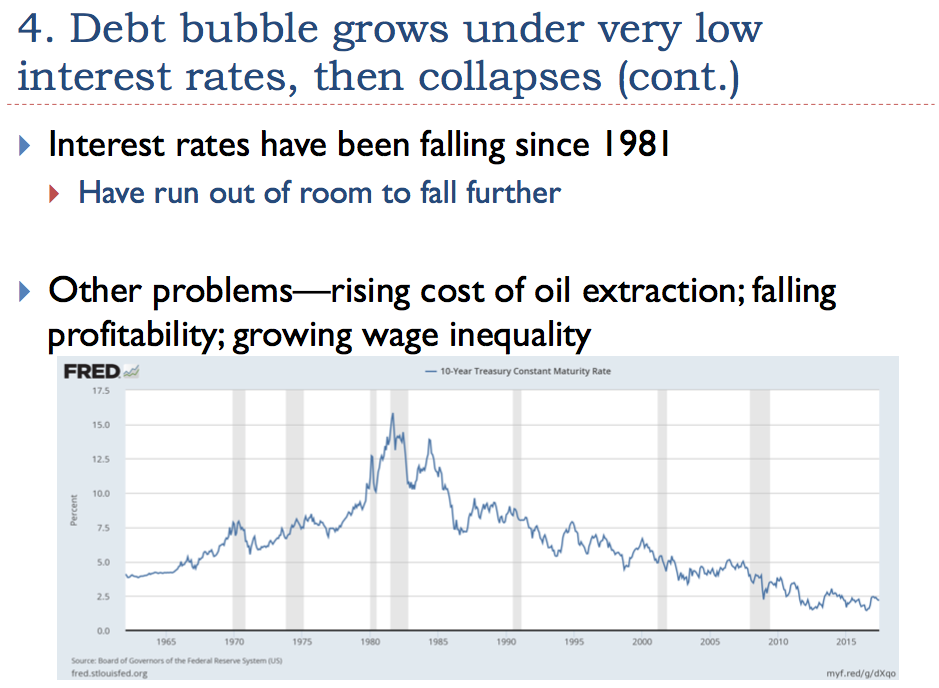
The interest rates shown on Slide 16 are those for 10-year treasuries. These typically underlie mortgage rates. These rates have been falling since 1981, helping to prop up prices for homes, land, farmland, and other assets purchased with long-term debt. Low interest rates make monthly payments more affordable than high interest rates, so more people can afford to buy such assets. With greater demand, asset prices tend to rise.
Also, with all of the talk about the US continuing to raise interest rates, those owning bonds realize that rising interest rates will cause the selling price of bonds they hold in their portfolio to fall. Thus, pension funds and other organizations that are making a choice between buying bonds (which are certain to fall in selling price, as interest rates rise) and buying stocks, will choose to “overweight” stocks in new purchases for their portfolios. This will tend to push the price of stocks higher, regardless of the earnings potential of the underlying companies.
One thing I didn’t mention in the presentation, but is probably worthwhile pointing out here: Short-term interest rates have been rising since late 2014, even as 10-year treasuries have been holding fairly steady (Figure 2, below). These shorter-term interest rates affect payments on other types of transactions–adjustable rate mortgages and auto loans, for example.
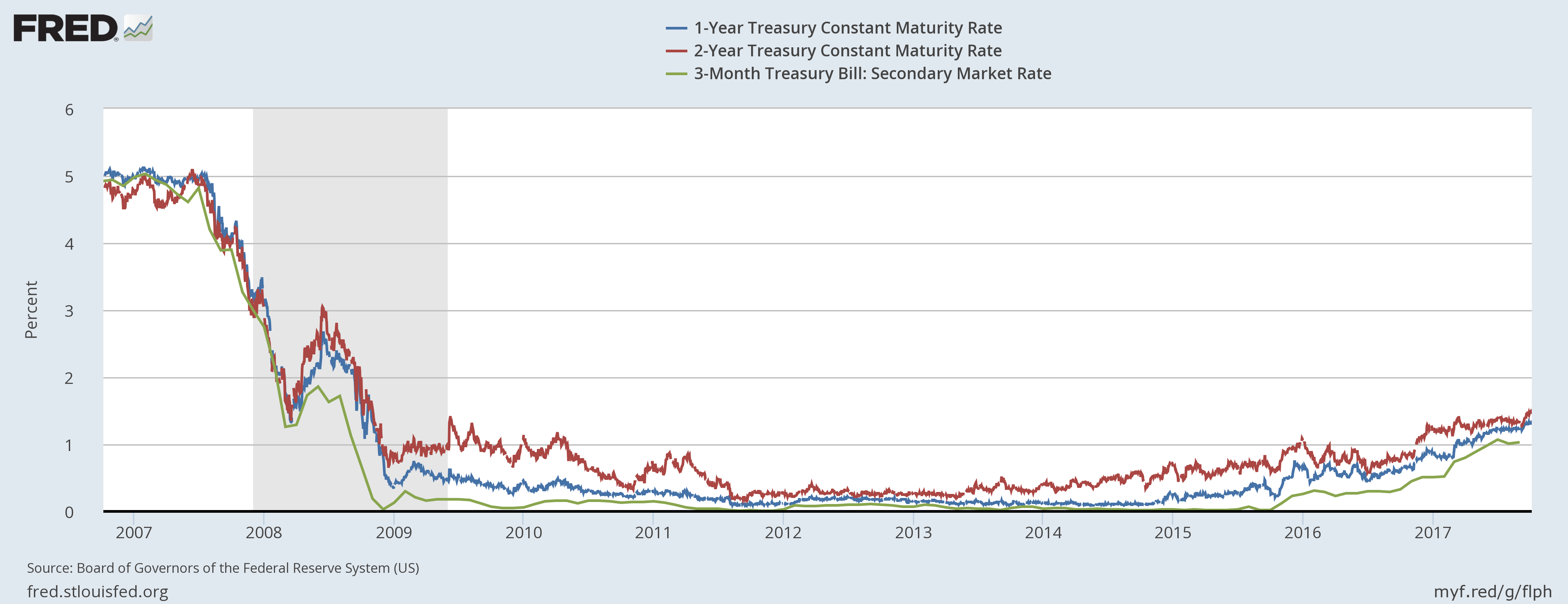
Figure 2. Chart showing 3-month, 1-year, and 2-year interest rates. Chart created by St. Louis Federal Reserve.
These short-term interest rates have been creeping upward, indirectly making certain types of goods less affordable. The increase in short-term interest rates will, by itself, push the economy in the direction of recession.
Eventually, the bubble in asset prices can be expected to collapse, as it did in 2008. Perhaps this will happen when corporate profits fall too low; perhaps this will happen when the economy hits recession. The prices of many types of assets, including shares of stock, prices of homes, and prices of businesses can be expected to fall. There are likely to be many debt defaults in the governmental, business, and personal sectors of the economy. In such a situation, banks may fail.
Slide 17
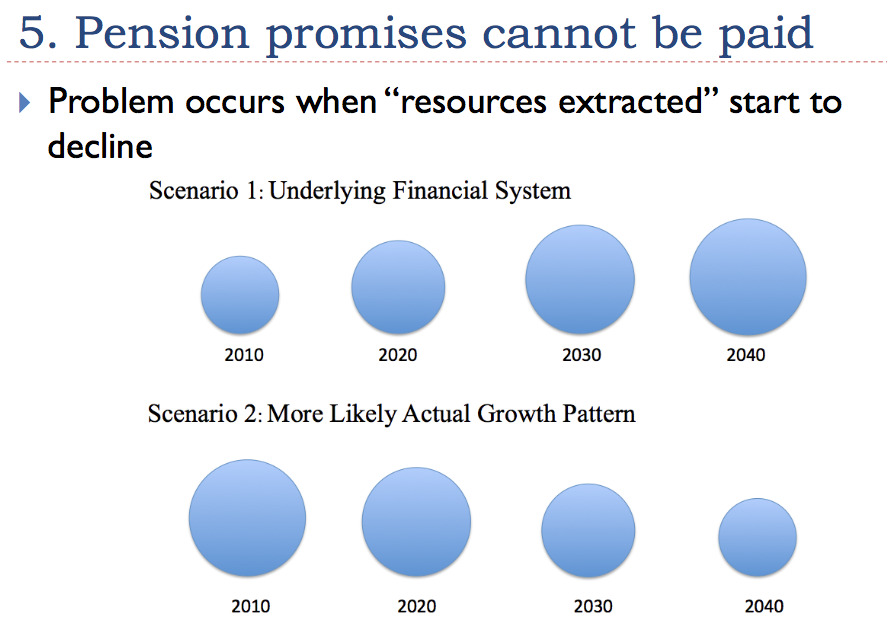
The goods and services that are delivered each year require the use of physical resources such as oil, coal, natural gas, metals from ores, and wood. In the past, the quantity of these physical resources has grown, year after year, as illustrated in Scenario 1.
In a finite world, we cannot expect the amount of physical resources to grow, indefinitely. At some point something will go wrong, and the amount of resources extracted each year will become start becoming smaller, as in Scenario 2. In a sense, the people of the world can expect to become poorer, because the quantity of goods and services that can be made with these resources grows smaller, instead of larger, and each person’s share of the world output becomes smaller.
Standard economic theory says that resource prices will rise, as the quantity of resources falls, but this view does not take into account the way a networked economy really works.
A more likely scenario is that as the quantity of resources falls, wage disparity will increase. As a result, the incomes of many of the lower-wage workers can be expected to fall. The problem is that jobs that pay well require the use of resources; if there is a decrease in resources available, some jobs are likely to be eliminated. Today, such job elimination may come through added technology, eliminating what were previously low-paid jobs. Studies of past collapses support the view that falling wages for the working class played a major role in these collapses. (See Secular Cycles by Peter Turchin and Surgey Nefedov.)
With greater wage disparity, a smaller share of people will be able to afford to buy homes and cars. Scenario 2 in Slide 17 will occur, not because we “run out,” but because too few people can afford to buy goods made with oil, gas, coal, metals and wood. Market prices will fall below the cost of extracting the necessary resources, and companies in these businesses will fail. Governments of oil exporters may collapse, because they cannot collect sufficient tax revenue at the low price available on world markets.

Slide 18
If there are physically less goods and services available, who will get the benefit of these goods and services? I see the situation as almost like musical chairs. Will it be pensioners who lose out, as bonds held by commercial pension programs default, and also as governmental plans are cut back? Or will it be the wages of the less skilled workers that are cut, as more processes are automated, and only managers and highly skilled workers are needed? If this happens, won’t commodity prices fall even further? We really need to have adequate wage levels for a wide range of workers, if we expect to have enough buyers for the goods produced.
Historically, when collapses have occurred, governments have lost out in the game of musical chairs because they could not collect enough tax revenue. The problem was that the bottom 90% of workers became poorer and poorer, and so less able to pay taxes. This brings us to our next potential US problem area.
Slide 19
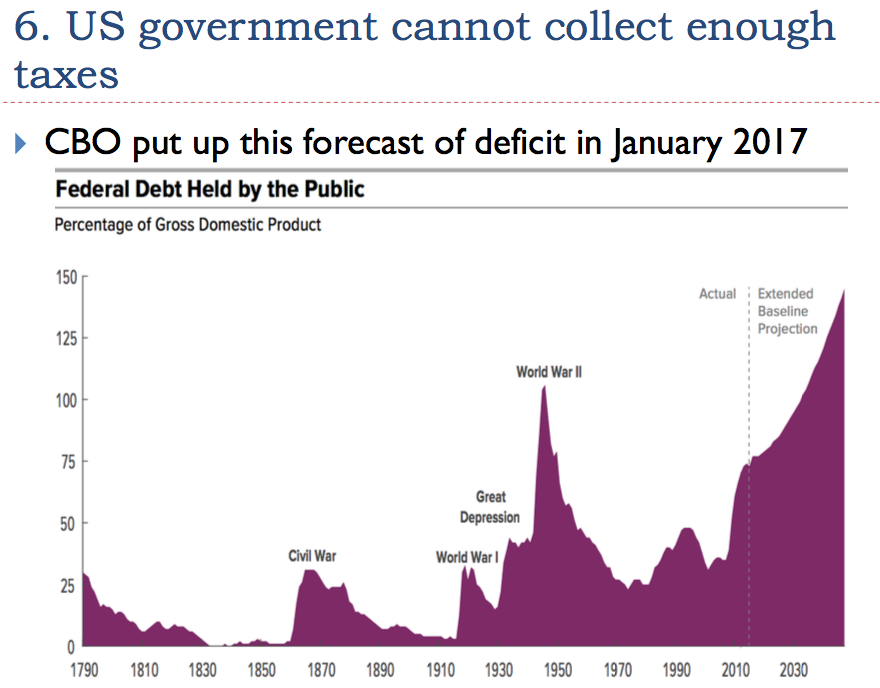
In January 2017, the US Congressional Budget Office made a projection of how federal debt held by the public would grow, based upon the information available at that time. Their forecast was that the debt would grow to amount to nearly 150% of GDP. This would be a much higher level than during World War II, World War I, or the Civil War (Slide 19).
Slide 20
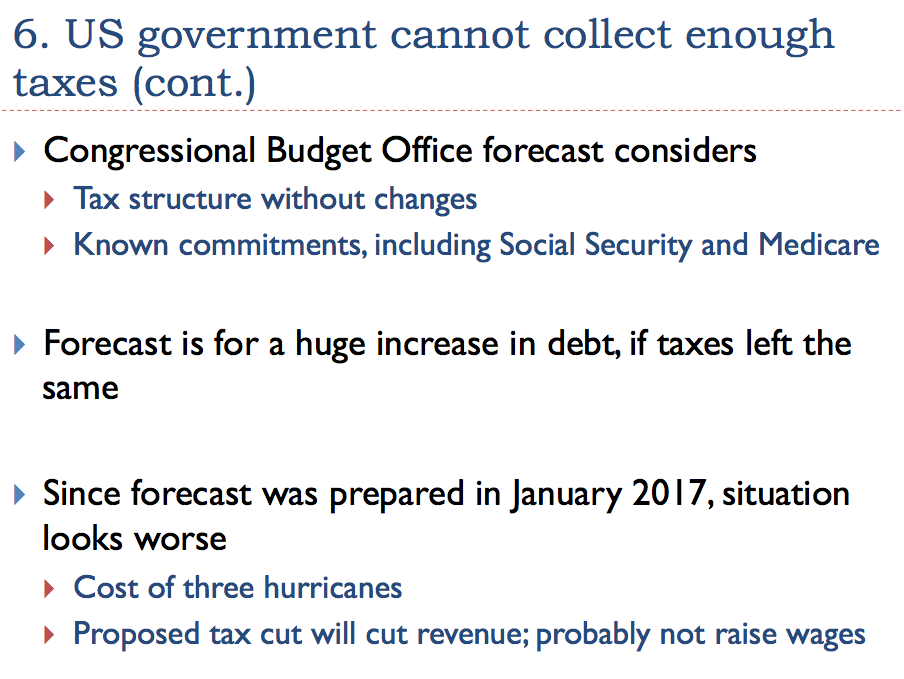
Since January 2017, more information has become available. We now know about three hurricanes, plus fires in California. Citizens affected by these events need financial support.
We also know about proposed legislation to reduce taxes, especially for businesses and high-income individuals. These proposals are likely to increase after-tax wage disparity, and increase the amount of the deficit. If corporations choose to return any of the benefit of the tax cut, it will likely be through dividends to those who are already wealthy. With respect to corporate tax rates, we are only trying to catch up with tax havens, so it is difficult to believe that the tax change will result in much more US investment.
Slide 21
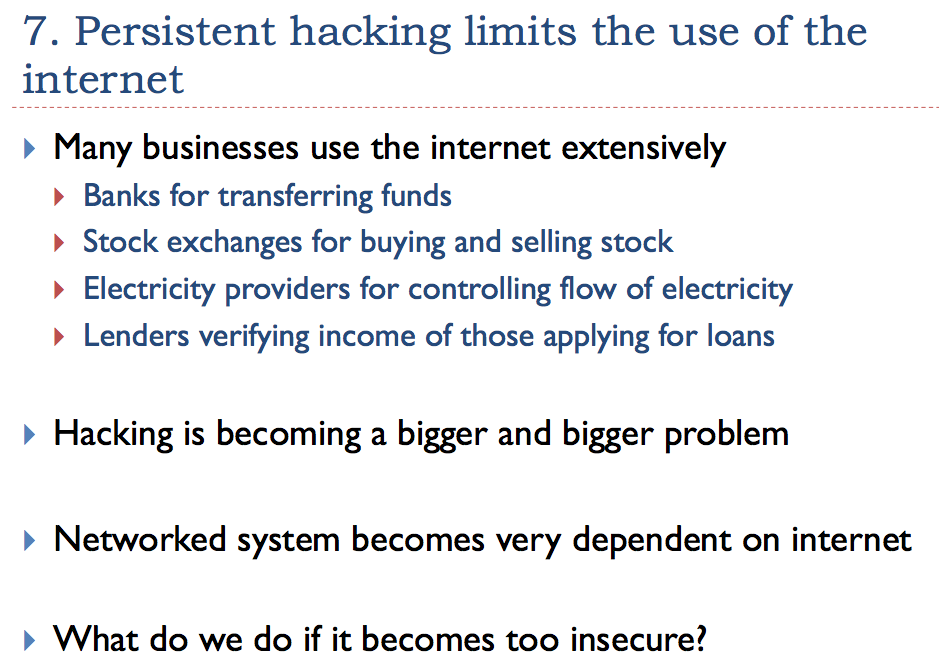
We don’t think about the internet as being important, but it has become an essential part of our interconnected world economy. The internet helps facilitate all of the just-in-time deliveries needed to operate today’s economy. All of the fancy workarounds for the use of intermittent electricity on the electric grid assume that the internet will be available to transmit information back and forth quickly. Banks make use of the internet to get information to approve loans and to clear checks with other banks.
In the United States, we seem to hear one story after another about the internet being hacked. The most recent story involves a major hack of the data collected by Equifax for the purpose of determining the credit-worthiness of individuals in the US. If this data gets into the wrong hands, it can be used for “Identity Theft.” An impostor can apply for a new loan in the name of someone else, or can steal an income tax refund intended for someone else.
A different hacking situation in the Atlanta area recently led to the theft of a large number of checks intended for direct deposit in teachers’ bank accounts being stolen. They were instead direct deposited to an impostor’s account.
If the internet is truly not secure, no matter what we do, this by itself could cause major problems for the system we now have in place. We don’t have a “Plan B” available, either. Trying to start over with “snail mail,” for example, would be a problem. This is another illustration of the difficulty involved in going back to an earlier technology.
——–
Clearly this list of potential problems is not complete. Hopefully, this list gives an idea of the wide range of issues we are facing.
Our Finite World by Gail Tverberg
53 Comments on "The Approaching US Energy-Economic Crisis"
Duncan Idaho on Thu, 19th Oct 2017 11:20 am
Gail– interesting.
But it is hard to take your analysis seriously, being a Global Warming Denier.
It really diminishes your work.
Shortend on Thu, 19th Oct 2017 1:00 pm
Duncan, Gail has prejudice against peer review consensus in general. Suppose her career as an Insurance actuary led her to believe “group think” gets it all wrong, all the time.
Her comment section on her blog is entertaining.
rockman on Thu, 19th Oct 2017 1:09 pm
Duncan – Worse then that: “With respect to corporate tax rates, we are only trying to catch up with tax havens, so it is difficult to believe that the tax change will result in much more US investment.”. So this “economist” thinks businesses can expand without an increased source of revenue. So companies can borrow their way to successful expansion…just like the petroleum industry did a few years ago. LOL. Also interesting g that her list of 7 doesn’t include the govt spending too much. Especially if it has to borrow a lot to do so.
But first the bullsh*t coming out of the current administration that lowering corporate tax rates and repatriating overseas revenue will mostly go to increasing salaries is just that…BULLSH’T. But it will provide businesses more capex to expand. I’ve seen very few companies in my lifetime that did not want to grow. And I don’t know of one business that can grown without capital to fund that expansion. How much a significantly growing GDP will increase salaries is speculative. But what isn’t is that company expansions will increase the number of jobs in the market place. And one would hope that the increase in the need for labor would put Howard pressure on salaries. But predicting family incomes will go up $X is ludicrous IMO.
But to assume that most if not all the increase in corporate revenues will be distributed to owners/shareholders is equally foolish. In reality those folks are the first in line at the feed trough. “Trickle down” only works if there something left to trickle down after the big ones have had their fill. Public companies have their priorities: management salaries then shareholder dividends then servicing debt then funding operations then staff salaries and ONLY THEN funding expansion that would required require more capex spending (which increases revenues of the companies they buy from) and hire more employees. The if there’s enough left over increase the salaries of existing employees.
How ever much the govt takes in taxes from corporations it isn’t going to reduce much of the feed to the top of the pyramid. Trickle down economics DOES NOT WORK…if there’s nothing left to trickle down after the ones at the head of the line have feed. How much will trickle down to those at the end of the line can be debated till the cows come home.
But what is undeniable is that those in control will get their fill and NOTHING WILL TRICKLE DOWN if the big pigs AND the govt split the vast majority of the feed. Increasing taxes only increases the govt’s take. Those at the top still get their pound of flesh.
Now in theory the govt’s take can be spread amongst the people not at the top of the pyramid. What folks who piss on the trickle down theory often ignore is that the govt’s take is also supposed to trickle down to those same folks. Given that the govt had to borrow almost $10 trillion during the previous administration to supplement that trickle indicates a serious problem with the dynamic.
Here are some interesting charts: https://www.usgovernmentrevenue.com/revenue_history
Check the chart showing taxes as % of GDP over the years. If we believe the data for more then 50 years the % of GDP of federal taxes has been fairly constant. It has been state and !oval taxes that have increased significantly. Check the other interesting charts.
In absolute numbers it’s interesting that during President Obama’s terms not only did US debt boom so did federal revenue. IOW the increase in federal revenue wasn’t nearly enough to keep up with spending. Which indicates the problem wasn’t taxes being too low but spending being too high.
https://www.usgovernmentrevenue.com/federal_revenue_chart
Also interesting that total taxes collected, $6 TRILLION, (fed+state+local) has increased more then 50% since a low point in 2009.
https://www.usgovernmentrevenue.com/total_revenue_chart
Lots of interactive charts to play with on this site.
Duncan Idaho on Thu, 19th Oct 2017 1:12 pm
Shortend
“Her comment section on her blog is entertaining.”
Yea, if you are into Altright boys clubs.
Duncan Idaho on Thu, 19th Oct 2017 1:14 pm
rockman–
I’ve alway enjoyed your input.
You analysis and real time experience was appreciated on the old Oil Drum.
LetStupidPeopleDid on Thu, 19th Oct 2017 1:16 pm
Gail writes the same blog post over and over. Gail is using the same graphs and picture over and over. She is a fraud with nothing interesting or new to say. Why people like her blog is beyond me. Either she is an idiot or suffer from dementia. Could be both too.
rockman on Thu, 19th Oct 2017 1:58 pm
Mucho thanks Duncan. Ran across this interesting site. Shows the wide variations in how different states generate their tax revenue. Each can check out their state and imagine how a crisis in one form or another might impact it. Texas ranks pretty good over all at 13th but at the bottom of the corporate tax at 49th. But that’s because the number includes revenue from petroleum reverence tax and thus a very high corporate tax revenue. But not a tax on corporate income per se. But when oil/NG prices fall so does that income. And then there’s Delaware at #50 and no severance tax. But collects taxes from countless corporations registered there. If the economy gross strong and a lot of new corporations: increased revenues. But a deep recession/depression: companies fold and revenues drop.
https://statetaxindex.org/tax/property/
Which brings up the subject of Amazon’s hunt for a new center. Lots of cities/states offering big taxes breaks. Which many criticize as too much corporate “welfare”. But look at all the pluses Delaware gives corporations for registering there…a sh*t load of “welfare”. And what do the citizens of Delaware get out if it? The worst (or best if you’re a citizen) corporate tax rating. What sort of tax base would that state have otherwise? Petroleum severance tax…no. Lot of taxes from the manufacturing industry..no.
Maybe they would have just cranked up personal income tax? I’m sure the citizens don’t have a problem with the corporate “welfare” their state is handing out.
dave thompson on Thu, 19th Oct 2017 2:36 pm
The Fed. Reserve that is neither, but a private banking cartel, owns and operates all aspects of the world economic monetary system and is never mentioned in these articles as such. From Thverberg to Hedges and Chomsky the Fed is never mentioned by these and other gate keepers of the media. Small wonder when you take into account what happened to two presidents that were murdered for their efforts and a third that was almost killed (Jackson) when he ended the private banking system.
onlooker on Thu, 19th Oct 2017 6:13 pm
http://charleshughsmith.blogspot.com/2017/10/the-consent-of-conned.html
THE CONSENT OF THE CONNED
http://charleshughsmith.blogspot.com/
GDP IS BOGUS
makati1 on Thu, 19th Oct 2017 7:12 pm
Yes, onlooker, the GDP is fake, just like the unemployment numbers, inflation rate, etc. The US is so busy trying to convince the serfs that all is well in exceptional land that it is becoming obvious to all but the most ignorant, that the numbers are cooked. More signs of the decline and Great Leveling.
makati1 on Thu, 19th Oct 2017 7:13 pm
dave, You understand the US banking system. I wish the rest of Americans did. Maybe they would have a chance to build a better system that benefited them instead of the wealthy. Alas, it is not to be so, I think.
Davy on Thu, 19th Oct 2017 7:30 pm
GDP is not fake mad katter nor is unemployment or inflation. Yea, they are manipulated and massaged and if you have half a brain then you can dig deeper and get closer to reality. Just saying it is fake because of your emotional agenda is bull shit. You are a serf pretending not to be one. This means you are a fraud.
makati1 on Thu, 19th Oct 2017 7:40 pm
Davy, what is “fake” but the not real? Twisting definitions does not change fact. Your need to dominate is showing. Do you beat your kids and wife? How about the dog?
http://www.merriam-webster.com/dictionary/fake
imposture, fraud, sham, fake, humbug, counterfeit mean a thing made to seem other than it is.
“…made to seem other than it is”. The US GDP is FAKE. It is to fool the ignorant masses. Nothing else.
Davy on Thu, 19th Oct 2017 7:46 pm
Mad katter, you are a fake. You have no purpose and your past is a fraud. You preach lies by mixing and distorting facts. US GDP is not fake mad katter. It is embellished and massaged. Get a grip stupid. No wonder you dropped out of college, got kicked out of the Mormon religion, and left your place of birth in disgrace. It is called being a failure and fraud.
makati1 on Thu, 19th Oct 2017 8:37 pm
“GDP is bogas: here’s why”
“The rot eating away at our society and economy is typically papered over with bogus statistics that “prove” everything’s getting better every day in every way. The prime “proof” of rising prosperity is the Gross Domestic Product (GDP), which never fails to loft higher, with the rare excepts being Spots of Bother (recessions) that never last more than a quarter or two. … GDP doesn’t reflect changes in the balance sheet, i.e. debt.
So if we borrow money to pay people to dig holes and then fill them with the excavated dirt, GDP rises to general applause. The debt we took on to fund the make-work isn’t accounted for at all.”
http://charleshughsmith.blogspot.com/2017/10/gdp-is-bogus-heres-why.html
Feelgood numbers for the foolish serfs. LMAO
Davy on Thu, 19th Oct 2017 8:50 pm
Mad katter, serfs like you that are not intelligent enough to dig deeper and determine what is going on just reject numbers as completely false when that feels good emotionally. So, mad katter, you are telling me all GDP figures are completely false. LOL. What a dumbass. You read what others tell you and they tell you what you want to hear so you reject it all. OH, IMA, if the numbers are what you want to hear then they are true. For example anything positive on the Philippines is trumpeted as a success and true. You are such a loser.
Boat on Thu, 19th Oct 2017 10:50 pm
mak,
Were you not gloating over the GDP drop during the last crash? Your just pissed that while you dream of crash the US is in the midst of one the longest expansions of GDP in history.
makati1 on Thu, 19th Oct 2017 11:24 pm
Boat, your mentality is even worse than I thought. But, keep believing that propaganda bullshit if it makes you feel better.
makati1 on Thu, 19th Oct 2017 11:30 pm
I don’t have to read anything, Davy. I see it happening in real life. The numbers keep being massaged depending on how bad they are. There has been ZERO growth in the US since at least 2008. If fact, it has been contracting (degrowth). Poverty is increasing. Buying power is decreasing. Debt is ballooning and debt is all that is keeping the US going. That too is reaching its end as credit gets maxed out and the ability to buy on credit disappears. But, like Boat, you live in your own delusional world so enjoy it if it make you feel good. Feelings are all that matters, right?
makati1 on Fri, 20th Oct 2017 3:31 am
Meanwhile, in the Philippines:
“MANILA (Reuters) – Three Russian warships, including two anti-submarine vessels, docked in Manila on Friday to unload what navy officials said was weaponry and military vehicles donated to the Philippines as part of a new defense relationship.
It was the third port visit this year by Russian warships as part of Philippine President Rodrigo Duterte’s moves to engage closely with Moscow, an arch-rival of Manila’s former colonial master and closest defense ally, the United States.
The load included 5,000 assault rifles, a million rounds of ammunition and 20 army trucks, Russian and Filipino navy officials said.
“We would do our best to make this port call a significant contribution indicating friendly ties and relations between two nations in the interest of security and stability in this region,” said Eduard Mikhailov, deputy commander of Russia’s Pacific Fleet flotilla.
The visit was timed to coincide with the arrival next week of Russian Defense Minister Sergei Shoigu, who is attending a regional defense meeting, and U.S. counterpart Jim Mattis, a Philippine navy spokesman said.
Russia and the Philippines are expected to sign a security deal on military logistics next week.”
https://ph.yahoo.com/news/russian-warships-dock-philippines-manila-cultivates-ties-054731651.html
The Ps is moving east and away from the US. About time! ^_^
Theedrich on Fri, 20th Oct 2017 3:45 am
It took the western Roman Empire from A.D. ~200 to 476 to collapse, due primarily to economic decline. (See Tainter on this.) Whichever way one wishes to view American economic history, our decline is progressing much faster. Only the tradition of lying is the same. The last element mentioned by Gail, namely chaos through cyber attacks, may cause an abrupt disaster. In any case, we are in uncharted territory from here on out.
Davy on Fri, 20th Oct 2017 5:10 am
“There has been ZERO growth in the US since at least 2008.”
Mad katter, there has been a combination of growth and mal-investment for years now globally. When this is factored into GDP figures global GDP is much less. The worst “kick the can” and extend and pretend is in your Asia and Europe. It is less bad in the US but not by much. Quit your US centric criticism. The worst mal-investment has been in Asian and in particular China. We need only look at the likely 20% or more of the $20 Trillion in non-preforming loans there to understand how false China’s GDP figures are. Why do you not mention China and Asia being in the same boat mad katter?
Davy on Fri, 20th Oct 2017 5:14 am
“Meanwhile, in the Philippines:”
Mad katter, quit your stupid showcasing of the P’s. They are insignificant in the bigger picture. You are making a mountain out of a mole hill. You are delusional.
“The load included 5,000 assault rifles, a million rounds of ammunition and 20 army trucks, Russian and Filipino navy officials said.”
Wow, mad katter, that is impressive. LOL. Russia gives the P’s a few worn out rifles. They will likely end up on the street and contribute to more crime. Double LOL.
fmr-paultard on Fri, 20th Oct 2017 7:13 am
how can SENTPs prevent intarweb hacking? they can’t. It really doesn’t jibe with the claim of supremacists extremists nazi tard preachers.
fmr-paultard on Fri, 20th Oct 2017 7:40 am
do SENTPs just need hugs? Sometimes bumpki solution is not optimal. I got rid of squirrel not by killing them but souring the milk. Of course we always want the bumpski and President Trump is not going to grab that so it’s all good.
“why don’t you like me dog?”
fmr-paultard on Fri, 20th Oct 2017 7:59 am
wow the phils are genius! they rejected billion dollars offers from US in return for 5000 old AKs. haha
yep duterte keep up with the killings because that’s how dicatorship works.
fmr-paultard on Fri, 20th Oct 2017 8:04 am
https://www.jta.org/2017/10/17/news-opinion/israel-middle-east/this-female-israeli-combat-soldier-is-now-a-model-for-weapons-companies
A female Israeli combat soldier proudly models for weapons companies
deadlykillerbeaz on Fri, 20th Oct 2017 9:38 am
Those doggone hackers make life miserable for this financial-ized world we live in.
Gail’s long posts make life even more miserable. lol
It’s crazy.
It’s a post-modern world, in it are the menaces who always do their handy work and nobody can stop them, they keep on trucking.
The post-modern super modern super fortresses have their work cut out for them.
Got to have 15,000 nuclear weapons everywhere you go, the land, air, and sea.
Makes for a more peaceful world!
bobinget on Fri, 20th Oct 2017 12:33 pm
I only read “The Nation” for the articles. Here, it’s for the educated comments section.
Your Big Brother on Fri, 20th Oct 2017 4:26 pm
“I only read “The Nation” for the articles. Here, it’s for the educated comments section.”
LOL
kanon on Fri, 20th Oct 2017 4:39 pm
The article is uniquely uninformative. I say uniquely because the energy/economy relationship is real and possibly the oil price being either too high for consumers or too low for producers, and the the metaphor to the stick construction. However, the economy has been more and more arranged to benefit the oligarch rentier class and prices can be and are being managed. But we do get that the privileges of the oligarchs can not be questioned and renewable energy can never replace fossil fuels, which is the real message
https://www.counterpunch.org/2017/10/20/socialism-land-and-banking-2017-compared-to-1917/
makati1 on Fri, 20th Oct 2017 5:34 pm
Yes, kanon, we are back to a variation on the Lords and Serfs era. We have tech, which is the new religion, and a liquid energy that has allowed us to commit species suicide in record time.
The intelligent ape is not very intelligent is he? Even the stupid dinosaurs lasted for over 180 million years. We won’t last 180 thousand. But, it has been fun. Enjoy the last few. They’re going to be interesting!
makati1 on Fri, 20th Oct 2017 6:39 pm
Do you want to see the REAL America?
https://www.youtube.com/watch?v=ofzPtqwIf6E
And:
https://www.youtube.com/watch?v=ofzPtqwIf6E
Enjoy!
Davy on Fri, 20th Oct 2017 7:05 pm
Or this:
https://www.youtube.com/watch?v=vnV7JIDqBh0
or this:
http://tinyurl.com/zjqs9cj
I won’t say “enjoy” because I am not psychologically sick like mad katter
Duncan Idaho on Fri, 20th Oct 2017 8:54 pm
“It took the western Roman Empire from A.D. ~200 to 476 to collapse, due primarily to economic decline. (See Tainter on this.) ”
We are taking a shortcut, and putting the Clown Bus right into the ditch.
I’m with Gibbons-it was in 313, Constantine and Licinius issued the Edict of Milan decriminalizing Christian worship.
Game over.
Just read SPQR if one wants to get a great view.
makati1 on Fri, 20th Oct 2017 10:54 pm
As I understand it, Duncan, They ran out of easy countries to conquer and pillage. Then the costs of government and keeping military garrisons all over their conquered lands bankrupted them. They devalued their money to the point of being almost worthless. Game over.
Does that sound familiar? ^_^
dave thompson on Fri, 20th Oct 2017 11:00 pm
https://youtu.be/_FUz0vPZc7w
makati1 on Fri, 20th Oct 2017 11:07 pm
Davy, look in your own back yard, Most pollutants are not viable in American rivers. A few plants floating in the bay is just nature. If the beaches of America were not cleaned daily, what would they look like? LOL
“When you think of polluted waterways, it’s easy to think of the garbage and scum covered rivers in underdeveloped countries, or even the unnatural colors that dye the Yellow River in Asia. What many people don’t think about is how the rivers they pass on interstates and even the ocean at their favorite beaches are just as badly polluted—it’s just not as visibly obvious. The most polluted waterways in the United States might shock you…”
http://www.outwardon.com/article/the-5-most-polluted-waterways-in-the-united-states/
“Our waterways are in rough shape. An eye-opening new report from Environment America Research and Policy Center finds that industry discharged 226 million pounds of toxic chemicals into America’s rivers and streams in 2010. The pollution included dead-zone-producing nitrates from food processors, mercury and other heavy metals from steel plants, and toxic chemicals from various kinds of refineries. Within the overall waste, the researchers identified 1.5 million pounds of carcinogens, 626,000 pounds of chemicals linked to developmental disorders and 354,000 pounds of those associated with reproductive problems.” I’m sure it has gotten worse since then.
http://www.motherjones.com/politics/2012/04/top-10-polluted-rivers-waterways/
“Untreated human sewage teems with salmonella, hepatitis, dysentery, cryptosporidium, and many other infectious diseases. One hundred years ago, epidemics of these diseases helped limit the life expectancy of a U.S. citizen to about 50 years. Estimates vary for how many people sewage still sickens or kills each year, but they are all large. Germs linger even after the stench of sewage has dispersed. Healthy adults may never realize that yesterday’s swim caused today’s cough, diarrhea, or ear infection.
Young children, their grandparents, and people already weakened by illness are more likely to become seriously ill or die. Scientists believe as many as 3.5 million Americans get sick each year after swimming, boating, fishing, or otherwise touching water they thought was safe.” Swimming in rivers and lakes is dangerous inn America. You cannot see the pollution there.
https://www.freedrinkingwater.com/water_quality/quality1/1-americas-ten-most-polluted-rivers-page2.htm
American hypocrisy.
____________________________________________ on Sat, 21st Oct 2017 12:37 am
Hello tranny-homo-tards. What does global warming have to do with oil depletion? Global worming is caused by the festering rectums of faggots like you. Roman empire fell because of it.
I can’t wait for the collapse. During that time please keep me updated in this comment section as you are suffering and slowly dying.
Boat on Sat, 21st Oct 2017 4:49 am
import export metal hisory 2017
Davy on Sat, 21st Oct 2017 5:30 am
“Tired Mountain Syndrome” – North Korea’s Nuclear Test Site Is Headed For A Deadly Collapse”
http://tinyurl.com/yb45gfaz
“UN Security Council sanctions aside, one of the reasons China has closed much of its border with North Korea and imposed emergency measures to monitor radiation flowing across the mountainous terrain is because the country’s scientists worry that the mountain under which North Korea has held five of its six nuclear tests is in danger of collapsing and unleashing a devastating cloud of radiation on the surrounding terrain. And just in case anybody doubted the veracity of China’s warnings, a slew of independent analysts have confirmed what Beijing has long feared: North Korea’s Mount Mantap, a 7,200-foot-peak under which North Korea has carried out most of its recent nuclear tests, is suffering from “tired mountain syndrome,”
Davy on Sat, 21st Oct 2017 5:37 am
“Most pollutants are not viable in American rivers. A few plants floating in the bay is just nature. If the beaches of America were not cleaned daily, what would they look like? LOL”
Mad katter, check this out again:
http://tinyurl.com/zjqs9cj
Most of the plastic in the Pacific comes from Asia. I don’t deny American rivers are dirty. Can you please goggle my comments with a reference where I said they were not dirty? What I am doing is showing you are the hypocrite. What a loon tune. Is this what old age is all about turning into a raving lunatic?
“Asia’s rivers send more plastic into the ocean than all other continents combined”
http://tinyurl.com/y9kq9xbk
makati1 on Sat, 21st Oct 2017 5:46 am
Davy, you have invisible pollution that is far more deadly than some plastic floating in the salty ocean. That junk has been purified of disease by the very water it is in. Salt kills bacteria and virus. However, the drugs, chemicals, sewage, etc. in US rivers is NOT purified. It is deadly.
Thirty years ago, when we took the Boy Scouts to the Adirondacks for a camping trip we were warned to not swallow any water when we swam. It had these little critters in it that was very bed for your digestive system and could be fatal. They were impassible to get rid of. And that was supposedly a clean, natural area of the US.
Funny that, when I see the local rivers here, they never have anything floating in them but plants that have been disturbed by high water or boats. Not saying that at certain times and places, there might mot be some. Better be more concerned for your own neighborhood and not so obsessive with mine. I live here and know. You don’t.
makati1 on Sat, 21st Oct 2017 5:50 am
BTW: Mailonline and Quartz are not the best refs. Both are known for untrue posts and plain bullshit.
Davy on Sat, 21st Oct 2017 5:59 am
I am not saying a market correction or route will collapse the world. My point has been the economy will end growth as we know it and the affluence we need to transform society. These transformations include renewable energy and EV’s. It includes sustainable development in the 3rd world. It points to worse inequality in the developed world and the associated tearing of the social fabric. Safety nets and pensions are at risk. Development of all kinds are dependent on global productivity. If this declines at this point in time we may not climb out of decline like we did in the 30’s. I think we are close to an event that will initiate a process of events. The degree and duration of these events and processes are unclear and for the most part unknown. The trend seems clear to honesty.
We are already in a process that is a battle of growth and decline. We are still growing but it is not all healthy growth. If it were healthy we would not have the debt we have. That is the plain and simple of it. No cornucopian can argue that point without ignoring economic realities. An investment is an effort in producing more than is expended. When a civilization is in a cycle of decline more investments are negative than positives. Many investments today are considered positive but do not contribute to a healthy civilization. Many more investments today are negative except for central banks creating the environment of extend and pretend where bad debt is rolled over or accommodated by ultra-low rates. Imbalances are massaged by quantitative easing. At some point in a linear civilization finite limits kick in. These are more than just physical they are also systematic.
“Bank Of America: “This Could Send The Nasdaq To 10,000”
http://tinyurl.com/yc8khnvw
“According to the hedge fund CIO, the “worst case scenario” is one in which despite an improving economy, yields simply refuse to go up, leading to the final asset bubble and Fed intervention that “pops” it:”
“The reason is simple: in attempting to stimulate wage growth, and thus benign inflation, the Fed continues to target the symptom of a condition which it no longer has any control over. Remember: Deflation = Debt + Demographics + Disruption? Well, they’re back. Quote Hartnett:”
“Kyle Bass: “Today’s Market Resembles The 1987 Debacle On Steroids”
http://tinyurl.com/y93jtp7j
“The shift from active to passive means that risk is in the hands of people who don’t know how to take risk. Therefore we’re likely to have a 1987 air pocket. This is like portfolio insurance on steroids, the way algorithmic trading is now running the market place. Investors are moving from active to passive, meaning they’re taking the wheel themselves all at a time when CTAs are running their own algo strategies where they’re one and a half times long and half short and they all believe they can come out at the same time.” “If you see the equity market crack 4 or 5 points, buckle up, because I think we’re going to see a pretty interesting air-pocket, and I don’t think investors are ready for that,” Bass said.”
Davy on Sat, 21st Oct 2017 6:06 am
Mad katter, you have the same invisible pollution in Asia and in fact much worse because the worst of the heavy manufacturing has been offshored to Asia. We hear of cancer villages and red rivers in Asia. Sorry mad katter, I do not deny pollution of our rivers. I used to be a member of Stream Team in Missouri back in the 90’s. I did important cleanup work on rivers. There is a big effort in the US to clean up rivers but it will never succeed with a modern society. European rivers are also a mess. The worst is in Asia where most rivers are dead near their confluence. Google my rivers in the Ozarks mad katter and compare them to the P’s. LMFAO. The Ozarks has some very healthy rivers. Not all of them but they are here.
Davy on Sat, 21st Oct 2017 6:08 am
“BTW: Mailonline and Quartz are not the best refs. Both are known for untrue posts and plain bullshit.”
So mad katter, let’s put things in writing here are you denying this article:
Mad katter, check this out again:
http://tinyurl.com/zjqs9cj
“Asia’s rivers send more plastic into the ocean than all other continents combined”
http://tinyurl.com/y9kq9xbk
Davy on Sat, 21st Oct 2017 6:12 am
WTF LMFAO
“Mugabe named as goodwill ambassador by WHO”
http://tinyurl.com/yaokn6cg
Dredd on Sat, 21st Oct 2017 6:41 am
Banker Jekyll Will Hyde Your Money – 2
makati1 on Sat, 21st Oct 2017 6:54 am
Ah Davy, but I am NOT in “Asia” I am in the Ps. HUGE difference. I live on 7,005 islands, not the mainland. I do not live in a country producing plastic shit for the US consumers. I live in a relatively clean country that puts even America to shame in many ways.
Yes, there are pockets of slums and debris here, but not on the scale as in the US. Your slums are in run down last century housing with boarded up windows, trash in the yards and a government paycheck paying for the 60″ TV and the SUV in the street. When the free money ends, you will see the 3rd world hiding behind those unpainted doors, cracked windows and leaking roofs. Better keep paying your taxes. They want a 72″ TV for Xmas! LMAO