
Peak Oil is You

Donate Bitcoins ;-) or Paypal :-)


Page added on April 20, 2014

Rapidly rising food costs sting at supermarket
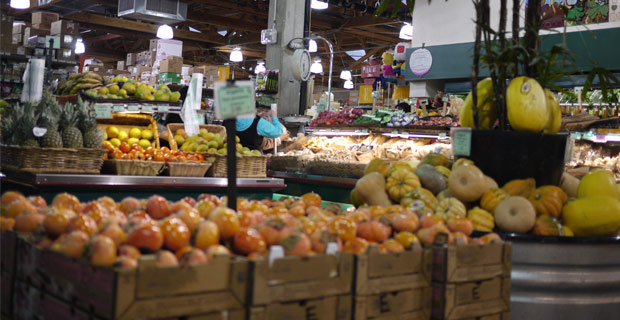
Alert shoppers are accustomed to watching food prices go up and down. But a string of forces—from droughts to diseases—is raising the cost of a trip to the grocery store at a rapid clip.
And it looks like it will be a while before the price pressure eases.
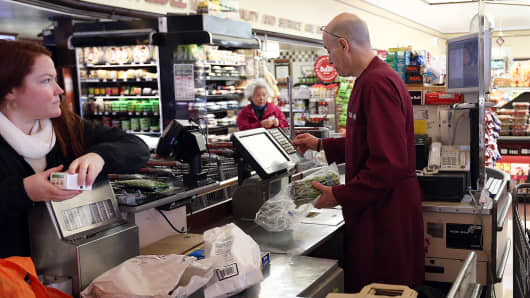
Some of that pressure is coming from California—the source of roughly half the nation’s fruits and vegetables—where a long-running drought is forcing farmers and ranchers to cut production. After the driest year on record, large sections of farmland are expected to lay fallow this year as the Golden State copes with an ongoing water crisis
That could have “large and lasting effects on fruit, vegetable, dairy and egg prices,” according to a recent USDA report, which said the full impact has yet to be felt.
Smaller cattle herds have forced meat prices higher in March—up more than 5 percent from a year ago, as demand remained strong despite tightener supplies. Ranchers are getting higher prices for cattle and food companies are able to pass them along.
Pork prices also have been rising after higher feed costs last year forced hog farmers to cut production. The upward price pressure on pork intensified this winter when a deadly virus thinned pig herds. That’s expected to bring even higher prices for this summer’s grilling season, when demand typically picks up.
“I think consumer should expect record high meat prices his year,” Tyson Foods CEO Donnie Smith told CNBC last month. “You should expect to see very high prices for your ground beef, your other meat cuts, all the pork cuts will be higher this year.”
Food prices are notoriously volatile, subject to short term spikes and drops based on weather-related shortages and surpluses. But the forces at work this year are longer-lasting.
An ongoing contraction in the U.S. dairy herd, for example, is pushing up retail prices of cheese, ice cream, and other processed dairy foods.
Farm egg prices have been among the most volatile, jumping by 20 percent in February after dropping by 28 percent in January.
U.S. farmers aren’t the only ones facing a production squeeze. A drought in coffee growing regions of southern Brazil, the world’s largest coffee producer, has pushed up the cost of a cup of Java worldwide. Coffee futures have surged 57 percent this year and rose above $2 a pound last month for the first time in two years.
With bacon and coffee prices surging, breakfast is becoming more expensive—especially if you include a glass of orange juice. Future prices are up 12 percent this year, hitting two-year highs, after Florida’s orange crop was hit by an insect-borne disease that’s expected to cut yields to the lowest levels in nearly a quarter century. Production could fall by about 15 percent to 114 million boxes this year, according to government forecasts, the lowest level since 1990.The recent series of food price hikes follow a relatively long stretch of stable consumer prices. Since 1990, retail food prices have risen by an average of 2.8 percent a year, according to USDA. From February through December of last year, average supermarket prices fell by 0.2 percent.
Consumers are also coping with higher costs beyond their supermarket shopping cart. After a brutal winter in much of the country kept shoppers home, a pickup in demand has sent clothing and used car prices higher in March.
Rents are also going up in most of the country, up 2.7 percent in the latest 12-months, a pace not seen since the housing market collapsed in 2007. Medical costs are also rising.
Because food prices are typically more volatile than other consumer costs, economists and policy makers at the Federal Reserve usually ignore them when looking at the so-called “core rate” of inflation. But after a long period of inflation running less than 2 percent a year, the latest surge in prices bears closer watching, according to Capital Insight senior economist Paul Dales.
“We suspect that core inflation will rise to 2 percent this year and beyond it next year, which would catch the Fed off guard,” he wrote in a recent note to clients..
9 Comments on "Rapidly rising food costs sting at supermarket"
Makati1 on Sun, 20th Apr 2014 1:00 am
We are heading back to the point where food will be a major part of our incomes as it is in most of the rest of the world. Nothing unexpected, with fuel costs rising and climate change killing crops. More to come.
Plantagenet on Sun, 20th Apr 2014 1:07 am
The FED has been printing dollars like crazy, causing their value to fall.
As the value of the dollar declines everything priced in dollars winds up costing more.
Repent on Sun, 20th Apr 2014 3:22 am
I have a family of four. This week we spent $730.00 grocery shopping. 10 years ago the same amount of food would have been half this number.
I’m in Canada, any collapse in the US will pull us down, as well as most of the rest of the world.
I known this would happen for some time, still I hate to see it all go…
Makati1 on Sun, 20th Apr 2014 9:05 am
Repent, this may make you ill, but, I remember when I was about 10 (1954) we went to the grocery store and splurged on all the groceries a big cart could hold including meats, veggies and fruit. Total bill was … $50. To put it into perspective, that was a week’s wage, after taxes, for my dad and we only did it that one time. It is all relative. That was when $1 per hour was normal and a 5 cent per hour raise was good.
At that time, 20% of your income went for food. Today it is about 10%, on average. But, it looks like that 20% is coming back fast.
Davy, Hermann, MO on Sun, 20th Apr 2014 11:36 am
Rising food cost are a mixed bag of issues good and bad. I like to start with the bad. In a world of population overshoot to carrying capacity with environmental degradation rising food cost will mean more attempts at increasing food production in a number of ways. All modern production AG efforts are harmful to the environment. Fragile land will be brought into production. More water is needed in an already water stressed world. Agriculture is a big contributor to AGW. A significant percentage of the global population is on the edge of adequate nutrition now any food cost increase at this point has exponential human costs. Food deprivation is among the biggest contributor to poverty and political unrest. The Arab Spring was a food issue with some other side issues. A collapse if and when it comes will have food insecurity as a primary issues. All other resource shortages lead to food insecurity. Riots will start after a few days without food. We are talking further stress on the financial system. We already have high energy prices sapping discretionary spending now we are having food cost rise further sapping that spending. Higher food prices are good for the farm sector but food prices like oil prices have a “goldilocks range” that they must remain in for a healthy economy. We are close to breaking that range and more dangerously in conjunction with energy prices. The good news is if a collapse is coming but a few years away the rising food prices will actually be the canary in the coal mine for the general public to make lifestyle changes. It is the one way to control the GP better than any. If the collapse is going to be softer and gentler we need a simmering crisis now as soon as possible. If we start having mild food shortages and higher prices we are going to see a shift to local food production and personal food productions. Nothing is better for a post carbon refresher than planting and maintaining a garden and or going to the local farmers market. Maybe bartering with the neighbor. The huge waste of food we see today may be diminished. Food equals AGW because of how energy intensive our food system is so less waste means less AGW. The increased pressure on the pocket book has good pre-collapse effects because it will temper those lifestyles that are unneeded mindless activities, energy intensive, and AGW contributors. A person in a garden is so much better than one with his bass boat being hauled to a lake 3 hours away by a ½ ton pickup. This is just one example of too numerous to count mindless activities engaged in by the modern general public everywhere but most notably in the rich developed world. We will not see the needed mass garden movement or mass local food effort but “ANY” increase is needed for what lies ahead. We are talking a game changer in just a few years when food and energy insecurity threaten the very stability of the global order.
Kenz300 on Sun, 20th Apr 2014 12:38 pm
If you own your own home…..plant a garden….. add a few fruit trees to the landscape. In a few years you will be glad you did.
Victory gardens can be very helpful……..
bobinget on Sun, 20th Apr 2014 4:41 pm
The sad truth, Kenz300 the masses moved to cities
and live in tight to crowded conditions with little or no access to breathing space much less growing.
As drought (or unseasonable flooding) drives more
people off land and into mega cities the situation worsens.
Even farmers have no time for gardens these days.
Most farm families in America work off the farm.
Try working ten hours and commuting two.
For myself (78) there is no way I could continue w/o diesel fueled machinery .
Like most farm families, most of us are getting older.
(40% of US farmers are over 55, in 1945 average was 35 years)
When “the little women” and I die developers will grab the water rights and build dozens of “country estates” for a horsey set. Suburban farmsteads this is common. When ‘real farms’, a thousand acres or more
come up for sale only corporations or speculators
selling to non farmers in cities around the world have the scratch.
We end up with 10,000+ acre ‘farms’ over worked by renters who will push land past its limits just to turn a small profit.
This month’s National Geographic deals with this very subject.
ghung on Sun, 20th Apr 2014 5:30 pm
Too busy in the garden to comment much. Put in four new blueberry bushes, two new figs, tomatoes, onions, taters, peppers soon, herbs are all in their new bed. Cukes, squash, some sweet corn, tomatillos, soon as well……. BAU here.
Davy, Hermann, MO on Sun, 20th Apr 2014 6:26 pm
G, debating tomatoes this week but I am a little further North. It has been a cold late winter early spring. I grew 7 exotic varieties started from seed:
green zebra
indigo rose
japanese trifele black
persimmon
old german
momotaro
ananas noire
Territorial Seed from Oregon. Great seed company