
Peak Oil is You

Donate Bitcoins ;-) or Paypal :-)


Page added on March 19, 2014

Psychological Trigger Points For Crude Oil Demand Destruction
I’ve talked about demand destruction before in this blog. Demand destruction occurs when the marginal benefit of using more crude oil exceeds the marginal cost for people. Essentially, when oil prices go too high, people use less oil. On a personal level, this means that people may drive fewer miles by staying closer to home on the weekends, they might postpone a long-distance vacation, or they might start taking the bus or work from home instead of commuting by car. The Economist wrote a nice article on this phenomenon last year where they stated “in the rich world oil demand has already peaked: it has fallen since 2005.”
While demand destruction occurs across every price up the ladder, there are certain psychological trigger points where people “wake up” to the fact that oil has gotten very expensive. Gas stations post their prices on the street and people notice when prices pass certain thresholds. In the United States, we price our fuel in dollars per gallon, and people definitely notice when regular gasoline passes $4 per gallon. In fact, when we look at the average US street price of regular gasoline, we see it bounces off a ceiling of $4 per gallon:
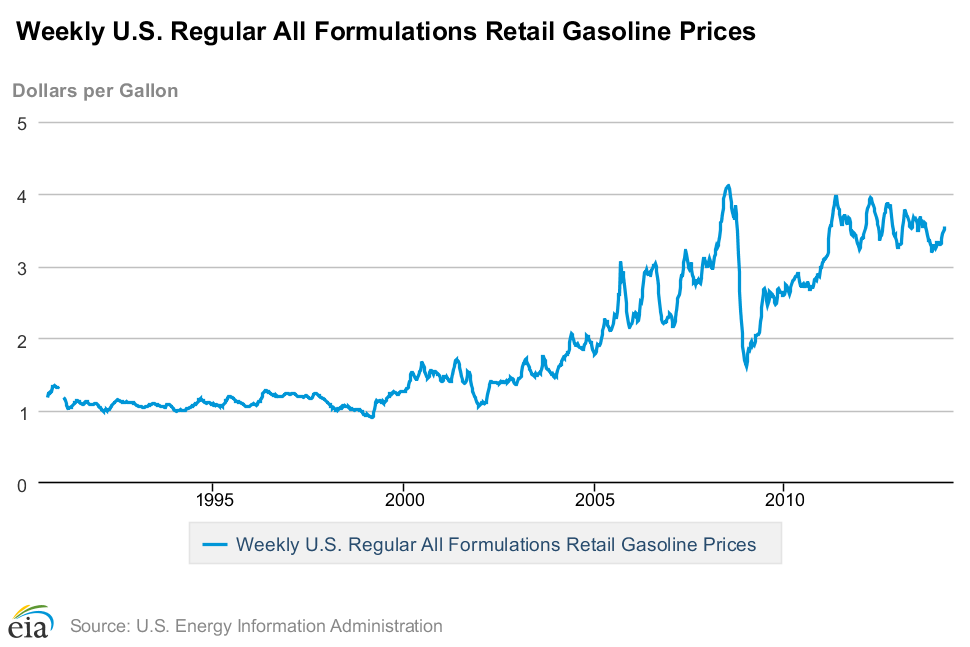
When Americans see $4 a gallon on their neighborhood gas station’s sign, the price of oil immediately becomes front-of-mind and they start changing their behavior. Already, there are signs that motorization in the US has peaked. We can imagine that if gasoline prices rose past $5 per gallon, people would dramatically cut back on their gasoline consumption.
In Europe, gasoline is priced in Euros per Liter. The EIA keeps a summary of current prices in Europe here. In Germany, the largest economy in Europe, 48% of cars are diesel, so the price of diesel is more important than the price of gasoline. Looking at historic diesel prices in Germany we also see a ceiling, but it is at €1.5/liter:
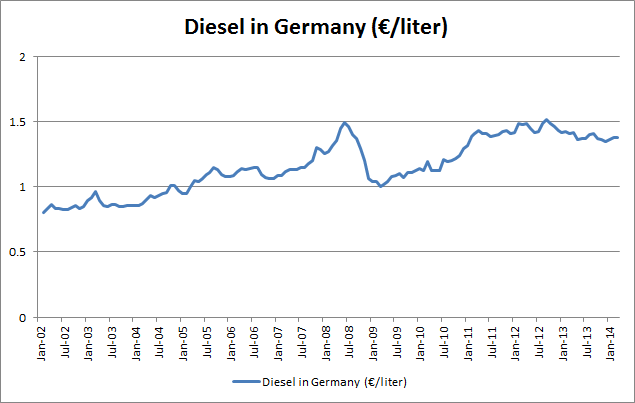
We can imagine that the next threshold in Germany is €2/liter, at which point Germans would almost certainly cut back significantly on their fuel consumption.
In China, gasoline and diesel is priced in yuan/liter. Current prices are ¥1.77/liter for diesel in Beijing. In Chinese culture, many numbers have strong physiological associations. Seven a lucky number associated with “togetherness” – so today’s price of ¥1.77/liter might be welcomed by people. Four is considered an unlucky number. In fact, many buildings in china don’t have a 4th floor (similar to how many buildings in the west don’t have a 13th floor). So while ¥2/liter is likely the next physiological threshold in China, we can imagine that if prices rose to ¥2.44/liter, they would be front-of-mind for people.
Converting Crude Oil Prices to Gasoline Prices
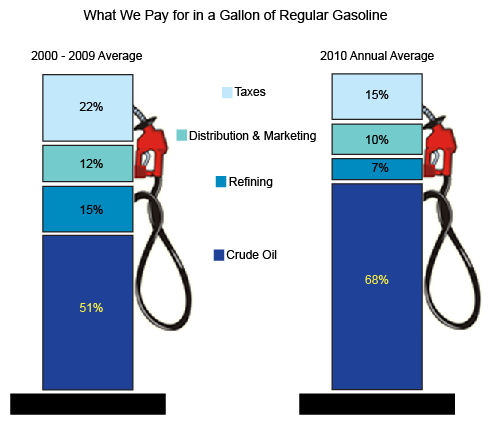
We can convert the price of crude oil to the price of gasoline by looking at the historical difference between these two prices. There are 42 gallons in a crude oil barrel, so a $100 crude oil price is $2.38 per gallon of crude oil. Obviously crude oil is the largest input cost for gasoline, but when you buy a gallon of gasoline you’re also paying for taxes, marketing, distribution and refining costs. The EIA has created a nice graphic showing what you pay for in a gallon of gasoline:
Over time, the price of crude oil has become a larger percent of the overall cost of gasoline:
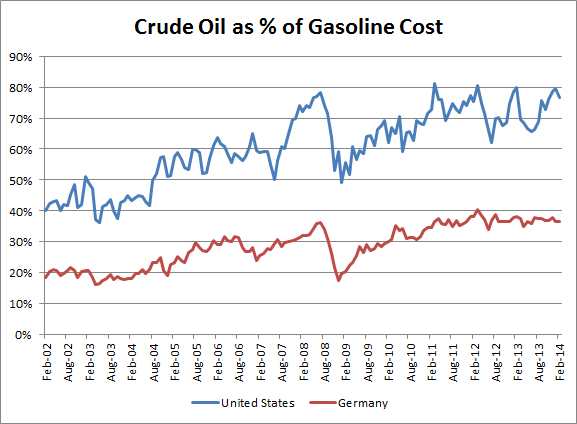
Today crude oil accounts for about 75% of the cost of gasoline in the United States and for about 35% of the cost of diesel in Germany (where taxes are far higher). Using historical data we can come up with a few simple rules of thumb for converting crude oil prices to local gasoline prices for the US, Europe and China:
- United States: Crude Oil ($/bbl) / 31.5 = Gasoline Price ($/gallon)
- Europe: Crude Oil ($/bbl) / 80 = Diesel Price (€/liter)
- China: Crude Oil ($/bbl) / 61.5 = (¥/liter)
Demand Destruction Thresholds
Going back to our psychological demand destruction thresholds, we can use our rules of thumb to convert them to crude oil prices:
- €1.5/liter in Europe: $120
- ¥2/liter in China: $123
- $4/gallon in the US: $126
- ¥2.44/liter in China: $150
- $5/gallon in the US: $157
- €2/liter in Europe: $160
10 Comments on "Psychological Trigger Points For Crude Oil Demand Destruction"
Makati1 on Wed, 19th Mar 2014 5:55 am
Philippine gasoline is P 53.5/liter or $ 4.70/per gallon. Outside of the city it is about $4.50. This is about average for the last 5 years, but depends on the exchange rate. It is always in the low 50s, but the devaluation of the peso recently has changed the US equal.
This represents about 3 1/2 hours labor for the average laborer.
Joe Clarkson on Wed, 19th Mar 2014 7:43 am
I have no doubt that there will be incremental demand destruction as the price of oil increases, but the psychological impact attenuates over time, probably fairly quickly. Here in Hawaii, we have been paying more than $4.00 per gallon for gasoline for several years and we are very accustomed to that price.
I think that there may be temporary episodes of psychological demand destruction as price thresholds are reached, but in the longer run the reduction in fuel use is due to equipment and lifestyle changes that gradually reduce overall per capita consumption. People adjust their fuel consumption not so much because they are shocked by higher prices, but because they simply don’t have the money to pay them.
Davy, Hermann, MO on Wed, 19th Mar 2014 10:33 am
As the economy changes so will the dynamics of oil demand destruction. “IF & when” a correction, contraction, or worse hits the financial system this time around we will see many more defaults, bankruptcies, and unemployment. As we move through this decade there is no reason to think the plateau in global oil supply will remain in the goldilocks range with global demand. Either way we are going to see more oil price volatility. I do not think we will see the severe depth or the height in prices as has been the case with the gold price range. Gold has yet to dip below production costs and Central banks can’t let it go to high or it affects interest rate policy. As mentioned in posts here a floor is around $90 with a spike range of $120/$140. I am really wondering about the whole situation of shortages and the corresponding policies of rationing. If this happens I am curious if this causes the kind of shock to the global system that begins the contraction spiral. Any of these scenarios are possible. I will say growth is over with oil on a plateau or decline. I see real growth over in the debt driven financial system. This financial system currently is following a debt driven pseudo growth with a corresponding wealth transfer of the poor worldwide and between developing countries and the rich 5% of developed countries. I see oil expensive relatively whether inflation, deflation, and or stagflation takes control. Globally due to instabilities in the new normal economic situation we will see a little of all the above globally in individual countries. My bet is on declines causing price dips causing shortages when production gets shut out. The Ponzi scheme debt driven financial system that is 3 times its normal productive size will parasitically destroy the global economy relatively quickly. Anytime you have a population in overshoot, economy at limits of growth with the productive class being bleed at the bottom by a rich upper class the social fabric frays and real wealth evaporates. This is the case now. Oil prices will follow the financial dynamics. Product is there, know how, people, and significant infrastructure are all present. The ability to apply these through capex and the markets will soon be strained. All it takes is a little loss to production to create wide price swings and economic decline.
Stuart on Wed, 19th Mar 2014 11:17 am
I remember the psychological price barrier in Australia was $1.00 per litre. There was a significant level of media coverage in the lead up to and when it went through this price.It is now $1.50 per litre. These barriers are temporary and as the boiled frog theory: you eventually become accustomed to the small incremental price rises, and carry on as before.
Kenz300 on Wed, 19th Mar 2014 12:41 pm
Walk, ride a bicycle or take mass transit. People use cars for short distance travel. That will continue to change as the price of fuel goes higher.
Bring on those electric vehicles. Wave as you pass a gasoline filling station.
rockman on Wed, 19th Mar 2014 1:27 pm
Joe – Good point. While there may be strong emotional triggers when the price of any price jump in the end folks pay for what they have to but only if they have the money to do so. Some folks might hate ExxonMobil but if they are 2 cents cheaper they’ll likely pull in their station. And they might give up the side order of fries at Mickey D’s after taking a hit at the pump. But they aren’t going to stop buying gasoline just because the price went up. As you say once the shock wears off and pissing/moaning doesn’t change anything folks just tend to lay back and take it if they have no choice. I’ve personally been a bit surprised how much of the world has accepted $100 oil all this time.
J-Gav on Wed, 19th Mar 2014 2:00 pm
Rockman – I’ve also been surprised that sustained $100 oil hasn’t had a bigger impact but, then again, exactly how much of our current economic stagnation is due to it is hard to gauge.
I expect the 1st ‘trigger’ mentioned in the article ($120-125) will appear within a few years and will have a more noticeable impact. But the real test for demand will be that 2nd trigger ($150-160 a barrel), although I see the timing for that one as being a little tougher to nail down.
rockman on Wed, 19th Mar 2014 4:56 pm
J-Gav: But then you haven’t lost a job or much mobility…I hope. And me…on top of the world. But last summer I cooked a pot of red beans and rice for a group of families having a garage sale (cloths, kid’s toys, etc.) trying to raise some money to help pay for their care of car pool gas to get to work. Some folks have a much lower trigger weight then others.
I’m sure you know the different definitions for recession and depression.
J-Gav on Wed, 19th Mar 2014 8:48 pm
Rockman – Actually, I have lost a job and some mobility. Not complaining, mind you. My spouse and I have our own little plan B which, in addition to the French government’s (not too generous but still existent) help for the likes of us oldsters, is allowing us to keep our heads above water for now. I see the shops closing all around us and the street people multiplying … After salaried work for 38 years and a few more off-salary, and still ending up on the razor’s edge every month, I know pretty well who I can count on – and yes, also know the difference between a recession and a depression. Been through some recessions but depression is what we’re faced with now – never been through a full-fledged version of that. it’ll be a helluva challenge for a lot of people, including my family. For the moment, though, we’re still cooking our own beans and rice – and throwing in some ground beef to boot.
Kenz300 on Fri, 21st Mar 2014 5:11 am
The price of oil continues to go higher………
Demand destruction and high prices will make alternatives a better option.
Time for cities to become more people friendly and less auto friendly.
More walking and biking paths are needed that connect work, schools, homes and businesses.
Better and more convenient mass transit is needed. Most major cities once had trolleys running thru them for easy access and transport. We need to rethink our priorities and do a better job of including, walking, biking and mass transit into our lives.