
Peak Oil is You

Donate Bitcoins ;-) or Paypal :-)


Page added on May 19, 2013

Predicting the Weather, Corn, Ethanol and Oil Production
News of the future was, in my youth, something that one found by crossing the palm of a lady in a dark tent with a piece or two of silver (or the modern equivalent) at one of the fairs that came to town. Such opportunities still exist, with all the caveats that existed back then likely still being in force. However, projecting the future, whether of the weather, the likely corn crop this year in the United States, or the production of crude oil by the nations of the world has become a much bigger business with copious tables, graphs and theories replacing the rather worn pack of cards or crystal ball of my youthful experience.
Our part of the world underwent a drought last year severe enough to kill several trees in our yard, for example, as well as hurting the corn crop. This year, corn plantings have been severely impacted by the heavy rains and cold weather, so that decisions on crop plantings have become more complicated and delayed, with follow-on impacts on the ultimate yield in a number of Midwestern states. Corn yield apparently falls at an average rate of 2.3 bushels per acre per day of delay in northern Wisconsin. These changing conditions make it difficult to assess how much ethanol, for example, will be available to meet demand, although the latest EIA TWIP holds out some optimism for this year.
The impact of the drought on corn prices, and the consequent fall in ethanol production, as production costs rose, are directly visible from their plot of the two over the last year.

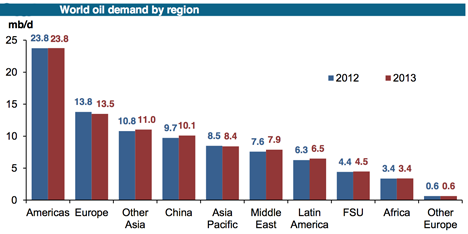
Moving to the slightly longer-term, the nations that form OPEC must try to estimate global demand for their products and the amount that other non-OPEC nations will produce, so that they can balance supply and demand at such a level that will sustain prices they are comfortable with. Their estimates come out as Monthly Oil Market Reports and in the latest (May) version they continue to expect global demand to increase by 0.8 mbd over 2013, but are beginning to hedge that bet as the global economy continues to appear anemic, with Russian and Asian economies slowing. Yet by the fourth quarter of the year, they anticipate that global demand will reach 90.9 mbd.
On a quarterly basis, US oil supply is seen to average 10.62 mb/d, 10.67 mb/d, 10.62 mb/d and 10.61 mb/d respectively.
The sustained gain in North American production comes about because:
On a quarterly basis, Canada’s production is anticipated to average 4.02mb/d, 3.97 mb/d, 4.02 mb/d and 4.12 mb/d respectively.
Russia is expected to continue to lead in oil production over the course of the year, although it is not longer expected to increase production above current levels.
On a quarterly basis, Russian oil supply is seen to average 10.45 mb/d, 10.43 mb/d, 10.43 mb/d and 10.43 mb/d respectively.
And this brings us back around to OPEC as they try and balance their production against the gap between global demand and non-OPEC supply. As has been the case for a while, OPEC produced two separate tables showing production, as reported by secondary sources as well as those directly reported by the countries themselves.
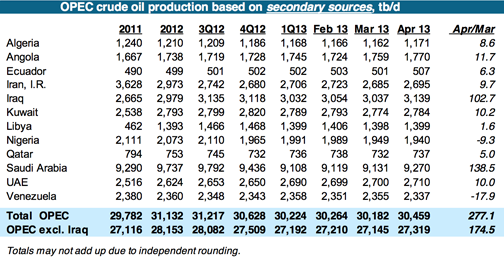
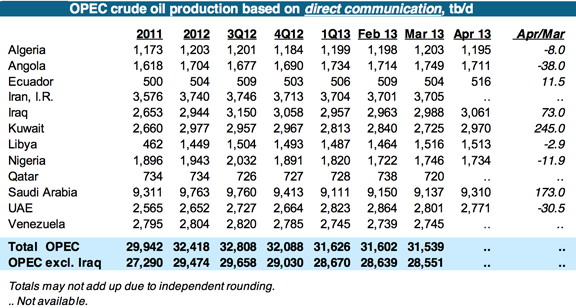
As long as OPEC has available reserves, it can continue this balance to keep enough oil available at an acceptable price to allow the world economy to continue at its present pace. And with that ongoing adjustment available, their projections for this year of a relatively stable price would seem fairly founded, absent some major change in one of the larger producing states.
Iraq overtook Iran as the second largest producer in OPEC last year (according to secondary sources) and expects that with production from Majnoon, it will increase production capability by upwards of 200 kbd by the end of the year. Ultimately the goal is to achieve a target production of 1.8 mbd. However, as overall production levels increase, Iraq may join with the Kingdom in controlling production to maintain price.
Yet even with those abilities, OPEC is becoming cautious about predicting that their estimate of the demand:supply balance numbers for this year will be accurate over that time interval.
With these uncertainties in even short-term projections of future production, whether it be corn, ethanol or crude, it is perhaps wise to continue a somewhat cynical view of projections over a longer time period. Although the bounding bar of a decline in existing field production continues to exist, and will continue to require an offset in increased production from new wells to offset. Perhaps that lady in the tent of my youth may prove as prescient as some of the more optimistic forecasts that we continue to see.
6 Comments on "Predicting the Weather, Corn, Ethanol and Oil Production"
BillT on Sun, 19th May 2013 2:30 pm
And when the corn belt dries up from climate change…then what?
Kenz300 on Sun, 19th May 2013 6:13 pm
Ending Our Oil Addiction: Yossie Hollander at TEDxChapmanU – YouTube
http://www.youtube.com/watch?v=iKEtQ_zz4GA
J-Gav on Sun, 19th May 2013 6:35 pm
Oooh! Good luck with all that, eh?
Could we not make things a little ‘simpler,’ instead of adding layers of un-necessary complexity to the unmanageable pile we’ve already built up? With all the “unintended consequences” th
rollin on Sun, 19th May 2013 6:44 pm
The corn to ethanol for fuel is a giant con game.
J-Gav on Sun, 19th May 2013 7:45 pm
..that implies. People(s) are are really going to have to get together in some as yet un-tested way in order to prolong the presence of our species on this planet. Lots of things are actually happening (though on rather small scales) around the world. Whether or not critical mass can be reached before it’s “too late,” whatever that might mean, we just don’t know. What we do know is that, even with a miraculously concerted international effort to “save the planet,” no positive outcome is guaranteed for our species (and many others). In spite of all that, I still think a difference can be made as to the ferocity of how the winding-down of our industrial/fossil fuel orgy plays out. Is it just a question of softening and delaying the inevitable? Quite possibly. But even that would be better than nothing, wouldn’t it?
BillT on Mon, 20th May 2013 1:30 am
It might be saved if there weren’t so many that believe that we are in the ‘last days’ and that they will be saved and go to the ‘Garden of Eden’ in some distant dimension, and they won’t suffer, so they don’t care what happens to the earth.