
Peak Oil is You

Donate Bitcoins ;-) or Paypal :-)


Page added on May 8, 2013

Peak Oil Revisited – Oil Limits Are Now Debt Limits
LIMITS TO GROWTH
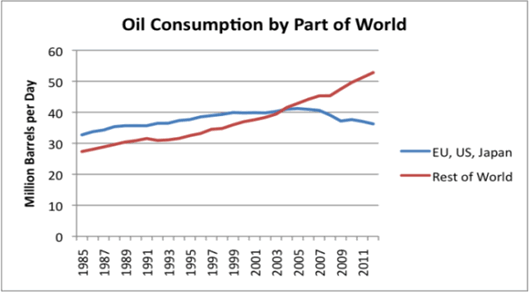
Oil and energy limits are more complex than what we have imagined so far. The crossover from OECD Old World dominance of oil market demand, to Rest Of World dominance was more than 7 years ago, but the perception of what this means has been slow. Very slow.
Source: OilVoice
Totally unexpected change, at least unexpectedly fast change across the global energy supply-demand space is only now beginning to produce the right analysis. The above chart that ends in 2011 can be continued with another unexpected change – both curves have broken downward. What we have today is not a lack of liquid hydrocarbon resources, or other hydrocarbon fuels, or non-hydrocarbon energy, but the inability of the Old World OECD to compete in a global economy based on using all kinds and types of what will become cheaper energy, starting with cheap coal. This was, ironically, the basis of the Old World’s economic takeoff and prosperity from the late 19th century.
The old paradigm was that cheaper energy in the shape of coal fuel anabled growth and led to higher standards of living. This paradigm was routed by the 1970s oil shocks and the ecology-environment and green energy movement, now morphed into the anti-Global Warming movement. The new paradigm is a future of declining oil and energy prices to levels too low for the 20 to 30 major oil exporting nations and major energy corporations, an economic and financial problem, just as too-high oil prices were an economic and financial problem for the more-than-160 oil importer nations. The old paradigm dating from the 1970s oil shocks had massive lingering impacts across the economy and economic policy space ever since, but however if oil and energy prices in general decline – and they will decline – the financial and debt connection will spell major crisis.
DEBT LIMITS TO GROWTH
Debt limits were also closely tied to oil supply limits. The crossover date for when this became a “were” problem is very easy to set. This was the period 2005-2008. Totally unexpected by most analysts, ignored by almost all economic and energy historians, oil and energy corporations and oil exporting countries face their own debt limits to growth, and can collapse like any other debt strangled company or country. We can include Russia in the candidate country list even if Saudi Arabia may be harder (but not impossible) to include.
At its most brutally simple, any return to the Cheap Oil era or epoch of 1985-2000, when oil cost around $15 – $20 per barrel is now completely impossible without a corporate and country debt crisis. The reasons for this start bad, and quickly become worse.
Overpriced oil is now obligatory, to prop up damaged and weakened national finances, and to finance “secondary and tertiary” oil production, always higher cost than “conventional oil”. The result is brutally simple – oil has to stay expensive, and has to price itself out of the energy mix, and is doing so, shown by world energy dependence on oil falling from about 53% of all energy in 1973, to about 32% in 2013. More than a half of all energy was oil, but today less than a third is oil. Two-thirds of world energy, today, is not oil energy.
Further contraction is inevitable. Only the rate of contraction is to discuss and analyze, and immediately throws us up against debt limits – for oil corporations and oil exporting countries, bent on producing and supplying more oil, and for the now fragile “bad banks” and financial entities of the world.
Unfortunately the mainstream media, deliberately seeking to idiotize the public show us appealing images of windfarms and solar panels, bicycles and buses, reycling and other Green Paradigms, that are anti-oil, and seek to hasten the inevitable demise of oil energy. The totally ironic result is that oil and energy must stay expensive, to keep producing it, at a time and in a context where clean hydrocarbon fuels, especially gas can only rise in supply and can play a leading role in a rational, energy-efficient, environmentally sustainable economy. This last option is however disappearing, rapidly.
ALL PROBLEMS ARE SOLVED – OR HAVE ONLY BEGUN
Mainstream media tells that “If the US can be oil independent, world oil supply problems are solved”. This goofy model is as idiotic as saying that if KFC chicken nuggets were made from shredded and recycled tennis balls, the animal protein supply problem would be fixed. The US is primarily and immediately gas import independent, and a future gas exporter. This alone will have unexpected and negative, even geopolitically dangerous impacts on several countries – notably and firstly Russia.
Almost totally ignored not only by the idiot media, but also by professional energy analysts, the US is increasing its shale-based oil production at typical breakeven prices around $70 per barrel, at a time when US oil consumption can “go South” in a semipermanent way, with no need of an accompanying economic crisis to do it. We only need to compare EU27 oil consumption per capita, in its 7th year of straight decline, at under 10 barrels per capita annual, with US per capita oil consumption. On this basis, the US could rather easily cut its oil demand by 50% – 65% before 2030, but its oil output will increase! No Einstein is needed to tell us what this means for prices. Oil demand down, but oil supply up means only one thing: Lower prices. When they fall below the high breakeven price, however, the US shale oil industry goes the same financial way as the US shale gas industry. The path to corporate debt crisis, as XTO Energy and Chesapeake have amply shown.
Without a huge increase in US domestic production of relatively expensive oil, however, the US will need to go on importing oil – while driving down the price of oil on world markets because its oil output will nevertheless be growing. The net result is to ruin the US oil industry with debt, to finance domestic oil production growth at high breakeven prices, while foreign oil corporations and oil exporter countries are also ruined, by their own recourse to debt, as global oil prices decline forcing them to try compensating this with increased output, at higher and higher cost per incremental barrel-day capacity.
For an advance snapshot of this paradigm, and how fast it operates, a quick look at the now-dying US coal industry is worthwhile. One reason is the US coal industry is unable to borrow, making industry wipeout much faster.
What will happen is hyper-simple and hyper-clear in a “Ricardo world of comparative advantage”. Oil exports will go to the countries that have low manufacturing costs, in the Chinese and Indian cases using a lot more coal, than oil, while corporate energy sector debt in the US subsidizes the USA’s fast growing refinery products export trade, and coming shale gas LNG export boom, both of them driving down world energy prices. None of this would logically “repatriate jobs to the US”, as Dow Chemical claims alongide other energy-intensive industries opposing US shale gas exports, we can add. The economic loss is major and does not have counterpart gains.
GREEN ENERGY TO INTENSIFY THE ROUT
The Green version of this paradigm is, with extreme irony that: “If world oil prices are rising, everything is fine”, because this automatically makes the financial case for Green energy better. Very close behind this paradigm is the back-up notion that Peak Oil of the M. King Hubbert type is alive and well, but this is basically a geological limit to growth. Our subject is near-term global economic stability and survival – because the real and menancing threat are near-term economic and financial limits to growth, of any kind, now operating in the energy sector as elsewhere in the economy.
Lower oil prices, which are inevitable, will only hasten the endgame of corporate and country debt spiralling to further extreme and unmanageable heights.
The previous paradigm was: “Limited oil supply and high oil prices lead to financial collapse”. That paradigm dates from the 1970s, and justified (or rationalized) massive investment, through borrowing, on the expectation that “rare” oil supplies and “costly energy substitutes” were permanent and unchanging features. Kicking away the props to this paradigm as has been happening for at least 5 years now, mostly ignored by analysts and the media, will generate a new and major strand of the global financial-economic crisis, and accelerate it, which we can add has no need for extra props.
Limited oil supply growth in 2004-2008, aggravated almost exclusively by oil demand of the “Asian Locomotive” countries predictably levered up oil prices, but the unexpected impacts included rapidly accelerating energy-saving and green energy development programs in OECD countries, and radically increased energy saving in “Asian Locomotive” and other nonOECD G20 countries, where typical national oil demand growth rates have halved since 2008. Adding also-radical falls in global and regional economic growth rates, other aggravating factors (for oil and energy demand) such as continually declining rates of population growth, and the radical increase in shale gas and stranded gas output and development, the only possible result, of declining energy prices, was a foregone conclusion. In no way does this resolve or ease the debt burden for “most exposed” corporations and countries, in fact the reverse, due to the global economy having adapted to overpriced oil in particular and overpriced energy in general, for decades. It is now unable to break out of this paradigm.
PETROCOLLAPSE — OR PETROMONEY COLLAPSE
The previous peak oil paradigm had the world unthinkingly running out of oil, imagined to supply “a huge proportion” of world energy, and impossible to subsitute either through alternate energy supply, or through reducing energy demand. Substitutability among other economic resources of all kinds, including global labour resources, was imagined as almost zero, or very slow.
The Green growth paradigm was “We can have a steady state economy forever”, but like the non-green or Grey growth paradigm, both of these paradigms were crippled by their unspoken assumption, that oil and energy prices would stay high.
Although we remain dependent on fossil fuels for food supply, producing metals and operating cities, this is unrelated to the financial system’s vast and towering overload of debt. Oil and hydrocarbon energy resource depletion is a multi-century problem but the “debt bubble” concerns the near-term and managing debt was in large part based on those crippled assumptions, above, which we can summarize this way:
*Economic growth at high rates is not only desirable, but is now obligatory to save the system.
*High oil and energy prices are caused by economic growth, and support borrowing for growth.
At its extremes, the “Peak Oil doom scenario” held that worldwide famine would result from oil resource exhaustion. In fact the global agricultural and food sector’s reaction and response to a decade of high-priced oil includes radical changes towards near-zero net energy farming, that is farming operations producing as much energy as they consume, albeit of different types. At its most extreme the “Global Warming doom scenario” held that intensifying the shift to Green energy required oil prices above $200 a barrel and carbon taxes up to $500 per tonne CO2 (equivalent to an additional oil tax of about $150 per barrel). Under that energy fantasy price scenario, a total shift away from coal, oil and gas is inevitable and would come rapidly.
The fantasy vision of oil prices at $200 or $250 per barrel would, if it became reality, firstly cause a radical intensification of shale oil, shale gas and stranded gas-LNG development, further intensifying the retreat from and death of oil. The fantasy vision of oil prices effortlessly able to continually grow, treated as if it was feasible, has for example levered major corporate borrowing and investor support, and state financial support to electric car and vehicle development, which to use Thatcher’s famous one-liner has No Future without extreme oil prices. Yet another lame duck industry based on debt!
The new energy-economic and financial paradigm is simple. “Overshoot and collapse” is now programmed into world energy financing and energy economics, due to energy prices necessarily falling but being thought of as “impossible” for too long.
Other ramifications of this crisis are, for certain, less stark or more subtle but are very wide ranging. Entities as apparently immune as the IMF and global central banks are examples – dependent on or accustomed to “hot money” petrodollar and petroeuro flows. Even fiscal drag in the energy intensive Western economies is another example. Drugged on high energy like the corporate sector, governments have a touching but blind faith in high-price energy.
One example, already mentioned, is the near-total dependence of the Green paradigm and Climate consciousness on high oil and energy prices. Only partly known to or accepted by the persons and entities working this now-depleting lode of public sympathy and support, either a debt collapse or an oil price collapse will not only bring down investment and interest in all fossil fuels, but will accelerate the already existing decline of investment support and new capacity in renewable energy.
Quite simply we will need less energy – so why produce more?
By Andrew McKillop
Andrew McKillop marketoracle.co.uk
8 Comments on "Peak Oil Revisited – Oil Limits Are Now Debt Limits"
Plantagenet on Wed, 8th May 2013 11:09 pm
China and India subsidize their gasoline to make it cheaper. In contrast the EU puts extremely high taxes on gasoline, to make it as expensive as possible.
GIven that EU tax policy INTENTIONALLY makes gasoline in the EU 2-3x more expensive then elsewhere, is it any surprise that the EUs economy can’t compete with the rest of the world and has essentially collapsed?
Arthur on Wed, 8th May 2013 11:39 pm
“GIven that EU tax policy INTENTIONALLY makes gasoline in the EU 2-3x more expensive then elsewhere, is it any surprise that the EUs economy can’t compete with the rest of the world and has essentially collapsed?”
I probably missed something.
http://www.wnd.com/2013/05/the-dollar-and-the-usa-is-toast/#MZjqFZzvdls1skvk.99
European cars are smaller and more fuel efficient than in the US, so that compensates for the higher fuel prices. Tax money goes amongst others to support those without an income; in Holland garanteed minimum 785,61 € (1033,78 US$), excluding benefits, like rent subsidy and health care. There are no 45 million on food stamps in Europe.
Beery on Wed, 8th May 2013 11:40 pm
Planty misreads the situation yet again.
Have you ever been to Europe, Planty? The countries that have the biggest taxes on gasoline are the countries doing best. They are not being hit as hard as countries with little or no gasoline tax.
Just wait until what’s happening in Europe really starts to hit the US. We are treading water as it is, and it can only get worse.
BillT on Thu, 9th May 2013 1:12 am
“… There are no 45 million on food stamps in Europe….” No, ALL of Europe is on “food Stamps”. Socialist countries all.
“Tax money goes amongst others to support those without an income.” What does that mean except that all Europeans are taxed to feed those who cannot find work. That number is double digits and growing. Same as in the Us.
This article pointed out that BAU is over. Contraction is the new norm. There will only be ‘cheap’ energy when no one can afford any. And it will be scarce. And, no, $200+ oil would NOT create an oil boom. It would create a collapse and world wide depression that would never end.
But then, this IS an ad for the services the author sells.
Arthur on Thu, 9th May 2013 7:43 am
I do not expect fuel prices to rise, instead continued demand destruction. People really start to economize on using energy, first and foremost driving.
Stephen on Thu, 9th May 2013 7:58 am
It is time for economists, city planners, politicians, corporate leaders to understand there are limits to growth and a finite amount of resources left” and to start having public forums and educating the public on what this all means. We also need a serious policy discussion on “where do we go from here”, because to create a society that is worth living in with limited resources involves changing expectations, standards of living, use of resources, the layout of the landscape, re-purposing land and buildings, re-learning skills our ancestors used, re-distributing wealth, cancelling or jubilee some debts, and even implementing changes to the laws to foster a lifestyle that uses less energy and resources. It will take a willingness to allow people other than capital investors, bankers, and corporate CEOs aren’t the only ones allowed calling the shots in terms of economic policy, monetary policy, and to make policies that sustain the earth get higher priority than economic growth, wealth for richest 1%, or mass scale marketing for the biggest corporations, and the like. Lastly, it will take the general public worldwide to wake up and mobilize and aid the transition to such a model.
A simple start by doing these things could reduce liquid fuel use by 30% or more:
1) Allow people to flex their work hours and pay by productivity rather than hours worked. Allow people to work from home as opposed to having everyone come to the central office 9-5. If 50% of the people did this, and did their work at home or a public place within a couple miles of home (rather than across town), and people mostly walked or rode their bikes there, this would cut gasoline usage significantly. The rush hour commute is the biggest waster of gas.
2) In the USA, if gasoline was taxed up to European Prices, it would limit unnecessary driving.
3)Implement a ban on coast-to-coast trucking of large shipments. Require shipments over a certain distance to be done by barge or intermodal rail. These methods use far less fuel.
4) Create incentives to assemble products close to home and end globalized assembly and manufacturing of parts.
5) Tax Oil prices so $200 a barrel is the new floor in price. This would give the industry an incentive to invest in as many supply fixes as we can, as well as alternative energy. Even though alternative energy does not have the EROEI of fossil fuel energy, there are many types worth investing in including but not limited to solar, wind, thorium nuclear, algae, sugarcane, jatropha, hemp, and switchgrass biofuel, ammonia, ocean wave motion, and much more.
6) Over time we will need to educate people on the skills of our ancestors.
BillT on Thu, 9th May 2013 12:06 pm
Stephan, wishing does not make it so…
SOS on Fri, 10th May 2013 2:50 am
comedian?