



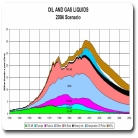
Over the past weekend, MA and I had several e-mail exchanges about Twilight in the Desert, about which I wrote this brief item yesterday. He pointed out some similarities between Simmons’ views and those of M. King Hubbert, who used mathematical models to predict that for a specific oil field, oil production peaks and then drops off suddenly. From Wikipedia:
The Hubbert peak theory, also known as peak oil, is an influential theory concerning the long-term rate of conventional oil (and other fossil fuel) extraction and depletion. It predicts that future world oil production will reach a peak and then rapidly decline. The actual peak year will only be known after it has passed. Based on available production data, proponents have predicted the peak year to be 1989, 1995, 1995-2000, or, according to the Association for the Study of Peak Oil and Gas, 2007 for oil and somewhat later for natural gas. This may lead to major economic consequences for the world since modern civilization is dependent on cheap and abundant fossil fuels, especially for transportation, food production, chemical industrial processes, water treatment, home heating and power generation. The Hubbert peak theory is named for geophysicist M. King Hubbert, who correctly predicted the peak of U.S. oil production fifteen years in advance. While controversial, the theory increasingly influences policy makers within government and the oil industry. The current debate is rarely about whether there will be a peak, but rather when it will occur and the severity of the post-peak effects. Even the most generous mainstream reports estimate petroleum reserves lasting no more than 100 years.
My reaction: Show me some economics. Show me the effects of expectations on prices.
First, it is incorrect to generalize what might be a geological condition in one field to the world economy. As (or if ) world oil becomes more scarce, prices will rise and extraction rates will decline. Also, higher prices induce more exploration. As Phil Miller says, “We will never run out of oil.”
Second, suppose Hubbert is correct. Sort of. Then speculators ought to be driving up the price of oil now by slowing the extraction rate, if not in Saudi Arabia then elsewhere. And keep in mind that even thought the U.S. imports only a small percentage of its oil from Saudi Arabia, if their oil stopped flowing into the world market, that would have a big impact on the world markets.
There was a very informative discussion of these topics by Hamilton and Kaufman recently here. Hamilton points out that the December 2011 future price of oil isn’t much different from the current spot price. Apparently, speculators disagree with those who are predicting doom and gloom. If you really think the Hubbert peak is drawing nigh, this is a good time to buy lots of long-term oil futures.
Where is Julian Simon when we need him?
CIA-MOLE on Tue, 23rd May 2017 9:42 am
Is this the same dude who riled up commenters previously about getting the definition of peak oil wrong?
Theedrich on Tue, 23rd May 2017 4:44 pm
The UK gods warn: “The Man’ster thing was naughty, yes. But Whitey, if you show any Islamophobia, we’ll imprison you. We’re not going to swerve from our course of national suicide, and you will be drowned by stone-age Mohammedans; Sharia is going to be the new law of the land. London already has a Muslim mayor (tee-hee). We’ll pretend to be for democracy and anti-terrorism, and you will go along with the farce or else. Besides, we need the oil from Allahland and oligarchic money from Sörös and his pals to keep ourselves in power. So return to your senescent nihilism and go back to sleep.”
banjo on Tue, 23rd May 2017 6:31 pm
I’d suggest the author review an article called “the mineral based economy” it will give a good outline on how price is not a good indicator of how and when a collapse in production can happen.
He may also want to review global debt since 2008 interest rates total employment specifically tax receipts and real economic growth I.e. excluding the trillions in debt inflation.
Yes put an economic lens on it you moron.
CIA-MOLE on Tue, 23rd May 2017 9:41 pm
I’m just tired of collapse talk because nobody is brave enough to admit they don’t know anything.
Any respectable peakers with integrity will put their reputation on the line and commit to a concrete timeline then quit the doom train when his/her prediction is off course.
GregT on Wed, 24th May 2017 12:26 am
“Any respectable peakers with integrity will put their reputation on the line and commit to a concrete timeline then quit the doom train when his/her prediction is off course.”
If you are under 50, within the timeframe of your natural life expectancy.
Gen on Wed, 24th May 2017 1:54 am
In the mid of the last century global oil consumption stood around 60 mn bbl/d while population accounted for around 2 bn people. Annual growth rate of oil consumtion fluctuated somewhere 0.2-0.3%.
Nowdays we face 95-97 mn bbl/d of global oil consumtion. In mid ninetees of the last centure it was 74-75 mn bbl/d. In the past decade growth rate of oil consumption stuck to 1.0-1.2% annually. On top of that we have over 7 bn people on the Earth. Most likely in advanced/developed economies we would see decrease in consumption per capita (1 bn people). This is gonna be incremental figures comparing with the big picture. In Asia-Pacific region we see over 3.5 bn people with consumtion per capita few times lower vs. USA’s or Europe’s rates. Chine case presents increase in consumtion from lower then 1 bn bbl/d couple decades ago up to the current 12 mn bbl/d. The growth comes from the East.
Jan on Wed, 24th May 2017 4:04 am
At the moment, most of the oil we a consuming was discovered in the late 1940s,1950s,60s, 70 and 80s.
Ghawar for instance had perhaps 170 billion barrels of original oil in place.
https://en.wikipedia.org/wiki/Ghawar_Field#Reserves
It was discovered in 1948 and after 60 years of production, it is obviously getting towards the end game. The large fields found before 1970 still produce over half the oil consumed, but they are very old.
If we compare the 170 billion barrel Ghawar with discoveries in recent years.
https://www.forbes.com/sites/christopherhelman/2014/01/08/the-10-biggest-oil-and-gas-discoveries-of-2013/#4785cc3a6a4c
In the relatively good year of 2013 all the companies drilling in the entire planet found just 20 billion.
In 2014 only around 12 billion were discovered.
http://news.ihsmarkit.com/press-release/energy-power-media/conventional-discoveries-outside-north-america-continue-their-decli
2015 was horrendous.
http://oilprice.com/Energy/Crude-Oil/2015-Worst-Year-For-Oil-Discoveries-Since-1952.html
and 2016 discoveries were horrendous.
https://www.iea.org/newsroom/news/2017/april/global-oil-discoveries-and-new-projects-fell-to-historic-lows-in-2016.html
In 5 years all the companies drilling in every place on earth did not find even half the oil contained in one field found in 1948.
Anyone who thinks about these facts for a while would understand exactly why peak oil will occur.
Anonymous on Wed, 24th May 2017 4:44 pm
EOR adds to reserves but the extra barrels are backdated in terms of discoveries. R to P ratio has been rising over the last few years/decades.
onlooker on Wed, 24th May 2017 4:51 pm
https://www.ft.com/content/441d0184-f13f-11e6-8758-6876151821a6
Oil and gas discoveries dry up to lowest total for 60 years