
Peak Oil is You

Donate Bitcoins ;-) or Paypal :-)


Page added on July 4, 2013

Peak Oil is not Synchronous

This morning, I took the oil consumption page of the BP spreadsheet, and applied a mechanical test to each country: was 2010 the highest year of consumption over the range 1990-2010? If this is true, let’s call the country an “advancer”, and if not, let’s call it a “decliner”. Here are all the advancers:
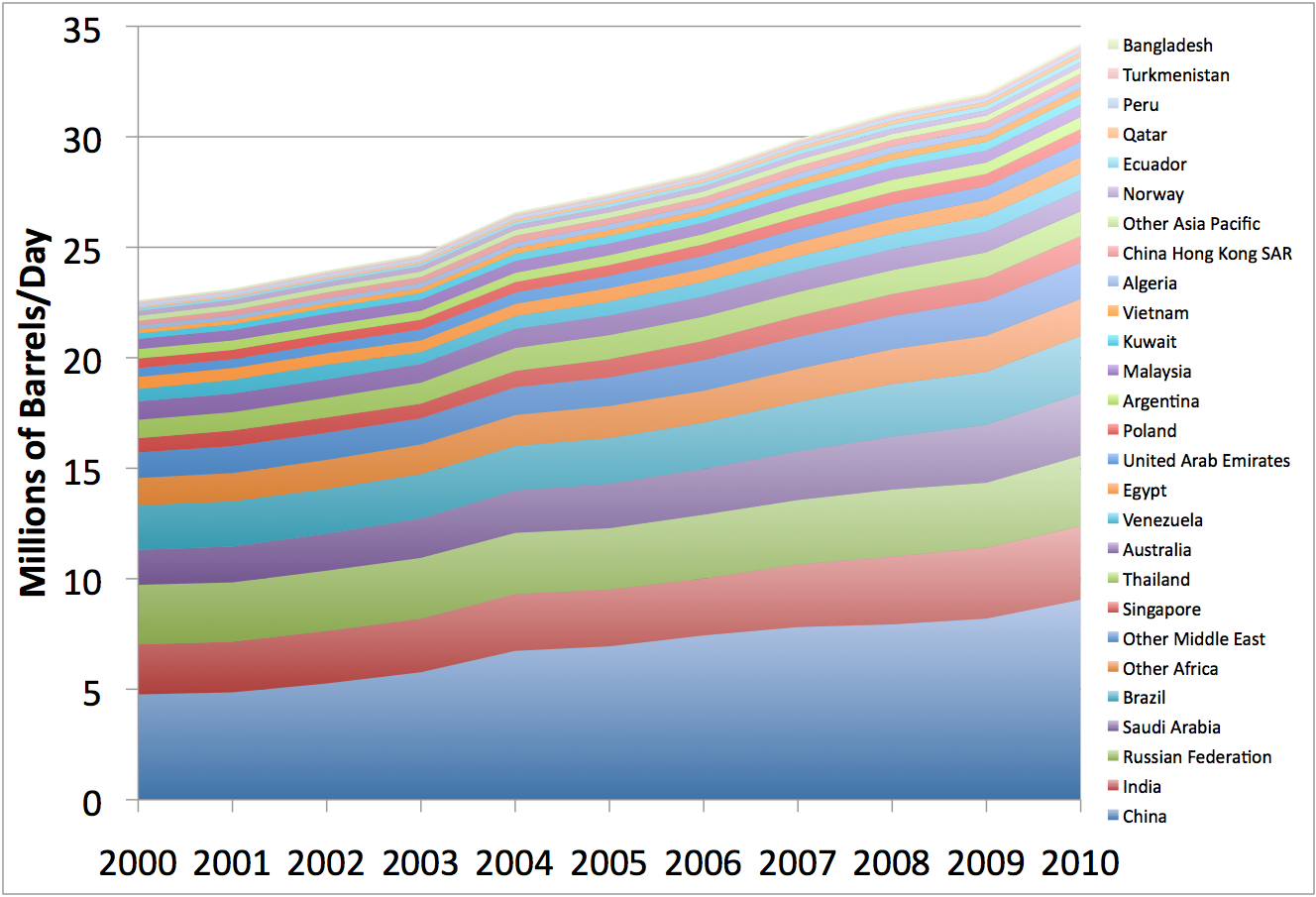
On this, and all the other graphs in this post, you can click to get a large version in a new window. You can see that the bulk of advancers are rapidly growing Asian or Middle Eastern countries, with a few other emerging markets from around the world thrown in. The only developed countries on this list are Norway and Australia – both big resource exporters. These countries in the aggregate account for a little over a third of global consumption.
To see the individual countries better, here’s the same data as a line graph, instead of a stacked area graph:
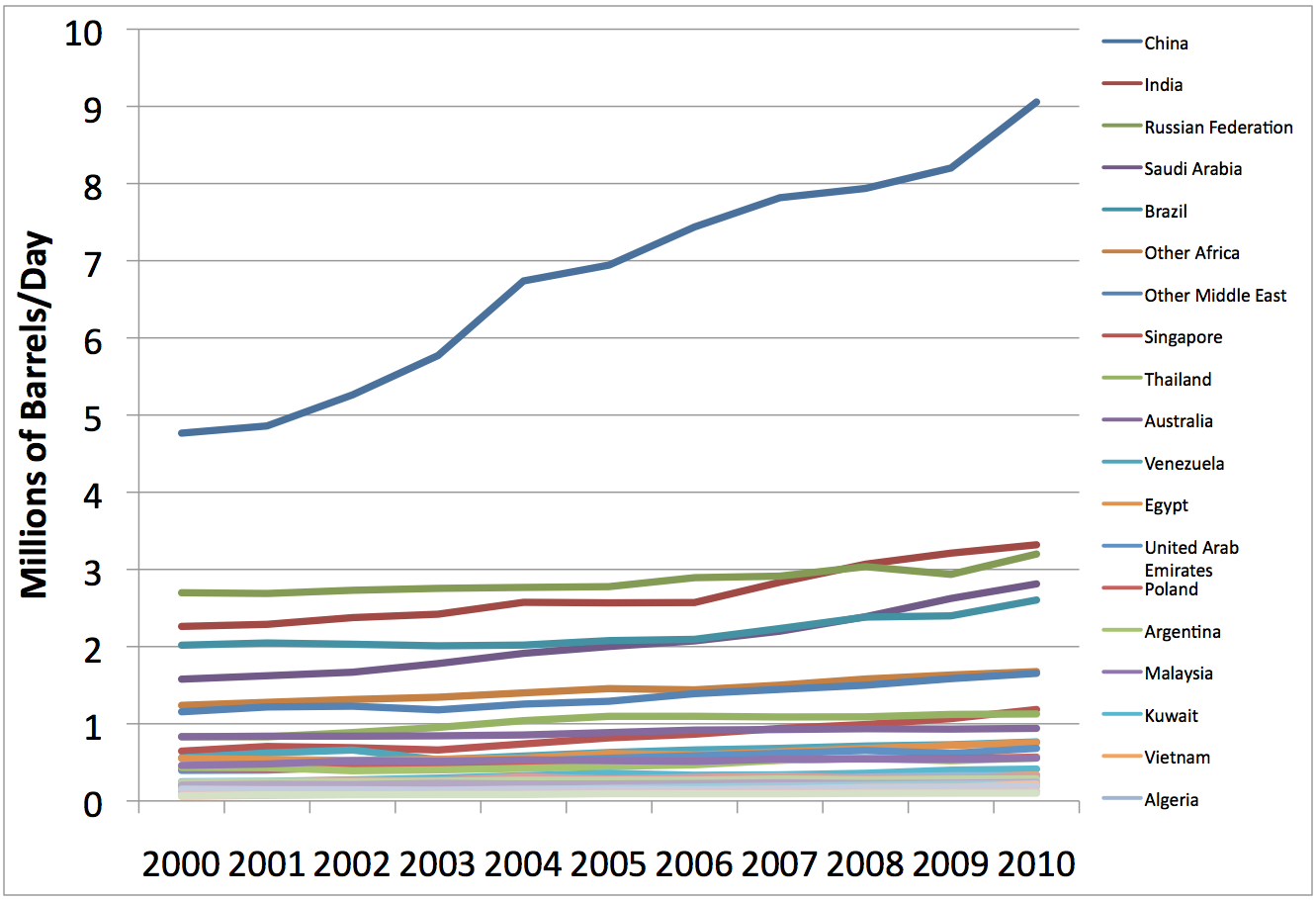
China really stands out. If we blow up the vertical scale so that we only go up to 4mbd (and thus exclude China), we get this:
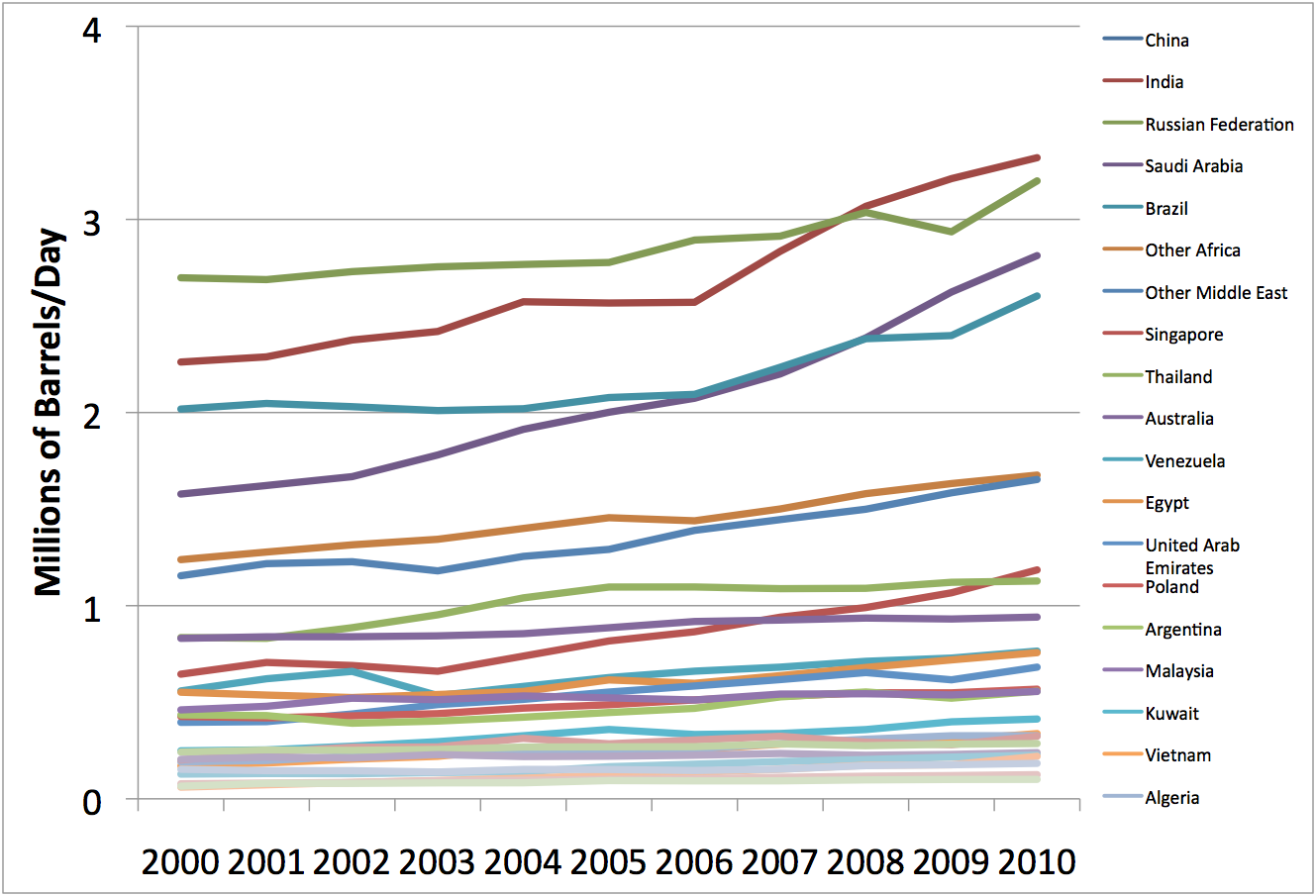
Notice how few had significant contraction due to the great recession. Looking at it yet another way, here’s the ten year average growth rate plotted against 2010 consumption:
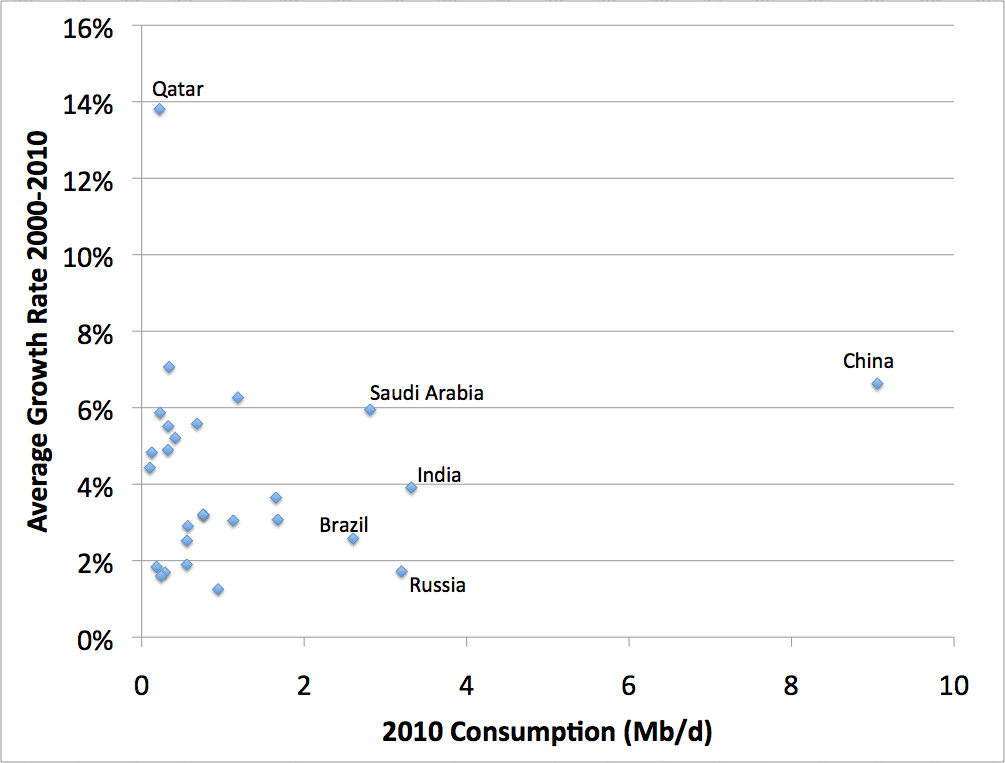
China is far and away the most important story, then Saudi Arabia, India, Brazil, and Russia. These countries have not reached their peak oil consumption, and probably won’t for some years to come.
If we look at the countries where 2010 was not the highest consumption, in the aggregate we get this:
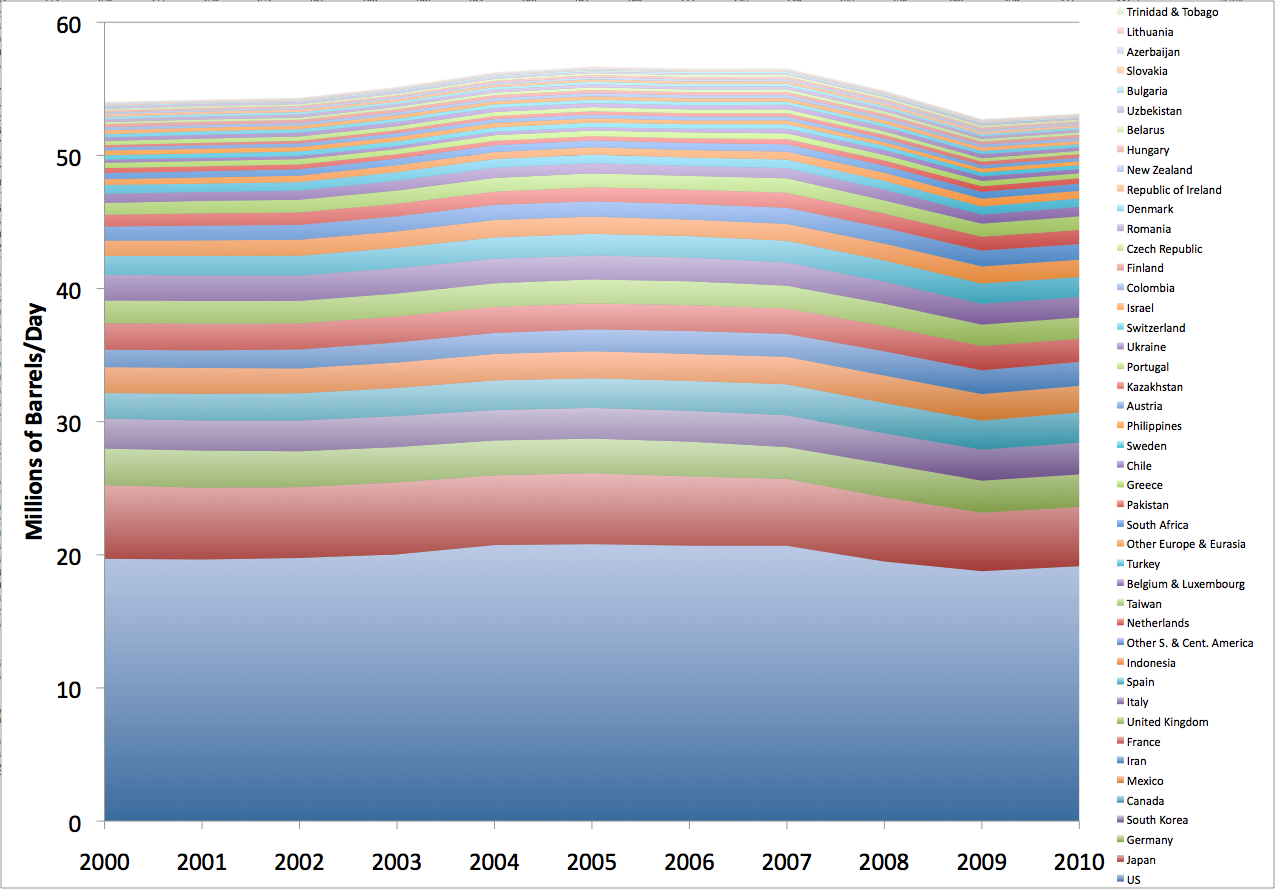
You’ll really need to click for the big version to read the legend, but basically most of the world’s developed countries are there, along with a few badly governed places like Mexico and Iran. The group as a whole peaked in about 2005.
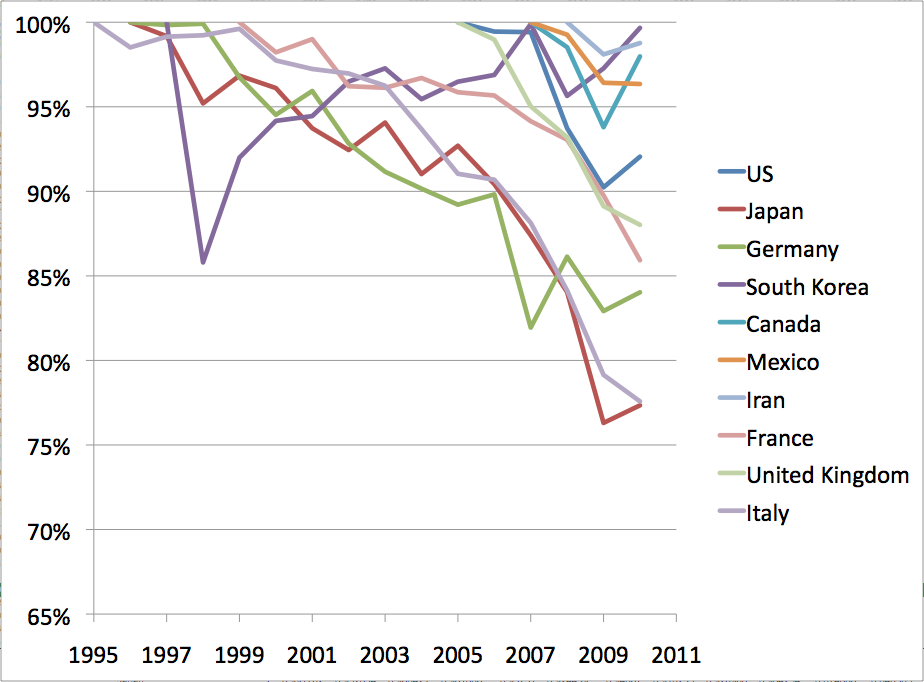
To get a clearer sense of what this means, it’s interesting to take the top ten largest decliners (by 2010 consumption) and plot their consumption post their respective peaks, as a percentage of that peak:
Two countries at least, South Korea and Canada, are likely on the list for temporary reasons and may yet exceed their former peaks. However, most of the rest have probably seen their greatest oil consumption and will need to further contract to make room for the still growing oil consumers.
The earliest to peak was Italy in 1995, with Japan and Germany not far behind. US consumption peaked in 2005. Obviously the story is a little different in each case. In Germany, this is mainly about getting more oil efficient, whereas in Japan there’s a strong component of economic stagnation. In the US, oil consumption only contracted on account of the 2005-2008 price spike and then the recent recession (but I don’t see how it can now exceed the 2005 peak given the overall supply and demand picture).
There are a few points worth emphasizing:
- Peak oil consumption arrives on a rolling basis at different times around the world. It very likely arrived in some places as early as 1995, and some countries will probably still be growing their oil consumption in 2020 or later. So it’s a multi-decadal event that we are somewhere in the middle of.
- 15 years after their oil consumption peaked, places like Italy, Germany, and Japan are pleasant and civilized countries to live in. So while peak oil certainly means higher oil prices, more economic weakness, and more stress on many individuals, it doesn’t have to mean the end of life as we know it.
17 Comments on "Peak Oil is not Synchronous"
ageostrophicwind on Thu, 4th Jul 2013 2:59 pm
Countries like Germany, Italy and Japan reduced oil consumption in an era with oil supply still growing and relatively cheap. If needed, oil could be had, even if at an elevated price. Even today, where oil production seems to be on an undulating plateau, this still holds true, though less so as getting the required supply is now at the cost of someone else being forced to deal with less. When world peak oil occurs, meaning the time when production falls off this plateau and enters a relentless decline, the situation is materially different. The total pie (oil) will be decreasing–any needed oil likely will become an ever greater struggle to obtain. This could translate into much greater hardship for these countries, and of course others, than experienced to date.
TyBurn on Thu, 4th Jul 2013 3:23 pm
On Iran….I don’t argue the badly governed, but the reason it Iran sees declining consumption is our sanctions, not the bad governance. This is an unhappy story for the people of Iran, of course (my wife and children are there right now, visiting family). We should keep in mind that their internal attempts to curb consumption through changes in policy have even been partly successful – prior to the sanctions, their consumption actually went down a tiny bit by intent.
Solarity on Thu, 4th Jul 2013 3:39 pm
“Peak oil … doesn’t mean the end of life as we know it.” A ray of light and reason (with real numbers!) among all the doomers and gloomers.
Hubbard was correct regarding conventional crude, but did not really analyze nor prophesy the overall ‘liquid’ energy marketplace. The various alternatives which are being substituted for oil will probably prop-up the current production-consumption plateau (~93 mbpd) another 10-15 years, to be followed by a slow decline. Consumption in the year 2100 will probably be equivalent to that of 1950, an indication that the ‘liquid’ energy peak occurred around 2025.
keith on Thu, 4th Jul 2013 3:46 pm
To bad about climate change. I guess climatologists are gloomers and doomers as well.
J-Gav on Thu, 4th Jul 2013 4:06 pm
Depends on how you define “Life as we know it.” As net per capita energy available on the planet continues to decline, and its cost continues to increase, certain, hmmm, how shall we put it? ‘lifestyle changes’ will become inevitable. Those expecting a relatively easy time of it until the end of the 21st century (see Solarity’s optimistic view above) may end up eating crow … literally! And yes, Keith is right to point out the potential that a long slow decline in fossil fuel use could well wreak climate havoc in the meantime … unless Svenmark’s Danish team is correct in saying that most warming is not due to CO2 but to solar activity and cosmic rays …
Plantagenet on Thu, 4th Jul 2013 4:21 pm
Italy is indeed a pleasant place to live…..if you have a job.
The unpleasant truth behind the oil consumption numbers is that falling oil consumption is almost always linked with economic stagnation.
Ed on Thu, 4th Jul 2013 5:07 pm
The graphs show how highly correlated the rate of change of oil consumption is to GDP growth. But we knew that already. What else are they telling us? Yawn
Arthur on Thu, 4th Jul 2013 5:07 pm
“15 years after their oil consumption peaked, places like Italy, Germany, and Japan are pleasant and civilized countries to live in.”
Every mountain climber knows that it costs more energy to reach a plateau than to stay on a plateau.
CAM on Thu, 4th Jul 2013 5:21 pm
Since we have yet to reach any significant decline, and are still on the peak oil plateau, it seems somewhat premature to predict that life as we know it will never change!
Laci on Thu, 4th Jul 2013 11:05 pm
The final conclusion of the author, stating that oil consumption may have peaked in many countries, yet they are still nice places to live, is misleading. We have to remember that countries like Germany and Japan are still “nice and pleasant” places to live, because there is still growing demand for products made in these countries, comming from many of the countries where consumption is yet to peak. What would Germany look like, if they were not able to sell more and more audi and mercedes cars, or industrial machinery to increaisngly afluent Asians and Arabs?
poaecdotcom on Fri, 5th Jul 2013 12:26 am
This article is dangerously misleading.
Italy and Germany import energy via finished goods from countries that are increasing their energy consumption.
The second law of thermodynamics makes a mockery of this nonsense.
If you reduce the energy into the system, you reduce complexity .
See how “pleasant” these places would be if they lived solely on their own energy production.
Japan. Pleasantly medieval.
Dmyers on Fri, 5th Jul 2013 12:30 am
The title is a little misleading. This article is about consumption rather than production. The connection isn’t drawn between peak oil consumption and peak oil. That would be an interesting treatment, even if ultimately based only on speculation.
Suffice it to say, however, we can predict that all advancers eventually will be decliners. That seems to be the evolutionary pattern, and the peak consumption curve may align with Hubbert’s curve, but so far as the matter has been discussed, the latter is not a single, direct cause of the former.
BillT on Fri, 5th Jul 2013 5:49 am
Address NET energy today and NET energy 20 years ago, and you will see that we are already on the energy decline. That the energy is now embedded in the goods that are traded around the world is never mentioned. The US energy consumption has not declined as much, if you take net imports into account.
If you subtract the lower energy sources called ‘oil’ today, the numbers would be quite different. We are on the down trajectory.
And, no, we cannot ‘stay on the mountain plateau’ for very long without major energy inputs that got us to that elevation. An asphalt road requires asphalt repairs regularly. We can exist on the old infrastructure for a while, but when it goes, it will NOT be replaced and that goes for technical system like the internet also.
John on Fri, 5th Jul 2013 8:43 am
Interesting post. I wonder how much the economy is a factor. Could you plot the % change in oil consumption vs % gdp change. Also, another plot of interest would be the export trend. And, for the countries that are exporting, you can add in consumption to get a production trend.
Arthur on Fri, 5th Jul 2013 9:37 am
Who needs asphalt and mobilize thousands of tons of steel to use the asphalt road on a daily basis, if you can have glass fiber? The challenge for the future will be to do the same thing with ever less energy, while replacing old fossil sources with solar based sources.
“And, no, we cannot ‘stay on the mountain plateau’ for very long without major energy inputs that got us to that elevation.”
We have new major energy inputs waiting for us around the corner:
http://deepresource.files.wordpress.com/2013/06/renewable-energy-reserves.png
BillT on Fri, 5th Jul 2013 6:14 pm
Arthur, dream on! Glass fiber for roads? Do you know the energy requirements to make glass? Then place it in some kind of mat that can survive freezing upheaval and beating of 40+ ton trucks hauling your windmill parts around the country?
There is over a billion barrels of oil in the roads of the US. Most in the north need resurfacing every 5-8 years to survive. And even more than 5 billion barrels of oil energy in the concrete highways that crisscross most of the world. 20 feet of concrete curbing equals 1 barrel of oil energy equivalent to make the materials and place them.
You can watch all of the techie porn you want but that is not going to make it happen. The human species is like a huge tanker that takes hours and miles to turn around. Getting the consumption engine going took decades and billions of dollars of TV time and Madison Avenue sales gimmicks. It will not be stopped with anything less than a total collapse of everything, making it impossible to continue.
Arthur on Fri, 5th Jul 2013 7:15 pm
“Arthur, dream on! Glass fiber for roads? Do you know the energy requirements to make glass?”
I was talking about ultra thin glass fibre cables, functioning as data highways. Let the concrete and asphalt rot away.
You call it “optical fiber” I see:
https://en.wikipedia.org/wiki/Optical_fiber