
Peak Oil is You

Donate Bitcoins ;-) or Paypal :-)


Page added on December 10, 2015

Peak Oil: are we seeing the real one?

Art Berman reports on his blog the latest data from IEA. These data speak volumes about what has been happening in the oil markets during the past two years or so. The whole thing seems to have gone out of control, with everyone pumping as much as possible, worrying only about harming competitors and without too much concern about the overall disaster caused by overproduction. The excess has stimulated demand, but only weakly. The result has been the collapse of the oil price, that we are still seeing today.
It seems, now, that the market is slowly redressing the unbalance. Demand is growing, and supply seems to have peaked in July 2015. In a few months, we may go back to a situation where demand matches supply, at this point we’ll see prices rising again. We’ll likely see production going down, and the whole system regaining some kind of balance; at least for a while. For sure, the main element in the readjustment is the decline in the production from shales in the US (image from Ron Patterson).
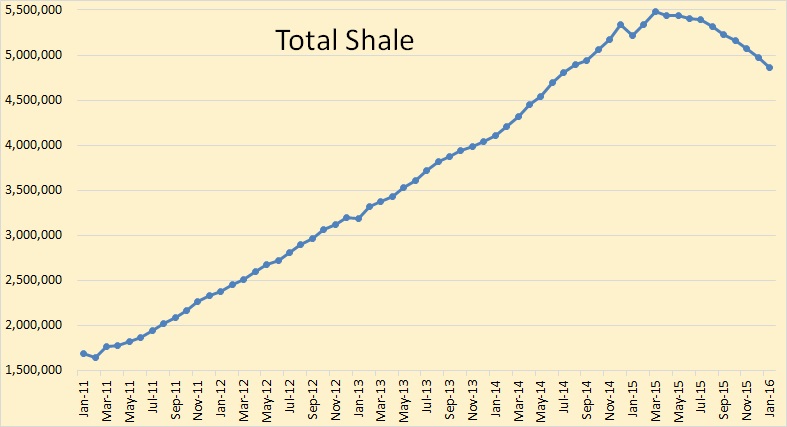
Is the July peak “the” peak for all combustible liquids? We can’t say yet, what we can say is that the period of oil glut has done a tremendous damage to the industry. Perhaps, we are starting right now the terminal decline of the world’s oil industry; but we still have to wait to be sure. Americans, it seems, love boom and bust cycles and, if prices go up again, they might want to pour again money into the shale industry. The only sure thing is that fossil fuels must go, sooner or later.
Cassandra’s legacy by Ugo Bard
21 Comments on "Peak Oil: are we seeing the real one?"
Harquebus on Thu, 10th Dec 2015 6:49 pm
Does not factor the massive amount of debt currently crashing the economy.
We’re goin’ down.
makati1 on Thu, 10th Dec 2015 7:24 pm
We saw the real petroleum peak in 2005. Now we are seeing the peak ‘oily things that burn’.
As for prices:
Too low and the oily system crashes from lack if profit.
Too high and the oily system crashes from lack of able buyers.
The proverbial “Rock and a Hard Place”.
We are in that twilight zone where the oily system is slowing being bled to death and cannot move to save itself, I think. The only question is how long can it last.
twocats on Thu, 10th Dec 2015 7:25 pm
Yeah first of all, that “total shale” chart includes an estimate for Jan 16 so its misleading. Second I’m not disputing that the high cost of oil is not contributing to this financial downturn, but its not the ONLY reason, but on the other hand the ONLY reason oil production is down is the downturn. So a year from now if there is a recovery we could see a new peak. Between 2008 and 2010 wasn’t there like 8 months between peaks or something?
makati1 on Thu, 10th Dec 2015 7:26 pm
LOL. “Slowly” … not “slowing”. I need another coffee.
rockman on Thu, 10th Dec 2015 7:30 pm
“In a few months, we may go back to a situation where demand matches supply, at this point we’ll see prices rising again.” Supply is matching demand today: The world is buying as much $38/bbl oil as it can get its hands on. Just supply matched demand a couple of years ago when the world was buying as much $100/bbl oil as it could get its hands on. The only possible situation when supply can’t match demand is when oil prices drop so low that there are more $’s available to buy oil then the companies can produce.
Otherwise pricing will always modulate the supply dynamic.
Revi on Thu, 10th Dec 2015 7:46 pm
We’ll know in about 18 months if this is the peak. If it is then Ron Patterson gets the glory of having predicted it.
Pete Bauer on Thu, 10th Dec 2015 8:51 pm
In this 96 million b/d supply figure.
How much is Petroleum Coke
3% or 1 million b/d equivalent.
How much is Biofuels
2 million b/d equivalent.
How much is NGL.
10 million b/d equivalent.
How much is hydrocarbons that are used to make plastics.
If you deduct all these things, finally the remaining oil to produce motor fuels may be much lesser.
marmico on Thu, 10th Dec 2015 9:53 pm
Artie Berman is full of shit. Why anyone would pay him a penny for his prognostications is beyond explanation.
He is a major loser on both shale oil and natty gas production. I don’t think that he is a stock picker, but if he is, he would lose twice as much as the average picker.
paulo1 on Thu, 10th Dec 2015 10:07 pm
Stock pricing has dick all to do with valuation or the truth, Marm. You aren’t fit to carry Art Bermans bags and your comments confirm this truth.
Pennsyguy on Thu, 10th Dec 2015 11:08 pm
Good point Pete. Also, oil from the Bakken, etc. is lighter than conventional crude. I’m not sure how that gets handled at the refinery, but I think that its good to mix with the heavy goo from Alberta.
marmico on Thu, 10th Dec 2015 11:16 pm
I sucked so much cock last night that I think I might be pregnant.
Boat on Fri, 11th Dec 2015 1:17 am
Rock
“In a few months, we may go back to a situation where demand matches supply, at this point we’ll see prices rising again.”
Good to see you counteract shorts narrative that low prices are here to stay, will deteriorate farther and cause world collapse.
The world is buying as much $38/bbl oil as it can get its hands on.
So why is oil at a low price still being stockpiled? Maybe the glut that is happening is because there simply isn’t a big enough market to absorb the oil being overproduced. That’s why prices drop driving out high cost producers. IMHO
Boat on Fri, 11th Dec 2015 1:31 am
catsman,
but on the other hand the ONLY reason oil production is down is the downturn.
Then why is oil consumption world wide up. Why is growth/world GDP up. The drop in US oil production is simply being replaced with oil around the world with cheaper development and production costs. Repeat, there is no slow down in world consumption. Doomers have trouble with this fact for some reason.
Davy on Fri, 11th Dec 2015 4:08 am
It is funny how we routinely have these conversations. Oil consumption is up but below par. World GDP is up but below par. I might add with world GDP there are many who question the numbers as massaged and manipulated. There is a minimum operating level the global system runs on for health. Without adequate growth we see bad debt. There is questions with the quality of growth we have and had. This is especially true out of the two largest economies.
The malinvestment and over capacity especially in China is legendary. Much of this should be realized bad debt. Instead the can is kicked down the road with debt being repriced or shifted to different sectors. Rehypothecation is a further issue with collateral guaranteed multiple times. Bubbles in markets and the US debt and dollar based easing is further distorting true price discovery and value considerations.
Oil is a foundational commodity with multiple demand drivers. Demand is up because population is up and global populations are aspiring to greater material affluence. A significant amount of this population and affluence is debt driven and oil is part of this. Prices are low which has picked demand up. Oil demand in and of itself does not mean economic health.
Low prices are not a good thing at least not as low as they are currently. We should not have a foundational commodity in such destructive demand supply dynamics. When everything about our global system is based on oil this is a ticking time bomb especially considering deletion and the shrinking EROI of oil sources.
We have come to believe in economics and markets for our survival but we don’t follow what we preach. Normal price discovery has been trumped by central planning. The central planning is increasingly morally hazardous with wealth transfer effects and the deterioration of the public private divide. All this is a sign of decay not development. Growth that is not healthy is just another world for decay. Cancer is like this.
Basing good or bad decisions on an abstract rate that is up or gas prices that are down does not capture the true picture of what is going on. These are very short term indicators. We have been habituated by trends. We extrapolate future trends as if they are governed by a natural law of human growth and development. We must look deeper than short term manipulated and increasingly unreliable numbers.
Global growth is increasingly unsatisfactory in relation to economic conditions. Currently debt is an issue. Growth is the problem with our ecosystem with pollution and climate instability. Oil consumption is rising but not enough to maintain the oil complex at levels needed to ensure long term growth exhibited by less than adequate prices. If prices rise enough we will have recessionary pressures. Deflation is already an issue.
We appear to have a compression of supply and demand with oil. This could become hazardous if basic demand is not met. When I say basic demand I mean what is needed to run the basics of the minimum operating level the global system must maintain. I am speaking of the food chain, distribution, extraction, and production. Our financial system must maintain liquidity and confidence in that liquidity. All these attributes of a modern complex system are under compression. Growth in oil consumption and GDP does not adequately capture good or bad in this respect.
shortonoil on Fri, 11th Dec 2015 7:46 am
From the cassandralegacy.blogspot.com
“Yes, I knew that site. It is a straightforward application of the concept of EROEI. Seems to be good work, although I never resolved myself to pay the 38 euros for the full report”
Mr Bardi is under the impression that the Etp Model is an application of the ERoEI concept. It is not; it is the solution of an equation. The “Entropy rate balance equation for control volumes” as applied to petroleum production. We have forwarded to him a copy of our report.
http://www.thehillsgroup.org/
shortonoil on Fri, 11th Dec 2015 8:30 am
The world’s petroleum producers passed the point of maximum sustainable production where all of their production could be used as an energy source in 2012. That was the energy half way point. Excess production beyond that point has resulted from the cannibalization of the energy embedded in existing infrastructure. That process has manifested itself in the economy as debt formation. When the monetary/ financial system can no longer absorb this accumulating debt – production will fall. That will also represent the onset of a major crisis in the world’s monetary/ financial system. The Central Bank structure of the present system is likely to fail.
http://www.thehillsgroup.org/
rockman on Fri, 11th Dec 2015 10:53 am
Guy – “Good point Pete. Also, oil from the Bakken, etc. is lighter than conventional crude. I’m not sure how that gets handled at the refinery, but I think that its good to mix with the heavy goo from Alberta.” Just a minor picky point. I’ve produced many conventional reservoirs with mush higher gravity oil then the Bakken. But perhaps you define “conventional” different than the oil patch does. We don’t have “conventional” or “unconventional” oil…we have conv3ntional/unconventional RESERVOIRS that can produce anything from very light to heavy oil.
FYI: as far as how refineries handle different gravity oils: for decades refiners have processed “bended oils” with a rather narrow range of weights: 31 API to 33 API. The gravity isn’t the only metric they use but it dominates. Until the shale boom in the Eagle Ford with its light oil production Gulf Coast refineries had to import a lot of light oil to blend with our heavy oil imports. Which is also the reason east coast Canadian refineries have been importing 50K to 100k bbls/day of Eagle Ford production for a number of years.
shortonoil on Fri, 11th Dec 2015 1:32 pm
Baker Hughes just reported that the rig count fell 21 last week. WTI hit $35.67 and the bond market, both junk, and HY is getting hammered. Currencies of oil producing nations all over the world are in free fall. The Petrodollar is strengthening, making it more difficult for domestic production to compete with foreign oil. Falling price, and the strong dollar are likely to be the last nail in the shale oil coffin!
shortonoil on Fri, 11th Dec 2015 2:28 pm
“So a year from now if there is a recovery we could see a new peak. Between 2008 and 2010 wasn’t there like 8 months between peaks or something?”
Oil prices have been in decline for 19 months, the longest, and biggest downturn in history. Petroleum powers 38% of the world’s GDP; from its production, and end user consumption sides. When oil goes down, so does GDP.
The underlying reason is that petroleum’s ability to power the economy is declining, as it does the economy will decline. It doesn’t seem likely that there will be a recovery in the near future unless some substitute for petroleum is found. That doesn’t seem likely either.
joe on Fri, 11th Dec 2015 4:03 pm
Demand may rise, but prices may not. Interest rate rises will dampen the credit markets, tight oil will become less profitable but who knows how things will change. The commodity/construction /services economy driven by oil is likely to end but if the process begins who knows where it will end. The real trouble is that in a post industrial economy commodities won because we had more time to consume, not having to work in factories. In the post oil economy, transportation and services are not demanded or not supplied but with energy localised and coming mainly from local schemes and transport becoming mainly costed against the harm it does to the earth then it’s price will diminish in line with its role. The real issue in the next 100 years is how to manager population, which is as big a ticking timebomb and is likely to prove to be as harmful to our future as GW if we are to attempt to live without oil.
antaris on Fri, 11th Dec 2015 4:09 pm
Joe. Population climbed because of oil and when the oil declines, so will population.