
Peak Oil is You

Donate Bitcoins ;-) or Paypal :-)


Page added on December 2, 2010

Peak oil and the end of growth: we need to start planning now
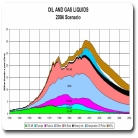
A few weeks ago, the International Energy Agency (IEA) released its World Energy Outlook 2010. The IEA is an organization established by the Organization for Economic Co-operation and Development (OECD) in 1974.
For the first time in its history, the IEA admitted that crude oil production (conventional oil) peaked in 2006 and will never ever grow again.
It also projected that the bulk of any new crude production needed just to compensate for the depletion of existing fields will come from fields “not yet discovered.”
That’s the good news!
The bad news is that the IEA is notorious for overstating its energy resource projections, often bowing to pressure from some of its members who fear market panic.
What cannot be overstated, however, are the massive implications of this peak in oil extraction.
First, you can expect sky-high oil prices in the not too distant future.
Of course, that will be painful at the pump. But it’s just the tip of the iceberg.
Think about it. Most food we eat today traveled from far away on fuel-propelled machines.
Petroleum products are used in the production of everything we wear, from our sunglasses to our shoelaces.
More expensive energy will make it harder to run our hospitals and our schools, heat our homes, let alone enjoy our yearly winter vacation in sunny Varadero.
Just about every thing we do and consume on a daily basis will be dramatically more expensive.
But actually, might it get more profound and complicated than that?
Might Peak Oil spell the end of growth as a political, economic and social goal?
Let me try to explain.
We have become increasingly aware that there are fundamental constraints to ongoing economic expansion, that perpetual growth on a finite planet is a fool’s dream.
If Peak Oil is here – and there is solid evidence showing that it is – then it means we have begun to run up against the planet’s natural constraints. Mother Nature has begun to tell us that the party is over.
It’s an uncomfortable thought, but one that can no longer be ignored.
We can no longer assume that decades of economic and population growth based on ever-increasing rates of resource extraction, manufacturing, and consumption can continue.
We can no longer assume that the systems we have built for a “growth economy” will work in a “no-growth economy.”
Take our monetary system.
For decades banks have lent more money than they have on deposit on the assumption of continuous economic growth. In essence, the collateral for today’s debt is the promise of increased future growth and wealth.
But what if the economy can’t expand because of limited energy resources?
Globally, debt obligations will then have to be increasingly met by default, resulting in the collapse of a fragile world monetary system.
What you are reading these days about Greece and Ireland may very well be the start of that process.
Peak Oil is a problem like no other.
It can’t be fixed by politicians, which probably explains why few dare to talk about it.
It can’t be fixed by the oil market itself, because the laws of supply and demand are no longer valid in that market.
It is truly a game-changer.
The first step in dealing with Peak Oil is to acknowledge its existence.
Communities that are quick to recognize the problem stand a better chance of weathering the storm.
Then, we need to start managing the risks.
We need to find ways to dramatically reduce our dependence on fossil fuel energies, start promoting local agriculture, alternative methods of transportation and energy efficiency.
Bottom line: we need to build our community’s capacity to adapt to a very different world.
Given what we know now, any discussion about the future of our community or our province that does not take into account Peak Oil is a misguided discussion.
5 Comments on "Peak oil and the end of growth: we need to start planning now"
KenZ300 on Thu, 2nd Dec 2010 10:49 pm
The global economy was built on cheap energy (oil) and as the price begins to rise that will change how we view the world economy. No longer will it make sense to ship goods around the world if they can be produced closer to the point of use.
We will once again be looking to develop sustainable communities with local labor producing local energy and local goods and services.
We need to begin this transition before it is thrust upon us by high energy prices and limited resources.
It is time to transition to clean, sustainable alternative energy. Wind,
solar, geothermal and second generation biofuels all need to become a bigger part of the energy mix.
It is time to end the oil monopoly on transportation fuel. Bring on the electric and flex-fuel vehicles.
Ron Wolfe on Fri, 3rd Dec 2010 6:15 am
So why is fuel still so inexpensive in the US?
For 30 years prognosticators have been touting the depletion of a finite supply of oil yet, in real dollars wee still pay less than we did in the 1980s.
Given increasing world-wide demand for oil and the fact that most of our oil is imported why is we still pay less than most other countries?
Marilyn Gayle on Sat, 4th Dec 2010 1:12 am
Hemp:
Marijuana was criminalized so that hemp could not compete with:
Oil (fuel and fiber)
Cotton (fabric)
Timber (paper)
Other countries are beginning to realize the many uses of hemp, while the world’s greatest polluter, the US, with its military entirely at the service of big oil and entirely dependent on petroleum to function, will eventually become a layer of dust in one narrow geological stratum of history. l
erichwwk on Sat, 4th Dec 2010 7:59 am
For an alternative try this:
http://www.democracynow.org/2010/11/26/chilean_economist_manfred_max_neef_on or
KenZ300 on Sun, 5th Dec 2010 5:27 am
Sustainable communities — producing local energy, local food and local jobs.