
Peak Oil is You
Donate Bitcoins ;-) or Paypal :-)


Page added on January 12, 2012

Peak Oil’s Impact: Holiday/Family Dinners
The (I hope) festive holiday season is once more in our collective rearview mirror, and we all now eagerly await the return of spring and the good feelings the change to warmer seasons always seem to usher in.
Most of us probably spent at least a brief period of time celebrating the holidays and (again, I hope!) enjoying our time with family and friends. Surely a good majority of us enjoyed a home-cooked meal or two at some point in these last seven or eight weeks….
What does this have to do with Peak Oil? Everything has to do with Peak Oil one way or another, and family meals are no different.
Another safe assumption I’ll offer up is that the home-cooked meals—be they simple all the way to extravagant—involved an electric or gas appliance or two. Pots and pans? Utensils and plates and cups? Travel to one or more stores and grocers to get all the fixins’? Air or car travel involved? And how about leftovers?
I doubt my family get-together was even marginally different than most of yours in those regards. One of our children drove up from her apartment some fifty miles away from us on four separate occasions. Another traveled back from college in New York on three separate occasions (via Amtrak). Our youngest was home on leave from the U.S. Army via a flight from Down South. He made two round-trips home in the last six weeks of 2011.
There were more than a few family/friend gatherings during that period. Lots of cooking, cleaning, eating (dining out, too) and leftovers. Sound familiar?
Not one single meal—purchase, prep, consumption, or “doggy bag”—and not one entrance into our home happened without some measure of fossil fuel usage. The multiple trips to grocery stores, drives back and forth from apartment to our home, travels to and from other states, pickups and drop-offs at Amtrak stations and Logan Airport, meal preparations, products used, re-used, and disposed of, leftovers packed away … all of that required that we use and consume some small and not-so-small amounts of oil and gas.
I’m sure I was the only one in my family who even once considered that fact, and even then I can’t say I spent much time contemplating it. I’m willing to wager a fair amount that the significant majority of readers paid that truth not even a second’s worth of attention. But it is the truth.
The farmers and others who provided the food and drink (along with the chain of suppliers who enabled them to do so in the first place), the transportation systems employed to get Seed A to Table B and all the interim phases and personnel … each and every one of them made some small or not-so-small use of fossil fuels as well. The manufacturers of the appliances and dishes and utensils we used, and the manufacturers of the machinery which allowed the manufacturers of the appliances et al to do their thing … they used fossil fuels, too. The plastic bags and Tupperware and Rubbermaid containers we all made use of liberally … same deal.
I could go on, but the picture should be fairly clear right about now. A lot of people required to make each family meal an enjoyable reality, and a lot of fossil fuels consumed along the way.
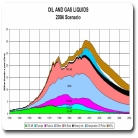
As I and others even more knowledgeable than me have noted before and do so once again: Oil production worldwide peaked in the middle of the last decade. Whatever supplies are left for us all to acquire and consume will surely cost more (and guess who pays?). The easy stuff is pretty much gone now, so what we are going to use will take longer to get from there to here. A lot of it won’t be nearly as efficient as good ole’ crude oil. That’s just for starters.
If supplies are about as good and plentiful as they’ll ever be from now on—soon enough embarking on an irreversible downward slide—what happens?
How many component manufacturers and suppliers in the chain of food and beverage production are going to find their capacities adversely affected when the fossil fuel supplies each and every one them needs is either restricted occasionally or frequently? Costs will rise, so that won’t help much. How many shortages of this or that item start cropping up, with no reasonable substitute waiting in the wings? Which transportation system finds itself lacking adequate supplies of fuel to meet demand?
What happens to our holiday family travel and dining plans as a result?
How many workers up and down the chain will lose their jobs because employers cannot meet demand and/or have lost business because resources and supplies simply aren’t available?
Of course, we could just decide that food and air travel (much more expensive, undoubtedly) are to be preserved as priorities no matter what (food … okay; air travel?).
Of course, that will require we collectively decide that something else will have to bear the burdens of less….Won’t that be fun!
3 Comments on "Peak Oil’s Impact: Holiday/Family Dinners"
sunweb on Thu, 12th Jan 2012 1:37 am
It blows my mind how much fossil fuel we use. On television, you see sea ports with thousands of shipping containers. Containers as far as the eye can see, stacked four, five, six high. Huge cranes. Huge ships. I mean HUGE ships. And you see pictures of cities all over the world with thousands, millions of cars. And you see pictures of the earth lit up at night across the northern hemisphere.
This essay with pictures supports your questions about our willy nilly energy use. The pictures of stadiums are stunning.
http://sunweber.blogspot.com/2011/11/saving-energy.html
Kenz300 on Thu, 12th Jan 2012 2:11 pm
How much energy could be saved if we turned off some or most of those lights from 3 am till 6 am? I have read of cities disconnecting their street lights because they can no longer afford to pay the electric bills. As the price of energy continues to rise we will all be looking for ways to save money and energy.
Stephen on Thu, 12th Jan 2012 6:52 pm
Maybe travelling by train and boat will become popular again and with less work in the workforce, this may mean longer vacation time to accomodate the slower travel methods.