
Peak Oil is You

Donate Bitcoins ;-) or Paypal :-)


Page added on April 18, 2013

Peak Everything Prophet Downgrades Peak Oil?
Jeremy Grantham is a fascinating dude. He is a highly successful capitalist who blames capitalism for killing the planet. If you’re familiar with this “connoisseur of [market] bubbles,” as the New York Times referred to him in a profile, it’s probably due to his increasingly Malthusian outlook. In 2011, he warned that “accelerated demand” from developing countries was depleting the earth’s natural resources. He declared that we “now live in a different, more constrained, world in which prices of raw materials will rise and shortages will be common.”
This resource depletion (peak everything!), combined with global warming, poses an existential threat to civilization, Grantham argues. Though some of his recent peak claims have been questioned by experts and ridiculed by pundits, his message has deeply resonated with greens, peak oilers, and climate activists. Two years ago, climate blogger Joe Romm wrote of Grantham:
He is one of the few leading financial figures who gets both peak oil and global warming.
Those two concerns competed for our attention during the 2000s. Now it appears that one of them has been downgraded in threat level, even by Grantham, who said this week in a Guardian interview:
Don’t worry about peak oil, worry about peak temperature.
I’m not sure if he was being facetious or just emphasizing climate change as the greater and more immediate threat. In any case, Grantham says a lot of interesting things in that interview, among them his belief that China will ride “to the rescue” with its massive investment in renewable energy technology. The thinking here, I guess, is that a Chinese breakthrough in clean energy will spell the end of fossil fuels and save us from a climate disaster.
But even if that comes to pass, what about Grantham’s other main bugaboo: resource depletion? After all, as he wrote in his latest quarterly newsletter, there is still capitalism’s growth paradigm and the aspirations of the developing world to contend with:
You don’t have to be a Ph.D. mathematician to work out that if the average Chinese and Indian were to catch up with (the theoretically moving target of) the average American, then our planet’s goose is cooked, along with most other things. Indeed, scientists calculate that if they caught up, we would need at least three planets to be fully sustainable.
Yes, the idea of the average Chinese and Indian sharing the same fruits of the planet as Grantham should give us pause. Can you imagine if everyone in the developing world got three square meals a day, an air conditioner and a flush toilet? After that, they’ll be wanting a car and some recreational income to fly to Disney World. And just think how bad things would get if some of these people wanted to live like a wealthy Malthusian:
Grantham leads what he calls “a reasonable fat-cat existence” — 10-year-old Volvo station wagon, 40-year-old 12-foot Boston Whaler, a country place near the ocean.
What if even a tiny, tiny percentage of Indians or Chinese had the carbon footprint of fat-cats? Our planet would be ruined.
23 Comments on "Peak Everything Prophet Downgrades Peak Oil?"
BillT on Thu, 18th Apr 2013 11:39 am
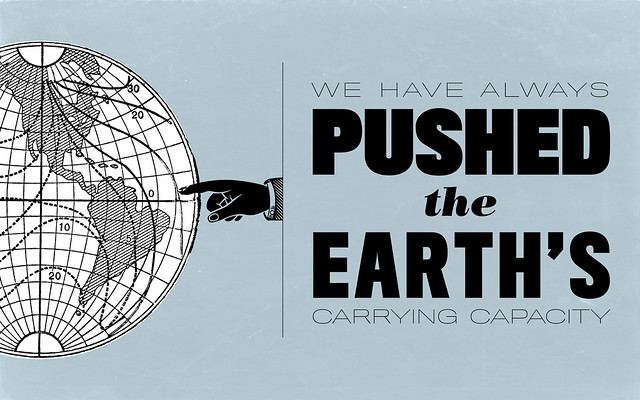
A lot of misleading statements in this piece of BS. From the title above to the claim in the image. Clever use of ? and the word ‘always’. I saw nothing downgrading peak oil. And we have NOT always ‘pushed the earth’s carrying capacity’. In fact we were doing ok up until about 150 years ago when oil was discovered. THEN we started pushing.
Arthur on Thu, 18th Apr 2013 11:43 am
Grantham is right, there is no immanent peakoil catastrophe looming. Even the worst energy pessimists, those of the Berlin based Energy Watch Group say: peak energy 2018 and in 2030 the world will ‘fall back’ to 2005 levels. That’s not good enough for the Four Horsemen to go for a ride. At university I learned that western society can continue by and large it’s old ways, if it has only 50% of it’s energy available, by simply applying ‘fascistoid’ methods of energy saving, switching to low energy vehicles, double glass, switching lights off, etc., etc. That was 1980. In the mean time we finally see rapid introduction of renewable energy happening. It is too late to fully compensate the retreat of fossil fuel after 2018 and the car and aviation are likely going to be the first victims of the coming inevitable energy crunch. So what? The future is going to be one with a lot of low energy footprint microprocessors and other solid state technology and few combustion engines.
DC on Thu, 18th Apr 2013 12:41 pm
Discover truly is the national enquirer of science ‘journalism’.
Q/In 2011, he warned that “accelerated demand” from developing countries was depleting the earth’s natural resources
It really does not get worse than that. To suggest its the 3rd world that are responsible for what we see around us is amerikan-grade ignorance. “We” are the ones creating mountains of plastic trash,discarded food and leaking oil like there is no tomorrow. Amerika garrisons to world with its corporate serf-soliders for the sole reason of safeguarding the transfers of resources from ‘them’ to ‘us’. Yet this trash article repeatedly suggests the ‘Chinese’ are principally to blame.
The take away message is, only amerika is entitled to squander the planets resources, that fact does not even rate a mention. BUT, if someone in China wants a vacation or an A/C, then its they who are the resource depleters.
See how it works?
BillT on Thu, 18th Apr 2013 2:17 pm
“… The future is going to be one with a lot of low energy footprint microprocessors and other solid state technology and few combustion engines …”
Really? And how is this going to happen? Who will have the money to buy them even if they are somehow manufactured? After all, those millions of wind mills and thousands of square miles of solar panels are going to eat up a lot of energy that they produce just to replicate themselves. So where is the money/energy coming from to haul components around the world for this other techie junk?
You are assuming that the internet is going to exist outside of military use. That Facebook and Google are going to be there? That Microsoft and Apple, etc. are going to exist. That even GE or any other huge corporation will/can exist in such a significantly reduced energy level economy. I think you are in for a very hard let-down in the next 20 years.
DC on Thu, 18th Apr 2013 2:46 pm
I understand the point your trying to make Arthur, I really do. But there are a few problems even with your view on electronics. The (real) fact is, the electronics industry has huge footprint, but even worse, it also generates jaw-dropping amounts of toxic waste. I say with some experience. I fix the things and for the last few months Ive been working part-time 🙁 basically hauling e-waste from work to the waste center. PC’s printers, media, you name it. All built up over time from just one tiny company in a nowhere town in N.A. Ive probably easily hauled over a ton(or two) of obsolete tech to trash alone, with more still to come.
Its true some devices DO consume low power-but are massively energy hungry to produce. The other problem is the same one we have everywhere, our tech is not to built to last anymore than our crappy cars or matchstick homes-or anyting else we buy. In principle we could build solid state devices that last for decades with far less degradation than is typical now, but of course we dont. The monster footprint of solid state tech would be far less of an issue if things were built to last decades, but not when they designed for a 3 year product cycle-or less.
When we get into the big league tech contractors and suppliers, the amount of waste they generate, much of it still useable or repairable(buy is often just disposed of), is truly immense. I was struck by how much my tiny company had on hand to dispose of,let alone what the ‘big’ guys have to deal with.
Mike on Thu, 18th Apr 2013 3:24 pm
We’re on the bumpy plateau and things are already horrific, once we start down the other side hang on to your bottom holes.
J-Gav on Thu, 18th Apr 2013 3:42 pm
Neither peak oil nor climate change have disappeared as major concerns, just like biodiversity loss, pollution and water/fishery/ general resource and soil depletion are. The next financial collapse will take some of the starch out of oil demand, perhaps delaying the big energy crunch for a few more years. The effects of climate change, year-to-year, are unpredictable but promise to be costly and locally lethal. The absence of an informed citizenry and the prevailing, mind-boggling lack of preparedness (as in a plan A, B or C!)given the unprecedented challenges we face, may yet make Malthus look like a lunatic optimist.
Meanwhile, we’ll continue to poison ourselves with our pesticidal, chemical, radioactive, heavy metal garbage … until … what? Revolution? Die-off? World War III? No matter how you slice it, not a pretty picture for the coming generation(s). Get out of dense urban centers, asphalted suburbia/exurbia, somewhere near a small town with arable land, a railroad and/or canal system and people who have maintained some sense of community. Develop basic skills – mechanical, electrical, communicational, building …That’s the best advice I can give for anybody who wants their children to have a fighting chance.
Arthur on Thu, 18th Apr 2013 4:21 pm
The reason why generations of electronic devices have an average lifespan of three years is of a) the speed with which technology progresses (hardware + software) and b) the amount of money the average westerner had until very recently to follow all these trends. I must have spend at least 30-40k euro on all these devices since my first 1982-Commodore64. Only a Sony Vaio laptop went kaputt after three years and I did not bother to let it repair as I already had set my sights on something better. Last month I cleared out the attic and discovered an old Philips tube radio of at least 45 years old… switched it on and it still worked. A few years ago I visited Havana-Cuba and was amazed by all these huge American cars from the **fifties**, still driving around.
I understand what DC says about electro-junk, but that all sounds like already obsolete stuff, like old monitors, printers, 15 kg desktops with loud ventilators. The ipad weighs ca. one kilo: aluminium back cover, glass plate, battery and a ‘mother board’ with a few chips, that’s it. A car weighs more than a ton, 1000 times the amount of material and 10,000 the energy consumption; they are finished. Desktops are on the way out now and are being replaced by in high tempo with tablets, which is good enough for consumers. Meanwhile is the replacement rate for PCs going doen: in Holland 40% of the corporate PCs still run on XP… because there is no real incentive to upgrade fast.
Bill, you keep assuming that money will be a driving factor in deciding if society in future will be able to afford electronics. It won’t. The largest factor in price is labour cost, nothing else and wages can vary. If a skilled IT worker has the choice to earn 1000$ rather than 5000$, like he used to, or become unemployed without benefits (like after a dollar crash), he will chose to continue to work and society will have electronics at it’s disposal after all.
Roberto on Thu, 18th Apr 2013 4:29 pm
Arthur is right. Automation and nanotechnology assemblers will overturn the conventional economics of manufacturing and food production.
Labour costs will account for less and less of the cost of production, which means that more people will be unemployed.
The rapid decline in populations in developed countries will only accelerate as young people cannot find work or start families.
Arthur on Thu, 18th Apr 2013 5:02 pm
Talking about Boston… what an event. Not the three people that died, that happens in every hospital every day, but the near certainty that this is yet another staged event… in the igadget/internet age!!! The guy with the black rucksack, is he already safely back in Tel Aviv? What a posse.
GregT on Thu, 18th Apr 2013 5:36 pm
J-Gav,
Totally agree, except for the timeline. We are all going to be in for a great deal of hurt, well within the next 2 decades. Get out of the cities now, and learn how to be self sustainable. iPads, desktops, and PC’s will not grow your food for you.
The largest factor will not be labour costs, and money and jobs will be irrelevant, in a society with a much reduced energy input. Cheap energy brought us the technology, that mass produces our food and allows us to extract the resources required to keep us all in jobs. Technology did not create energy, and it only allows us to deplete non renewable resources faster. When those resources are no longer viable, society will fall apart. It has already begun, and it will unravel much faster than most realize.
Arthur on Thu, 18th Apr 2013 6:15 pm
“Cheap energy brought us the technology, that mass produces our food”
The US produces enough food for itself plus a lot of exports… with how many people? 2%? There will be enormous potential for armies of unemployed to find employment in agriculture.
Science sans conscience on Thu, 18th Apr 2013 6:23 pm
This little HDMI key can run Ubuntu and it consumes less than 2 watts.
http://goo.gl/4vCPM
So it’s possible to run a personal computer with very little power, but not really the monitor.
GregT on Thu, 18th Apr 2013 7:05 pm
“There will be enormous potential for armies of unemployed to find employment in agriculture.”
Exactly. Just as it always was for tens of thousands of years, pre-modern industrial society.
Arthur on Thu, 18th Apr 2013 7:51 pm
Exactly. And when they come home at night from the Kolchoze, Kibbutz, or whatever these collective production facilities are going to be called in the future, they will be watching the nine o’clock news on their tablets and play a game of Wordfeud with a cousin in Europe, before going to bed early.
Provided of course that it was a sunny day.
GregT on Thu, 18th Apr 2013 8:03 pm
Perhaps, once we figure out a way to synthesize all of the raw materials and energy required to manufacture said tablets. Or maybe some of the small percentage of humans left will able able to carve them out of the wood they don’t need for cooking and heating.
Arthur on Fri, 19th Apr 2013 9:39 am
With our fossil fuels reserves we can either continue driving for 2-3 decades or switch to an IT-infrastructure for 2-3 centuries, eliminating the need for driving to search for stuff, to travel to familymembers (when I skype with my brother I see him in more detail than I would care for.lol). It is amazing how well for instance sites like marktplaats.nl work to get rid of old skates, furniture, gadgets, books, etc., etc. And walk to a local collectivist agrarian production facility for a few hours per week and come home with a bag full of potatoes, apples, carrots, cabbages, eggs, milk and other barter stuff. And back at home use IT to exchange this stuff in no time against other values. IT enables total market transparancy and consequently maximizes efficiency. You can even take a picture of your apples before you barter them.
BillT on Fri, 19th Apr 2013 12:51 pm
Dream on Arthur, dream on. Denial blinds you to the truth. I don’t think you have any idea of what is coming. You don’t appear to have enough life experience to see that all of this tech is a mirage, soon to be wiped out by reality. You hold something on your hand and think it will go on forever. You are not taking into account that it exists only because 1,000,000,000 people have excess money to buy it. That market is shrinking daily. It ALL exists because there is still excess money/energy to make and sell it. Not so in the future.
jeyeykei on Fri, 19th Apr 2013 1:17 pm
In a flash all of these things will be gone…like a thief in the night.
Arthur on Fri, 19th Apr 2013 2:20 pm
Bill and other dogmatic doomers simply can’t count. An average car consumes 10,000 times the amount of energy during operation than an e-gadget and 1000 times as much during construction. Even a baby can figure out what is going first and what last as a consequence. On top of that they keep seeying these devices as play-consoles rather than efficient means of communication, information distribution, cloud-based working, educational devices and greasing of market processes.
“You don’t appear to have enough life experience to see that all of this tech is a mirage, soon to be wiped out by reality.”
Or you are too old to keep up with latest developments. Even Richard Heinberg does not rule out that the internet could keep playing a role in the future.
I am always amazed at the cultural implosion of Euro-America. The last time I saw a cocky optimistic self-confident American was in the eighties, and I have met and worked with many of them. Today many of them are entirely nihilistic and WANT to the world to go down, probably because they instinctively feel that a USSR 2.0 is next for them.
http://tinyurl.com/bqg4yab
energyskeptic on Fri, 19th Apr 2013 6:54 pm
I make the case in “Peak Resources and the Preservation of Knowledge” that microchips will be one of the first technologies to go at http://energyskeptic.com/preservation-of-knowledge/
Two excerpts that are at the heart of this argument (if you don’t have time to read the full article) are:
http://www.resilience.org/stories/2006-08-10/fragility-global-trade-and-infrastructure
http://www.resilience.org/stories/2006-08-10/fragility-microprocessors
Arthur on Sat, 20th Apr 2013 8:27 am
@energyskeptic “I make the case in “Peak Resources and the Preservation of Knowledge” that microchips will be one of the first technologies to go”
Your argument against microchips is based on the assumption that globalism is a necessary precondition for production. It is not. Microprocessors today are indeed build in a globalist environment, but that is not necessary.
“If you were shrunk to chip size and tied to a wafer, you’d go through the car wash from hell.”
Nowhere do you attempt to quantify the amount of energy necessary to produce microchips. Numerous companies all over the world have mastered the process and there is no reason to assume they will fail to do so in the future. We need to make hard decisions and decide to dump the car and most of the oil companies and steel companies and asphalt companies that come with it. Once they are ‘wiped of the map’, there will be enough energy available to operate the clean rooms, as before, and build a new localized society, based on one of the most energy efficient technologies around.
dashster on Mon, 22nd Apr 2013 1:11 am
I think it is much smarter to believe in endless everything. That way you are blissfully happy until something peaks.