
Peak Oil is You

Donate Bitcoins ;-) or Paypal :-)


Page added on August 9, 2014

Peak Driving
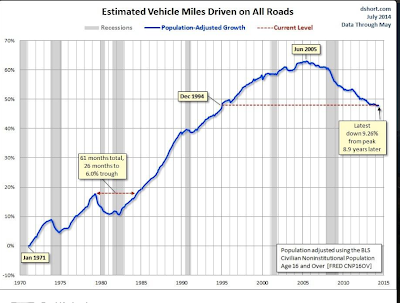
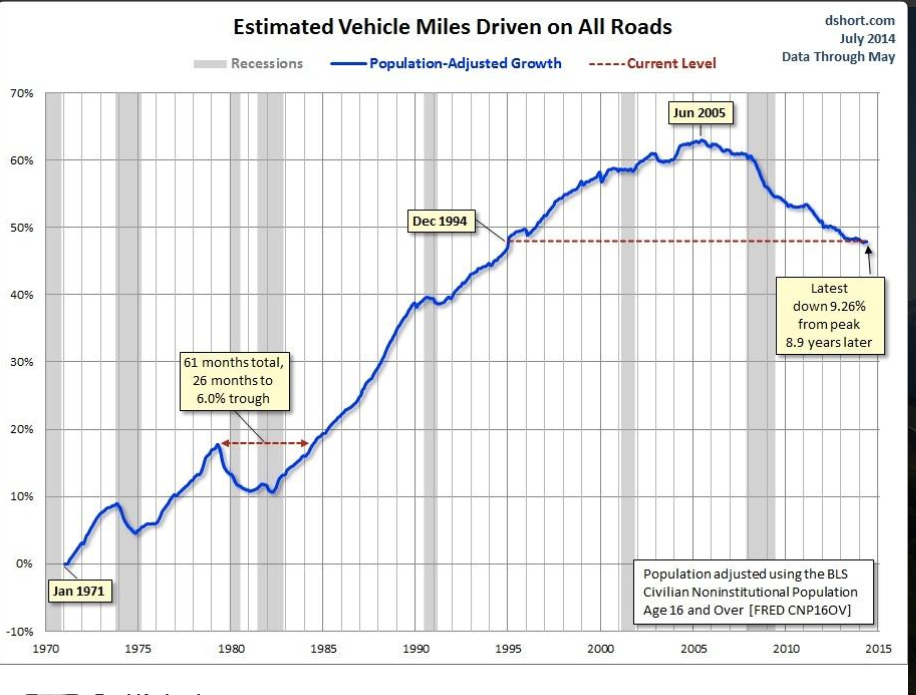
Pundits have talked about peak oil and peak water, and peak nearly every finite resource. A peak in certain behavior is suggestive of a potential social shift. Paul Kedrosky at Bloomberg tweeted this Great Graphic from dshort.com. It shows the change in miles driven by Americans adjusted for population. It peaked in June 2005, and has since fallen a little more than 9% to return to levels last seen in 1994.
This decline in miles driven is the largest since the time series began. It has already considerably longer than the pullback seen in the late 1970s/early 1980s. The magnitude of the reduction is also 50% larger. It is also telling that the decline has continued through the economic recovery.
My longer-term work is predicated on the 19th and early 20th century insight that there is a fundamental contradiction at the heart of market economies between the forces of production and social relations. When the contradiction becomes acute, social relations are transformed. Just like social relations changed after the Great Depression, my work finds that social relations are already changing. These include gender relations, the relationship between the sovereign and the citizens and employers and employees.It is not simply that the crisis causes the transformation of relationships, as many were already changing. Rather the crisis may help expedite or help shape those changes. The essays exploring elements of these theme can be found by clicking on the Noteworthy Posts button on the top of the blog.
13 Comments on "Peak Driving"
Makati1 on Sat, 9th Aug 2014 7:16 am
In my ~50 years of car ownership, I figured I drove at least one million miles or 38 times around the world. I don’t even want to think about what it cost me over those 50 years. Now I walk, ride a taxi once a month and fly to the US once a year. The last year I drove, the government was giving a tax deduction of about $0.50 per mile. Now I can fly half way around the world for $0.08 per mile. And, I do NOT miss owning a car.
eugene on Sat, 9th Aug 2014 7:39 am
What “economic recovery” is being referred to. I think the real issue is there hasn’t been much of an economic recovery. We are millions of jobs short, wages are stagnant, many of the “recovered” jobs are part time, gas prices have risen (a major factor), inflation steadily eats into what we do make, etc, etc. Simplistic explanations make for clear cut explanations but really state nothing.
Stephen on Sat, 9th Aug 2014 7:55 am
I think it is the result of higher gas prices has led to less driving. I also think the greater restrictions on teen drivers (a.k.a graduated licenses) may be to blame as less teens have the desire to get their license when they are 16 as the result.
Chris Hill on Sat, 9th Aug 2014 8:33 am
More chain stores require fewer route salespeople for one thing. Also, social networking is cool and driving is expensive for the teen-age set.
bobinget on Sat, 9th Aug 2014 9:11 am
Cheaper. safer, to fly then drive ALONE on trips over 500 (1000 RT) miles. Shorter trips would be cheaper, once we bring back rail.
I remember setting out across the nation by car for vacation! It’s worth your life today to drive through Central America without two large bodyguards armed with lots of dollars to bribe both police and bandits.
Also we old folks loved to drive when younger. Today
my new truck beeps fearfully whenever I back-up closer then two feet to a fixed object.
After owning the thing for a for a few months I thought about looking under the hood. From checking the oil, water, tire pressure on every gas stop to never bothering, we’ve kinda lost interest in the ‘fun’ of driving. Do you remember the term “grease job”?
If you do, your too old.
Davy on Sat, 9th Aug 2014 9:46 am
The complaints about the US rolling stock are shortsighted because in a localized North America we will still have great transportation from a vast road system. Sure it will deteriorate from lack of maintenance but roads are efficient for animal driven transport (Amish type). We will see what little FF remain will run vehicles that are much tougher and have more capacity than the overseas versions. I see 15 to 20 people riding in a large American pickup. IMA pickups that are built tough and will last on roads losing serviceability from potholes and plant invasion. Our freight train track system is as good as anywhere in the world with a vast network. Many of these tracks have been well invested with repairs and upgrades in the last 10 years with the major corporate freight train consolidations. Warren Buffet for example has invested in Burlington Northern Santa Fe. The US has the lack of local train service and city service. This is definitely a drawback but these will suffer entropic decay in places like Europe and China where excessive complexity has been introduced. I do not see a long life for fast trains. The US can leap frog the rest of the world with very simple trains on track used for freight in a world of much lower economic activity. The US is blessed with waterways that are among the best in the world. These will fire back up as will intercostal sailing ships. OK, now ant-Americans do your bashing and contrarian responses. I am making a point that balances a view of the US transport system in the US from the numerous and varied criticisms. I agree BAU American transport is a dead man walking but the salvage of that system has many opportunities.
Makati1 on Sat, 9th Aug 2014 10:18 am
bobinget, I used to do my own grease jobs. And yes, I enjoyed driving when I was young. Drag racing on the new inter-state with my new 65′ Chevy Impala super sport convertible with a 386 cu.in. engine and a quadri-jet carb. (Got 15 mpg on average and gas was about $0.50/gal. Minimum wage was $1.25/hr.) Spinning the wheels and leaving a black rubber streak on the road. Drive-in movies and drive-in fast food lots where they served your burger and fries on a tray that hooked on your window. Hires Root beer in frosted mugs. Don’t get me started …lol. Young people today have no idea what fun is. Hint, it is NOT electronic.
Makati1 on Sat, 9th Aug 2014 10:23 am
Oops! 396 not 386 cu.in.
shortonoil on Sat, 9th Aug 2014 11:34 am
Many in the blog space, and pundits are discussing Peak Oil; claiming a peak might arrive in 2016-2020. Unfortunately, their analysis is like shutting the barn door after the horse has run way down the road. For a lack of readily available data, and the lack of adequate skill sets to evaluate what data they have, they are very, very busy processing the wrong set of numbers! They are adding up the production of petrochemicals as opposed to crude oil. They are doing this without establishing a correlation between petrochemical production, and the economy.
The relationship between conventional crude (API 30-45) and the economy is well established. We have established that relationship through thermodynamic analysis, and this is verified with statistical analysis as shown in Graph# 25 at our site “World GDP vs Cumulative Production”:
http://www.thehillsgroup.org/depletion2_012.htm
There is also a large amount of anecdotal evidence to support the claim that the production decline of conventional crude has had a tremendous impact on the economy, just as our model predicts. World trade has declined since the 2005 peak, debt formation has been growing exponentially, and economies around the globe are in deep recessions, or depressions. Geopolitical unrest is on the rise, and unemployment continues to get worse. The authors graph above is just one more piece of anecdotal evidence to support our determination that as conventional crude continues its decline, the world’s economic state will follow it.
The production of petrochemicals is ancillary to the production of conventional crude. By themselves they have little or no impact on the economy. The obsession of attempting to evaluate Peak Petrochemicals is having dire consequences. It is leading to poor policy formation in almost all essential areas; from monetary policy, to foreign affairs. If we continue to proceed along a decision path following Peak Petrochemicals, we will continue to stumble down a rocky road that will lead us no where but heightened deprivation.
http://www.thehillsgroup.org/
JuanP on Sat, 9th Aug 2014 11:44 am
My wife and I drive a lot less than we used to. We moved to the same block where my wife works, so she rides the elevator to work and walks a few yards down a courtyard to get to the office. We both telecommute most of the time. We’ve shared one car for a few years, while we had two cars before for most of our lives here. And we travel a lot less by car on vacation, too, preferring to sail and raft in the surrounding waters. We drove the USA coast to coast four times like twenty years ago.
This is all just the way we like it, I’m almost done with long distance travels, maybe Canada next year and that’s it.
Davy on Sat, 9th Aug 2014 11:49 am
Short, hell, I would call it common sense! It seems people want to over analysis things and get lost in the process. I greatly appreciate your contribution to my understanding of PO dynamics that dove-tails with my passion of systems theory and analysis.
Davy on Sat, 9th Aug 2014 11:59 am
Juan, I drive as little as I can get away with. I try to drive once a week to town for supplies. I organized my trips for maximum effectiveness with multiple stops for different supplies wrapped up in one trip. I avoid one off town runs except for emergency needs. I have to go twice a month to where my boys live to spend some time with them and do volunteer work at their catholic school. I make an effort to do my supply runs during this trip to incorporate both efforts. I am not apologetic with fuel use. In my mind the sooner we bring on fuel shortages the sooner BAU crisis develops and the sooner lifestyles and attitudes change. This also is in line with my thoughts on CC. We need to bring down BAU to make a difference with carbon emissions. The East Asians will use whatever liquid fuels we don’t use anyway so screw it. The commons are an energy sink black hole with no controls. I fly in my families private jet which most here would say is a “no no” for human equity and CC reasons. I would say if it is available and if there is room I hop on. I am not going to turn my back on my family just because they are 1%er’s. It is these 1%er people that we need to change and I am working on them in subtle ways. My reason for managing my driving is postindustrial man training. Training in resilience and sustainability. Practicing prepping practices.
JuanP on Sat, 9th Aug 2014 12:20 pm
Davy, while I boycotted flying for pleasure for over a decade, I no longer do it, and I always regarded it kind of like a personal challenge and change in lifestyle more than anything else.
I tell people all the time not to worry about things like that and enjoy the good times now as much as possible while we still can. This is the moment to travel and have fun with our family and friends while BAU lasts. We all burn something, it can’t be helped, we’re but cogs in the machine. Things will get tough enough in time. If you want to go somewhere or do something special and you can, do it now!
Carpe Diem.