
Peak Oil is You

Donate Bitcoins ;-) or Paypal :-)


Page added on October 15, 2014

Over the Peak – Why Peak Oil Matters
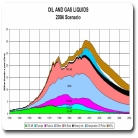

In the last few days (written 14 October 2014) the headlines have focused on the increase in oil production from OPEC producers, now at its highest level since the summer of 2013 – In its monthly oil market report, OPEC said its oil production rose by 402,000 barrels a day in September 2014 to total 30.47 million barrels a day. Higher levels of supply from Iraq and Libya were the main drivers of the production increases. Oil production is also rising due in part to the shale oil boom in North America. Whereas demand has weakened as growth falls in the global economy, this saw a 20% fall in the spot price for Brent crude over 3½ months.
From the oil industry’s point of view this all sounds very positive, growing production, a product where supply exceeds current demand. But we need to step back and look at the longer-term picture. Richard Miller and Steven Sorrell, writing in the Philosophical Transactions of The Royal Society, in an article called “The Future of Oil Supply”, say that, “The core issue for future supply is the extent and rate of depletion of conventional oil, since this currently provides around 95% of global all-liquids supply.” They say that conventional oil production plateaued in 2005 and recent increases in petroleum supply has come from unconventional sources, including tar sands and tight oil. They say that, “Crude oil production is heavily concentrated in a small number of countries and a small number of giant fields, with approximately 100 fields producing one half of global supply, 25 producing one quarter and a single filed (Ghawar in Saudi Arabia) producing approximately 7%.” Most of the giant fields are old and many have passed their peak of production, few new giant fields are expected to be found. They note that, “Future global production is therefore heavily dependent on the future prospects of the giant fields.”
From previous studies Miller and Sorrell concluded that, “a sustained decline in global conventional production appears probable before 2030 and there is significant risk of this beginning before 2020. This assessment excluded tight oil resources since these were classified as unconventional. However, on current evidence the inclusion of tight oil resources appears unlikely to significantly affect this conclusion, partly because the resource base appears relatively modest. Despite rising proved reserves, the depletion of conventional oil resources is relatively advanced.”
They dismiss any possibility that tight oil (fracking) can replace declining conventional oil output because of its relatively limited reserves (10% of the estimate for existing conventional oil reserves), high decline rates (approaching 100% p.a. in some cases) and the need to continuous drill closely spaced wells.
They conclude that “Most authors accept that the conventional oil resources are at an advanced stage of depletion and that liquid fuels will become more expensive and increasingly scare. The tight oil ‘revolution’ has provided some short-term relief, but seems unlikely to make a significant difference in the longer term.” They add, “Climate-friendly solutions to ‘peak oil’ are available, but they will not be easy, they will not be quick and they appear unlikely to allow the majority of the world’s population to achieve the levels of mobility currently enjoyed in the West. Lower mobility, in turn, implies a very different direction for future economic development. In sum, adapting rapidly and peacefully to oil scarcity in a manner that does not destroy the global environment provides humanity with a formidable challenge.”
Their carefully chosen words point to a profound change in the operation of the global economy, at some time in the next five to ten years. Once oil becomes scarce prices will inevitably climb, and the sub-$100 a barrel price in the later half of 2014 will be a distant memory, like petrol at 25C a gallon in the United States in the 1970s.
We need to be planning for the post-oil future, one where electric cars are the main personal mode of transport (or bicycles in the city), and high speed trains replace aircraft. We are approaching an inflexion point, after which things will never be the same. The world will be one in which travel is increasingly expensive and therefore restricted, where the price of food and other essentials which rely on cheap hydrocarbons, increases and the problem becomes of managing a declining and deflationary economy.
23 Comments on "Over the Peak – Why Peak Oil Matters"
Davy on Wed, 15th Oct 2014 6:44 am
This is an excellent articles that the corns will have a hard time beating up on. Good luck Marm & NOo with your excellent cavalier analysis. PO dynamics is a very complex subject covered well in this article. I think the articles point of oil prices will surely rise needs to be clarified. BAU may be or soon will be in a terminal decline. There is no reason why a BAU in terminal decline would not be in a demand destruction mode with prices falling in lockstep. This scenario is of course the end of supply increases with lost production never to be rebooted. Oil will always have the potential for high value but not in a cascading economy where its value is diminished by its effective use in the economy.
ghung on Wed, 15th Oct 2014 8:43 am
US stocks opened this morning down another 2%. Not sure where this will lead, but we may be seeing the beginning of the next step down, led by oil.
paulo1 on Wed, 15th Oct 2014 8:47 am
re: “We are approaching an inflexion point, after which things will never be the same.”
We certainly are, aren’t we?
And where do you want to be when this happens and is obvious to all?
Excellent article.
Davy on Wed, 15th Oct 2014 8:47 am
G-man, the 200 day moving has been broken which is not a good sign for the boys who want to stay in the market
paulo1 on Wed, 15th Oct 2014 8:50 am
Ghung,
That didn’t take long, did it? Last night it was down what, 8 points? What happened overnight?
Paulo
ghung on Wed, 15th Oct 2014 8:59 am
Paulo- EU markets are down pretty sharply less than 2 hours from closing. US markets are bouncing around lower, again, though I’m sure many cornucopians will see this as a buying opportunity. They don’t know what else to do. Welcome to the age of ‘running out of options’.
Nony on Wed, 15th Oct 2014 9:17 am
Rock’s terminology point about conventional/unconventional applying to the reservoir not the substance is very applicable here. How is WTI from a conventional reservoir from 50 years ago chemically different from recent Bakken oil? They price almost exactly the same at the refinery door. Have API almost same, sulfur almost same. Even similar yields.
Makati1 on Wed, 15th Oct 2014 9:21 am
For countries that use oil productively, $200+ oil is not too high. It may cut car sales in China but they will still use oil for chemicals, trucks, mining machines, airlines, etc. Ditto for the other growing economies in the East and South. After all, Europe has had $8+ gas for a long time and they are still here.
The US can live with $8+ gas too, but it will hurt for a while. Gas was $1 not too long ago and we survived when it went to $4. The West will have the most difficult time stepping down from the top, but that too is overdue and necessary if we are to go on existing on this planet.
Are you voluntarily stepping down or waiting for the ladder to be pulled out from under you?
Plantagenet on Wed, 15th Oct 2014 9:22 am
It seems crazy for KSA to be increasing oil production and driving oil prices lower. I wonder what they think they will gain from it?
bobinget on Wed, 15th Oct 2014 9:53 am
Like the famous line in “The Graduate” Exxon is moving into plastics. Perhaps… XOM, in spite of its aggressive
opposition to AGW science knows something.
I’ll include today’s EIA report, note imports are higher
overall consumption grew a meager .07% over last year this time.
Summary of Weekly Petroleum Data for the Week Ending October 3, 2014
U.S. crude oil refinery inputs averaged about 15.6 million barrels per day during the week ending October 3, 2014, 135,000 barrels per day less than the previous week’s average. Refineries operated at 89.3% of their operable capacity last week. Gasoline production decreased last week, averaging 8.9 million barrels per day. Distillate fuel production decreased last week, averaging over 4.7 million barrels per day.
U.S. crude oil imports averaged over 7.7 million barrels per day last week, up by 428,000 barrels per day from the previous week. Over the last four weeks, crude oil imports averaged 7.5 million barrels per day, 6.0% below the same four-week period last year.
Total motor gasoline imports (including both finished gasoline and gasoline blending components) last week averaged 417,000 barrels per day. Distillate fuel imports averaged 47,000 barrels per day last week.
U.S. commercial crude oil inventories (excluding those in the Strategic Petroleum Reserve) increased by 5.0 million barrels from the previous week. At 361.7 million barrels, U.S. crude oil inventories are in the upper half of the average range for this time of year.
Total motor gasoline inventories increased by 1.2 million barrels last week, and are in the middle of the average range. Finished gasoline inventories decreased while blending components inventories increased last week. Distillate fuel inventories increased by 0.4 million barrels last week and are in the lower half of the average range for this time of year. Propane/propylene inventories rose 1.1 million barrels last week and are well above the upper limit of the average range. Total commercial petroleum inventories increased by 3.8 million barrels last week.
Total products supplied over the last four-week period averaged over 19.3 million barrels per day, up by 0.7% from the same period last year. Over the last four weeks, motor gasoline product supplied averaged 8.7 million barrels per day, down by 1.3% from the same period last year. Distillate fuel product supplied averaged 3.8 million barrels per day over the last four weeks, down by 0.6% from the same period last year. Jet fuel product supplied is up 5.5% compared to the same four-week period last year.
Posters note:
Notice that lower gasoline prices have as yet to effect
the West Coast. Refiners are trying to make hay while sun shines— for refiners… anyway…
Im impressed by airline consumption. Looks like
long, solo automobile travel may have seen its day until battery technology catches up.
Davy on Wed, 15th Oct 2014 10:57 am
China can’t afford $200/oil because it’s economy needs to export to countries that can’t afford $200/oil. It is an open joke on this board those who preach the decoupling of the Brics. The same is true of low oil prices. China’s growth is export driven so a world deflated is going to lower Chinese growth significantly. If our idealogues here think China/Russian decouple is possible we again have delusions. Why do folks here dewell in their game board world? Is reality not enough excitement?
Perk Earl on Wed, 15th Oct 2014 11:02 am
Ghung, Dow has lost 1000 points in the last 6 trading days.
I figured this was going to happen, as oil price dropped it seemed likely stocks would follow.
Northwest Resident on Wed, 15th Oct 2014 11:23 am
“…adapting rapidly and peacefully to oil scarcity in a manner that does not destroy the global environment provides humanity with a formidable challenge.”
Good luck with that. Too little too late is what it looks like to me.
“Formidable challenge” — got that right.
Danlxyz on Wed, 15th Oct 2014 11:25 am
Bob, That was last weeks report. This weeks report will be out on the 16th. Delay because of Columbus Day Holiday?
Northwest Resident on Wed, 15th Oct 2014 12:04 pm
A Stunned Wall Street Reacts To Today’s Epic Move
As Davy characterizes the situation, it appears that things are really “churning”.
What we’re seeing (and feeling) with the Saudi Arabia oil price cuts and these stock market churnings are just the first few curves and hills in what promises to be the wildest rollercoaster ride you’ve ever been on.
“In the first 15 minutes of trading the S&P 500 E-Minis traded below the S&P 500 cash index despite a fair basis, according to Bloomberg, of -6.72. This is unheard of and something I have never witnessed in my near fourteen year career on the Street. I can only conclude that many large institutions threw in the towel on the Open in wake of the dislocations in not only stocks but also treasuries.”
ht tp://www.zerohedge.com/news/2014-10-15/stunned-wall-street-reacts-todays-epic-move
J-Gav on Wed, 15th Oct 2014 12:15 pm
Look for the PPT (Plunge Protection Team) to step in soon to try and stem the financial hemorrhaging long enough so the big players can get out before the average sucker gets thrown under the bus.
Davy on Wed, 15th Oct 2014 12:35 pm
Margin call time coming around the end of the day should be anything but peachy. NOo and Marm speak to me boys. I need cheerleading. NOo I need some econ 101 to make sense of life. Marm slap some corn sense into me so I don’t get doomed. Folks, where are the corns when you need them.
Northwest Resident on Wed, 15th Oct 2014 12:55 pm
“…where are the corns when you need them.”
Davy, while probably not true — yet — it is amusing and smugly satisfying to think that our local cast of Cornies (and trolls) have been bitch-slapped into a state of reality awareness by recent events, and are even now frantically pounding on their keyboards, on the phone with their brokers, buying and selling, making mad dashes to the wholesale stores to stock up on all that long shelf life food and stuff that they never thought they’d need.
Well, probably not quite yet, but they’re going to have to wake up and face reality sooner rather than later, and when they do, we’ll be searching for their corny posts here but all we’ll find is white space where once they crowed about American energy independence, BAU forever, NG exports, the mighty Marcellus — and all that hogwash.
marmico on Wed, 15th Oct 2014 2:25 pm
The annual real price of gasoline has averaged $2.44 per gallon since 1976. Today it is $3.20, call it 30% above the 38 year average. The typical 2015 model year vehicle is about 30% more fuel efficient than the 38 year average. It’s not a big deal. Prices fluctuate. Is that cornie enough for ya, Davy-boy? 🙂
Davy on Wed, 15th Oct 2014 3:01 pm
Marm, I can’t win for loosin, you win. Can I join the corn club. Do you and NOo do hazing and bizarre initiation rituals cause I am not the kinky type….at least not with guys. NOo is a little corny looking in his cheerleading uniform so who knows with NOo. I can’t picture you yet Marm. You seem suit, tie, cufflinks and cole Hans.
Nony on Wed, 15th Oct 2014 10:24 pm
2.99 at the pumps. That cheer you, Davy? Power to the consumers. Love the price war! Rock…back to the veggie hauling.
Davy on Wed, 15th Oct 2014 11:23 pm
NOo, your great, always happy and positive. I can’t knock that and that’s why I poke you in the ribs all the time. Yet, Noo, sometimes you remind me of Nero and Rome.
GregT on Thu, 16th Oct 2014 12:05 am
2.99 at the pumps. Cheery alright.
Nothing like saving 10 bucks on a tank of gas, to keep ones mind off of losing 10% of their life savings.