
Peak Oil is You

Donate Bitcoins ;-) or Paypal :-)


Page added on April 21, 2014

Oil Supply, Oil Price and the Economy
There has been considerable debate lately on what effect the supply and price of oil is having on the economy. It is, to my mind, a lot more serious than the vast majority of economists believe. In fact one can just look at what is happening today to see the effect of a constrained oil supply and high oil prices. Just look at the unemployment rate:
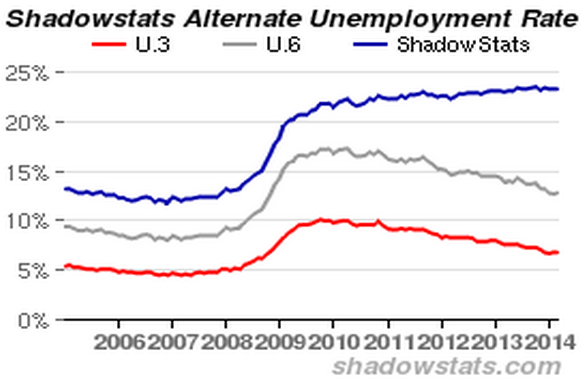
Real unemployment is double what it was in 2007. And it is creeping higher.
If you have not watched Oil Supply and Demand Forecasting with Steven Kopits then you have missed the best and most informative video that has come along since this whole debate started over a decade ago. I have just finished watching it for the third time. This time I made notes.
Kopits makes it very clear that oil is a binding constraint on economic growth. Of course that is obvious to most of us but you would be surprised at how many economists deny this. But for starters a few charts from Kopits video:
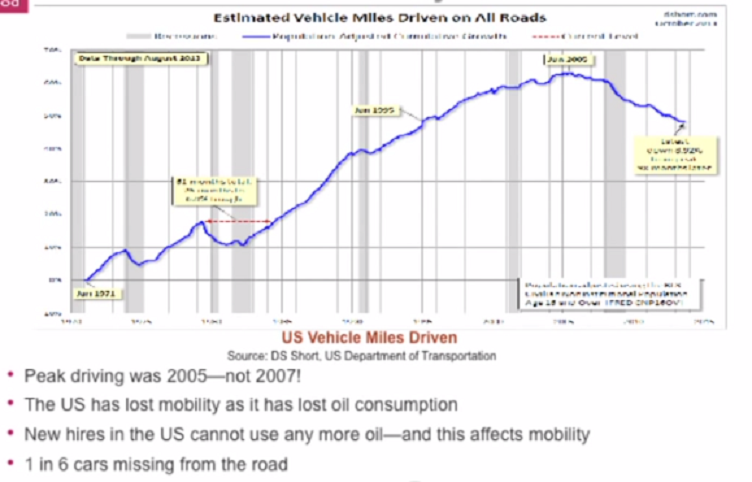
This is a direct result of the high price of oil.
And the difference between the motorization of the West and the Motorization of the East.
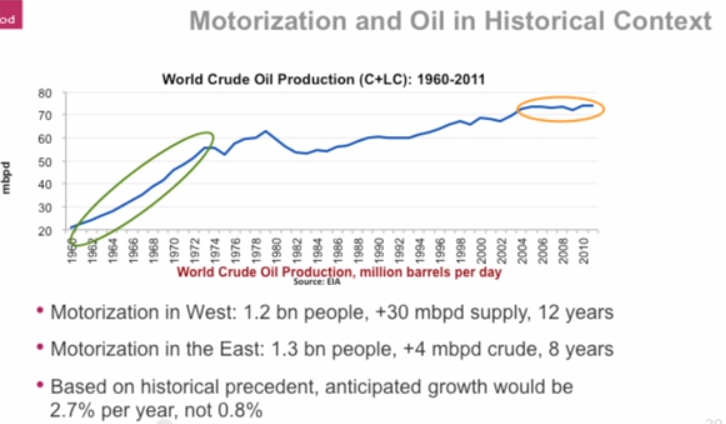
The obvious reason for the difference was supply constraint. The oil was just not there therefore the supply could not grow.
Air transportation was affected by supply constraint even more than road transportation.
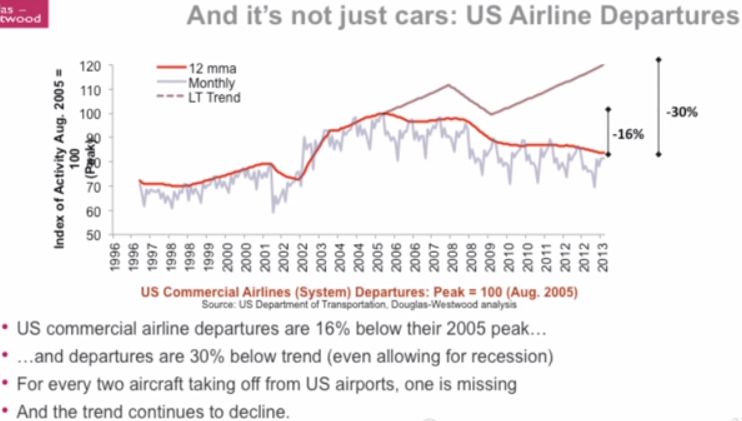
But we are hanging on as best we can to our mobility while cutting more drastically in other areas.
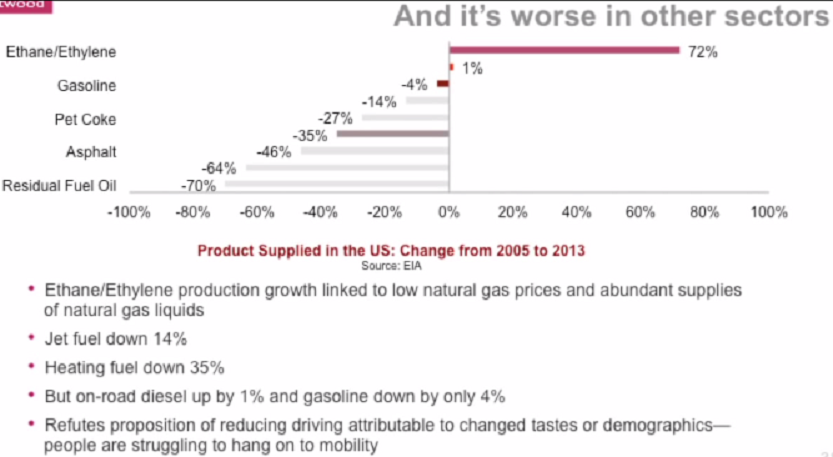
People are switching to natural gas where they can but hanging on to their driving habits as best they can.
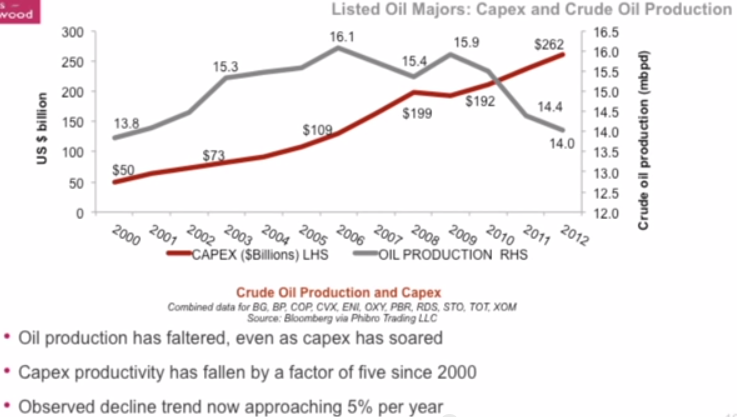
And it’t going to get a lot worse. Kopits: “Oil company profits have lagged because costs are rising faster than revenues. E&P capex per barrel has been rising by nearly 11% per year. Brent prices have been largely flat. A number of projects have consequently been deferred, cancelled or return for re-evaluation.”
I must add here, what is happening to the majors is also happening to the national oil companies as far as new oil is concerned. Their old giant fields will continue to pump oil at a few bucks a barrel but new exploration and drilling cost are rising just as fast for them as it is for the majors. For instance Aramco boosts drilling in seismically tough Red Sea.
Aramco is seeking reserves in anticipation of global economic growth and increasing demand for oil. The Red Sea is two kilometres deep in places with a 7,000-foot thick salt sequence which can distort seismic images, according to the magazine.
Just looking for the oil will cost them billions, and many more billions to produce it if they find any, which is a very big if.
Kopits: “In a demand constrained model: Price = Marginal Cost.
In a supply constrained model this is not the case. The price increases to a point where the marginal consumer would rather do with less than pay more. They will not recognize your marginal cost. If your cost continues to rise your consumer will not recognize it.”
Understand he is talking about the marginal consumer here. Every consumer has a price limit. If you are in the top 10% income bracket then your marginal price is very high. But for the masses there is a limit.
Kopits: “Oil majors are very slow to understand what is happening because they don’t use supply constrained forecasting. So that’s made them inherently optimistic. They say ‘Oh prices will rise’. But they are not rising. They don’t know why they are not rising. But now they are in a position saying ‘Oh we must sell something because our investors want dividends’.
Conclusions:
Demand-constrained models dominate thinking about oil and demand, supply, prices and their effect on the economy.
The data have not supported these models in recent years; the data do fit a supply-constrained model.
A supply-constrained approach will not be applicable if China falters, US short term latent demand is sated, and oil supply growth is robust.
For a supply-constrained model to be valid, oil must be holding back GDP growth as an implicit element of model construct.
If the supply-constrained approach is right, then GDP growth depends intrinsically on increasing oil production.
Without such increases, OECD GDP growth will continue to lag indefinitely, with a long-term GDP growth rate in the 1-2% range entirely plausable, and indeed, likely.
In turn, if this is true, then current national budget deficit levels and debt levels will prove unsustainable, and a second round of material and lasting adjustment will be necessary.
Okay then, just how high can prices go in 2013 dollars before the marginal consumers start to cut back on their consumption. This of course would not only halt the price rise but also be felt in other sectors of the economy. Well I would say we are at that point right now. In fact we are always pushing on that point. Every time prices rise a little some consumers cut back, and their cutting back affects other sectors of the economy.
But of course if the supply were to start dropping by say one or two percent per year, or higher, then prices would of course go higher. But the economy would suffer the consequences. And those consequences could be a killer.
David Hughes saw that I was using screen grabs from the video and was kind enough to send me the deck from Steve Kopits’ presentation. Here is the download address:
Oil and Economic Growth A Supply-Constrained View
9 Comments on "Oil Supply, Oil Price and the Economy"
Davy, Hermann, MO on Mon, 21st Apr 2014 11:42 am
ARTICLE SAID – Without such increases, OECD GDP growth will continue to lag indefinitely, with a long-term GDP growth rate in the 1-2% range.
The article brings up a good point that economist have generally discounted or ignored. We cannot substitute for oil in the economic growth formula. We may have been able to 20 or 30 years ago with an alternative economy and industrial man lifestyles. We had the resources and a lower population then. I feel the economic situation is currently showing a real aggregated GDP growth rate that is negative. Positive growth rate publications are demonstrated through the debt bubble and wealth transfer policies with corresponding distorted statistical indicators. We have in effect a house of cards. Financial repression policies by the central bank manipulate the cost of money and money supply. These policy efforts are maintaining a growth in the upper classes that own financial assets. These policies are nothing more than parasitic corporate and rich welfare. These policies are subsidies for high cost energy by lowering the cost of money for energy capex. These policies are social cannibalism for the lower classes and the future generations. This can continue for some time as long as confidence among the rich remain allowing necessary liquidity. Eventually either the financial system will give and or the energy brick wall which isa head shortly will stop these financial repression policies dead in their tracks.
Pops on Mon, 21st Apr 2014 1:02 pm
Kopits’ description of the change from demand constrained to supply constrained market has made a world of difference in my thinking.
A couple of links from the forums:
http://peakoil.com/forums/kopits-peak-oil-is-when-t69064.html
http://peakoil.com/forums/post1179399.html?hilit=kopits#p1179399
http://peakoil.com/forums/peak-investment-peak-oil-t69147.html
Nony on Mon, 21st Apr 2014 3:02 pm
Kopits is better than most of you, but “demand” versus “supply” thinking is moronic. Econ 101 teaches to look at both.
Makati1 on Mon, 21st Apr 2014 3:38 pm
Nony, Econ 101 is not working so well in this fiat word with contracting energy. The so called ‘economists’ are all reading from their antique texts looking for a world long gone.
Nony on Mon, 21st Apr 2014 3:50 pm
Makati, you’re confusing macro (econ 201) with micro (101). Micro holds everywhere.
Nony on Mon, 21st Apr 2014 3:58 pm
😛
GregT on Mon, 21st Apr 2014 5:25 pm
Econ xxx is meeting reality. In the end, physics, biology, and basic mathematics will expose Econ xxx for what it really is, a flawed human cult.
Boat on Mon, 21st Apr 2014 6:18 pm
“Oil majors are very slow to understand what is happening because they don’t use supply constrained forecasting. So that’s made them inherently optimistic. They say ‘Oh prices will rise’. But they are not rising. They don’t know why they are not rising. But now they are in a position saying ‘Oh we must sell something because our investors want dividends’.
The companies that guess the best seem to hang around longer. And who is buying all this equipment, a non oil guy who wants yard ornaments? That paragraph was one of the silliest yet.
Kenz300 on Tue, 22nd Apr 2014 7:56 am
The price of oil, coal and nuclear keeps rising and causing environmental damage.
The price of wind and solar keeps dropping and it is safe and clean.
Alternative energy sources are the future.
You can now produce biofuels from algae, cellulose and waste. Every landfill in the world can not be converted to produce energy, biofuels and recycled raw materials for new products. This does not fit the current oil company business model of massive centralized production of energy. Distributed, local energy production is the future. The oil companies need to change their business models and move to become energy companies with many local distributed production facilities.