
Peak Oil is You

Donate Bitcoins ;-) or Paypal :-)


Page added on December 17, 2014

Oil Prices as an Indicator of Global Economic Conditions
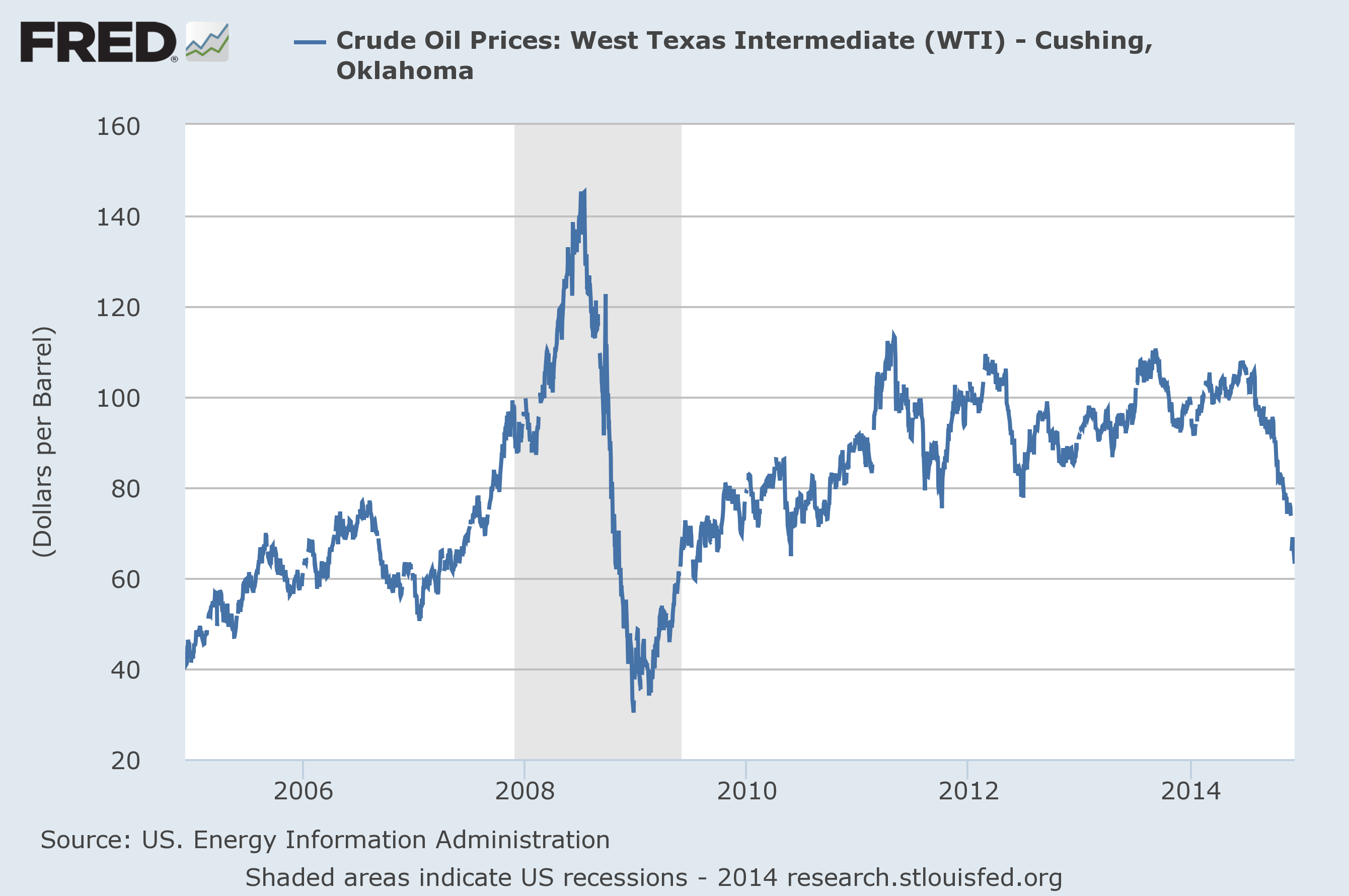
West Texas Intermediate sold for $105 a barrel at the start of July, but ended last week at $58. The most important factor has been surging U.S. production. But another reason oil prices have slid so much is weakness in demand for the product, which may be related to a slowdown of overall world economic growth. Here I comment on the importance of that second factor.
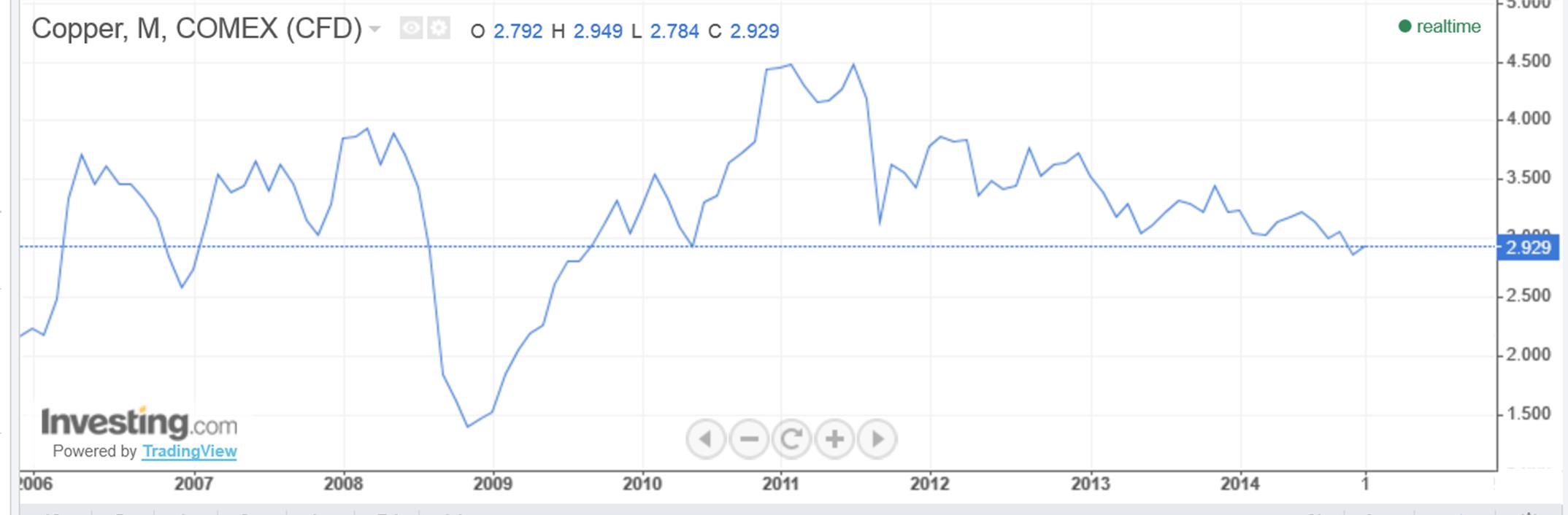
For example, the price of copper fell from $3.27/pound to $2.93, a 10% drop over those same six months. This of course has nothing to do with the success of people in getting more oil out of rocks in Texas. Softness in demand for commodities like copper and oil may be one indicator of new weakness in the world economy.
The yield on 10-year U.S. Treasury bonds is also down almost 50 basis points over the period, for which I believe the most plausible interpretation is again weakness in the world economy.

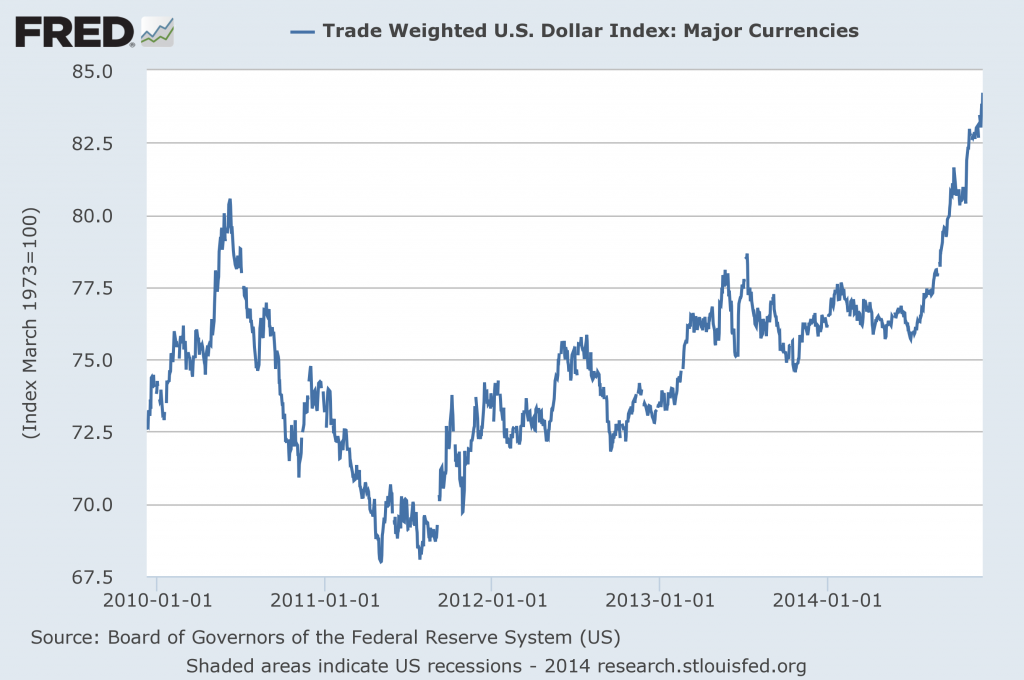
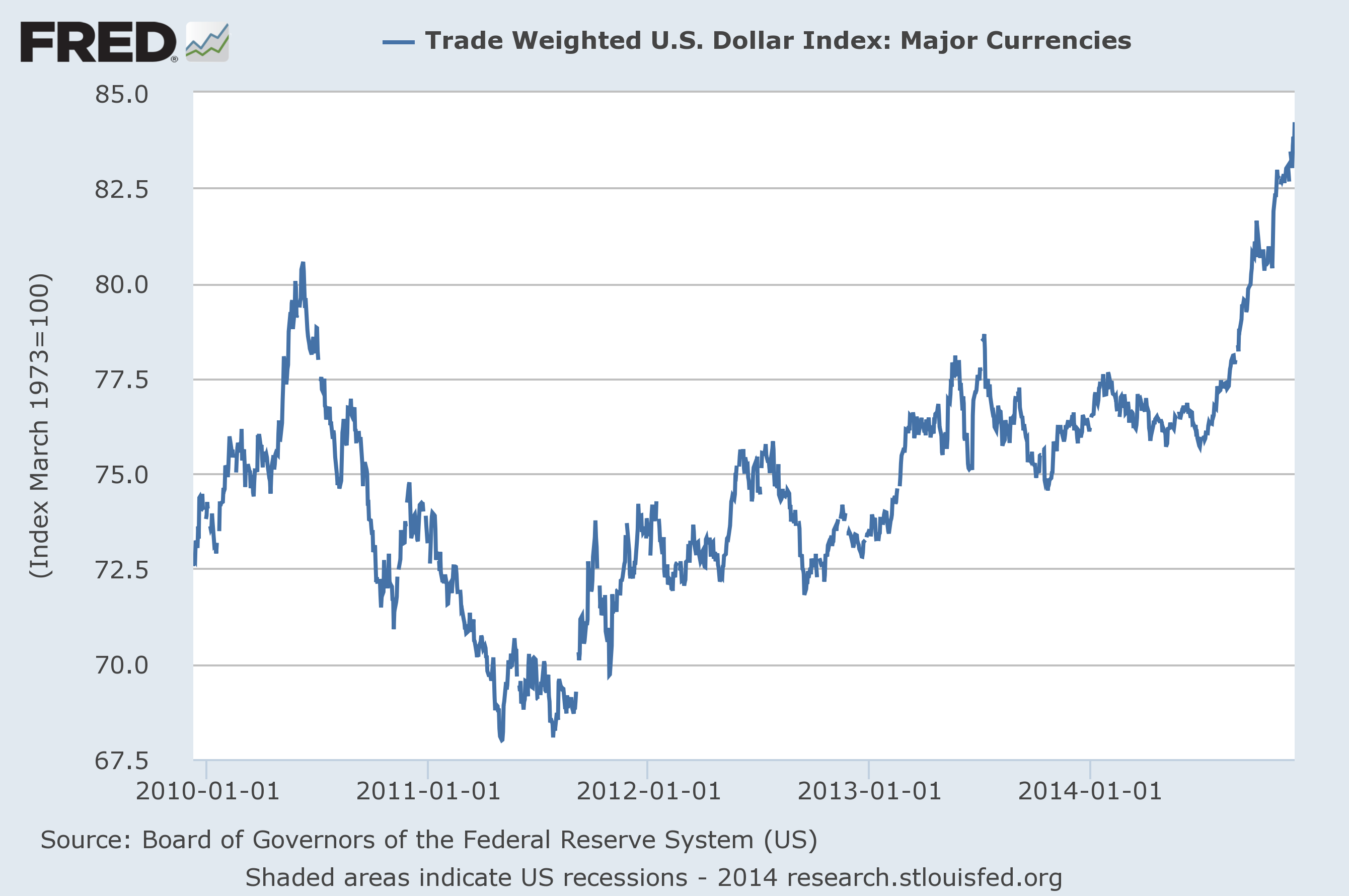
And the dollar is up 11%, which I attribute to the same cause.
To get an impression of the quantitative importance of these developments, I regressed the weekly change in the natural logarithm of the crude oil price (here’s why I use logarithms for this) on the change in the 10-year yield and the change in the logs of the copper price and the value of the dollar using data from April 2007 to June 2014. Here are the results of that regression, with t-statistics in parentheses as calculated using a Newey-West adjustment with 5 lags:

I then used the coefficients from that historical relation to see how much of the drop in oil prices since this summer we would have expected to observe, given the observed drop in copper prices and the 10-year yield and the rise in the value of the dollar. Those predicted values are plotted as the dashed line in the figure below, with the actual price of oil in solid black. Even if we knew nothing on the production side of the oil market, we would have anticipated the price of oil to have fallen from $105/barrel in June to $85 dollars today on the basis of these other three potential indicators of world economic activity.
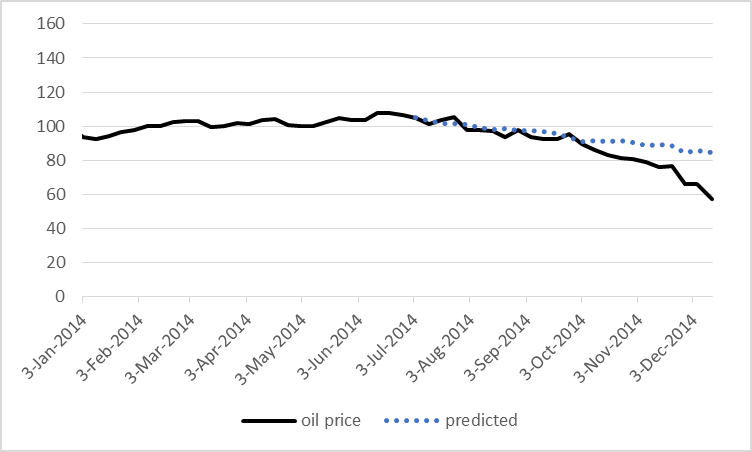
Actual price of West Texas Intermediate (in black) and value predicted on the basis of the above regression (dashed blue).
In other words, of the observed 45% decline in the price of oil, 19 percentage points– more than 2/5– might be reflecting new indications of weakness in the global economy.
10 Comments on "Oil Prices as an Indicator of Global Economic Conditions"
SugarSeam on Wed, 17th Dec 2014 12:41 pm
Certainly feels like wages have stagnated… Unless you’re a pro athlete or coach… Well, my industry – journalism – is rapidly downsizing, and those who’ve survived haven’t seen a basic cost-of-living 2-% raise in 6-7 years.
bobinget on Wed, 17th Dec 2014 12:55 pm
Here’s typical news from annual producing nation;
ABUJA, Nigeria (AP) — Nigeria’s finance minister presented a 2015 budget of $23 billion to parliament on Wednesday, slashed by nearly $3 billion to accommodate slumping oil prices.
Minister Ngozi Ikonjo-Iweala said she expects government revenue of $19.7 billion off growth of 5.5 percent next year, down from an earlier projection of 6.35 percent.
She said she has tried to make up for dropped oil prices by raising non-oil revenue. President Goodluck Jonathan had in September proposed a 2015 budget of about $26 billion based on oil prices of $78 a barrel. Ikonjo-Iweala said the new budget is based on an assumption of $65 a barrel and production of 2.27 billion barrels a day in Africa’s biggest oil producer.
But economist Bismarck Rewane of Financial Derivatives Consultancy in Lagos said the country is pumping only about 2 million barrels a day and suffers massive losses from oil theft.
“This budget points to the fact that this country is a non-oil country,” Ikonjo-Iweala told legislators. “The key is that we focus on diversification.”
While income from agriculture of other industries has grown, the government depends on oil for about 80 percent of its revenue and 95 percent of foreign reserves.
Let me repeat that: 80% of revenue, 90% of foreign reserves.
In KSA it’s 90% of both.
Venezuela: whopping 95%
Libya 70%
As of 2012 oil and gas sector accounted for 16% of the GDP, 52% of Russia’s federal budget
Read more: http://www.dailymail.co.uk/wires/ap/article-2877789/Nigerian-budget-slashed-slumping-oil-prices.html#ixzz3MBMkMSFy
Follow us: @MailOnline on Twitter | DailyMail on Facebook
Apneaman on Wed, 17th Dec 2014 1:58 pm
This Is Why the Oil-Price Crash Will Maul the US Economy
http://wolfstreet.com/2014/12/15/why-the-oil-price-crash-will-punch-not-boost-the-american-economy/
Northwest Resident on Wed, 17th Dec 2014 3:23 pm
Speaking of global economic conditions. What happens when interest rates go up? Wouldn’t that put another shovel full of dirt into the shallow grave that shale producers are piling into?
It is difficult to believe any hints that Yellen gives, but if we are to believe her recent serving of minced word salad, we can speculate with some degree of accuracy that interest rates will finally be going up sometime in April/May timeframe next year.
http://www.zerohedge.com/news/2014-12-17/couple-means-two-why-important
GregT on Wed, 17th Dec 2014 3:59 pm
NWR,
The central bankers will fight deflation at all costs. QE has not worked. The only option left is to raise interest rates. If they raise interest rates with the economy in the state that it is in, they will crash the system. Lower oil prices is a form of economic stimulus, at least in appearances. Happy ‘consumers’ heading into the festive winter carnival season should bring the numbers up, at least enough to make people believe that the economy has improved. When they raise rates in the spring, they will be able to lay the blame for the carnage on something else, like perhaps the recent ‘devil du jour’, Vladimir Putin and the evil Russians.
penury on Wed, 17th Dec 2014 4:14 pm
Raising rates is math impossible for the U.S. Interest payments on the debt would climb to consume too much of our income. Even tho the Fed Res owns trillions of dollars of t-bill at basically zero interest (all interest collected by the Fed in excess of operating expenses is returned to the Treas.) we still owe more money than we can pay interest on. Our monetary system is totally dependent upon “growth” which must be higher than the interest paid or the economy cannot function. I know this is known to everyone, however it is a good idea to think about this on FOMAC days.
Nony on Wed, 17th Dec 2014 5:57 pm
Hamilton omits to mention that he wrote an article a few months ago called the end of cheap oil and predicting 100 oil for the duration. Pretty biased dude.
Nony on Wed, 17th Dec 2014 5:59 pm
BTW, did you notice the smackdown that Mason Inman got by EIA and Scott Tinker? He is a pretty hack lefty journo (triple redundancy)? I used to think he was a better than average peaker but I guess that is like a smart Marine or a good looking Packers fan. dude wrote a bunch of breathy articles a year ago about how he was going to parse the Marcellus. And then he gave up. And it just plowed ahead at its usual 3 BCF/day/year addition.
Davy on Thu, 18th Dec 2014 7:44 am
The Dow Is Up 500 Points In 48 Hours (And Japan Up 1100)
http://www.zerohedge.com/news/2014-12-18/dow-500-points-48-hours-and-japan-1100
Folks, how can such volatility and turbulence in an environment of corruption, market manipulation, statistical distortions, MSM distorted reality, and CB financial repression end well? I see this as further evidence of the paradigm shift has occurred just like a cold front has moved through with the air temp and wind having not quite shifted.
This is it and we are in for one hell of a ride. BAU is going to fly apart eventually. I am not smart enough to know when but anything as complex as BAU surely cannot stomach volatility, turbulence and gyrations like we are seeing. Human nature of fear and panic has to be near the surface. We are already seeing it in Russia. The west and Asia are next. Just another normal day in the third world.
You Know It’s Bad in Russia When They Start Hoarding the Buckwheat
http://www.bloomberg.com/news/2014-12-18/russians-stockpile-buckwheat-brace-for-job-firings-amid-crisis.html
Kenz300 on Fri, 19th Dec 2014 9:30 am
Surging US oil production………..at what price…..