



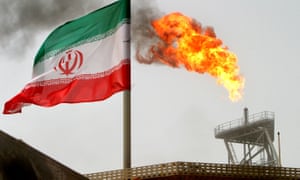

The big story in the financial markets in 2018 has been the sharp rise in oil prices, which last week hit $80 a barrel for the first time in four years.
But if oil analysts are right and the cost of crude is set to carry on rising, hitting $100 a barrel over the coming months, the big story of 2019 is going to be how oil came down to earth with a bump.
There are, without question, solid reasons for the oil price rises. The global economy has been performing more strongly than expected, with almost every region doing its bit to push up demand. Donald Trump’s tax cuts in the US and the reluctance of the Bank of Japan and the European Central Bank to tighten policy mean there is no immediate threat of recession.
On the other side of the equation, supply has been kept in check. Part of this – the Opec production curbs – was planned. Other aspects of it – the chaos in Venezuela and Donald Trump’s decision to pull out of the Iran nuclear deal – were not.
As a result, there is no longer an oil glut as there was in the middle of the decade. If Iran is frozen out of the global oil market, other suppliers will eventually take up the slack. But it will take time for Opec members to ratchet up supply – even assuming that they decide to do so. The same applies to shale-oil producers in the US. Prices are going up because traders are speculating that demand for oil will exceed supply – and for now that looks like a reasonable assumption.
But push things forward six or nine months and things look a bit different. Although the global economy seems healthy enough, it has eased back since hitting a peak in the final months of 2017 and early 2018. Europe had a weaker-than-expected first quarter; China is clearly slowing down.
In the US, it is a different story. There, the economy is operating at close to full employment, investment is up and consumers are spending freely. But, in a classic case of the law of unintended consequences, any benefits Americans enjoy from Trump’s tax cuts are soon going to be gobbled up by the higher fuel prices caused by the president’s get-tough approach towards Iran.
The Federal Reserve, America’s central bank, is already thinking about raising interest rates three times before the end of this year, and is even more likely to act if it sees higher petrol and diesel prices pushing up inflation when the labour market is so tight.
To be sure, there are reasons to think oil prices may hit $100 a barrel and carry on rising. With Trump in the White House, anything could happen. The Middle East could erupt into a full-scale conflict between Iran and Israel. The brittle detente between North Korea and the US could break down. In those circumstances, the cost of crude would stay higher for longer.
But in the absence of a new geopolitical shock, oil prices will eventually start falling. In oil-importing countries, more expensive crude will eat in to the discretionary spending power of consumers, leading to weaker demand in 2019. This will happen just as the US public is starting to feel the impact of higher interest rates, and as the effects of the tax cuts are wearing off.
On the supply side, two things will happen. First, US shale production – which is highly profitable with oil at $80 a barrel – will expand. Second, Opec producers will – whatever they say in public – quietly start to exceed their quotas in order to make up for the shortfall caused by sanctions on Iran.
Demand for oil is going to fall while supply is going to rise. Markets do not always behave in the way the economics textbooks predict, but this time, they will.
MPs were right to give Carillion chiefs a roasting
The language of the joint select committee report into the collapse of Carillion was punchy, even bombastic. It told of “recklessness, hubris and greed” at the failed outsourcing firm, lamented a “rotten corporate culture” and named and shamed three directors.
The Confederation of British Industry was not impressed. Deputy director general Josh Hardie complained that the report was irresponsible, giving and gave the impression that British business in general was greedy and reckless. Such “knee-jerk soundbites” – as he described the choicest phrases – risked harming investment in Britain.
Perhaps the criticisms struck a little too close to home. After all, Carillion was taken to task for its aggressive accounting, including booking revenues it had not yet pocketed. That’s not a million miles away from the accounting scandal at Tesco, where corporate responsibility fell for eight years under the eye of one J Hardie. It is also worth noting that Carillion’s auditor, KPMG, and the other big accountants, are all members of the CBI.
The Institute of Directors took the opposite approach. Ministers were “right to criticise the failures” at Carillion, said director of policy Edwin Morgan, as many in the business community had been “appalled” by the affair.
The tone of the Carillion report may be edgy, but it is also refreshing. Its authors dispensed with the niceties, abstractions and caveats common to these documents. After such an ignominious scandal, members of the public want to hear what happened in plain English and, for once, that’s what they got.
If there is a reason not to invest in Britain, it isn’t the language of the Carillion post-mortem, but the inadequacies of the directors, regulators, government and corporate culture that killed it. That needed saying.
Corruption solutions start on the home front
Corruption is a global tax on development. Tax havens are awash with cash that could and should be spent alleviating poverty in poor countries. Overseas demand for real estate in Belgravia or Manhattan is the other end of the dirty deals that siphon off cash that might otherwise be spent on health and education in the developing world.
Knowing that corruption exists is one thing. Fighting it is altogether more difficult. That much is obvious from the new memoir, Fighting Corruption Is Dangerous by Ngozi Okonjo-Iweala, who spent two spells as finance minister of Nigeria, trying to clean up the oil-rich country.
Okonjo-Iweala had some successes in her anti-corruption drive. Modernising Nigeria’s payments system, for example, rooted out more than 60,000 “ghost” workers. But she made powerful enemies along the way and left office in 2015 with the job far from complete.
Clearly, Nigeria is by no means the only country with a corruption problem, but should be considered a test case. If it can be cracked there, it can be cracked anywhere.
So what needs to be done? While pressure from the International Monetary Fund can help, the fight against corruption is ultimately a domestic affair. Governments have to be up for the struggle, and they need a thought-through plan that can build and maintain a domestic coalition willing to take on vested interests. Leadership from the top is vital. So is a good communications strategy to keep the public on board.
Fighting corruption requires strong institutions and administrative arrangements for tax collection, record keeping and law enforcement – things poor countries often lack. This is where outside help could make a difference. Okonjo-Iweala suggests that western countries could also offer paid fellowships to provide safety nets for those who take personal risks by exposing corruption. The IMF has also announced that it will monitor developed countries to ensure that their financial systems are not conduits for money laundering.
The temptation is to think that eradicating corruption is about getting the good guys to take over from the bad. It is a bit more complex than that.
twocats on Sun, 20th May 2018 8:29 am
Name one analyst predicting oil going to $100.
The over-reliance on shale is on track to disappoint many.
How many OPEC members have actual spare capacity? Maybe three. The others are in decline.
twocats on Sun, 20th May 2018 8:32 am
North Dakota is looking awfully peaky right about now. A double peak undulation due to economic factors. We need a better classification of peaks. How about for Bakken – Economic Double Peak.
Steve on Sun, 20th May 2018 9:58 am
“U.S. shale oil is highly profitable at $80 a barrel” Really? https://tinyurl.com/y8eut468
BobInget on Sun, 20th May 2018 10:24 am
Short answer: When our economy collapses.
Fracking for natural gas, condensates, will remain profitable because of pre anti fossil dated pipeline infrastructure already in existence.
As for oil, profitable ‘tight rock’ has yet to make money for anyone save day traders and bankers.
“Oil Is Above $70, but Frackers Still Struggle to Make Money Most of top 20 shale-oil producers spent more than they made in first quarter”e U.S. Economy
@DeanFantazzini
May 17
“Oil Is Above $70, but Frackers Still Struggle to Make Money Most of top 20 shale-oil producers spent more than they made in first quarter” … but where are those (renewed) fantasies of break-even #crudeoil prices at $17/bbl when you neet them?
https://www.wsj.com/articles/oils-at-70-but-frackers-still-struggling-to-make-money-1526549401 …
BobInget on Sun, 20th May 2018 11:10 am
Venezuela has yet to bottom out. China was counting on Venezuelan supply. Now ever more elusive.
Instead, China & India will be buying our loser shale produced supply until even the dumbest
investor goes broke feeding the SPP..
(Shale Ponzi Plan)
This is the deal concocted over the weekend for
‘China to buy more American goods’ IOW’s
raw materials to keep China’s factories humming.
Once again, a few fleet of foot day traders and hedge funds will profit at the expense of US tax payers and gasoline and diesel consumers.
In the words of one poet, “we was totally violated”
Exporting shale dregs at (currently) $8.00 under world prices (Brent) will drive this nation into bankruptcy.
With Venezuela out of bidness, we will find ourselves almost totally reliant on Canada’s oil sands. For now, it’s a race between disinterested
US and China for North America’s remaining crude. Such is the excitement over phony-shale profits, Canadian oil company share prices, in most cases are lower today @ $70 then when oil was $45.
The big fight between BC and Alberta is all aboot
a bigger mountain pipeline making ChInda exports
viable. If Canada’s federal government wins out
and the Mountain Pipe get’s BC nod, US loses its EXCLUSIVE oil lifeline, as ANOTHER poet wrote: WTF!
Davy on Sun, 20th May 2018 11:27 am
Bob, I thought you said China was going to take over Venezuela? For almost a year you were shouting this every chance you had. Did you finally get a taste of reality?
Davy on Sun, 20th May 2018 11:32 am
“If Canada’s federal government wins out
and the Mountain Pipe get’s BC nod, US loses its EXCLUSIVE oil lifeline, as ANOTHER poet wrote: WTF!”
Sure bob. Just like that 100% shut down in US sales. What about the light stuff Canada needs to mix to make the pipeline work? Bob did you forget your car keys or what keys are for?
Norman Pagett on Sun, 20th May 2018 5:14 pm
oil has no use until it is burned (or used in some other way)—thus creating ”employment”
Employment is the prime function of oil.
80 years ago—the energy return on that burning was 100: 1—now it’s down to 20: 1 (on good wells) and falling.
This means that oil is no longer cheap—–yet we are trying to sustain our industrial economic system as though it is still cheap
it isn’t
we are reaching the point where we can no longer afford to use oil to create employment
this explains why our oil is becoming unaffordable at any price
https://extranewsfeed.com/no-matter-how-much-oil-is-down-there-it-still-costs-too-much-f7142428849b
Harquebus on Sun, 20th May 2018 6:43 pm
If anyone is going to take over Venezuela, it will be the U.S. I have had my money on this event taking place before a middle east conflict for quite some time. It makes business sense. Closer, easier and the rewards are greater.
Outcast_Searcher on Sun, 20th May 2018 7:20 pm
Well of course, Norman. I would have NEVER driven an ICE car because I needed to get places. I ONLY did so because I new oil provides jobs. And of course, everyone is just like me. /s
Let’s just make up all kinds of cr*p about anything imperfect and claim its an epic fail, if doom isn’t proceeding as fast as the fast crash doomers have predicted for quite a few decades now.