
Peak Oil is You

Donate Bitcoins ;-) or Paypal :-)


Page added on March 21, 2014

Oil Limits and the Economy: One Story, Not Two

The two big stories of our day are
(1) Our economic problems: The inability of economies to grow as rapidly as they would like, add as many jobs as they would like, and raise the standards of living of citizens as much as they would like. Associated with this slow economic growth is a continued need for ultra-low interest rates to keep economies of the developed world from slipping back into recession.
(2) Our oil related-problems: One part of the story relates to too little, so-called “peak oil,” and the need for substitutes for oil. Another part of the story relates to too much carbon released by burning fossil fuels, including oil, leading to climate change.
While the press treats these issues as separate stories, they are in fact very closely connected, related to the fact that we are reaching limits in many different directions simultaneously. The economy is the coordinating system that ties together all available resources, as well as the users of these resources. It does this almost magically, by figuring out what prices are needed to keep the system in balance—how much materials of which types are needed, given what consumers can afford to pay.
The catch is that the economic system is not infinitely flexible. It needs to grow, to have enough funds to (sort of) pay back debt with interest and to make good on all the promises that have been made, such as Social Security.
Energy use is very closely tied to economic growth. When energy consumption becomes slow-growing (or high-priced—which is closely tied to slow-growing), it pulls back on economic growth. Job growth becomes more difficult, and governments find it difficult to get enough funding through tax revenue. This is the situation we have been experiencing for the last several years.
We might think that governments would be aware of these issues and would alert their populations to them. But governments either don’t understand these issues, or only partially understand them and are frightened by the prospect of what is happening. The purpose of my writing is to try to explain what is happening in terms that people who are used to reading the Wall Street Journal or Financial Times can understand.
I am not an economist, so I can’t speak to the question of what economists are saying. I do know that what economists say tends to change from time to time and from researcher to researcher. For example, in 2004, the International Energy Agency prepared an analysis with the collaboration of the OECD Economics Department and with the assistance of the International Monetary Fund Research Department (Full Report, Summary only). That report said, “. . . a sustained $10 per barrel increase in oil prices from $25 to $35 would result in the OECD as a whole losing 0.4% of GDP in the first and second year of higher prices. Inflation would rise by half a percentage point and unemployment would also increase.” This finding is consistent with the issues I am concerned about, but I expect that not all economists would agree with it. Oil prices are now around $100 per barrel, not $35 per barrel.
The Tie of Oil and Other Forms of Energy to the Economy
Oil and other forms of energy are used to power the economy. Historically, rises and falls in the use of oil and other types of energy have tended to parallel GDP growth (Figure 1).
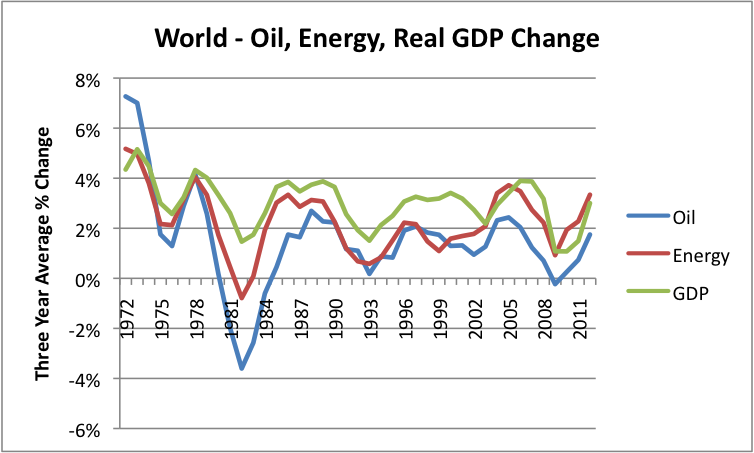
Figure 1. Growth in world GDP, compared to growth in world of oil consumption and energy consumption, based on 3 year averages. Data from BP 2013 Statistical Review of World Energy and USDA compilation of World Real GDP.
There is disagreement as to which is cause and which is effect—does GDP growth lead to more oil and energy demand, or does the availability of cheap oil and other types of energy power the economy? In my view, the causality goes both ways. Oil and other types of energy are needed for economic growth. But if people cannot afford oil or other types of energy products, typically because they don’t have jobs, then energy use will drop. And if oil prices drop too low, we will be in real trouble because oil production will stop.
How Oil Limits Work
People tend to think of limits as working in the same manner as having a box with a dozen eggs. Once the last egg is gone, we are out of luck. Or a creek dries up from lack of rainfall. The water is no longer available, so we have lost our water source.
With the benefit of the economy, though, limits are more complicated than this. If we live in today’s economy, we can purchase another box of eggs if we run short of eggs, assuming markets provide eggs at a price we can afford. If the creek runs dry, we can figure out a different approach to getting water, such as buying bottled water or hiring a tanker to get water from a source at a distance and bringing it to where it is needed.
Oil limits are a kind of limit we often hear concerns about. Being able to drill oil wells at all and refine the oil into products of many kinds requires a complex economy, one that can educate engineers working in oil extraction and can build paved roads, pipelines, and refineries. The economy needs to be able to produce high tech equipment using raw materials from around the world. Thus, there must be an operating financial system that allows buyers at one end of the globe to purchase materials from the other end of the globe, and sellers to have the confidence that they will be paid for contracted products.
If a company wants to extract oil, it can almost always figure out places where this theoretically can be done. If a company can gather together all of the things it needs—trained workers; enough high tech extraction equipment of the right type; enough pollution-fighting equipment, to prevent oil spills and spills of radioactive water; and leases on land where drilling is to done, then, in theory, oil can be extracted.
In fact, the big issue is whether the extraction can be done in a sufficiently cost-effective manner that the whole economic system can be supported. Even if the cost of extraction “looks” fairly cheap, such as in Iraq, or in some of the older installations elsewhere in the Middle East, the vast majority of the revenue that is generated from oil extraction (often as much as 90%) goes to support the government of the country where the oil is extracted (Rogers, 2014). This revenue is needed for many purposes: desalination plants to provide water for the people; food subsidies, especially when oil prices are high because food prices will tend to be high as well; new ports and other infrastructure; and revenue to provide jobs and programs to pacify the people so that the government will not be overtaken by revolt.
A major issue at this point is the fact that most of the easy-to-extract oil is already under development, so companies that want to develop new projects need to move on to locations that are more difficult and expensive to extract (Bloomberg, 2007). According to oil industry consultant Steven Kopits, the cost of one major category of oil production expenses increased by an average of 10.9% per year between 1999 and 2013. In the period between 1985 and 1999, these same expenses increased by 0.9% per year (Kopits, 2014) (Tverberg, 2014).
When production costs are higher, someone loses out. It is as if the economy is becoming less and less efficient. It takes more people, more energy products, and more equipment to produce the same amount of oil. This leaves fewer people and less energy products to produce the goods and services that people really want, putting a squeeze on the economy. The economy tends to grow less quickly because part of the goods and services available are being channeled into less productive operations.
The situation of the economy becoming less and less efficient at producing oil is called diminishing returns. A similar problem exists with fresh water in many parts of the world. We can extract more fresh water, but it takes deeper wells. Or we have to ship in water from a distance, using a pipeline or trucks. Or we need to use desalination. Water is still available but at a higher per-gallon price.
Diminishing Returns is Like a Treadmill that Runs Faster and Faster
There are many ways we can reach diminishing returns. One easy-to-illustrate example relates to mining metals. We usually extract the cheapest-to-extract ores first. An important cost consideration is how much waste material is mixed in with the metal we really want–this determines the ore “grade.” As we are gradually forced to move from high-grade ores to lower-grade ores, the amount of waste material grows slowly at first, then dramatically increases (Figure 2).
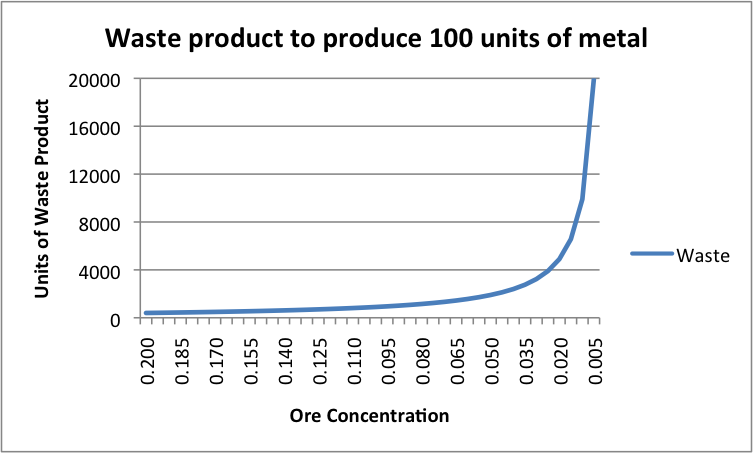
Figure 2. Waste product to produce 100 units of metal
We know that this kind of effect is happening right now. For example, the SRSrocco Report indicates that between 2005 and 2012, diesel consumption per ounce of refined gold has doubled from 12.7 gallons per ounce to 25.8 gallons per ounce, based on the indications of the top five companies. Such a pattern suggests that if we want to extract more gold, the price of gold will need to rise.
The economy is affected by all of the types of diminishing returns that are taking place (oil, fresh water, several kinds of metals, and others). Even attempting to substitute “renewables” for nuclear and fossil fuels electricity production acts as a type of diminishing returns, if such substitution raises the cost of electricity production, as it seems to in Germany and Spain.
If the total extent of diminishing returns is not very great, increased efficiency and substitution can act as workarounds. But if the combined effect becomes too great, diminishing returns acts as a drag on the economy.
Oil Increases are Already Higher than the Economy Can Comfortably Absorb
For oil, we can estimate the historical impact of increased efficiency and substitution by looking at the historical relationship between growth in GDP and growth in oil consumption. Based on the worldwide data underlying Figure 1, this has averaged 2.0% to 2.4% per year since 1970, depending on the period studied. Occasional years have exceeded 3%.
The problem in recent years is that increases in the cost of oil production have been much higher than 2% to 3%. As mentioned previously, a major portion of oil extraction costs seem to be increasing at 10.9% per year. To make this comparable to inflation adjusted GDP increases, the 10.9% increase needs to be adjusted (1) to take out the portion related to “overall inflation” and (2) to adjust for likely lower inflation on the portion of oil production costs not included in Kopits’ calculation. Even if this is done, total oil extraction costs are probably still increasing by about 5% or 6% per year—higher than we have historically been able to make up.
According to Kopits, we are already reaching a point where oil limits are constraining OECD GDP growth by 1% to 2% per year (Kopits, 2014) (Tverberg, 2014). Efficiency gains aren’t happening fast enough to allow GDP to grow at the desired rate.
A major concern is that the treadmill of rising costs will speed up further in the future. If it is hard to keep up now, it will be even harder in the future. Also, the economy “adds together” the adverse effects of diminishing returns from many different sources—-higher electricity cost of production, higher metal cost of production, and the higher cost of oil production. The economy has to increasingly struggle because wages don’t rise to handle all of these increased costs.
As one might guess, when economies hit diminishing returns on resources that are important to the economy, the results aren’t very good. According to Joseph Tainter (1990), many of these economies have collapsed.
Why Haven’t Governments Told Us About these Difficulties?
The story outlined above is not an easy story to understand. It is possible that governments don’t fully understand today’s problems. It is easy to focus on one part of the story such as, “Shale oil extraction is rising in response to higher oil prices,” and miss the important rest of the story—the economy cannot really withstand high oil (and water and electricity and metals) prices. The economy tends to contract in response to a need to use so many resources in increasingly unproductive ways. We associate this contraction with recession.
We have many researchers looking at these issues. Unfortunately, most of these researchers are focused on one small portion of the story. Without understanding the full picture, it is easy to draw invalid conclusions. For example, it is easy to get the idea that we have more time for substitution than we really have. Financial systems are fragile. The world financial system almost failed in 2008, after oil prices spiked. We are still in very worrisome territory, with many countries continuing a policy of Quantitative Easing and ultra low interest rates. We may have only a few months or a year or two left for substitution, not 40 or 50 years, as some seem to assume.
Of course, if governments do understand the worrisome nature of our current situation, they may not want to say anything. It could make the situation worse, if citizens start a “run on the banks.”
The other side of the issue is that if governments and citizens don’t understand the full story, they may inadvertently do things that will make the situation worse. They certainly won’t be looking long and hard at what collapse might look like in the current context and what can be done to mitigate its impacts.
19 Comments on "Oil Limits and the Economy: One Story, Not Two"
rollin on Fri, 21st Mar 2014 6:30 pm
Why is everyone looking at the government to provide everything? It is private individuals, companies and corporations that provide the energy and materials to run society. They should be the ones looking at this and providing answers.
Northwest Resident on Fri, 21st Mar 2014 6:33 pm
Great summarization.
Some people are thinking that hey, you doomer types told us eight years ago that we are on the verge of TSHTF, but nothing has happened during that time — nothing! And the point seems to be that since it didn’t happen back in 2008 when the doomer types said it would, that the “logical” conclusion is, therefore, it won’t ever happen.
Note to those who would make that point: Economic collapse has merely been postponed with QE, un-payable levels of debt pumped into the global economy to compensate for the lack of fossil fuel input, and by fraud and excess in the stock market that has turned into a surreal vestige of its former self.
The question asked in this article — how much longer can this charade continue — is THE BIG QUESTION of the day.
Assuming many trillions more of QE and debt inflation, but otherwise a “rocking steady” economy, maybe we can extend BAU and the current version of human civilization for another five or ten or twenty years. But the realities are stacked heavily against BAU continuing for much more than a few years at most, or a year or two at worst.
J-Gav on Fri, 21st Mar 2014 8:41 pm
The marginal returns in our (overly)complex Western (but not alone) societies are trending downwards – have been for a while. This can mean only one thing : more people after a piece of a shrinking pie. What with our parasitical elites taking the lion’s share, it seems clear that a breaking point will be reached within a decade or two. Who knows what that will spawn? Not likely to be very pretty …
shortonoil on Fri, 21st Mar 2014 9:08 pm
What Gail fails to realize, and I’m sure the insecure government that she refers to also fails to see is that petroleum is King Oil. Conventional crude has been driving the world’s economy for the last century (see graph# 12 at our site). Graph# 12 is a plot of EIA and World Bank data. Also, because most are trying to understand this phenomenon of declining economies from an economic perspective they are missing the main force that is driving this decline. Petroleum’s ability to power the economy is weakening. The calculated rate of petroleum’s driving force is falling at a rate that is very close to what the economic data describes (if you subtract the funny money that is being printed by the Central Banks).
However, Gail is correct that a government, and population that doesn’t understand the problem are likely to make it worse. Recent attempts to hamstring the internet by various government agencies testifies to this. But the most important oversight committed by both is that this is a situation that is not going to improve. It is going to continue to deteriorate. The energy delivered to the general economy from petroleum is now declining by about 2.5% per year, and that will accelerate as we fall deeper into the depletion event. As a society we are walking through dream land. One day we are going to wake up, and find out that we are no longer in our comfortable, secure old world.
http://www.thehillsgroup.org
Nony on Fri, 21st Mar 2014 9:17 pm
1. Gail has a long, long list of failed predictions. Big, bold, wrong ones.
2. And has not come to terms with, done non-defensive, “what I learned” post mortems of them.
3. She’s a nice lady. And she has a numerate job and kinda prides herself on that. But…it pains me to say, since I don’t want to squash her…she ain’t that bright on stats, microecon, or corporate finance. Someone like Kopits is someone who is still a peaker but much savvier about markets.
4. The whole article is belaboring a basic point (diminishing returns) that is not news to anyone.
5. Totally lacks a discussion of technology evolution (which can affect diminishing returns). Doesn’t even acknowledge it as a factor! I’m not saying you have to think it wins, but to not even mention it? (And technology is more than new tools and techniques, it includes things like improvements in efficiency of manufacturing).
DC on Fri, 21st Mar 2014 9:22 pm
Q/We might think that governments would be aware of these issues and would alert their populations to them. But governments either don’t understand these issues, or only partially understand them and are frightened by the prospect of what is happening.
As usual, the ‘actuary’ is a little out to lunch on a key point. Governments, actually do ‘know’ what is happening. They are nowhere near as myopic or stupid as the ‘actuary’ likes to think. The problem is, not that they dont ‘understand’, they probably understand better than most of us do(having privileged access to data and reources that we lack).No, the problem is not, a lack of ‘understanding’ as such, but rather a complete lack of desire to do anything about it. A completely different proposition.
The only thing govt likes to ‘alert’ people to these days, are non-existent ‘terrorist’ threats and threats to the economy. If your not shopping and driving your GM gas burner around and buying crap you dont need on credit-well that IS something govts always find alarming. Resource depletion though, yea, we know all about it-but would rather not talk that.Not now, not ever.
The ‘reason’ governments dont appear to ‘understand’ according to gail, inst that they are stupid, but that government is not an independent actor here, regardless of which OECD country any of us are from. What we call ‘Government’ are now wholly owned subsidiaries of global corporate capitalism. Thus, gov’ts priorities, are corporate priorities. Why do you think rightist govts are cashiering climate commissions and govt funded, that is to say, non-corporate research ever chance they get? All in the name of ‘austerity of course. Its going on full tilt in my country. And its going on, in order to ensure no data or research is being produced that conflicts with corporate priorities.
Davey on Fri, 21st Mar 2014 9:28 pm
Nony, I have not had time to read this but one word on Gail. She speaks to the masses well. She has an excellent grasp of the issues especially in a systematic way. I agree she has her short comings but who doesn’t? She is high in my book. I am not sold on technological evolution because it will lack reliability and economies of scale as the global economy contracts. I admit with enough money thrown at it wow what we could do. We could probably land a man on Mars but reality is our economy and society are not healthy. We are broke as a species.
hvacman on Fri, 21st Mar 2014 9:28 pm
The great insight I gained from this article (as an engineer) is the clear and simple articulation of why we can’t engineer our way out of this mess. With perpetual growth, despite ongoing engineering strides at improving technological efficiencies in many economic sectors, growing material resource extraction inefficiencies eventually overwhelm efficiency improvements in downstream material use. The treadmill/Red Queen syndrome. We get more fit as the treadmill accelerates, but eventually the resource treadmill accelerates faster than we get fitter. We then fall down and are spit off the back in a heap.
Bonking on a run always hurts.
Northwest Resident on Fri, 21st Mar 2014 9:34 pm
Nony — Gail has discussed technology “evolution” and improvements in several past articles. As shortonoil accurately pointed out in a previous post, new advanced technologies require even greater inputs of energy, and when energy IS the problem, how much benefit are we likely to derive from increasingly complex technologies.
You call it “belaboring a basic point”. Another way of putting that is, trying to explain to the not-so-bright masses exactly WHY our economy is headed for collapse in the very near future. She really scales it down well to the least-intelligent common denominator in hopes of reaching even the most dim-witted amongst us. But she is not entirely successful in many cases, and apparently not in your case either.
Nony on Fri, 21st Mar 2014 9:59 pm
She’s a hoot, man. Is she one of the experts I should listen to? Instead of Ralph Eads? 😉
OK…bike now. Vitamin-D-shine! 🙂
Northwest Resident on Fri, 21st Mar 2014 10:20 pm
“Is she one of the experts I should listen to?”
Apparantly not, Nony. I mean, you’re so smart that you’ve figured out an “easy” way to stop importing NG and to create an excess of NG that would make it profitable to export to Europe. Dude, you’re a friggin’ GENIUS! Of course you shouldn’t listen to Gail, or to anybody except that little genius inside of you who keeps telling you that you’re smarter than everybody else. Hey, let me know when you make your first billion $$ exporting NG to Europe — go tell it to the oil/NG industry leaders who haven’t been able to figure it out yet. They’ll be really happy to hear your genius ideas, Nony. Good luck, bro.
Davy, Hermann, MO on Fri, 21st Mar 2014 11:45 pm
DC said – The problem is, not that they dont ‘understand’, they probably understand better than most of us do(having privileged access to data and reources that we lack).No, the problem is not, a lack of ‘understanding’ as such, but rather a complete lack of desire to do anything about it. A completely different proposition.
DC, come on you are giving too much credit to government. You need to be more specific. You cannot tell me many in congress understand this. What about state and local government? No, sorry they are out of the loop and sold on plenty and exceptionalism. Many believe in angles and pots of gold at the end of the rainbows. If you mean the military, intelligence agencies, and maybe some leadership very high up in congress ok. DC, even they are deluding themselves with plenty and exceptionalism and writing off doomers and collapsniks. They are studying the issues though I am sure.
DC said – government is not an independent actor here, regardless of which OECD country any of us are from. What we call ‘Government’ are now wholly owned subsidiaries of global corporate capitalism.
Clarification is needed DC. Corporate interest and government have comingled ownership and interests. The system is a revolving door of patronage. Governments own the industries as much and vice versa. The ownership does not have to be actual paper ownership. It is an understanding and arrangements. Lobbyist write the laws. Lawyers, accountants, and industry leaders move into government to fill out their resumes and net worth. Government officials leave public swindle (I meant service) and move to the top of corporations.
Northwest Resident on Sat, 22nd Mar 2014 2:01 am
Hey Nony — If you’re still reading this thread, I apologize for being so sarcastic and derisive toward you. I actually like Gail a lot, not personally of course since I don’t know her, but I respect the efforts she makes to convey the problems our world is facing to whoever might be interested to learn more. She deals with facts and logic, and is concerned about the future just like all of us are. When you dinged her, it lit a fuse under me and I went off. I maintain my POV that you’re unduly optimistic about NG possibilities, and your reference to “peaker people” irritated me a little. You must realize that we are at a point where resource consumption IS peaking. Anyway, keep on hoping that NG and technology will save the day, and I’ll keep disagreeing with you, with less sarcastic fervor in the future — unless you piss me off again…:-)
Nony on Sat, 22nd Mar 2014 3:39 am
Don’t hurt me, Hammer. (I’ll leave Gail alone.) 😉
https://www.youtube.com/watch?v=otCpCn0l4Wo
shortonoil on Sat, 22nd Mar 2014 1:24 pm
Gail says:
“Why Haven’t Governments Told Us About these Difficulties?
The story outlined above is not an easy story to understand. It is possible that governments don’t fully understand today’s problems. It is easy to focus on one part of the story such as, “Shale oil extraction is rising in response to higher oil prices,” and miss the important rest of the story—the economy cannot really withstand high oil (and water and electricity and metals) prices.”
According to our calculations: from the study
“In the United States – federal, state and local governments, along with some private organizations annually invest $2.1 trillion to protect, manage and regulate the flow of petroleum”
The story is actually quite easy to understand, governments have a huge vested interest in the future of petroleum. Any semblance of their present structure can not exist without it, but petroleum’s ability to power their economies is declining. Petroleum’s ability to support huge government bureaucracies is on the decline.
Whether governments fully understand the problems, or not is almost irrelevant. They can’t address the issues without dissembling themselves. They are just as much a part of the problem as the Soccer Moms, and perpetual growth corporatist. For most in their dying institutions it is easier to believe in the illusion of a “Shale Miracle” than to face the reality of a world no longer eternally enriched by oil.
http://www.thehillsgroup.org
Davy, Hermann, MO on Sat, 22nd Mar 2014 1:46 pm
Short Said – Whether governments fully understand the problems, or not is almost irrelevant. They can’t address the issues without dissembling themselves. They are just as much a part of the problem as the Soccer Moms, and perpetual growth corporatist. For most in their dying institutions it is easier to believe in the illusion of a “Shale Miracle” than to face the reality of a world no longer eternally enriched by oil.
Well put Short!
I see the whole global system politically, economically, and with respect to vital resources at limits of growth. Systematically the system cannot manage a de-growth without unintended consequences due to the reliance of the system on growth and the global systems interconnected nature. At some point the system will fail and break to a lower level of complexity and output. We are nearing that threshold now. This is evident with the ever multiplying tipping points in all aspect of over human environment.
Cloud9 on Sat, 22nd Mar 2014 2:02 pm
If you still have a job then it is easy not to recognize the collapse that is taking place all around us. Look at the trends of neighborhoods that sport the highest incomes. There was a time when Detroit held a front row seat. When Detroit went into decline as a result of the 70’s gas crisis, globalization and unions, the center moved to the tech areas and the financial districts. Now those areas are in decline and the wealthiest neighborhoods surround the centers of political power. That is not a sustainable trend.
In my area, the middle class is becoming dominated by government employees. The cops, the firemen, the school teachers and the bureaucrats are doing fine. Those that service those people are hanging on. The rest are struggling.
I have friends waiting to be evicted because their revenue streams have collapsed. One has not made a house payment in four years and still has not been evicted. To look at them you would think that they are fine. There are nice cars in the drive way. The grass is mowed. But, it is an illusion. They are one knock on the door away from being homeless. These are not bad, ignorant or slothful people. They are victims of the ongoing contraction.
I suspect their condition mirrors that of millions of individuals and small businesses around the country. Gasoline retail sales have declined by two thirds in the last decade. If that doesn’t tell you that the collapse is underway then nothing will.
http://www.google.com/url?sa=t&rct=j&q=&esrc=s&source=web&cd=1&cad=rja&uact=8&ved=0CCgQFjAA&url=http%3A%2F%2Fwww.eia.gov%2Fdnav%2Fpet%2Fhist%2FLeafHandler.ashx%3Fn%3DPET%26s%3DA103600001%26f%3DM&ei=uZctU-zMG4f50gG5xIHQCg&usg=AFQjCNFx0pHp_iZcMzMalL65_o1pELuU9w&bvm=bv.63556303,d.dmQ
rollin on Sat, 22nd Mar 2014 3:19 pm
NW resident said:
“Some people are thinking that hey, you doomer types told us eight years ago that we are on the verge of TSHTF, but nothing has happened during that time — nothing! And the point seems to be that since it didn’t happen back in 2008 when the doomer types said it would, that the “logical” conclusion is, therefore, it won’t ever happen.”
A lot has happened NWR. TSHTF for a lot of people and businesses. Just because total collapse has not happened in a short time frame may only indicate that the model fo TSHTF is wrong. Reality may just be a little slower and more devastating in the long run. A series of very painful events until we change or give up.
Davy, Hermann, MO on Sat, 22nd Mar 2014 3:55 pm
We Humans need immediacy. Collapse may be like water phase change. Phase change in water (especially ice to water) develops slowly but when it changes it is far faster than expected. I imagine contraction and or collapse could possibly happen this way.