
Peak Oil is You

Donate Bitcoins ;-) or Paypal :-)


Page added on August 24, 2014

Oil experts say demand will stay high
Every year in August there is a week-long event — “The Oil & Gas Conference.” It draws an international audience and by most accounts EnerCom is the best on the schedule.
This year 118 companies made presentations. If I could only hear one presentation, and attend one breakout session, I’d choose Netherlands-based Core Labs — hands down.
“The maximum yearly oil production of the planet is taking place now!” That from CEO Dave Demshur. Core Labs has 70 offices in 50 countries. Their business is analyzing drilling results for all major, and hundreds of smaller companies in the global energy finding industry.
Core Labs (CLB $150) has a unique view of the world few others could envision. As a byproduct of their normal business activities, CLB accumulates data about the current status of all major oil and gas basins on the planet.
World instability has prompted them to withdraw from Russia, Venezuela, and as expected, Iraq.
While drilling, CLB evaluates the rock samples and evaluates the potential of finding oil and gas below. After a oil or gas field is producing, CLB helps the well operators to extract the maximum amount of hydrocarbons from the reservoir. Information that extensive about all the major energy basins in 50 countries is a unique collection of data.
Never very bashful in the breakout session, CEO Dave Demshur readily offered his thoughts about the big energy picture. When queried about increased oil availability he took the under in most cases. Basically he looks for flat, or lower, future oil generation from Mexico, Iraq, Iran, North Sea, Russia, and the shocker – Saudi.
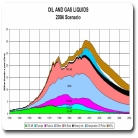
Demshur is a “peak oil” proponent – translated it means that at some point the oil production of the planet will maximize, flatten, and then diminish. His estimated planetary oil production in 2014 is an average 88 million barrels per day.
When I asked what his 88 million bbl/day prediction would do to the future price of oil, Demshur said; “I’m just a supply guy.” In asking many of the attendees if they could envision lower demand in the future, their answers were no in every case.
17 Comments on "Oil experts say demand will stay high"
Beery on Sun, 24th Aug 2014 8:02 am
“Oil experts say demand will stay high”
In other news, the sky is blue and water is wet.
westexas on Sun, 24th Aug 2014 8:44 am
And I wonder what happens to net exports, given flat to rising consumption in oil exporting countries, versus declining production?
Davy on Sun, 24th Aug 2014 8:54 am
Demand destruction is close at hand. We are talking a few years. Key systematic instabilities are present in predicaments of financial repressive economic policies bumping up to diminishing returns of effectiveness causing the bubble financial markets to be at risk. This global debt and equity markets are in a huge bubble that is the one source of confidence maintaining a financial system that is extended far from its source of equilibrium in quantity and quality. IOW these adjustments and pain needed to stabilize this aspect of the economic system in a direction of more sustainability of less growth was missed. Even if this pain would have been embraced it is still doubtful BAU could have been maintained more than a few more years if at all. Instead the very important act of liquidity injection and artificial repression of debt costs continued and became normalized in a new normal. These actions saved us from collapse but now risk a worse collapse. Those actions were a lifesaving drug but never intended to be a maintenance drug. It is unclear how long these policies can garner confidence. Confidence is liquidity and liquidity is growth. The end of growth will crash distribution, production, and exchange in a dangerous deflation of economic activity. This deflation of economic activity will cause a cascade of business failures further cascading reductions in necessary energy and food to a population and carrying capacity in overshoot to normal equilibrium. Currently demand is contingent in the short term to the maintenance of this repressed complex global economic and financial system. Just a little further out lies the predicament of the compression of the goldilocks range of cost benefits of our global energy segment. IOW oil production destruction will end demand growth. The other black swan that appeared recently is a polarizing multipolar world in conjunction with the economic destabilizing actions of trade and currency wars. Demand is here until it ain’t. IOW this is a phenomenon subject to the randomness of descent and diminishing returns that has recently entered the systematic situation of our complex interconnect global system. We can talk exponential growth because we have to. It is all that maintains maintain confidence currently. Imagine the talk in the big MSM outlets that PO is real and the end of growth. Imagine the talk that food supply growth is over and dangerous food instability is close at hand. The two above predicaments among two handfuls of other predicaments become accelerated and critical with the actual fall from growth to an actual quantifiable descent paradigm. We are talking the naked fact of de-growth with no amount of repression, market manipulation and corruption of acceptable accounting of economic results can mask. When this naked fact of undeniable de-growth occurs BAU is over.
shortonoil on Sun, 24th Aug 2014 9:32 am
“And I wonder what happens to net exports, given flat to rising consumption in oil exporting countries, versus declining production?”
Sort of says it all!!!
The largest user of the energy produced from petroleum, is now the petroleum industry, and its percentage of the total is increasing. Demand will continue to increase as the industry itself uses more, and more of it own product. This will continue until the end user can no longer afford the industries’ products. Looking at the rate of world debt growth, 40% in the last six years, that should not be too far into the future. We will then have a lot of industry “experts” blaming the FED, ISIS, lazy Americans, crazy Chinese, and the weather!
If you are waiting for an admission that game time is almost over, you will have a long, long wait.
http://www.thehillsgroup.org/
Kenz300 on Sun, 24th Aug 2014 9:45 am
The cost for discovery and production of new oil is rising and this price rise will make all alternatives more competitive.
It is time to end the oil monopoly on transportation fuels.
Bring on the electric, flex-fuel, hybrid, biofuel, CNG. LNG and hydrogen fueled vehicles.
pat on Sun, 24th Aug 2014 9:52 am
the year 2015 is going to be only the precursor of the bigger event following soon… all of the events, regional, geopolitical, natural, economic etc all indicate of a huge oil crisis not far as in year 2015.
rockman on Sun, 24th Aug 2014 10:00 am
“…lower demand in the future, their answers were no in every case.” And once again back to one definition of demand: that volume the market can afford to buy…not what they would like to acquire. And supply is the volume that is produced…not the maximum that could be produced. And demand will be moderated by price. And thus price will determine supply. But only to a point: if price drop too low their will be more buyers then supply. But that’s really just theoretical since, IMHO, the only reason prices would drop that low would be a global recession/depression. In such circumstances the buyers will have limited ability to buy oil.
So IMHO what will future demand (how much oil is purchased daily) be? Depends on the price of oil. What will future supply (how much oil will be produced daily) be? Whatever demand will be. As long as the free market dynamics control the distribution of oil then supply will always match demand. Of course there will be short periods of imbalance since it will take a bit of time for that status to return.
If this model holds as we slide down the backside of PO the price of oil will rise only to the limit of what the most affluent buyers can afford. Will that price (adjusted for inflation) be $100/bbl? $150/bbl? $200/bbl? In one sense less oil produced in the future won’t produce circumstances that we haven’t seen in the past: even when oil fell to almost $10/bbl this price was still too high for hundreds of millions to handle. Just as it is today. And just as it will be should price increase significantly in the future.
There has always been the “haves” and “have nots”. I see no reason to expect that dynamic to be much different in a post PO world. Of course, military adventures might abound. But again we’ve seen that in the past also. Consider the contribution of the embargo of Japanese oil imports (effectively a sudden PO for Japan). That wasn’t the only factor that caused the war in the Pacific but it increased the power and influence of the Japanese military which had been pushing expansionist dreams for decades. Expansion focused on controlling many resource as well as energy.
With that in the background consider how many of the current conflicts in the world seem to have energy based expansionist motivations. Either directly or by proxy as many view the US actions in Iraq for the last 20 years. Oddly enough some of the current conflicts might be called “de-expantionism”. Such would be the situation with the Kurds and their effort to separate from the efforts of British expansionists who created the “country” of Iraq.
Is the world’s glass of oil half full or half empty? If ones economy can’t afford a sip from that glass does it really matter to them? Only those with the capital will be able to slip a straw into that glass however one characterizes the volume.
Davy on Sun, 24th Aug 2014 10:53 am
Deep Rock deep !
Nony on Sun, 24th Aug 2014 10:54 am
I see people in general confusing the issue of the demand curve (the whole line) shifting versus price movement along the line (from supply changes).
Add into that, people who should know better (like James Hamilton) writing long, basic papers that have ~20+ graphs of oil peaking (supply depletion), but lack a thoughtful breakdown of supply and demand segments, lack supply/demand curves that rise above cartoons.
The whole thing is a lack of micro-economic intuition. Either from lack of the basic understanding. Or from fluffy macro/econometrician attitude. Believe me…I’ve seen rationing, arbitrage, little cartels in commodities before. The world runs on micro-economics. It really does. That is the path to understanding and learning.
Boat on Sun, 24th Aug 2014 11:21 am
Considering North America has a plethora of nat gas to stretch the oil so to say they are uniquely positioned for the near future. CHP tech is another tech petroleum stretcher running at over 90% efficiency vrs old tech that nat gas used at 60%. Lets not forget the advancement of important tech in wind, gasoline and diesel engines. With every oil increase comes more innovation and research to save money by using tech and efficiency. Bring on another price increase.
shortonoil on Sun, 24th Aug 2014 2:16 pm
“Is the world’s glass of oil half full or half empty? If ones economy can’t afford a sip from that glass does it really matter to them? Only those with the capital will be able to slip a straw into that glass however one characterizes the volume.”
Not necessarily so. The world’s production of hydrocarbons depends an a globally integrated economy to supply it knowledge, techniques, equipment, and parts. That globally integrated economy is powered by oil. It has massive maintenance, and over head costs. At some point those costs will overwhelm petroleum’s declining ability to keep that vast system operating. That capital is only viable if the rest of the world is working to maintain it. The day of the sovereign man, nation, or industry is over.
rockman on Sun, 24th Aug 2014 3:10 pm
Shorty – So true. I didn’t imply there would be a lot of oil. Just enough for those who can produce/control/buy what is available. The current is not a very pleasant world for hundreds of millions. It will be so for many more in the future.
tahoe1780 on Sun, 24th Aug 2014 3:30 pm
http://en.wikipedia.org/wiki/Jevons_paradox
Say you come up with a car that burns 50% less gasoline per mile. You have to use energy/materials to build that car. Those cars are now more economical to run, so you sell more of them to the marginal buyers. Sell one more car than you would and where have your savings gone? And you’re still drawing down reserves.
Speculawyer on Sun, 24th Aug 2014 3:43 pm
Really? You mean all those Chinese, Americans, and Europeans that are buying new cars aren’t just going to park them and let them sit there? I never would have guessed that! Who knew?
BTW . . . buy a plug-in people . . . it is a great hedge on oil prices. It doesn’t need to be a pure electric, a good plug-in hybrid can massively reduce gasoline/diesel usage.
Sharpie on Sun, 24th Aug 2014 7:35 pm
So let’s suppose our gas-powered fleet was quickly swapped out to plug-ins, right now.
The lights would go out.
Boat on Sun, 24th Aug 2014 8:00 pm
18% of the world doesn’t have electricity. Are we talking about that world? Are the parts of the world that never had electricity in demand destruction? When they have a drought and folks die, is that now a tragedy or business as usual.
Kenz300 on Mon, 25th Aug 2014 9:48 am
The transition to safer, cleaner and cheaper alternative energy sources is growing every year.
———————
Global Renewable Energy Status Uncovered
http://www.renewableenergyworld.com/rea/news/article/2014/08/global-renewable-energy-status-uncovered?page=all
—————
Big Companies, Big Renewable Investments
http://www.renewableenergyworld.com/rea/news/article/2014/08/big-companies-big-renewable-investments