
Peak Oil is You

Donate Bitcoins ;-) or Paypal :-)


Page added on November 30, 2018

Low Oil Prices: An Indication of Major Problems Ahead?

Many people, including most Peak Oilers, expect that oil prices will rise endlessly. They expect rising oil prices because, over time, companies find it necessary to access more difficult-to-extract oil. Accessing such oil tends to be increasingly expensive because it tends to require the use of greater quantities of resources and more advanced technology. This issue is sometimes referred to as diminishing returns. Figure 1 shows how oil prices might be expected to rise, if the higher costs encountered as a result of diminishing returns can be fully recovered from the ultimate customers of this oil.

Figure 1. Chart showing expected long-term rise in oil prices as the full cost of oil production becomes increasingly expensive due to diminishing returns.
In my view, this analysis suggesting ever-rising prices is incomplete. After a point, prices can’t really keep up with rising costs because the wages of many workers lag behind the growing cost of extraction.
The economy is a networked system facing many pressures, including a growing level of debt and the rising use of technology. When these pressures are considered, my analysis indicates that oil prices may fall too low for producers, rather than rise too high for consumers. Oil companies may close down if prices remain too low. Because of this, low oil prices should be of just as much concern as high oil prices.
In recent years, we have heard a great deal about the possibility of Peak Oil, including high oil prices. If the issue we are facing is really prices that are too low for producers, then there seems to be the possibility of a different limits issue, called Collapse. Many early economies seem to have collapsed as they reached resource limits. Collapse seems to be characterized by growing wealth disparity, inadequate wages for non-elite workers, failing governments, debt defaults, resource wars, and epidemics. Eventually, population associated with collapsed economies may fall very low or completely disappear. As Collapse approaches, commodity prices seem to be low, rather than high.
The low oil prices we have been seeing recently fit in disturbingly well with the hypothesis that the world economy is reaching affordability limits for a wide range of commodities, nearly all of which are subject to diminishing returns. This is a different problem than most researchers have been concerned about. In this article, I explain this situation further.
One thing that is a little confusing is the relative roles of diminishing returns and efficiency. I see diminishing returns as being more or less the opposite of growing efficiency.

Figure 2.
The fact that inflation-adjusted oil prices are now much higher than they were in the 1940s to 1960s is a sign that for oil, the contest between diminishing returns and efficiency has basically been won by diminishing returns for over 40 years.
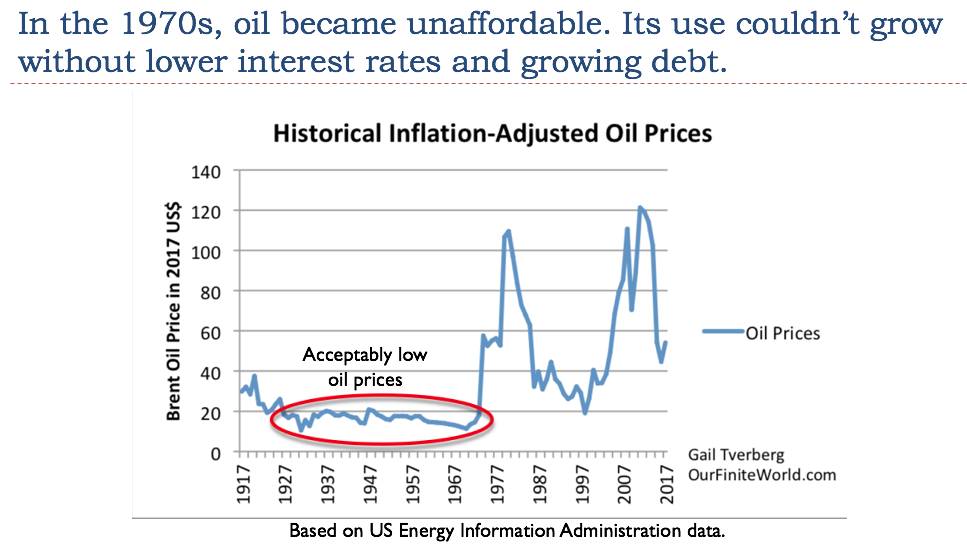
Figure 3.
Oil Prices Cannot Rise Endlessly
It makes no sense for oil prices to rise endlessly, for what is inherently growing inefficiency. Endlessly rising prices for oil would be similar to paying a human laborer more and more for building widgets, during a time that that laborer becomes increasingly disabled. If the number of widgets that the worker can produce in one hour decreases by 50%, logically that worker’s wages should fall by 50%, not rise to make up for his/her growing inefficiency.
The problem with paying higher prices for what is equivalent to growing inefficiency can be hidden for a while, if the economy is growing rapidly enough. The way that the growing inefficiency is hidden is by adding Debt and Complexity (Figure 4).
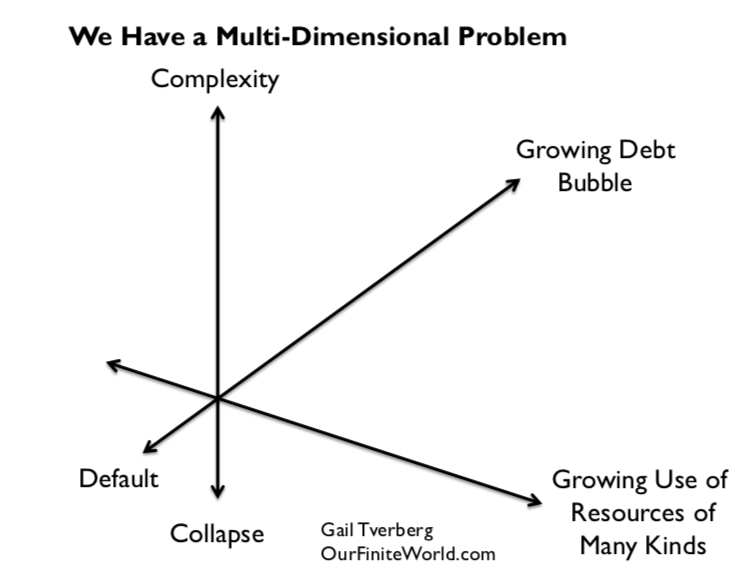
Figure 4.
Growing complexity is very closely related to “Technology will save us.” Growing complexity involves the use of more advanced machinery and ever-more specialized workers. Businesses become larger and more hierarchical. International trade becomes increasingly important. Financial products such as derivatives become common.
Growing debt goes hand in hand with growing complexity. Businesses need growing debt to support capital expenditures for their new technology. Consumers find growing debt helpful in affording major purchases, such as homes and vehicles. Governments make debt-like promises of pensions to citizen. Thanks to these promised pensions, families can have fewer children and devote fewer years to child care at home.
The problem with adding complexity and adding debt is that they, too, reach diminishing returns. The easiest (and cheapest) fixes tend to be added first. For example, irrigating a field in a dry area may be an easy and cheap way to fix a problem with inadequate food supply. There may be other approaches that could be used as well, such as breeding crops that do well with little rainfall, but the payback on this investment may be smaller and later.
A major drawback of adding complexity is that doing so tends to increase wage and wealth disparity. When an employer pays high wages to supervisory workers and highly skilled workers, this leaves fewer funds with which to pay less skilled workers. Furthermore, the huge amount of capital goods required in this more complex economy tends to disproportionately benefit workers who are already highly paid. This happens because the owners of shares of stock in companies tend to overlap with employees who are already highly paid. Low paid employees can’t afford such purchases.
The net result of greater wage and wealth disparity is that it becomes increasingly difficult to keep prices high enough for oil producers. The many workers with low wages find it difficult to afford homes and families of their own. Their low purchasing power tends to hold down prices of commodities of all kinds. The higher wages of the highly trained and supervisory staff don’t make up for the shortfall in commodity demand because these highly paid workers spend their wages differently. They tend to spend proportionately more on services rather than on commodity-intensive goods. For example, they may send their children to elite colleges and pay for tax avoidance services. These services use relatively little in the way of commodities.
Once the Economy Slows Too Much, the Whole System Tends to Implode
A growing economy can hide a multitude of problems. Paying back debt with interest is easy, if a worker finds his wages growing. In fact, it doesn’t matter if the growth that supports his growing wages comes from inflationary growth or “real” growth, since debt repayment is typically not adjusted for inflation.
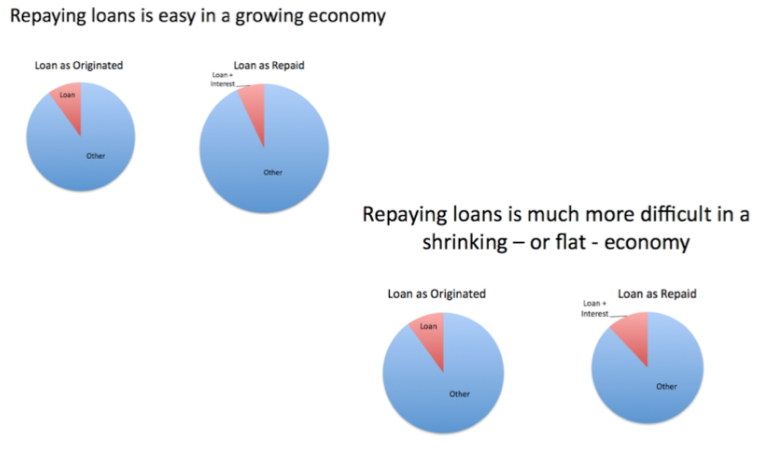
Figure 5. Repaying loans is easy in a growing economy, but much more difficult in a shrinking economy.
Both real growth and inflationary growth help workers have enough funds left at the end of the period for other goods they need, despite repaying debt with interest.
Once the economy stops growing, the whole system tends to implode. Wage disparity becomes a huge problem. It becomes impossible to repay debt with interest. Young people find that their standards of living are lower than those of their parents. Investments do not appear to be worthwhile without government subsidies. Businesses find that economies of scale no longer work to their advantage. Pension promises become overwhelming, compared to the wages of young people.
The Real Situation with Oil Prices
The real situation with oil prices–and in fact with respect to commodity prices in general–is approximately like that shown in Figure 6.
Figure 6.
What tends to happen is that oil prices tend to fall farther and farther behind what producers require, if they are truly to make adequate reinvestment in new fields and also pay high taxes to their governments. This should not be too surprising because oil prices represent a compromise between what citizens can afford and what producers require.

Figure 7. Illustration indicating that the world has already reached a point where no oil price works for both oil suppliers and oil consumers.
In the years before diminishing returns became too much of a problem (back before 2005, for example), it was possible to find prices that were within an acceptable range for both sellers and buyers. As diminishing returns has become an increasing problem, the price that consumers can afford has tended to fall increasingly far below the price that producers require. This is why oil prices at first fall a little too low for producers, and eventually seem likely to fall far below what producers need to stay in business. The problem is that no price works for both producers and consumers.
Affordability Issues Affect All Commodity Prices, Not Just Oil
We are dealing with a situation in which a growing share of workers (and would be workers) find it difficult to afford a home and family, because of wage disparity issues. Some workers have been displaced from their jobs by robots or by globalization. Some spend many years in advanced schooling and are left with large amounts of debt, making it difficult to afford a home, a family, and other things that many in the older generation were able to take for granted. Many of today’s workers are in low-wage countries; they cannot afford very much of the output of the world economy.
At the same time, diminishing returns affect nearly all commodities, just as they affect oil. Mineral ores are affected by diminishing returns because the highest grade ores tend to be extracted first. Food production is also subject to diminishing returns because population keeps rising, but arable land does not. As a result, each year it is necessary to grow more food per arable acre, leading to a need for more complexity (more irrigation or more fertilizer, or better hybrid seed), often at higher cost.
When the problem of growing wage disparity is matched up with the problem of diminishing returns for the many different types of commodity production, the same problem occurs that occurs with oil. Prices of a wide range of commodities tend to fall below the cost of production–first by a little and, if the debt bubble pops, by a whole lot.
We hear people say, “Of course oil prices will rise. Oil is a necessity.” The thing that they don’t realize is that the problem affects a much bigger “package” of commodities than just oil prices. In fact, finished goods and services of all kinds made with these commodities are also affected, including new homes and vehicles. Thus, the pattern we see of low oil prices, relative to what is required for true profitability, is really an extremely widespread problem.
Interest Rate Policies Affect Affordability
Commodity prices bear surprisingly little relationship to the cost of production. Instead, they seem to depend more on interest rate policies of government agencies. If interest rates rise or fall, this tends to have a big impact on household budgets, because monthly auto payments and home payments depend on interest rates. For example, US interest rates spiked in 1981.
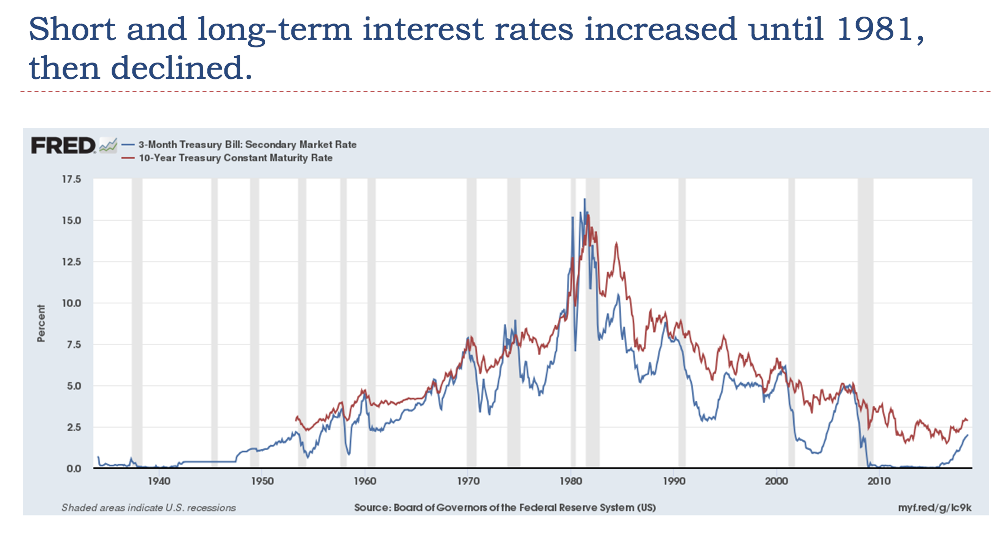
Figure 8. US short and long term interest rates. Graph by FRED.
This spike in interest rates led to a major cutback in energy consumption and in GDP growth.

Figure 9. World GDP Growth versus Energy Consumption Growth, based on data of 2018 BP Statistical Review of World Energy and GDP data in 2010$ amounts, from the World Bank.
Oil prices began to slide, with the higher interest rates.

Figure 10.
Figure 11 indicates that the popping of a debt bubble (mostly relating to US sub-prime housing) sent oil prices down in 2008. Once interest rates were lowered through the US adoption of Quantitative Easing (QE), oil prices rose again. They fell again, when the US discontinued QE.

Figure 11. Figure showing collapsing debt bubble at the time US oil prices peaked, and the use of Quantitative Easing (QE) to stimulate the economy, and thus bring prices back up again.
While these charts show oil prices, there is a tendency for a broad range of commodity prices to move more or less together. This happens because the commodity price issue seems to be driven to a significant extent by the affordability of finished goods and services, including homes, automobiles, and restaurant food.
If the collapse of a major debt bubble occurs again, the world seems likely to experience impacts somewhat similar to those in 2008, depending, of course, on the location(s) and size(s) of the debt bubble(s). A wide variety of commodity prices are likely to fall very low; asset prices may also be affected. This time, however, government organizations seem to have fewer tools for pulling the world economy out of a prolonged slump because interest rates are already very low. Thus, the issues are likely to look more like a widespread economic problem (including far too low commodity prices) than an oil problem.
Lack of Growth in Energy Consumption Per Capita Seems to Lead to Collapse Scenarios
When we look back, the good times from an economic viewpoint occurred when energy consumption per capita (top red parts on Figure 12) were rising rapidly.

Figure 12.
The bad times for the economy were the valleys in Figure 12. Separate labels for these valleys have been added in Figure 13. If energy consumption is not growing relative to the rising world population, collapse in at least a part of the world economy tends to occur.
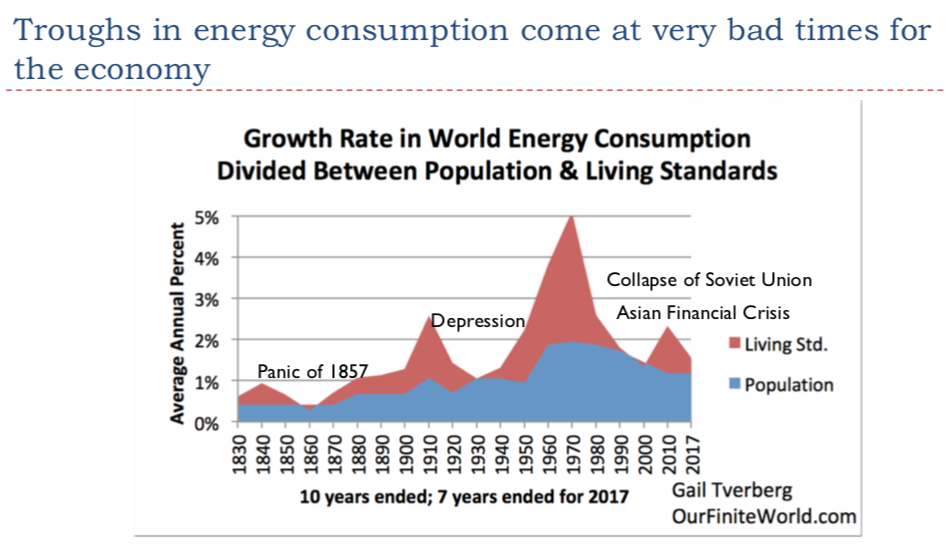
Figure 13.
The laws of physics tell us that energy consumption is required for movement and for heat. These are the basic processes involved in GDP generation, and in electricity transmission. Thus, it is logical to believe that energy consumption is required for GDP growth. We can see in Figure 9 that growth in energy consumption tends to come before GDP growth, strongly suggesting that it is the cause of GDP growth. This further confirms what the laws of physics tell us.
The fact that partial collapses tend to occur when the growth in energy consumption per capita falls too low is further confirmation of the way the economics system really operates. The Panic of 1857 occurred when the asset price bubble enabled by the California Gold Rush collapsed. Home, farm, and commodity prices fell very low. The problems ultimately were finally resolved in the US Civil War (1861 to 1865).
Similarly, the Depression of the 1930s was preceded by a stock market crash in 1929. During the Great Depression, wage disparity was a major problem. Commodity prices fell very low, as did farm prices. The issues of the Depression were not fully resolved until World War II.
At this point, world growth in energy consumption per capita seems to be falling again. We are also starting to see evidence of some of the same problems associated with earlier collapses: growing wage disparity, growing debt bubbles, and increasingly war-like behavior by world leaders. We should be aware that today’s low oil prices, together with these other symptoms of economic distress, may be pointing to yet another collapse scenario on the horizon.
Oil’s Role in the Economy Is Different From What Many Have Assumed
We have heard for a long time that the world is running out of oil, and we need to find substitutes. The story should have been, “Affordability of all commodities is falling too low, because of diminishing returns and growing wage disparity. We need to find rapidly rising quantities of very, very cheap energy products. We need a cheap substitute for oil. We cannot afford to substitute high-cost energy products for low-cost energy products. High-cost energy products affect the economy too adversely.”
In fact, the whole “Peak Oil” story is not really right. Neither is the “Renewables will save us” story, especially if the renewables require subsidies and are not very scalable. Energy prices can never be expected to rise high enough for renewables to become economic.
The issues we should truly be concerned about are Collapse, as encountered by many economies previously. If Collapse occurs, it seems likely to cut off production of many commodities, including oil and much of the food supply, indirectly because of low prices.
Low oil prices and low prices of other commodities are signs that we truly should be concerned about. Too many people have missed this point. They have been taken in by the false models of economists and by the confusion of Peak Oilers. At this point, we should start considering the very real possibility that our next world problem is likely to be Collapse of at least a portion of the world economy.
Interesting times seem to be ahead.
64 Comments on "Low Oil Prices: An Indication of Major Problems Ahead?"
rockman on Fri, 30th Nov 2018 3:16 pm
“Many people, including most Peak Oilers, expect that oil prices will rise endlessly.” Starting out with a false assertion of the other side of the debate always makes for an easy debate to win. As pointed out many time before peak oil was clearly explained to the Rockman 40 years ago by his first mentor. And ever increasing oil prices was never a part of that dynamic. Eventually when enough time has passed to be certain global PO had been reached we may find exceptionally high OR LOW oil prices were seen that same year. Oil pricing is a short term dynamic…peak oil is a very long term dynamic.
This is similar to folks who confuse the weather with the climate.
Darrell Cloud on Fri, 30th Nov 2018 6:29 pm
Are we there yet?
More Popcorn Please on Fri, 30th Nov 2018 7:10 pm
I think the “casual peakers” probably did/do think that oil prices would only go up once peak was hit. I know whenever I try to talk with those unfamiliar with the concept they invariably think I’m suggesting we’re going to suddenly run out of the stuff.
JCSR on Fri, 30th Nov 2018 7:31 pm
All that and I still won’t give a dang if in the future when I want to go anywhere i’ll take an electric bike, bus or Uber. Heat my apartment by electricity. Get my packages and groceries delivered by electric vehicles all powered by renewable energy. Woo Hoo!
Anonymous on Fri, 30th Nov 2018 9:40 pm
More Gail blabla that shows a lack of knowledge of the most basic concepts of supply and demand curves.
Plantagenet on Fri, 30th Nov 2018 10:47 pm
Gail is confusing an oversupply of oil with the collapse of the global economy. They aren’t the same thing.
Cheers!
makati1 on Fri, 30th Nov 2018 10:58 pm
Gail seems to be stumbling around. Low oil prices “could” cause a collapse of the US economy as the frakers and others cannot pay their debts. That does not mean that the rest of the world goes down with it. It just means there will be a reset that will even out the world economy, not kill it. The reset is going to be the most painful to those living above the world average. About $16,000 per person, per year PPP. Basically the level of China.
https://en.wikipedia.org/wiki/List_of_countries_by_GDP_%28PPP%29_per_capita
Where do you live?
Antius on Fri, 30th Nov 2018 11:00 pm
I don’t think Gail is confusing anything. She understands the problem well enough. There is a limit to what we can afford to pay for energy, because there is a certain energy intensity to GDP. If energy is getting more expensive or difficult to produce, then total prosperity will be constrained. And the effects will fall heavier on some compared to others, hence rising inequality. Because oil is a key input to the economy, shortages have some unexpected consequences. Economic problems ensuing mean that demand and price do not behave in ways that we would expect, i.e. shortages ultimately leading to low prices due to economic damage.
Cloggie on Fri, 30th Nov 2018 11:28 pm
Poland wants to reduce its dependency on Russia and is building a new gas pipeline to Norway:
https://goo.gl/images/tkqU8C
Operational 2020.
http://www.spiegel.de/wirtschaft/soziales/baltic-pipe-polen-und-daenemark-ueber-gaspipeline-unter-der-ostsee-einig-a-1241441.html
Cloggie on Fri, 30th Nov 2018 11:36 pm
Aachen Technical University —> German Post/DHL —> building new e-vehicles.
First Streetscooter:
https://youtu.be/aVeTPfw8Rd0
than e.Go:
https://youtu.be/x9g8EeOLpBo
now an e-truck:
http://www.spiegel.de/auto/aktuell/rwth-aachen-streetscooter-entwickler-stellen-prototyp-fuer-e-lkw-vor-a-1241362.html
makati1 on Sat, 1st Dec 2018 1:24 am
Antius, oily prices will affect those who need it most, the 1st world. Yes, China uses a lot, but not a per capita basis.
Based on 42 gallons per barrel, the US consumed about 1,000 gallons of oil per capita in 2017.
China, same math, consumed about 140 gallons of oil per capita in 2017. Less than 1/7th that of the US per capita. Who is going to hurt the most? Hint: Not China.
https://en.wikipedia.org/wiki/List_of_countries_by_oil_consumption
BTW: The Philippines uses only about 40 gallons of oil per capita, per year or about one barrel per person annually. The US military consumes more than that annually.
https://www.globalfirepower.com/oil-consumption-by-country.asp
Who is going to suffer the most pain? LOL
Antius on Sat, 1st Dec 2018 1:54 am
Makati, I believe you are ultimately correct, though I doubt it is quite so simple as you make out. A lot of what the US consumes is re-exported as refined products. Also, the US produces most of its oil domestically, whereas China’s is imported. China is far more export dependant, so recession in foreign markets will hit it harder than the other way round. Both the US and Chinese economies have huge internal deficiencies. China is a command economy pumped up by huge infrastructure spending. The US has more problems than I care to go into. Both economies face decline in the future. China’s is likely to be slow, as bad debt, peaking of working age population, peak energy and diminishing returns gradually turn its economic growth negative. The US decline is likely to be more rapid and may indeed involve civil war.
makati1 on Sat, 1st Dec 2018 4:00 am
Antius, but the US imports “oil” in many forms, like that PC you are typing on, the junk on the shelves at Walmart, etc. millions, maybe many millions of barrels of oil in the form of your necessities. Yes, a price increase in oil because of a real shortage would affect everything, but who needs it more? The US consumer who relies on it for most everything important in his/her life or the countries that use it mostly to produce exports, not food and real necessities?
Oil/gas prices could double here in the Philippines and it would mostly affect the few million who own cars. Instead of my bus trip costing $5 it may cost $8 or $10 but buses here are mostly a luxury, not a necessity. Many never ride one. No need. They have what they need within walking distance. Not so Americans.
AS for the US oil “independence” that is a huge joke. When the financial system collapses, most of the fraking oil will end. The price of oil imports will skyrocket as no one will want paper dollars in payment.
China is building an internal domestic market and relying less and less on exports. This TRUMP tariff bullshit may just end the US. Americans need to look with open eyes at China today, not the propaganda of the US MSM, but the China that is all over the world buying up resources, building the infrastructure to move those resources to market (China), helping countries to move up and away from the US.
Your last few sentences prove you do see what is happening. The US decline may be swift. The rest of the world may be slower and stop at a new level of world economy but the US will be on the same level as they are, or worse, when it is over. It will no longer be an empire. It may not even be one country.
Davy on Sat, 1st Dec 2018 5:30 am
“Eventually when enough time has passed to be certain global PO had been reached we may find exceptionally high OR LOW oil prices were seen that same year. Oil pricing is a short term dynamic…peak oil is a very long term dynamic. This is similar to folks who confuse the weather with the climate.”
Neder once ridiculed me about peak oil dynamics. Rock coined the term and the above is a nice summation of some of it. I would include PO includes many individual dynamics that converge into a general dynamic of overall PO. We hit conventional PO a few years ago as one example. The cheap easy to get stuff in large fields that remain for years are dying. Global PO is surely approaching. How long can production continue to grow for all liquids? Whether it is catastrophic or not will depend on other variables. What is certain is our growing global economic paradigm will not like global PO. The dynamics never sleep. Depletion, infrastructure decline, increasing populations needing oil in oil states, failed oil states, and unconventional production costs rising are a few…
There are others dynamics playing out in the other direction with renewables and economic demand destruction. The dynamics of renewables may sound like a positive but if you are of the camp that feels renewables will never create a transition only a transformation then you realize renewables could strand us with not enough oil. This might happen with a population unprepared because they think renewables will save us. Renewables might take us to a place where we need oil more to service and replace so much renewable production. Renewables will likely never replicate renewables. A KW is not a KW when all is factored in. Raw electricity may be a KW = KW once in the grid but the dynamics of a grid and the economy it lives in is a whole other animal. We may spend too much on renewables and not enough on fossil fuels. I don’t like fossil fuels because they are dirty but if they are our only hope then think about underinvesting in them when you can’t live without them. Renewables are not proven as a transition energy paradigm no matter how hard fake green technophiles parrot they are.
We then have economic demand destruction which is part of overall civilizational decline from multiple forces. This may free up supply in the short run from a stalling economy losing economic velocity. Yet, this slowing will also likely curtail E&P for oil. It is critical that projects continue and new ones are planned. A lot goes into finding and producing oil. It is a many year effort. We forget this simple fact far too often when technophiles say PO is dead for whatever reason fake green or dirty brown. PO also lives among other societal dynamics causing economic decline. PO will affect it but also be affected by PO. It is this reciprocity of systematic forces that are complex and difficult to forecast. People forget the difference between complicated and complex. Finding oil is complicated. Oil’s role in civilization complex. There are nonlinear relationships of knowns and unknowns converging negatively and positively. Oil is still critical to our world but many think PO is dead. It is taking a rest and will surely become a reoccurring danger and likely in the not too distant future.
Davy on Sat, 1st Dec 2018 5:35 am
“I don’t think Gail is confusing anything. She understands the problem well enough. There is a limit to what we can afford to pay for energy, because there is a certain energy intensity to GDP. If energy is getting more expensive or difficult to produce, then total prosperity will be constrained.”
Gail and antius understand the economics of oil better than most. Many here don’t. Many here use the idea of PO alive or dead for a packaged agenda. Gail and antius are above these petty exercises.
marmico on Sat, 1st Dec 2018 6:29 am
Tverberg is clueless about affordability. In 1957 Joe6Pack earned $1.88 per hour and gasoline cost $0.31 per gallon in a vehicle with fuel efficiency of 12 miles per gallon. In 2017 Joe earned $20.88 per hour, bought gasoline for $2.41 per gallon and travelled 22 miles per gallon.
In 1957 Joe travelled 73 miles per hour of work but likewise 191 miles in 2017.
Her entire shtick is based on the following chart:
https://blog.p2pfoundation.net/the-tverberg-estimate-of-future-energy-production/2014/11/09
Tverberg is a nutter.
Davy on Sat, 1st Dec 2018 6:34 am
There is more to affordability than “1957 Joe6Pack”.
Sissyfuss on Sat, 1st Dec 2018 8:49 am
Excellent observation, Davy. ” Renewables will never create a transition, only a transformation.” When the sad mathematics of EROEI presage a lower standard of living for the majority and climate disruption takes care of the rest what we transition to will be unrecognizable to those that are left.
Paul on Sat, 1st Dec 2018 9:13 am
Complaining about the price of gasoline is one of the things that all people have in common. Short or tall, gay or straight, smart or stupid—everyone notices the how much it costs to fill the tank. The per gallon price in my USA town went down about ten cents two weeks before Election Day. It will probably remain that way until after the big spending of the Christmas season.
Cloggie on Sat, 1st Dec 2018 9:23 am
Tverberg is clueless about affordability. In 1957 Joe6Pack earned $1.88 per hour and gasoline cost $0.31 per gallon in a vehicle with fuel efficiency of 12 miles per gallon. In 2017 Joe earned $20.88 per hour, bought gasoline for $2.41 per gallon and travelled 22 miles per gallon.
In 1957 Joe travelled 73 miles per hour of work but likewise 191 miles in 2017.
Excellent observation, marmico.
After the Heinberg debacle, I stopped taking serious laymen/women with an opinion about energy. Waste of time. Professionals only. Gail should stick to bean counting.
And these Google engineers should go back to programming.
https://www.greentechmedia.com/articles/read/google-engineers-explain-why-they-stopped-rd-in-renewable-energy#gs.BS243uo
Sissyfuss on Sat, 1st Dec 2018 1:15 pm
If arrogance was fungible, Cleinsnit you would never be broke.
Cloggie on Sat, 1st Dec 2018 2:08 pm
If arrogance was fungible, Cleinsnit you would never be broke.
Ah, that’s why I have never been broke, although I have planned to be broke once… later in my “life”:
https://www.amazon.com/Die-Broke-Radical-Four-Part-Financial/dp/0887309429/ref=sr_1_2
Cloggie on Sun, 2nd Dec 2018 11:02 am
The many skeptics here might have been proven wrong. Four years ago the world’s first solar bicycle lane was built in the Netherlands for hefty sum of 3 million euro.
The solaroad yielded more electricity than anticipated and see, there is a new project in the pipeline, this time open for heavy duty traffic along the Fokkerweg (F*ckerway) in the municipality of Haarlemmermeer, next to Schiphol airport:
https://deepresource.wordpress.com/2018/12/02/solaroad-followup-project/
Prefab concrete slabs with solar panels baked in:
https://tinyurl.com/y946r4fq
I AM THE MOB on Sun, 2nd Dec 2018 11:12 am
Clogg
World’s oil supply gone by 2041, study says
University of California: Environmental Science & Technology (Malyshkina 2010)
1. It Will Take 131 Years to Replace Oil with Alternatives
2. World oil production will peak between 2010-2030
3. World proven oil reserves gone by 2041
https://www.scribd.com/document/394656677/Future-Sustainability-Forecasting-by-Exchange-Markets-Basic-Theory-and-an-Application-Malyshkina-2010
Happy Hanukkah!
I AM THE MOB on Sun, 2nd Dec 2018 11:16 am
Europe is falling!
Paris Burns as Worst Riots in a Decade Engulf the City; Macron Vows Action
https://www.haaretz.com/world-news/paris-burns-as-worst-riot-in-a-decade-engulf-the-city-macron-vows-action-1.6703172
Let that Mother fucker burn!
Cloggie on Sun, 2nd Dec 2018 11:19 am
Oh and the revolters are mostly WHITE!!
They have enough of paying for the Soros-parasites.
Hang the US ambassador to the highest lamppost!!
Let the hunt begin everywhere in Eurasia!
Cloggie on Sun, 2nd Dec 2018 11:20 am
Bring it on now!!!!
https://www.amazon.com/End-American-Era-Geopolitics-Twenty-first-ebook/dp/B000XUDGTY/ref=sr_1_3
Cloggie on Sun, 2nd Dec 2018 11:25 am
Who are the protesters?
https://www.nbcnews.com/news/world/who-are-france-s-yellow-jacket-protesters-what-do-they-n940016
WHO IS PROTESTING?
“The white middle class, the forgotten middle class in France,” said Famke Krumbmüller, an expert in French politics at OpenCitiz political consultancy firm in Paris.
It is exactly the same as in the US, the deplorable whites are rising up against the (Anglo-Zionist) globalists and oligarchs!
The lefties, the 1968-generation is going down!
Europeans, Russians, Chinese and American deplorables… our time has come!
No mercy!
rockman on Sun, 2nd Dec 2018 11:42 am
I just noticed Gail is missing the effect of a free market and that of a very effective oil cartel: “The fact that inflation-adjusted oil prices are now much higher than they were in the 1940s to 1960s is a sign that for oil, the contest between diminishing returns and efficiency has basically been won by diminishing returns for over 40 years.” That highly effective oil cartel being, of course, the Texas Rail Road Commission. The price of oil from the end of WWII to the early 1970’s was not controlled by the free market. IOW it had nothing to do with returns or efficiency. Texas was THE Saudi Arabia during that period: it was the primary supplier of oil to the US and the rest of the world. The TRRC thus has absolute control of oil prices by its use of its PRORATION ALLOWABLE REGULUTION. The TRRC would set the % amount of oil every month that the producers in Texas could deliver from their wells. If prices got to low (in the opinion of the TRRC) it would reduce the amount of oil Texas operators could produce the next month. If prices got too high it would increase the amount of oil from Texas wells.
The TRRC proration allowable explains the stability of oil prices during that period…and not any of the dynamics Gail highlights.
The TRRC had this control until the early 1970’s when the KSA started exporting significant volumes of oil. BTW the TRRC still has the legal authority to determine every month how much oil is produced from wells in Texas: every month since the early 70’s the TRRC has set the allowable at 100%. Think of the political uproar if next month the TRRC voted the allowable to be reduced to 50% especially If it were a country, Texas would be the world’s No. 3 oil producer, behind only Russia and Saudi Arabia.
And don’t expect help from the courts: many decades ago the TRRC proration reg was challenged in the federal courts and it was upheld.
Davy on Sun, 2nd Dec 2018 11:42 am
“Paris Burns as Worst Riots in a Decade Engulf the City; Macron Vows Action”
The real CW is in euroland. The kind that sees and existing order dissolve (not the kind neder is preaching either). Hopefully that will not devolve into a shooting war that the euros are so good at.
Cloggie on Sun, 2nd Dec 2018 12:19 pm
Leftist Guardian comes to the same conclusion, this is a deplorable revolution, against Davos-people and “the elite”:
https://www.theguardian.com/commentisfree/2018/dec/02/france-is-deeply-fractured-gilets-jeunes-just-a-symptom
Marine le Pen has expressed support for the movement, meaning that this is NOT the Banlieu revolting.
Hopefully that will not devolve into a shooting war that the euros are so good at.
We are much better in fighting than you, because we have much higher morale. We believe in blood and soil, you only in the dollar. And the next bullets will be directed against you, empire dave. Time is up. And do not think for a minute that you have the option to flee to Italy, other than in a blackshirt, talking fluent Italian.LOL
Arrivederci!
Anonymous on Sun, 2nd Dec 2018 12:35 pm
Rock:
You often state that predictions need to be predicated on price deck. Given that, think you will enjoy the following video. I linked to the relevant time, 7:45.
https://youtu.be/jVjC1SE2n9U?t=465
Scott Tinker, UT professor gives the production of US natural gas until 2007 and asks how many could predict gas growth. (It had rolled over in 2007). He EVEN GIVES the price deck (which crashed) and the rig count (which crashed).
But the funny thing of course is production exploded. That was a full on supply revolution. Not drilling more because it was expensive. But crashing the price because the shale wells were monsters.
I AM THE MOB on Sun, 2nd Dec 2018 1:00 pm
CLogg
Imagine when the oil shortage and price spike hit in an few years..Europe will collapse faster and harder than the soviet union did..
When Europe goes bankrupt that should create many more nazi’s though..So at least you have that going for ya!
You are going to end up like Hitler..Out of gas and with a bullet to your brain..
LMFAO!
Davy on Sun, 2nd Dec 2018 1:10 pm
Euroland is in the process of dissolving and what does neder do but double down that everything is fine. Lol. What a Baghdad Bob clown.
I AM THE MOB on Sun, 2nd Dec 2018 1:14 pm
Promise Delivered: Macron Promised a Revolution, He Got One, Against Himself
It’s rare for politicians to deliver on campaign promises. But French president Emmanuel Macron did. He promised a revolution, and he got one.
onlooker on Sun, 2nd Dec 2018 1:25 pm
Europe does not have military of the US, nor the resources of Russia and China. And it is and will be ever more invaded by the impoverished hordes of Africa, Asia and ME
Eutope is finished
Cloggie on Sun, 2nd Dec 2018 1:50 pm
Europe does not have military of the US, nor the resources of Russia and China. And it is and will be ever more invaded by the impoverished hordes of Africa, Asia and ME
Eutope is finished
Sure onlooker. Despite America’s “mighty army”, that can’t even beat North-Vietnan, Iraq or Afghanistan, America is far more invaded by impoverished hordes than Europe. It is America that is finished:
https://documents1940.wordpress.com/2018/05/21/european-america-is-over/
I AM THE MOB on Sun, 2nd Dec 2018 2:11 pm
self imposed white genocide!
https://i.redd.it/s7kz92sfiv121.jpg
Clogg thinks he there is going to be a revolution against the worlds most intelligent and powerful..With an army of morons like that..
I AM THE MOB on Sun, 2nd Dec 2018 2:15 pm
Clogg
We defeated Libya and Iraq..And Afghanistan isn’t meant to be won ever..its meant to be ongoing forever so the MIC can sell US made weapons..
So we are 3/3 in the 21st century!
Next comes Iran and finally the grand prize! Russia! Ukraine will instigate the war because us and Russia..just like Kuwait did for us between Iraq..
Cloggie on Sun, 2nd Dec 2018 2:21 pm
French government accuses Marine le Pen of being behind the oprising:
https://news.sky.com/story/tear-gas-fired-at-furious-protesters-in-france-11561900
“I AM THE FLOP” is looking forward to a RIGHT-WING revolution.ROFL
He has zero understanding of politics.
“Clogg
We defeated Libya and Iraq”
No you fool, you invested $6T in order to hand over the Iraq joint to your arch-foe Iran.
Your fellow kikes at the NYT are a little smarter than you:
https://www.nytimes.com/2017/07/15/world/middleeast/iran-iraq-iranian-power.html
“Iran Dominates in Iraq After U.S. ‘Handed the Country Over’”
LMFAO
I AM THE MOB on Sun, 2nd Dec 2018 2:30 pm
Clogg
Sky news is another Rupert Murdoch owned fake news conservative site..
You always go for sources you know are hardcore biased and fake..
And you always get riled up by click bait..
I AM THE MOB on Sun, 2nd Dec 2018 2:33 pm
Clogg
All we wanted from Iraq was the oil you moron..And we have tripled their production..
See this Clogg
https://imgur.com/a/Qpatuoz
That is called “Mission Accomplished”
And we can spend unlimited amounts of money because we have the worlds reserve currency..
Cloggie on Sun, 2nd Dec 2018 2:37 pm
Rupert Murdoch used to be an NWO source, now he changed course. He knows the NWO and jews and empire are toast:
https://edition.cnn.com/2012/11/19/opinion/kurtz-murdoch-tweets/index.html
He now supports the deplorables. Murdoch has a neck to lose.
What is now happening in France will sooner or later happen in the US. The French are just more vigorous than Americans.
2025 max, the western version of 1989.
Could easy be as early as 2020, if Trump would lose.
Davy on Sun, 2nd Dec 2018 2:38 pm
Neder, like I said many times the US has not lost a major engagement since the Korean War. Military actions have only been lost politically. You have no bragging rights with no successes. Euroland is a impotent regional amalgamation of multiple conflicting nationalities. You need either the Americans or the Russians to apply security and balance of power. Poor neder constantly tries to pump out his chest and feel proud but to no avail. Join reality neder it will set you free.
Cloggie on Sun, 2nd Dec 2018 2:42 pm
No you idiot, you wanted to turn Iraq in another KSA, but failed majestically. In the end all of you were trapped in the Green Zone. As Pat Buchanan uses to say: “Americans are lousy imperialists”.
Iraq AND Syria are now solidly Iranian sphere of influence. And KSA is next. And Yemen.
You are such a complete bumpkin.
Cloggie on Sun, 2nd Dec 2018 2:46 pm
“You need either the Americans or the Russians to apply security and balance of power.”
We need you and your British water carriers like the plague. But the roles are now reversed. White America will need us to bail them out in CW2 that is now immanent.
I AM THE MOB on Sun, 2nd Dec 2018 2:48 pm
Clogg
Pat Buchannan said it, it must be true..That fat ignorant dough blowhard..
We have tripled the Iraqi oil production
I showed you the facts nothing was refuted..
Mission accomplished!
I AM THE MOB on Sun, 2nd Dec 2018 2:50 pm
Low IQ & Conservative Beliefs Linked to Prejudice
https://www.livescience.com/18132-intelligence-social-conservatism-racism.html
Conservatives Big on Fear, Brain Study Finds
https://www.psychologytoday.com/us/blog/the-human-beast/201104/conservatives-big-fear-brain-study-finds
I AM THE MOB on Sun, 2nd Dec 2018 2:53 pm
Look its clogg..Huffing that fake news
https://imgur.com/a/xbNflY8
He is in a ‘deep state” of paranoia
onlooker on Sun, 2nd Dec 2018 2:55 pm
And Afghanistan isn’t meant to be won ever..its meant to be ongoing forever so the MIC can sell US made weapons.. You forgot the Opium Mob. Sphere of influence Cog? Really, guess you do not know about Shia and Sunnis and their perpetual animosity. Nor that oil is traded in markets with petrodollars, something the US can create out of nothing. While Europe is stuck with high taxes on gas.