
Peak Oil is You

Donate Bitcoins ;-) or Paypal :-)


Page added on July 9, 2014

Italy: adapting to collapse
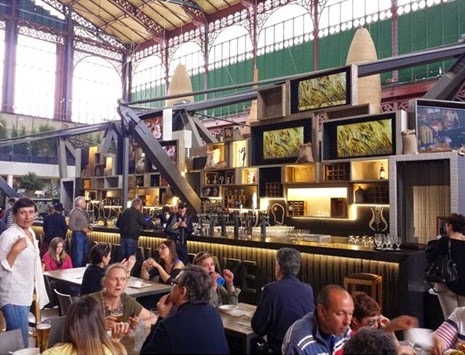
If you happen to visit Florence, these days, you may notice the brand new food mall on the upper floor of the ancient downtown market. It is a major restructuration of what used to be a vegetable market, which used to be patronized mainly by locals. Now, it is a typical American style, “food court” with many different restaurants sharing the same tables.
From my personal experience, I can tell you that the food in this place is of medium quality; overpriced, but not terribly so. It is the kind of food that foreign tourists have come to expect in Florence, I’d call it fusion food with a Florentine veneer. Note that I have no intention of discouraging you from trying this place. On the contrary, it is at least a way to avoid the many abominable tourist traps you may be unfortunate enough to stumble upon in Florence (you may also like to take a look at some notes of mine on the ancient Florentine cuisine). I just wanted to note how it the new food court is an example of the present trends of the Italian economy.
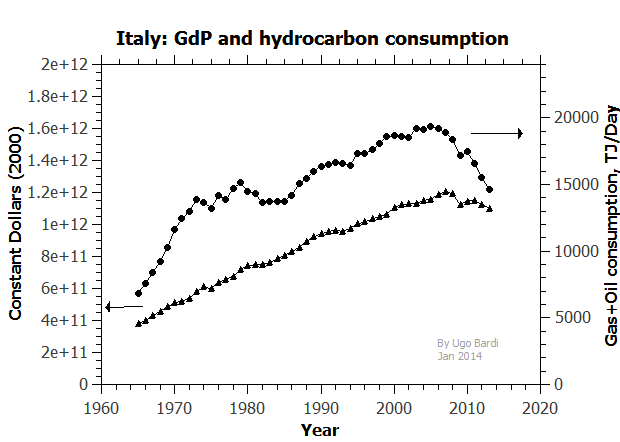
I have already discussed the Italian collapse in previous posts (one and two). The collapse keeps going and the latest results from the Italian Statistical Institute (ISTAT) indicate that Italy has lost 25% of its industrial production after 2008, with no signs of improvement in view. Politicians are screaming about “restarting growth” but there is little that anyone can do facing such a disaster. The best they seem to be able to conceive is to trick the statistics in order to create the appearance of a non-existing recovery.
The collapse is mainly the result of the increasing burden on the Italian economy of more and more expensive imported mineral commodities. This extra burden has destroyed the competitivity of the Italian manufacturing industry. As a consequence, the Italian economic system is actively re-adapting, trying to find new resources. It must find “light” market niches, areas which don’t need large amounts of energy and minerals to be run. It is finding them mainly in the fashion and the food industries.
 If you live in Italy, and especially in Florence, you can’t avoid noticing how the fashion industry is prospering; you can see that also from highly debatable initiatives such as “dressing” the Baptistery church in Florence as if it were a gigantic foulard. Gone are the traditional manufacturing power centers, and with them there went much of the traditional financial power in Italy. The Monte dei Paschi Italian bank survived the Black Death during the Middle Ages, but it may not survive peak oil! Even the celebrated new prime minister of Italy, Mr. Matteo Renzi, is a consequence of the new balancing of the economic power in Italy.
Tourism is also quickly gaining a new status of fundamental resource in the Italian economy. Tourism has always been a traditional Italian industry, but now it is becoming something new: with impoverished Italians traveling less and less, International tourism is becoming dominant. But it is not any more the time when international visitors would stay in Italy for months or years, to explore the ancient culture and landscape. Now, tourists stay a few days at most and have little time and interest to explore things other than the standard sightseeing tours in the art cities: Venice, Florence and Rome. The result is the concentration of tourism in areas where it can be efficiently exploited by initiatives such as the food court in Florence I was reporting about. Outside these centers, tourism is in trouble, too.
So far, the expanding economies of some countries, primarily China, are providing an increasing flux of tourists to the main touristic centers of Italy. However, it takes little to expose the fragility of this small economic boom in Italy. Think of the possibility of a new financial crisis, such as the one of 2008, and you can imagine what’s going to happen. Will the upper floor of the San Lorenzo market return what it used to be? Maybe, and my impression is that we really lost something by dismantling the old vegetable market.
10 Comments on "Italy: adapting to collapse"
J-Gav on Wed, 9th Jul 2014 5:53 pm
This article is of minimal interest since it conveys minimal information.
“Tourism is also quickly gaining a new status of fundamental resource in the Italian economy.” Santa Maria vergine con tutti i santi dentro e Cristo come tappo! It’s not as if this hasn’t already been the case for some time now.
Povera buggerata Italia! If anyone’s interested in a more detailed analysis, you could take a look here :
http://www.lrb.co.uk/v36/n10/perry-anderson/the-italian-disaster
Makati1 on Wed, 9th Jul 2014 8:03 pm
“… The best they seem to be able to conceive is to trick the statistics in order to create the appearance of a non-existing recovery…”
Sounds like they did learn something from the US…
Plantagenet on Wed, 9th Jul 2014 9:41 pm
Interesting article about the de-industrialization of Italy. The reason for this is the Euro—-in the old days Italy would devalue the Lira to make their manufacturing exports competitive on the world market. But now they are stuck with the Euro, and as the Euro gains in value the Italian products become more and more expensive and are no longer competitive on the world market.
Beery on Thu, 10th Jul 2014 6:12 am
Not sure how a 150 year-old market can be called “ancient”, but maybe the writer is an American.
herrmeier on Thu, 10th Jul 2014 6:13 am
I never understood that argument “and as the Euro gains in value the Italian products become more and more expensive and are no longer competitive”.
Why not lower the price? Ain’t that having the same effect as devaluing your currency?
J-Gav on Thu, 10th Jul 2014 3:13 pm
herrmeier – Euh, no, because that means that your profit margins are so low that wages and workforce will be slashed. Not exactly a ‘solution’ in a consumer-based society, if you follow my drift.
herrmeier on Thu, 10th Jul 2014 3:53 pm
J-Gav: I don’t quite get your drift. I don’t mean lower the price on your goods sold only, but ripple it thru to the bottom man. Lower salary.
In the end whether I sell something for 10000 lira that cost me 9000 lira to make is the same as selling it for euro 8 I paid euro 7 to make. I’m not getting it.
J-Gav on Thu, 10th Jul 2014 4:02 pm
herrmeier – Just how are salaries supposed to go any lower than they are now without a major disruption for retailers? Henry Ford understood that a century ago when he said ‘I pay my workers decent wages because I want them to be able to buy the products they produce.’ Not rocket-science.
herrmeier on Thu, 10th Jul 2014 4:24 pm
Yes J-Gav. I understand. But that’s not what I’m asking.
I’m asking what is the difference between lower a guy’s salary or have it evaporate using inflation?
Again. If a guy makes 10000 lira an hour working in a factory it’s the same as working for $10/hr.
When I goes out to have beer he will either pay 5000 lira for the beer or he pais $5 for the beer. What’s the difference?
When he imports a Mercedes he will have to pay 10M lira to get it or $100k, what’s the differenc?
I don’t quite understand why having your own currency and inflate it will make you more competitive as opposed to just lower minimum wage and leave your currency alone.
Makati1 on Thu, 10th Jul 2014 7:48 pm
herr, the problem in the US today is that wages are falling, causing stores to close due to lack of cash for the items they sell. In most cases, labor is not the major cost of an item, it is energy, materials, machinery, factory buildings, and shipping of those same things to the customer. Lowering wages only makes it more likely you will not sell any of your product at any price unless it is a necessity and few things are REAL necessities. 95% of the malls would be empty if they only sold necessities.