
Peak Oil is You

Donate Bitcoins ;-) or Paypal :-)


Page added on November 19, 2013

Imminent peak oil could burst US, global economic bubble
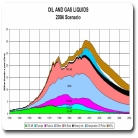
A new multi-disciplinary study led by the University of Maryland calls for immediate action by government, private and commercial sectors to reduce vulnerability to the imminent threat of global peak oil, which could put the entire US economy and other major industrial economies at risk.
The peer-reviewed study contradicts the recent claims within the oil industry that peak oil has been indefinitely offset by shale gas and other unconventional oil and gas resources. A report by the World Energy Council (WEC) last month, for instance, stated that peak oil was unlikely to be realised within the next forty years at least. This is due to global reserves being 25 per cent higher than in 1993. According to the WEC report, 80% of global energy is currently produced by either oil, gas or coal, a situation which is likely to continue for the foreseeable future.
The new University of Maryland study, in contrast, conducts a review of the scientific literature on global oil production and argues that the bulk of independent, credible studies indicate that a “production peak for conventional oil [is] likely before 2030”, with a “significant risk” it could occur “before 2020.” Unconventional oil such as Canadian tar sands is “unlikely to expand enough to fill the gap”, and this also applies to “shale oil and gas.” Shale wells, the study argues, “reach their maximum production levels (peaks) much earlier than conventional ones and are therefore difficult to operate profitably.”
Although US Geological Survey (USGS), Energy Information Administration (EIA) and International Energy Agency (IEA) estimates project that the decline of conventional resources will be more than compensated by ‘yet to be developed’ and ‘yet to be found’ fields, other scientific studies find that these “projections are overly optimistic.”
The new study is published in the journal Global Environmental Change (GEC) by the leading academic science publisher, Elsevier. GEC is the most influential geography and environmental studies journal in the world.
Mapping out the key sectors most vulnerable to the impact of peak oil, the paper concludes:
“Given that there is substantial evidence that Peak Oil is imminent, the paucity of research looking at the potential economic impacts of this phenomenon is surprising.”
The study notes that “oil shortages pose a high risk for economies” and points to evidence that high oil prices were a “partial cause” for the 2008 global financial crisis. Focusing on the US economy – the biggest consumer of oil and oil-based products in the world – the study found that all major industrial sectors were at risk, including food and food processing, primary agriculture, metals and metals processing, and transport:
“Because such sectors contribute substantially to US GDP, and because they connect to so many other sectors, they could put the entire economy at risk in the case of Peak Oil or other supply interruptions. The present economic system relies strongly on them and their output may become significantly more expensive due to oil price increases.
The IMF has calculated that for the global economy to grow by 4% in the next five years, oil production must increase by 3% per year. This looks increasingly unlikely.
Last year, a paper in Nature co-authored by Sir David King, the UK government’s former chief scientific adviser and currently the government’s climate change envoy, concluded that a “tipping point” in the global oil supply had been reached since 2005, with global conventional production hitting a ceiling of around 75 million barrels per day (mbd) despite price increases of 15% a year. That paper also noted that production at shale gas wells can drop 60 to 90% in the first year of operation.
There are two prime ways to adapt to these potential risks, according to the new study. One is to decrease the vulnerability of critical sectors:
“Examples may include curbing the strong dependence on artificial fertilizers by promoting organic farming techniques, or reducing the overall distance traveled by people and goods by fostering local, decentralized economies.”
The other is to identify substitutes for vulnerable sectors with outputs from less vulnerable sectors.
The problem with the latter approach is that “our society is reaching limits in the possible global production flows of many natural resources” including coal, phosphorous, uranium and other minerals. However, the risks mapped out here could help “in designing a roadmap toward a post-carbon economy.”
4 Comments on "Imminent peak oil could burst US, global economic bubble"
J-Gav on Wed, 20th Nov 2013 12:13 am
” … production peak for conventional oil is likely before 2030″ ???!!!
With a “significant risk it could occur before 2020” ???!!!
I think I’m gonna bust a gut laughing … because then they go on to indicate a “tipping point” was reached in 2005!
The article seems well-intentioned but how many contorsions does a journalist have to go through to make a simple statement?
BillT on Wed, 20th Nov 2013 1:28 am
There was a reason that most people were employed at farming for so many millennia. They did not have oil slaves to do it for them.
The ‘middle class’ exists because of the excess oil energy of the last 100+ years. No other reason. The ‘excess’ energy skimming was started by priests, then came kings, then nobles, then merchants. It took coal, oil and NG to make the next jump to ‘middle class’ people who did not have to work on farms or were not of the ‘upper class’. As that excess hydrocarbon energy declines, so will the middle class. Serfs and Nobles, IF there is a future for homo sapiens.
bobinget on Wed, 20th Nov 2013 5:07 pm
Continuing Bill’s line of thought.
Oil consumption went higher last week by over 7% from last year. As any old crappy jobs come back we will consume more oil.
For the week of Nov 15th:EIA
Total products supplied over the last four-week period averaged 20.3 million barrels per
day, up by 7.4% from the same period last year. Over the last four weeks, motor gasoline
product supplied averaged 9.1 million barrels per day, up by 3.8% from the same period
last year. Distillate fuel product supplied averaged 4.2 million barrels per day over the
last four weeks, up by 8.8% from the same period last year. Jet fuel product supplied is
up 7.8% compared to the same four-week period last year.
shortonoil on Wed, 20th Nov 2013 8:25 pm
Petroleum production requires an energy input, just like all economic activity. As time progresses, viscosity, well depth, and water cut increase. This requires more energy to overcome. As petroleum is used primarily as a source of energy it must be capable of delivering more energy than it takes to produce it. If it didn’t it would no longer be a source, but a sink.
Greater production is not necessarily beneficial. Shale oil, bitumen, and extra-heavy oil are very feeble energy suppliers. In the meantime the energy requirements for conventional crude production have been increasing. The additional energy needed to produce conventional passed the little bit extra that is supplied by non-conventional several years ago. We are definitely past peak energy from petroleum, and unless several new Ghawars are found, it is downhill from here. Expect a long term economic decline to go with it. Expect a significant decline in the integrated global economy over the next two decades. The days of fabulous oil wealth are ending!