
Peak Oil is You

Donate Bitcoins ;-) or Paypal :-)


Page added on February 16, 2016

How far can a bridge fuel reach?
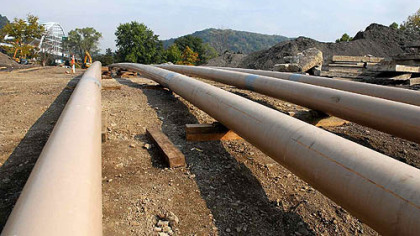
Rarely have things in the volatile world of energy aligned to make as much economic sense as, say, building new natural gas-fired power plants, expanding transmission pipelines and extending gas utility service to entire communities.
Natural gas has become the fuel du jour as a boom in drilling over the past decade has sent prices plummeting. Natural gas also has half the carbon emissions of coal and therefore an advantage as regulators strive for a cleaner energy sector across the board. Advocates often call it a “bridge fuel” to a future powered by renewable energy.
Despite projections that natural gas prices will remain low for at least the next few years, some have wondered whether the power sector’s love affair with the commodity is risky business. Extending the bridge analogy, they ask: How wide is the river, anyway?
“It’s pretty clear that natural gas has a pertinent role to play in lowering electricity costs and reducing carbon pollution,” said John Rogers, senior energy analyst at the Union of Concerned Scientists and co-author of a report in October that ranked states on risks of overreliance on natural gas generation.
“The issue is how much is too much. … Are we overbuilding, are we putting stuff in the ground that we’re not going to want?”
The Cambridge, Mass., nonprofit found two-thirds of states are at risk of “overreliance” on natural gas generation by measuring the states’ current share of overall capacity, the expected increase in share of capacity, emissions and two other categories. Pennsylvania is among six riskiest states, the group found.
In the report, the group suggested clean energy and efficiency should play a greater role in discussions about the future of the power sector. If, and when, natural gas prices would rise, power plants could become more expensive to operate. And should there ever be a price on carbon, those costs would be passed on to consumers.
“Pennsylvania is really going to want to think hard about maximizing clean energy before going down the natural gas path with big new commitments,” Mr. Rogers said, noting the Commonwealth ranks 16th in the country for wind generation and 12th for solar. “Even though it’s one of the top producers, it’s still got to worry about price spikes, the added costs of carbon pollution.”
Long-term commitments
Still, most others — including gas producers, financial and credit analysts and government officials — don’t see a problem, particularly when it comes to transmission pipelines. If anything, the problem is the opposite: not enough infrastructure.
“The current conditions clearly suggest there aren’t enough pipelines in the area,” said Lindsay Schneider, principal analyst for Wood MacKenzie.
Last fall, more than 3 billion cubic feet per day (Bcf/d) of pipeline capacity became available in Ohio and Pennsylvania, Ms. Schneider said. Projects proposed to come into service this fall amount to half that capacity — 1.3 Bcf/d — as pipeline builders have postponed projects in response to the poor market conditions.
“It’s not like these pipelines are going to be built without firm commitments,” from both producers and power plants, she said.
Indeed, the method for bringing new pipelines into service requires long-term commitments, said Anusha de Silva, an associate director with IHS Energy. Interested natural gas customers — such as a power plant or a local utility — essentially underwrite the project by agreeing to pay for a portion of a pipeline’s capacity.
Unlike a utility customer’s monthly bill, pipeline customers pay a fixed amount for capacity, regardless how much gas actually flows through the pipe, Ms. de Silva explained.
Dictated by geography
Mr. Rogers of the Union of Concerned Scientists said natural gas is important to fill the gap, but he’s concerned that natural gas is crowding out renewables.
Ms. de Silva said the cost-effectiveness of solar and wind depends on the location. Pennsylvania, for example, has wind turbines on top of ridges in Somerset and Fayette counties, but lacks the flat windy plains of Kansas.
Therefore, the consumers have spoken, in part, by underwriting the growth in pipelines.
“You can wish to have all of our energy production to be sourced by renewable generation in a utopian world, but in reality, the geography dictates how much renewables you can have,” she said. “You can use this generation to fill the gap where you wouldn’t be able to serve if you just had renewables.”
Still, recent credit reports for power utilities highlight possible risk when it comes to natural gas prices.
Despite the harsh rhetoric surrounding environmental regulations — including arguments that led to a surprising U.S. Supreme Court stay last week of federal cuts on carbon emissions — electric utilities remain protected by regulation, guaranteed revenue and access to cheap natural gas, according to a 2016 credit outlook from Standard & Poor’s Ratings Services last month.
But the report also found diminished fuel diversity poses a long-term threat as utilities switch to natural gas.
“Although industry projections are that natural gas prices will be stable, we believe that the return of price volatility is ultimately unavoidable,” writes Jeffrey Panger, author of the report. Higher prices could happen if “demand for natural gas increases due to economic expansion or regulations prompt switching” to gas from coal, he wrote.
Specifically on clean air regulations, Mr. Panger wrote that ”as long as gas prices remain low, the impact [of the regulations] should by-and-large by manageable. But should historical volatility return, the financial burden and risk would be greatly magnified.”
In that report, the credit agency projected natural gas prices will average $3 per million British thermal units (mmBtu) in 2016, $3.25 per mmBtu in 2017 and $3.50 per mmBtu in 2018. The agency has since lowered price expectations by 50 cents to $2.50 in 2016, $2.75 in 2017 and $3 in 2018 and beyond.
13 Comments on "How far can a bridge fuel reach?"
coffeeguyzz on Tue, 16th Feb 2016 8:15 am
The final sentence in the above article has enormous ramifications.
That sentence stems from the latest developments emanating out of the Utica.
rockman on Tue, 16th Feb 2016 8:36 am
Folks can accept such prediction as the like. But check the volatility of NG prices (http://geology.com/articles/natural-gas-prices/natural-gas-price-history.gif) over the last 15 years and consider that I don’t recall a single correct prediction of any boom or bust in the price of NG. But I do recall many that were completely ass backwards. Like the predictions at Devon when I was on contract there. Those projections led them to signing 18 long term drill contracts to chase NG in the Haynesville Shale. And then suddenly they paid $40 million to cancel 14 of those contracts when prices collapsed. And IMHO the folks at Devon where some of the smartest I had worked with in 4 decades.
coffeeguyzz on Tue, 16th Feb 2016 9:27 am
Rockman
The historical volativity is real, as is the ever present uncertainty regarding the future.
However, the continuing success in accessing both the so-called dry gas area of the Utica and the more recent Deep Utica (11,500′-13,500’+) is profoundly altering the view of future supply.
Antero’s recent Rymer 4HD is the southernmost deep Utica being located in Tyler county West Virginia.
It is flowing 20MMcfd on restricted choke.
100 miles to the northeast, as the crow flies, is Consol’s Gaut 4IH, IP of 61MMcf and currently flowing at varying rates in testing mode.
Between these two wells lie some of the most hydrocarbon rich rock on the planet.
The sweet spot of the Marcellus is 5,000′ above the Utica as is the Upper Devonian formations (Burket, Genesee, Rhinestreet, Middlesex, Geneseo) and, deeper yet, the Trenton-Black River.
I sure don’t know what the pricing will be next week, let alone several years out. But there is growing consensus that this vast, vast hydrocarbon resource is only in its earliest phases of being developed.
Alpha9 on Tue, 16th Feb 2016 11:23 am
Nat Gas is dead in the 20 US southern states. Solar and wind are cheaper.
There is no economic justification for Fracking for Electricity.
Apneaman on Tue, 16th Feb 2016 11:49 am
coffeeguyzz, try not to cum in your pants. enormous ramifications? No. Only in your corny head. It’s over and no amount of fracking is bringing back what once was. Look at all the oil and gas that was extracted because of fracking in the last decade. What good has it done economically? Fuck all. Maybe delayed a fast collapse, but there was never anything other than a paper recovery and can kicking. Now it’s crashing all over again and all this so called cheap energy ain’t making a damn bit of difference. Counting barrels and BTU’s has as much bearing on reality as the football scores. Keep obsessively counting though – it’s a great way to avoid the bigger picture.
marmico on Tue, 16th Feb 2016 11:54 am
For the doom porn aggregator:
After a brief hiatus the Mighty Marcellus Bridge gets longer.
http://www.ohio.com/blogs/drilling/ohio-utica-shale-1.291290/new-pipelines-boost-production-in-utica-marcellus-shales-1.662407
JuanP on Tue, 16th Feb 2016 12:22 pm
This bridge won’t reach far enough for most of humanity, but it is working today in many places.
There was no piped natural gas in Uruguay 25 years ago, just bottled Propane. Now there is a pipeline that brings Bolivian gas and many people use piped NG from Bolivia in their homes. Building the pipeline network to distribute this gas in the cities is a never ending construction mess down there. Very few still use heating oil.
Nony on Tue, 16th Feb 2016 12:53 pm
Gas is up 40% in volume from the mid-2000s.*
http://intelligentgastechnology.com/img/fullsize/ng_prod_900x639.png
*At the same time price is down ~70%, so it’s a supply increase more than a demand increase. There is just a LOT of natural gas in the US and it is available at CHEAP prices. Rock knows this. He got his ass kicked out of GOM gas drilling because it was not economical. It’s not economical because shale can do it better. Survival of the fittest–and a powerful animal is on the prowl.
Apneaman on Tue, 16th Feb 2016 1:00 pm
marmi, I thought you had no opinion on anything AGW related?
Apneaman on Tue, 16th Feb 2016 1:04 pm
I’m in Awe at Just How Fast Global Trade is Unraveling
http://monetarywatch.com/2016/02/im-in-awe-at-just-how-fast-global-trade-is-unraveling/
Apneaman on Tue, 16th Feb 2016 1:06 pm
Chinese Exports Plunge 11.2 Percent As Economic Activity Continues To Collapse All Over The Planet
http://banksterbubble.com/chinese-exports-plunge-11-2-percent-as-economic-activity-continues-to-collapse-all-over-the-planet/
Yabut the Marcellus and and bridges N stuff. Side air bags too.
Apneaman on Tue, 16th Feb 2016 1:13 pm
High risk of bankruptcy for one-third of oil firms: Deloitte
“Roughly a third of oil producers are at high risk of slipping into bankruptcy this year as low commodity prices crimp their access to cash and ability to cut debt, according to a study by Deloitte, the auditing and consulting firm.
The report, based on a review of more than 500 publicly traded oil and natural gas exploration and production companies across the globe, highlights the deep unease permeating the energy sector as crude prices sit near their lowest levels in more than a decade, eroding margins, forcing budget cuts and thousands of layoffs.
The roughly 175 companies at risk of bankruptcy have more than $150 billion in debt, with the slipping value of secondary stock offerings and asset sales further hindering their ability to generate cash, Deloitte said in the report, released Tuesday.
“These companies have kicked the can down the road as long as they can and now they’re in danger of kicking the bucket,” said William Snyder, head of corporate restructuring at Deloitte, in an interview. “It’s all about liquidity.”
http://www.reuters.com/article/us-usa-shale-bankruptcy-idUSKCN0VP0O6
“….they’re in danger of kicking the bucket….”
https://youtu.be/LKPOhFZuFQg?t=8
penury on Wed, 17th Feb 2016 4:12 pm
The strange thing is, that most people will not believe in the collapse until it hits them. Too late folk. But if ignorence is bliss, then these folk will be happier than us.