
Peak Oil is You
Donate Bitcoins ;-) or Paypal :-)


Page added on October 19, 2016

Hidden Fragility – What Happens When The Electricity Is Off For Three Days?
what happens when an electricity dependent society and economy has an extended loss of electrical grid and communications?
One of the hidden realities of modern life is its fragility. For example, few people are aware of the precariousness of the supply chain that refills gasoline/petrol stations around the world every few days.
A new book, When Trucks Stop Running: Energy and the Future of Transportation explores the fragilities of our truck-dependent supply chains.
Longtime correspondent Bart D. (Australia) recently experienced a multi-day regional loss of electricity. His first-person observations help us understand what breakdowns in energy are like on the ground.
* * *
Observations of life in an extended power failure by Bart D. (Australia)
South Oz is continuing with its streak of extreme weather. The latest being our encounter with what’s being described as a category 2 ‘hurricane’ with the added bonus of a severe front preceding it that produced many low-grade tornados. A score of major power transmission towers were twisted off their footings, 80 000 lightning strikes fried out a lot of ‘secondary’ electricity infrastructure … 40% of power that is usually being generated from wind had to be shut down due to extreme winds and base load backup generators failed in many locations (including my region).
End result … entire state without electricity for a day and a half. Some regions, including my home region, (about the size of the state of Tasmania) were without electricity for 3 nights and 2.5 days.
It was a fascinating opportunity to observe firsthand what happens when an electricity dependent society and economy has an extended and complete loss of electrical grid and communications.
Key observations for my local area are:
1. Many people have small petrol generators thanks to our lovely coastal wilderness and a preoccupation with Glamping (Glam Camping)
2. Very few people had a store of petrol at home more than 5 to 10 litres. (usually kept for use in lawn mowers, brush cutters, chainsaws). Some owners of small boats had up to 20 litres on hand.
3. When the electricity goes out … the pumps at fuel stations don’t work. To my great surprise, only 1 fuel station in my nearest city of about 14 000 population had (or quickly acquired) a back-up generator to work their fuel pumps. There was a 3 hour wait for customers to get from back of queue to the pumps … and a ridiculous show of ‘bulk buying’ where people didn’t just take fuel that they personally needed; they showed up with between 3 and 8 X 20 litre (5 gallon) fuel cans as well as filling their cars. Hopefully the canned fuel was distributed among family and friends. (My assertion is that the owners of the station should have rationed fuel to 40 litres per customer to keep the que moving faster and to make sure everyone had some, rather than creating an ‘all or nothing’ situation)
4. Due to the difficulty with getting hold of petrol after the blackout started … almost everyone with generators at home could only run them for a few hours over the course of the entire blackout. Even then, the small camping gensets usually lacked the capacity to run large modern refrigerator/freezers. So … most people lost the contents of their fridges by the end. Due to cold weather, at least freezers stayed cold for the most part.
5. Big shops had their own gensets … but they can’t power the banks of chillers for meat and dairy … so these items became unavailable by the evening of the blackout starting.
6. The full loss of grid, grid back-up and other smaller backups caused telecommunications and data transmission to practically cease. This meant limitations of EFTPOS in stores. Banks were shut, ATM’s didn’t work and some shops that were open could only take cash. Generally though, everyone muddled through the sketchy electronic payment systems one way or another. Internet access failed for the most part. Social media pretty much collapsed … my two daughters though their social lives were over. I didn’t miss it. My wife found more time to do other things too.
7. The items that disappeared from the shelves fast, and were tricky to find after 24 hours without power were : Bread, D cell batteries, 6 volt square batteries, matches, heat beads, butane gas cans, fresh meat, sandwich meats, cheeses. (not sure about bottled water – most here have rain tanks anyway). Everything else seemed fine, although fresh fruit and veg got limited after 48 hours.
8. In hardware/camping stores that managed to open: bottled LPG quickly sold out as did BBQ’s, camp stoves, camp lights and batteries to run them. Most here have a gas BBQ at home, but if you didn’t already have a full bottle of gas … it was very hard to get a replacement after 48 hours.
9. No one here knows how to use a road intersection properly when the traffic lights are out! I think this helped create major gridlock in the states capital but was even noticeable here at my much smaller regional city with just one such intersection containing lights. (public education urgently required on this)
10. The number of back-up gensets at critical locations (including hospitals and communications systems) that failed was disturbing. There needs to be a major inquiry into why the back-ups on critical services failed. This nearly caused a shutdown of mains water supply as our water is pumped out of aquifers and has to be lifted to storage tanks high up in the hills. More of a problem for sanitation than drinking, as rain tanks are common here.
11. Then there were a few people like me … I ran my big ‘workshop’ genset 7 hours a day (hour in the morning, hour at lunch time, 4-5 hours in the evening) and was burning about 7 litres of fuel a day in doing so. My home fuel reserve meant I could run at that extravagant level for a month if need be, or supply others who fell short. We ran refrigerators, lights and TV almost ‘as usual’ and offered to charge anyone’s batteries who needed it and supplied a small camping gas burner, full cylinder of gas and a good battery powered camping light to my parents-in-law who were seriously underprepared. The rest of my small home town (located 20km from a regional city) was rather dark and quiet for the three nights (in part due to the lack of pre-stored fuel to run camping gensets).
12. We have a gas stove in our kitchen, with bottled LNG that lasts 3 -5 months in normal use, so cooking was as normal for us. Since we didn’t try to use the gas to also heat washing/bathing water it would have lasted for the usual amount of time.
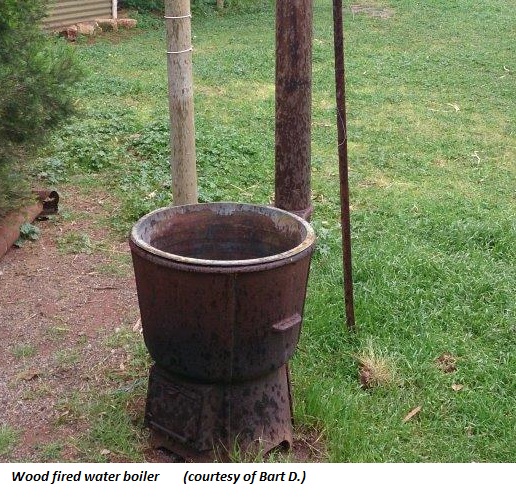
13. When most were having cold showers, no showers, wasting their BBQ gas to heat pots of water or crowding into friends and relations who had LNG hot water systems in their houses … our family had hot baths by candle light in huge volumes of wood heated water. (Picture of my old wood heater below.) It is very efficient, made in the 1940’s I think, but possibly much older. The inner bowl is copper and absorbs heat from a small fire lit behind the square opening in front. It can boil 70 litres in 20 minutes from a cold start, or 15 minutes for a refill of water once it’s already been going a while.
14. Apart from the fuel distribution fiasco everything remained orderly, people remained calm and helpful and life went on. Strangers were a lot chattier with other strangers than usual … which is good to see. I saw examples of shops extending ‘unsecured credit’ for small amounts of basic food items to people who had no cash on them and whose cards didn’t work. No looting, no “Law Enforcement” out making trouble and plenty of sharing and cooperation.
15. Although about a quarter of houses have solar panels or solar thermal hot water where I live … none of it worked as it’s all grid connect AND doesn’t work under the heavy cloud/rain/cold of a 3 day storm.
I’ve been thinking about getting ‘stand-alone’ solar power (ie connected to my own batteries) since they closed the big coal fired station in the north of my region, (and the price of these systems has become quite affordable). Our region is at ‘the end of the line’ of our state grid now and I expect regular outages this summer when hot, calm conditions prevail that reduce our wind generation output at the same time as spiking power use for air conditioners. Our electricity now has to travel up to 1600km (1000 miles) from the state of Victoria to reach us when the windmills aren’t working here!
* * *
Thank you, Bart, for sharing your observations. The resilience (or lack thereof) of complex systems is difficult to assess until there are atypical strains placed on the system.
What seems effortlessly resilient on average days can break down dramatically if redundancies, proper maintenance and crisis response have been stripped from the system by incompetence, budget cuts and/or the self-serving priorities of managers and employees.
As a result, we only discover systems have become fragile and brittle in crisis, when it’s too late to restore resilience.
Of related interest: Australia Finds Out Wind Power Doesn’t Really Work (via John D’A.)
This entry was drawn from Musings Report 42. The Musings Reports are emailed exclusively to subscribers and patrons at the $5/month or above level.
Join me in seeking solutions by becoming a $1/month patron of my work via patreon.com.
Hugh-Smith via OfTwoMinds blog
15 Comments on "Hidden Fragility – What Happens When The Electricity Is Off For Three Days?"
makati1 on Wed, 19th Oct 2016 7:27 pm
Send money…. LMAO
Most every winter, electric is off for days, sometimes a week, where my sister lives. They are prepared. When I designed their home 22 years ago, I made sure they had a very efficient European made fireplace and that everything was well insulated. They keep plenty of food and supplies and have a generator for use if needed. No problem. If you live in a northern region of the world, you prepare or suffer.
For the coming breakdown of the grid in the US, few are even close to prepared. Weeks without electric will cause millions of deaths. Millions of bodies to dispose of. Few can even imagine such a scenario as it has not happened in their life time. Even worse, few in America even have the resources to prepare if they did know.
Ghung on Wed, 19th Oct 2016 7:42 pm
Gridweenie problems.
Hawkcreek on Wed, 19th Oct 2016 8:27 pm
Yep, its good to live off grid. I’ll just stay away from town until the bodies quit stinking.
makati1 on Wed, 19th Oct 2016 8:54 pm
Hawk, the disease WILL come to your house. You have no need to go there. And who said your neighbors will not be among the dead? Or even you?
Denial of shared problems does not make them go away. Nor the rats, flies, fleas and other disease carrying vermin that will flourish with so much dead meat around. The Black Plague was carried by the fleas on rats. And who knows what is now carried by mosquitoes.
rockman on Wed, 19th Oct 2016 10:31 pm
“…few people are aware of the precariousness of the supply chain…” Except, of course, for the millions that grew up in hurricane alley. And probably a few other spots around the country. Granted it was for an extended periods. But you don’t have to deal with 98° temp in S La without even a fan too long to appreciate that it sucks. LOL. Nor see the latest report of someone freezing to death or dying from carbon monoxide poisoning and not appreciate the dangers of no heat in a Minnesota winter.
Maybe instead of a national night out to meet the neighbors maybe a national week w/o electricity would help some appreciate such circumstances better.
JuanP on Wed, 19th Oct 2016 10:34 pm
If we lost power in Miami for 3 or more days during the summer then many homes would start having mold problems which would lead to huge expenses. Homes that are ore than 40 years old would be mostly OK but the newer a place is the worse its ventilation.
makati1 on Wed, 19th Oct 2016 11:40 pm
JuanP, all stick wood and sawdust(frame) houses would begin to deteriorate right away. Even faster than they do with A/C to keep them semi-dry. Same here in the Ps where most construction is masonry and concrete with metal roofs. Little wood is used here in construction, except by foreigners who don’t seem to know better and want a home like they had ‘back home’.
Cross ventilation and natural light are not often a consideration in new American homes. It is ASSUMED that there will ALWAYS be electric to power the dryers and lighting, so “appearance” is more important. Our grandparents, if they are still around can tell us all about those problems, pre-electric.
Davy on Thu, 20th Oct 2016 5:44 am
Power being out for a few days is good for people. It reminds them of reality. It is kind a like when out in the woods and taking a shit and accidently stepping in it. What this does is it makes you take ownership instead of being an angle above it all. Electricity off for more than a few weeks is the end of the game folks. The dislocation of all those fine-tuned survival networks both physical and abstract are sure to deteriorate quickly beyond that point. What happens is you get past a point and the decay takes parts off line permanently. This is a knock on effect and contagious. This is if the outage is widespread. Earthquakes and hurricanes are not a big deal compared to regions or nations.
What is more likely in our future is the Paki or Iraqi experience in places like Karachi or the Sunni tribal areas where you get electricity intermittently and variably or where generators dominate. These current generator option will eventually go intermittent and variable also as the global oil supply network goes variable and intermittent. We are likely heading into a world of variability and intermittency without regularity.
This is a perfect world to prepare for with a small scale solar system individually. If the power goes out you are going to want lighting. Next if you have the resources a small frig run by solar. This will be a world of economic decay with food and fuel insecurity. It will be a difficult world for those places exposed to adverse climate and unsustainable food networks. Places like the third world will become even more a disaster as the larger populations become unsupportable at all. Remember food today is global and in direct relationship to fossil fuels. Lower electricity and liquid fuels and you lower food output. Most overpopulated third world countries are still growing now because of adequate energy and a still growing global economy.
I say still growing but that is a misnomer. It is growing malinvestment that is a Ponzi arrangement of wealth transfer and natural exploitation. The adequate energy is a misnomer because energy supplies are being destroyed by demand destruction. We are operating an oil industry into the ground with debt destruction and physical cannibalization. Bad debt destroys industries and economies and that is the nature of the oil industry at all levels. We are going down a deflationary spiral with an underlying global situation of overshoot across a broad spectrum of support.
Power represent the highest of our complexity and the reliability and quality of electricity will signal the real decay of our world. Currently we see many articles explaining how technology and efficiency is lowering energy intensity. The big talk now is peak demand because we are so innovative not for the real reason of deflation and declining demand velocity. If you want to see what is really going on in an economy monitor the electricity demand and the quality of the delivery. Yes, technology and efficiency is playing a part in the reduction of demand but the amounts are negligible compared to deflation and demand destruction. It is a great rallying point for the gridweenies and greenies alike. They want to point to a shiny new world of low carbon and green prosperity. Our reality is very much different than the social narrative of status quo progress.
onlooker on Thu, 20th Oct 2016 7:22 am
For the coming breakdown of the grid in the US, few are even close to prepared. So true Mak. Checkout this article http://www.naturalnews.com/036355_natural_disaster_power_grid_preparedness.html
Notice: In a total grid down scenario, food and water supplies in a given U.S. city will disappear almost overnight. It’s much the same for gasoline, batteries and even ammunition. All these supplies (and many more) will simply be stripped from the shelves.
peakyeast on Thu, 20th Oct 2016 7:37 am
During a longer breakdown of electricity or food deliveries we will see something far worse than a Zombie war: We will see other ordinary humans.. Nothing on earth is more dangerous.
makati1 on Thu, 20th Oct 2016 7:58 am
Peaky, can you imagine what the sheeple will be like when their SNAP cards don’t work because the whole system is gone? ATMs are black and not even a message saying “Too Bad Fool!”. Credit/debit cards are useless plastic. Checks are worthless paper along with the stuff in their wallets. Banks closed. And, most terrible of all, their I-toys are just useless junk. All their “online” friends evaporate into the either.
It will be ‘hell on earth’ in the most developed countries where all of that is a necessity of daily life. Not to mention food, water, and shelter which will no longer be a given. I bet most have never given the permanent loss of electric a thought. lol
Kenz300 on Thu, 20th Oct 2016 2:24 pm
Wind and solar power with battery storage is the future.
Sissyfuss on Thu, 20th Oct 2016 4:37 pm
You whineey doomers can shut your traps now.
Kenz just showed us there is nuttin to fret over. Now I can get back to my origami. Oh look, it’s a buzzard, I think.
sparky on Thu, 20th Oct 2016 4:52 pm
.
some of the issues are easy to fix , some have to be managed , others have to be accepted
back up generators failures ,
diesel generators have to be started on a regular schedule to keep them healthy
that’s an industry standard ,for a critical use every week
some incompetent dumb asses should be fired !
petrol stations without power
this has been seen so many times it’s not funny
the solution is to have a junction box outside where a portable generator can be brought up and connected easily ,in New Jersey it took ages for the state emergency to connect .
a mandatory 5 gallons limit for one purchase is appropriate
Communication ,Efpos and ATM failure , that’s a bit more complicated and has to be managed
radio channels can transmit some basic information easily enough and give people the warm feeling of not being ignored ,
frequent visits by authorities help a lot , even if it’s to be yelled at.
designated emergency point for banking can be set up in one branch ,
it would have to receive a lot of cash quickly , much more than normal
(literally helicopter money !)
Failure of road signals , some education , some human interaction ,
busy crossing are actually quite good place to locate police and some comms
shops supplies ,
that’s that , shelves will empty , food will spoil ,first come first served .
heating and cooking can be problematic , depending on the location and the duration of the outage ,short term LNG bottles are good , one of the good point of having BBQ
long term forget it , severe rationing up to burning furniture and picket fences is on the horizon
unmentioned ,South Australians are very docile , amicable low pressure breed
Australians in general handle disaster with great matter of fact style and a shrug
they are self policing to a large degree and have a low population density
I’m sure some overcrowded mega-cities would simply become unmanageable
Kenz300 on Sun, 23rd Oct 2016 11:47 am
Fossil fuels are the past.
Wind and solar are the future.
How battery-powered homes are unplugging Australia
http://www.smh.com.au/business/energy/how-batterypowered-homes-are-unplugging-australia-20150731-giogk2.html