
Peak Oil is You

Donate Bitcoins ;-) or Paypal :-)


Page added on August 12, 2013

Heinberg: The Brief, Tragic Reign of Consumerism—and the birth of a happy alternative
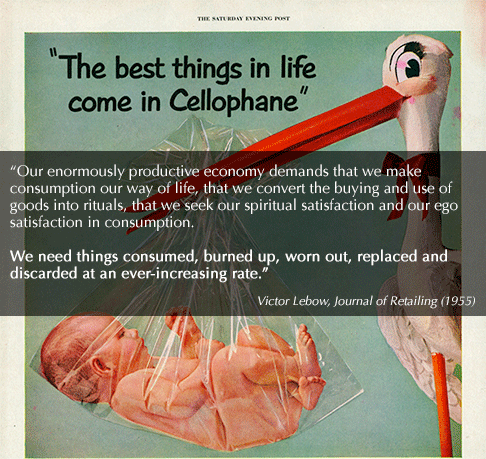
You and I consume; we are consumers. The global economy is set up to enable us to do what we innately want to do—buy, use, discard, and buy some more. If we do our job well, the economy thrives; if for some reason we fail at our task, the economy falters. The model of economic existence just described is reinforced in the business pages of every newspaper, and in the daily reportage of nearly every broadcast and web-based financial news service, and it has a familiar name: consumerism.
Consumerism also has a history, but not a long one. True, humans—like all other animals—are consumers in the most basic sense, in that we must eat to live. Further, we have been making weapons, ornaments, clothing, utensils, toys, and musical instruments for thousands of years, and commerce has likewise been with us for untold millennia.
What’s new is the project of organizing an entire society around the necessity for ever-increasing rates of personal consumption.
This is how it happened
Consumerism arose from a unique historic milieu. In the early 20th century, a temporary abundance of cheap, concentrated, storable, and portable energy in the form of fossil fuels enabled a dramatic increase in the rate and scope of resource extraction (via powered mining equipment, chain saws, tractors, powered fishing boats, and more). Coupled with powered assembly lines and the use of petrochemicals, cheap fossil energy also permitted the vastly expanded manufacture of a widening array of commercial products. This resulted in a serious economic problem known as overproduction (too many goods chasing too few buyers), which would eventually contribute to the Great Depression.
Industrialists found a solution. How they did so is detailed a book that deserves renewed attention, Captains of Consciousness by social historian Stuart Ewen (1976). Ewen traced the rapid, massive expansion of the advertising industry during the 20th century, as well as its extraordinary social and political impacts (if you really want to understand Mad Men, start here). Ewen argued that “Consumerism, the mass participation in the values of the mass-industrial market . . . emerged in the 1920s not as a smooth progression from earlier and less ‘developed’ patterns of consumption, but rather as an aggressive device of corporate survival.”
In a later book, PR! (1996), Ewen recounts how, during the 1930s, the US-based National Association of Manufacturers enlisted a team of advertisers, marketers, and psychologists to formulate a strategy to counter government efforts to plan and manage the economy in the wake of the Depression. They proposed a massive, ongoing ad campaign to equate consumerism with “The American Way.” Progress would henceforth be framed entirely in economic terms, as the fruit of manufacturers’ ingenuity. Americans were to be referred to in public discourse (newspapers, magazines, radio) as consumers, and were to be reminded at every opportunity of their duty to contribute to the economy by purchasing factory-made products, as directed by increasingly sophisticated and ubiquitous advertising cues.
While advertising was an essential prop to consumerism, by itself it was incapable of stoking sufficient demand to soak up all the goods rolling off assembly lines. In the early years of the last century Americans were accustomed to paying cash for their purchases; but then along came automobiles: not many people could afford to pay for one outright, yet nearly everybody wanted one. In addition to being talked into desiring more products, consumers had to be enabled to purchase more of them than they could immediately pay for; hence the widespread deployment of time payments and other forms of consumer credit. With credit, households could consume now and pay later. Consumers took on more debt, the financial industry mushroomed, and manufacturers sold more products.
Though consumerism began as a project organized by corporate America, government at all levels swiftly lent its support. When citizens spent more on consumer goods, sales tax and income tax revenues tended to swell. After World War II, government advocacy of increased consumer spending was formalized with the adoption of Gross Domestic Product (GDP) as the nation’s primary measure of economic success, and with the increasing use of the term consumer by government agencies.
By the 1950s, consumerism was thoroughly interwoven in the fabric of American society. In 1955, economist Victor Lebow would epitomize the new status quo, writing in the Journal of Retailing: “Our enormously productive economy demands that we make consumption our way of life, that we convert the buying and use of goods into rituals, that we seek our spiritual satisfaction and our ego satisfaction in consumption. We need things consumed, burned up, worn out, replaced and discarded at an ever-increasing rate.”
What could possibly go wrong?
Meanwhile critics had identified a couple of serious problems with consumerism.
First problem: Consumerism, according to the critics, warps human values.
Way back in 1899, when consumerism was barely a glimmer in advertisers’ neurons, economist Thorstein Veblen asserted in his widely cited book The Theory of the Leisure Class that there exists a fundamental split in society between those who work and those who exploit the work of others; as societies evolve, the latter come to constitute a “leisure class” that engages in “conspicuous consumption.” Veblen saw mass production as a way to universalize the trappings of leisure so the owning class could engage workers in an endless pursuit of status symbols, thus deflecting their attention from society’s increasingly unequal distribution of wealth and from their own political impotence. Later critics of consumerism included German historian Oswald Spengler, who wrote that “Life in America is exclusively economic in structure and lacks depth”; Mohandas Gandhi, who regarded a simple life free from possessions as morally ennobling; and Scott and Helen Nearing, authors of Living the Good Life and pioneers of the back-to-the-land movement. Social critics of consumerism like Duane Elgin, Juliet Schor, and Vicki Robin have argued that relationships with a product or brand name are dysfunctional substitutes for healthy human relationships and that consumer choice is a soporific stand-in for genuine democracy.
A second and more crucial problem with consumerism, say the critics, has to do with resource limits. Environmental scientists assert that, regardless of whether consumerism is socially desirable, in the long run it is physically impossible to maintain. The math is simple: even at a fraction of one percent per year growth in consumption, all of Earth’s resources would eventually be used up. The consumer economy also produces an unending variety of wastes, of which water, air, and soil can absorb only so much before planetary life-support systems begin unraveling.
In his 1954 book The Challenge of Man’s Future, physicist Harrison Brown envisioned devastating social and environmental consequences from the relentless growth of human population and resource consumption; Brown even managed to foresee the current climate crisis.
A few years later a team of researchers at MIT began using a computer to model likely future scenarios ensuing from population expansion, consumption growth, and environmental decline. In the computer’s “standard run” scenario, continued growth led to a global economic collapse in the mid 21st century. That project’s findings were documented in the pivotal 1972 book, Limits to Growth, which received blistering reviews from mainstream economists but has since been vindicated by independent retrospective analysis.
More recently, E. F. Schumacher, Herman Daly, William Rees, and other advocates of ecological economics have pointed out that the consumer economy treats Earth’s irreplaceable capital (natural resources) as if it were income—an obvious theoretical error with potentially catastrophic real-world results.
A self-reinforcing system
Often these critiques have led to a simple personal prescription: If buying ever more stuff is bad for the environment and turns us into vapid mall drones, then it’s up to each of us to rein in our consumptive habits. Buy nothing! Reuse! Recycle! Share!
Yet treating consumerism as though it were merely an individual proclivity rather than a complex, interdependent system with financial and governmental as well as commercial components is both wrong and mostly ineffectual. Consider this simple thought experiment: What would happen if everyone were to suddenly embrace a Gandhian ethic of voluntary simplicity? Commerce would contract; jobs would vanish; pension funds would lose value; tax revenues would shrivel, and so would government services. Absent sweeping structural changes to government and the economy, the result would be a deep, long-lasting economic depression.
This is not to say that personal efforts toward voluntary simplicity have no benefit—they do, for the individual and her circle of associates; however, the system of consumerism can only be altered or replaced through systemic action. Yet systemic action is hampered by the fact that consumerism has become self-reinforcing: those with significant roles in the system who try to rein it in get whacked, while those who help it expand get stroked. Nearly everybody wants an economy with more jobs and higher returns on investments, so for a majority the incentive to shut up and get with the program is overwhelming. Arguments against consumerism may be rationally irrefutable, but few people stop to think about them.
If mere persuasion could dismantle consumerism or replace it with something better, it would have done so by now.
Crisis time
Still, as the critics have insisted all along, consumerism as a system cannot continue indefinitely; it contains the seeds of its own demise. And the natural constraints to consumerism—fossil fuel limits, environmental sink limits (leading to climate change, ocean acidification, and other pollution dilemmas), and debt limits—appear to be well within sight. While there may be short-term ways of pushing back against these limits (unconventional oil and gas, geo-engineering, and quantitative easing), there is no way around them. Consumerism is doomed. But since consumerism now effectively is the economy (70 percent of US GDP comes from consumer spending), when it goes down the economy goes too.
A train wreck is foreseeable. No one knows exactly when the impact will occur or precisely how bad it will be. But it is possible to say with some confidence that this wreck will manifest itself as an economic depression accompanied by a series of worsening environmental disasters and possibly wars and revolutions. This should be news to nobody by now, as recent government and UN reports spin out the scenarios in ever grimmer detail: rising sea levels, waves of environmental refugees, droughts, floods, famines, and collapsing economies.
Indeed, in view of the events since 2007, it’s likely the impact has already commenced, though it is happening in agonizingly slow motion as the system fights to maintain itself.
The happy alternative
It is not too soon to wonder what comes after consumerism. If there is good news to be gleaned from the story just told, it is that this mode of economic existence is not biologically determined. Consumerism arose from a certain set of circumstances; as circumstances change, other economic arrangements will become adaptive.
If we have some idea of the circumstances that are likely to emerge in the decades ahead, we may get some clue as to what those alternative arrangements might look like. As we’ve already seen, the consumerist economy of the 20th century was driven by cheap energy and overproduction. All signs suggest the new century will be shaped by energy limits, environmental sink limits, and debt limits—and therefore by declining production per capita. Under these circumstances, policy makers will surely strive to provide a sufficiency economy. But how do we get from a consumerist economy to a sufficiency economy?
Perhaps the most promising clue comes from the emerging happiness movement. Since the 1970s, the tiny Himalayan kingdom of Bhutan has experimented with Gross National Happiness (GNH) as a measure of economic success, and recently convened a meeting at the United Nations to advocate widespread international adoption of GNH. Concurrently, the New Economics Foundation of Britain has begun publishing an annually updated Happy Planet Index (HPI), which ranks nations by the self-reported levels of happiness of citizens and by the size of countries’ ecological footprints.
The point of GNH and HPI is to count economic success more by how people feel about their lives and circumstances, and less by measuring consumption (which is what GDP does, in effect). Happiness metrics are kryptonite to consumerism, which has been shown time and again to make people less satisfied with the circumstances of their lives. A wholesale official adoption of GNH or HPI by the world’s nations would ultimately lead to a profound shuffling of priorities. Governments would have to promote policies that lead to more sharing, more equity, more transparency, and more citizen participation in governance, since it is these sorts of things that tend to push happiness scores higher.
The guardians of the consumer economy are not stupid. They will not permit the wholesale introduction of happiness metrics absent necessity. But, as we’ve seen, necessity is coming. As the current consumer economy frays and sputters, policy makers will need increasingly to find ways to pacify the multitudes and give them some sense of direction. Beyond a certain point, promises of a return to the days of carefree shopping will ring hollow. Moreover, upon first consideration, happiness indices appear relatively innocuous: they merely propose an alternative to GDP, which many economists acknowledge is deeply flawed anyway.
The happiness movement cannot solve all our problems. By itself, it can do little directly to address climate change, water scarcity, overpopulation, or a dozen other converging crises—though it could overturn an economic paradigm that tends to exacerbate all of them.
Happiness indices may constitute a collective adaptation that could ease the transition from one economic mode to the next, reducing the trauma that will likely accompany the demise of consumerism. GNH or HPI may be effective packages in which to “sell” sufficiency to policy makers and citizens; they may also be pathways to a genuinely superior mode of human existence.
10 Comments on "Heinberg: The Brief, Tragic Reign of Consumerism—and the birth of a happy alternative"
BillT on Tue, 13th Aug 2013 1:14 am
“… Consumerism … warps human values … consumerism, as a system, cannot continue indefinitely … Consumerism is doomed … when it goes down the economy goes too … this wreck will manifest itself as an economic depression accompanied by a series of worsening environmental disasters and possibly wars and revolutions. …”
All true. But, to think that we will make a 180 degree turn and overcome decades of brainwashing in time to make ” a genuinely superior mode of human existence” is just another dream. Such things only happen in novels and movies and not with the real world collapsing around them.
GregT on Tue, 13th Aug 2013 2:36 am
Heinberg gets it, and he also understands that without hope, all will be lost, for most.
The sad fact of the matter is, happiness is equated with successful careers, monetary gain, and maintaining the status quo. Nothing could be further from the truth of where we are headed.
Before this entire mess falls apart, it would be prudent to get as far away from those that don’t get it, as possible. Large population centers are not full of enlightened people. They are full of people that have been brainwashed into believing that consumerism is a foregone conclusion, and that BAU will continue on for ever.
There is a huge wake up call coming, and when people are shaken out of their sleep, they will get very hostile, very quickly.
DC on Tue, 13th Aug 2013 3:50 am
I think you are correct Greg, because humans have essentially two reactions when there apple carts get upset.
They deal with it and make new arrangements or do whatever is necessary to make the adjustments needed,
-OR-
They get really really pissed off and starting looking for someone to blame for taking away all their toys.
Now if the population were smaller, and better educated, there would a decent chance the first group would win out over the second. However, we actually have now, is a bloated population of people largely trained and skilled in consuming and wasting resources on mostly non-essential crapola.
So yes, I think they’re going to get pretty rowdy and do a lot of damage before they all start starving to death. The spirit warriors would be well advised to head for the hills before the headhunters can turn them into spirit-hunter sushi.
Arthur on Tue, 13th Aug 2013 8:50 am
Just to get in the mood for Heinberg’s post-consumerist world… yesterday watched on television the charming American romantic drama from 2010:
http://en.wikipedia.org/wiki/Letters_to_Juliet
It is about a girl from New York, who goes to Italy with her fiancee, to Verona, a city build long before the rise of the fossil fuel era. The story is not important here, important are the images of pastoral Italy, hands down the most beautiful country in Europe and thus the world. The images are somewhat idealized, but not too much. Here is a society without any signs of consumerism, apart from a rare scooter here and there. The key is community and family life against the background of a beautiful ancient architecture. It is essentially a localized community life. No bloody foreigners buth ethnic consistency and as a consequence high trust levels, no screaming advertising, local traditional produce only. No stupid cubicle jobs at the other side of the country, that become superfluous after a year anyway. This is how post peak life could look like in the long run and it is indeed not too bad.
DC on Tue, 13th Aug 2013 9:33 am
Italy may be well be all you describe, but Its important to keep in mind, Italy has some severe economic and political problems,which I am sure being where you are located, you have a better sense of that than we do. All our media reports on is the fake ‘stock market’ and the crisis of economies far away is often seldom reported, and if it is, with little depth or context.
All that rural, traditional oriented culture you speak of STILL requires a stable economy and relatively stable political system in order to remain as peaceful and bucolic as the the tourist agencies(and amerikan film directors), need it to be.
I doubt that *amerikan* director has any conception of what life in Italy is actually like, instead, I am sure he created a idealized hollywood conception based on…..probably nothing at all. Rather, amerikan directors often pick ‘exotic’ looking locales with pleasing optics and then proceed to create caricatures based on amerikans scant-to-non-existent ideas of how life is outside the ‘homeland’. Remember Arthur, despite the fact that 80% of my country lives within 150 miles of the US border, most amerikans think its all igloos and Mounties in red Serge jackets. Imagine how little there dream-factory directors are going to portray life in a country on the opposite side of the world-poorly.
In any event, I understand your point-but again, I think we need to keep in mind, that style of life you discuss is only possible in the context of a stable industrial regime. Any chance of a post-consumerist world like that film depicts, would be unlikely to come about. While its not impossible, its unlikely. Too many pre-conditions would need to be in place before a collapse, and our industrial corporate elites have shown zero inclination to allow anything like them to exist. All there efforts to date, have been focused in fact, on eliminating ALL alternatives to mass industrial, homogenous ‘civilization’, even in sunny Italy…
rollin on Tue, 13th Aug 2013 12:24 pm
“Consider this simple thought experiment: What would happen if everyone were to suddenly embrace a Gandhian ethic of voluntary simplicity? Commerce would contract; jobs would vanish; pension funds would lose value; tax revenues would shrivel, and so would government services. Absent sweeping structural changes to government and the economy, the result would be a deep, long-lasting economic depression.”
In the US and many other places many of the people would become instantly homeless due to property taxes and laws, bodies frozen in the winter weather and disease from contaminated water sources (can’t drink from the streams anymore) would be rampant. Not very appealing to most.
It would be far worse than the 1930’s and get far meaner.
Arthur on Tue, 13th Aug 2013 12:33 pm
“All that rural, traditional oriented culture you speak of STILL requires a stable economy and relatively stable political system in order to remain as peaceful and bucolic as the the tourist agencies(and amerikan film directors), need it to be.”
Everybody thinks that Italy is about to implode, relax, it is not. Italy is financially the strongest country in the western world:
http://deepresource.wordpress.com/2012/12/11/the-real-state-of-western-finances/dwo-eu-27nachhaltigkeitsran/
It is the only western country with a surplus. Reason: everybody owns his/her house, nobody has a mortgage. Nobody goes into serious debt, except for the state, since everybody evades taxes. Call them crooks, libertarian or both. It is an isolated country, an appendix of Europe really, most do not speak ‘languages’. There are hardly foreigners on the roads outside the tourist season, unlike Holland for instance, where every fourth car has a foreign license plate (German, Belgian, Polish, British, French, in that order).
Another facet of Italy that is interesting is that it is all small and midsize companies, often family businesses with high quality products that are pleasant and add to quality of life: food, wine, fashion, design.
And I do not see many problems with political stability either. Italy is homogeneous catholic from top to bottom. There is some insignificant tendency to split the country in north and south but for the moment has no chance. Italy hardly had an empire worth mentioning and as a consequence Italy is still Italian, where London is about to stop being british (70% children foreign, real foreign) because of it’s imperial past. US same story. If you visit the world, the world will visit you. Italians in contrast in principle stay home. No reason to leave. Even so much so that Italians are notorious for staying in ‘hotel mama’ until 30. France same story. In international projects I met British, Americans, fellow Dutch and a few Scandinavians and that’s it. All from protestant cosmopolitan mercantile hard core capitalist countries.
“Remember Arthur, despite the fact that 80% of my country lives within 150 miles of the US border, most amerikans think its all igloos and Mounties in red Serge jackets.”
Haha, the first woman in my life I asked to marry was in fact Canadian. I regularly called her ‘my eskimo’, which I got away with, but calling her ‘American’ was beyond the pale. She was with a male fellow student in my town and the first evening I took them both out into town and the guy remarked after a while that it was a nice place to live but also ‘the most godd*** Americanized place’ he had ever seen. I still am not sure if he meant that as a compliment or not.lol In the end it did not work out, Atlantic and stuff although I almost managed to find a job in Kingston for a solar company, quite near her home.
To sum it up, I think Italy is a good model how future western society could be. And it is advanced when it comes to solar panels and smart grid too. And they have about the lowest electricity consumption in the west: 16 kwh/capita/day and yet good quality of living.
GregT on Tue, 13th Aug 2013 6:19 pm
Arthur,
“It is about a girl……………This is how post peak life could look like in the long run and it is indeed not too bad.”
Absolutely agree, except for the racism. (believe it or not, different ethnicities CAN actually get along ) What you are missing however, is how we get to there, from here. For starters, the population would need to be cut back dramatically.
“The key is community and family life…………….essentially a localized community life.”
This is exactly what I have been advocating all along, and is well in reach for those that are willing to make the change. Waiting for society to make the change for us, will be nothing short of a series of lucid dreams, interspersed with unimaginable nightmares. The vast majority of people do not want their lives to change, let alone have any idea what-so-ever, as to why they are about to change. Millions of angry, scared, and hungry people, do not make a recipe for a smooth transition to a low carbon future.
The opportunity exists to live the life that you describe, right now. Those that are doing so when societies fall apart, will be much better prepared for the future. Unless, of course, runaway catastrophic climate change is triggered first.
Arthur on Tue, 13th Aug 2013 9:02 pm
“believe it or not, different ethnicities CAN actually get along”
Go tell that the Syrians, Iraqies, Yugoslavs, Ruandans, etc., etc. I don’t hate other people, I just hate genocide and war and I am fond of peace and quiet.
GregT on Thu, 15th Aug 2013 4:34 am
Arthur,
Even if you were surrounded by millions of people of only your own race, what do you think would happen if there was only enough food to sustain a small percentage?
Discrimination, segregation, and intollerance, do not end with nationality, skin color, race or religion. People will still find ways to identify differences, to justify killing each other.