
Peak Oil is You

Donate Bitcoins ;-) or Paypal :-)


Page added on November 21, 2015

Heinberg: Can We Afford The Future?

A logging truck transporting rainforest timber in Jambi Province, Sumatra, Indonesia. (Photo: Rainforest Action Network)
As a child of the 1950s I grew up immersed in a near-universal expectation of progress. Everybody expected a shiny new future; the only thing that might have prevented us from having it was nuclear war, and thankfully that hasn’t happened (so far). But, in the intervening decades, progress has begun to lose its luster. Official agencies still project economic growth as far as the eye can see, but those forecasts of a better future now ring hollow.
Why? It’s simple. We can’t afford it.
To understand why, it’s helpful to recall how the present got to be so much grander (in terms of economic activity) than the past. Much of that story has to do with fossil fuels. Everything we do requires energy, and coal, natural gas, and oil provided energy that was cheap, abundant, concentrated, and easily stored and transported. Once we figured out how to get these fuels out of the ground and use them, we went on history’s biggest joy ride.
But fossil fuels are depleting non-renewable resources, and are therefore subject to declining resource quality. Oil is the most economically important of the fossil fuels, and depletion is already eating away at expectations of further petroleum-fed progress. During the past decade, production rates for conventional oil—the stuff that fueled the economic extravaganza of the 20th century—have stalled out and are set to drop (according to the IEA’s latest forecast). Between 2004 and 2014, the oil industry’s costs for exploration and production rose at almost 11 percent per year. The main bright spot in the oil world has been growing production of unconventional oil—specifically tight oil in North America associated with the fracking boom. But now that boom is going bust.
It’s true that boom and bust cycles have typified the oil and gas industry throughout its history, but this time it really does seem different. Tight oil is expensive to produce, individual wells decline quickly, well quality varies greatly, and good drilling sites are limited in number. These problems didn’t seem to be an issue at first. During the boom years money was cheap and investors were easily conned. The frackers had every incentive to lease as much land as they could borrow money for, drill the best sites as quickly as possible, and leave the leftovers for laggards. This mentality led them to over-produce over the short run, driving oil prices down far below the cost of doing business. Now drilling rigs are idled and production is headed south, leaving fracking companies’ high-priced PR spokescritters to whine that surely production will pick up again when prices eventually recover. Will it? Only if new cadres of investors (read: “suckers”) can be found, and even then only briefly. Overall, the oil industry is in treacherous waters and headed for worse.
This is part of a general trend. Extractive industries are always ruled by the imperative to target highest-quality resources first and leave the crappy stuff for later. After decades of extracting oil, coal, and natural gas, the fossil fuel industry is increasingly faced with unpalatable future prospects (unconventional oil and gas, lower grades of coal) that are more expensive to extract and that entail higher environmental risks and costs.
So the fossil-fueled future will be more expensive. But if we want to tally its real cost, we must add the also soaring “external” costs of burning fossil fuels. Over the short run, the biggest of those costs may simply be the health impacts from breathing coal smoke and dust: a study I co-authored in 2011 calculated that coal use costs the U.S. between a third and over half a trillion dollars each year in health, economic, and environmental impacts. The costs for China, where 670,000 people die each year of coal-related diseases, is no doubt far higher. Now add the bills for cleaning up oil spills, for the health impacts of fracking, and for the potential health costs of environmentally dispersed petrochemical-based hormone disrupters, and we’re talking real money.
On top of all that, add the costs of climate change. They’re relatively modest now, but set to explode. What would be the cost the U.S., for example, of having to largely abandon one major coastal city (Miami or New Orleans)? How about a dozen (possibly including New York)? What would be the cost from death and illness due to an unprecedented heat wave? What would be the cost of the nearly complete loss of agricultural production in California’s Central Valley due to drought? The answer: it’s probably incalculable. But that’s all just the tip of the proverbial (and quickly melting) iceberg, and it’s all just a matter of time. It should be clear by now that we really can’t afford a fossil-fueled future.
Well then, how about a renewable energy future? I must start by noting my own view that a transition to renewable energy is necessary and inevitable, and that we must organize and pursue that effort as a top societal priority. But that doesn’t mean we can just unplug coal power plants, plug in solar panels, and continue living essentially as we do now. True, solar and wind are getting cheaper. A lot cheaper. Which is a good thing, because until recently they required subsidies for any substantial growth. They still do, in many situations. But even assuming further cost reductions, the fact is that an energy transition is a big deal. It takes time and the replacement of an extraordinary amount of infrastructure. Solar and wind energy production is greatly expandable, but these energy sources have some drawbacks: they produce energy intermittently and uncontrollably. It takes additional technology to adapt these sources to our 24/7 energy demand patterns.
In recent studies, Mark Jacobson of Stanford University and his co-authors have concluded that a full transition to renewable energy would be affordable. Their conclusion depends on counting savings from the avoided costs of climate change and health damage from fossil fuel use. However, subtracting these avoided costs tells us only that a transition to renewables would be more affordable than maintaining our status quo reliance on fossil fuels; it does not necessarily mean that the transition would be affordable on its own terms.
Estimating how much a total energy transition would cost is difficult. The problem can be simplified greatly by including only the direct cost of solar panels and wind turbines, but doing so is unrealistic. Better estimates would include the costs of energy storage, grid redesign, and redundant capacity; plus required investments in new technology for the transportation, agriculture, and manufacturing sectors; in new equipment for building operations; and in energy efficiency retrofits to nearly every existing structure. Just one example: we currently make cement (which is used in nearly all construction projects) using high heat from fossil fuels; we could get that heat from sunlight, hydrogen, or electricity, but that would require a complete redesign of the process, and it’s unclear how much cement made with renewable energy would cost relative to cement made with fossil fuels. Altogether, the cost of a full global renewable energy transition would certainly run into the many tens of trillions of dollars—if (and this is crucial) our goal is to produce enough energy to maintain current levels of mobility and amenity.
(IEA, World Energy Outlook 2015)
Actual rates of investment in renewable energy globally have leveled off in the past four years, with investment rates in Europe shrinking while China continues to surge ahead.
Wait, I’m not finished. This isn’t all about energy, though energy is probably the single greatest factor determining whether we can afford our assumed future of further material progress. Ask any civil engineer and they will tell you the United States is literally falling apart. Roads, bridges, water mains, airports, rails, and power grids were built during the last century in an orgy of construction such as the world had never seen. Today that infrastructure is aging, and we can’t seem to find the money with which to repair or replace it.
Finally we come to the financial tool inevitably used to deal with all such costs—debt. Credit (the other side of the debt coin) is wonderful: it enables us to spend now but pay later. We’ve exploited this tool ruthlessly over the past few decades, and as a result today’s household debt, corporate debt, and government debt are all at or near record levels. The financial crisis of 2008 is widely regarded as having been triggered by too much unserviceable debt; nevertheless, global debt has actually increased by $57 Trillion since then. Greece’s debt crisis still threatens the economic stability of the European continent. Global debt now stands at 286 percent of GDP, a level that many economists believe is unsustainable and must eventually lead to a deleveraging event perhaps comparable to, or worse than, the Great Depression. But how are we to pay for our energy future (fossil fueled or renewable), and needed infrastructure repair, without still more debt? It doesn’t look as though we’ll be able to do all that spending using current account surpluses, as world GDP growth is slowing rather than accelerating.
Some readers may assume that I just got up on the wrong side of the bed, and that this is all just too pessimistic. Surely we will muddle through, with new technology making further progress affordable. I must be cherry-picking a worst-case scenario, right? No, in my view there is no exaggeration here. The evidence as I see it is stacked almost entirely on the side of my thesis: we (as a nation, or as a global civilization, take your pick) really and truly cannot afford much more of the kind of progress—defined in terms of increases in energy and material consumption—that we got used to during the last century.
That means that if we don’t start planning for whatever kind of future we can afford (in both dollar and energy terms), we’ll end up broke, foreclosed, and without much of a future worth living in.
Clearly, the affordable future will be slower, simpler, and less mobile than Futurama daydreams of the 1960s. It will entail living closer to the land and using much less in the way of energy and materials than folks in wealthy industrial nations currently are accustomed to using. If we’re dropped headlong into that future with no preparation, we’re likely to see it as—and turn it into—a dystopian, post-apocalyptic nightmare. However, if we plan and prepare, our affordable future could actually be an improvement over the soul-destroying existence that pervades so much of urban and suburban America these days. Permaculturists, organizations of idealistic young organic farmers, eco-villages like Dancing Rabbit and The Farm, and Transition Initiatives represent what appear currently to be barely visible fringe phenomena. But the folks pursuing these roads-less-traveled deserve our attention and help, because they’re about the only people in the industrialized world who are preparing for the kind of future that’s actually within our means.
Richard Heinberg is a senior fellow at the Post Carbon Institute and the author of twelve books, including his most recent: Afterburn: Society Beyond Fossil Fuels.Previous books include: Snake Oil: How Fracking’s False Promise of Plenty Imperils Our Future; The Party’s Over: Oil, War, and the Fate of Industrial Societies; Peak Everything: Waking Up to the Century of Declines; and The End of Growth: Adapting to Our New Economic Reality.
This work is licensed under a Creative Commons Attribution-Share Alike 3.0 License
39 Comments on "Heinberg: Can We Afford The Future?"
onlooker on Sat, 21st Nov 2015 1:39 pm
This is one of the first authors/people who have instructed me about peak oil and other sustainability matters. Mr. Heinberg is both pragmatic but also very sage about the current and future scenarios. It is obvious that using money and energy interchangeably is convenient as a tool of communication. Yet money/debt is a imaginary unit that will begin to decouple from real world considerations ever more with the contraction in the world economy. It is in fact already doing so with all the Quantum Easing and Fiat money printing. Money cannot substitute for real resources and that is what Heinberg is really saying. We cannot afford this type of civilization and economic arrangement anymore into the future. The problem is two-fold, we have no replacement holistic system to replace it especially fossil fuels and secondly our ability to do anything to deal with the collapse of our principal human systems will be ever more limited as our current systems devolve and deteriorate and resource shortages and disruptions worsen. So in summary, whatever systems materialize to deal with the realities thrust upon us are constrained by those same realities of a surplus population and artificial and real shortages of key resources to attend to all the needs and wants of 7 plus billion people.
penury on Sat, 21st Nov 2015 2:52 pm
The question is not”Can we afford the future? But, can we afford any future? And the answer is: TA DA NO. Humans have created a trap for themselves with no exit. Human existence as we know it, will vanish. What will replace it? I have no idea, but it will be a challenge.
Solarity on Sat, 21st Nov 2015 3:32 pm
“… The United States is literally falling apart. Roads, bridges, water mains, airports, rails, and power grids, … [all] infrastructure [that] is aging, and we can’t find the money with which to repair or replace it. ”
How can a society sustain itself which distributes significant value (via food stamps and other subsistence) to hordes of able-bodied people while not mustering them into a force for maintaining these key foundations of economic well being?
Don S on Sat, 21st Nov 2015 3:48 pm
Solarity, the other side of that coin is how can we allow people to get obscenely rich off this society without taxing them to maintain it?
I imagine the answer to your question involves the problems in training these able-bodied people to do these necessary tasks, the impact that would have on the industries where people already do this work, and the ethics in the government wielding a minimum-wage slave labor force.
apneaman on Sat, 21st Nov 2015 5:50 pm
“On top of all that, add the costs of climate change. They’re relatively modest now, but set to explode.”
Are the costs modest? Compared to what? The costs are not modest and they are growing. Already some things will never be fixed or replaced. Eventually, this will break industrial civilization.
For concrete, climate change may mean a shorter lifespan
Two Northeastern engineers warn that a key building material is less solid than we think
https://www.bostonglobe.com/ideas/2014/10/11/for-concrete-climate-change-may-mean-shorter-lifespan/rJ8vWjSp2xRShwFmDS6lQJ/story.html?p1=Article_Recommended_ArticleText
Beyond the high tides, South Florida water is changing
“Miami Beach has put into action an aggressive and expensive plan to combat the effects of sea level rise. As some streets keep flooding from recent king tide events, the city continues rolling out its plan of attack and will spend between $400-$500 million over the next five years doing so”
http://www.miamiherald.com/news/local/environment/article41416653.html
What Will SC Road And Dam Repairs Cost Taxpayers?
“Even though it’s been more than a month since record flooding swamped South Carolina, the state doesn’t know how much the damage to roads, bridges, and dams will cost taxpayers. SCDOT Secretary Christy Hall told the SCDOT Commission, “I’m expecting that it’s probably going to be Thanksgiving or later before I’m able to come before you with a number.”
http://wspa.com/2015/11/12/what-will-sc-road-dam-repairs-cost-taxpayers/
Rodster on Sat, 21st Nov 2015 6:31 pm
“Geoengineering now becoming a global business, while mainstream media and government continue to deny the truth”
http://www.naturalnews.com/052037_geoengineering_weather_modification_government_coverup.html
apneaman on Sat, 21st Nov 2015 7:10 pm
The only geo-engineering going on is the unintentional, yet suicidal version that started at the beginning of the industrial revolution. The fact that the man wishes to be called “The Health Ranger” should be evidence enough that your dealing with a complete fucking retard. Maybe he should get a side kick to help increase the fan base and merchandise sales.
“Vitamin Boy”
Maybe if you’re a good boy, Santa will bring you a Health Ranger decoder ring and a Vitamin Boy action figure for christmas
NaturalNews
“NaturalNews.com (formerly Newstarget) is an anti-science conspiracy website founded by Mike Adams (self-labeled “The Health Ranger”) which promotes numerous alternative medicines and assorted woo.[2] Even other quacks think it’s a quack site.[3]
The site particularly specializes in vaccine denialism and woo,[4] AIDS/HIV denialism,[5] quack cancer treatments,[6] and conspiracy theories about “Big Pharma”[7] and modern medicine in toto.
Furthermore, Adams supports quantum woo, specifically quantum healing[8] and quantum consciousness.[9] NaturalNews advances a hard green position, even though the site also promotes global warming denialism.[10] To top it off, Adams promotes conspiracy theories about gun control.[11]
If you cite NaturalNews on any matter whatsoever, you are almost certainly wrong.”
http://rationalwiki.org/wiki/NaturalNews
“Mike Adams is a self-described “Health Ranger” and the nut behind the Internet’s most embarrassing collection of paranoia and misinformation, the Natural News website. At first glance, he appears to be just another run of the mill alt-med blogger. He promotes the tired old ideas that everything related to science based medicine is corrupt and poisonous, and that everything “natural” is the key to all health. Yawn.
What’s interesting about Mike, and the reason I honor him as a wacko, is the way he illustrates how people who believe one crazy thing are very likely to believe many crazy things. Completely aside from his usual alt-med stuff, look at this list of other things he promotes:
Jesse Ventura and his conspiracy theories.
Plastic water bottles will kill you.
Alkaline water is a miracle drug.
The breast cancer “industry” is a giant profit-driven deception.
Cancer is your body’s natural healing system.
Well-funded covert operatives are trying to suppress him (this is a sign of true mental delusion).
In short, name the conspiracy theory or paranoid delusion of your choice, and chances are you’ll find the Health Ranger promoting it somewhere.
UPDATE 2014-07-27: Mike Adams has gone from being a typical wacko to a dangerous one by calling for the murder of all those who don’t accept his misinformed world view.”
http://wackos.gallery/
Mike Adams, a.k.a. the Health Ranger, a health scamster profiled
http://scienceblogs.com/insolence/2015/03/11/mike-adams-a-k-a-the-health-ranger-a-health-seamster-profiled/
onlooker on Sat, 21st Nov 2015 7:41 pm
“Cancer is your body’s natural healing system.” and Global Warming is a scam. ummm beyond wacko. I see though a common link he says things people want want to hear their is nothing really really bad going on so don’t worry and just be happy and healthy.
Rodster on Sat, 21st Nov 2015 7:59 pm
“The only geo-engineering going on is the unintentional”
It appears that’s no longer the case. There’s a 1966 Dept of Defense document which says the US Govt was actively pursuing weather modification and weather warfare as far back as the 1950’s. Then there’s the US Govt claiming success in “Operation Popeye” during the Vietnam War. There’s now come to light a 750 page Congressional Report that also shows how the US Govt along with other Nations have been purposely altering the weather.
This is another article recently posted regarding Geoengineering.
“Weather on Demand: Making It Rain Is Now a Global Business. Welcome to the strange world of cloud seeding.”
http://www.bloomberg.com/features/2015-cloud-seeding-india/
apneaman on Sat, 21st Nov 2015 8:38 pm
Cloud seeding? Big deal. It’s been known for decades – no secret. The Chinese did it during the Beijing summer Olympics – was not a secret. Doesn’t prove anything, least not the wild conspiracy claims, which are largely made by the same demographic as deniers – white, male, American, conservative. They must have secret knowledge the rest of us are not a party to.
Every gallon of gas you burn puts 19lbs of long lasting invisible CO2 into the atmosphere. All the shit combined is about 30 billion tons every year and about 60% stays in the atmosphere for a long time. There’s your geo engineering. Pre industrial was 280ppm CO2 now it’s 400ppm. Anyone with even an entry level understanding of atmospheric chemistry would know that amount is massive and the speed is unprecedented. Add in the methane, CFC’s and a few others and the sky is the biggest fucking sewer in history (480 ppm CO2E). There has not been this much CO2 in the atmosphere in 15 million years and again the speed is unprecedented and will be deadly for many species including stupid fucking apes. Fruit flies are about the only thing that will be able to evolve to the changes in environment fast enough. There is lag time from emissions to heating 10 – 35 years. Almost half of the CO2 has been emitted in the the last 30 years.
makati1 on Sat, 21st Nov 2015 8:50 pm
“But the folks pursuing these roads-less-traveled deserve our attention and help, because they’re about the only people in the industrialized world who are preparing for the kind of future that’s actually within our means.”
I’ve read a lot of Heinberg’s stuff and basically agree with him. Too bad he had to throw that last sentence in as a ‘feel good’ for the masses. Those efforts are like tying to bail out the Titanic with a drinking cup. Wasted effort.
Anyone who believes that humanity can ‘come together’ to make a difference is not a student of history nor humanity. We are reverting to our true selves now that the opium of easy, plentiful energy is becoming less and less available to the ‘privileged’ masses. You can see it everywhere you look in the West. Chaos is becoming the norm there. And will only get worse. Dying of disease and starvation used to be the provenance of the 3rd world. That is no longer true. It is now the future for all of us.
apneaman on Sat, 21st Nov 2015 9:04 pm
Good Advice
“Let me put this another way:
There is no point getting angry, terrified or grief-stricken at the actions of politicians, corporatists, psychopaths (organized or disorganized), factory farmers, lawyers, bureaucrats, organized crime, ideologues, corrupt ‘leaders’, the military-industrial complex, the 1% or anyone else, and trying to coerce them to change their behaviour or get them out of power. They are doing what they think is best. There is no point trying to reform our broken systems. There is no point signing petitions or marching in the street. Complex systems, especially those with the momentum of our globalized industrial systems, will resist change and self-perpetuate until they become unsustainable and collapse. That’s what complex systems do.”
http://howtosavetheworld.ca/2015/11/20/know-yourself-heal-self-liberate-experiment-build-community/
Rodster on Sat, 21st Nov 2015 9:36 pm
“Cloud seeding? Big deal. It’s been known for decades – no secret. The Chinese did it during the Beijing summer Olympics – was not a secret. Doesn’t prove anything, least not the wild conspiracy claims, which are largely made by the same demographic as deniers – white, male, American, conservative. They must have secret knowledge the rest of us are not a party to.”
Sure it proves the weather can be manuplated to varying degrees. It also proves climate and weather disruptions disruptions and why the weather can get pretty wacky within short periods of time and the US Govt has admitted to such.
I don’t believe all our ills are based on Fossil Fuel burning and the same goes for Geoengineering. My thoughts are it’s a combination of both.
apneaman on Sat, 21st Nov 2015 10:43 pm
What have they admitted? links
GregT on Sat, 21st Nov 2015 10:54 pm
“There is no point signing petitions or marching in the street. Complex systems, especially those with the momentum of our globalized industrial systems, will resist change and self-perpetuate until they become unsustainable and collapse.”
So many people, so little time.
Rodster on Sun, 22nd Nov 2015 3:38 am
“What have they admitted? links”
That there has been and continues to be a concerted effort for decades to destabilize the global weather system and most nations are in on it.
Davy on Sun, 22nd Nov 2015 8:01 am
Ape Man said “Anyone who believes that humanity can ‘come together’ to make a difference is not a student of history nor humanity.”
Ape you are so right at the global level but at the lower levels of community, locals, tribes, and family I feel we do have a chance for a coming together in the name of survival. This may be doomed futile effort of too little and too late but I feel it is our natural human tendency. It has been how humans have lived for most of our history. Most of man’s history has been small groups coming together in common needs of survival. This will be the key element of what is needed for survival in the coming collapse of industrial man. We will survive in locals not what we see today.
Man’s brief stint with civilization at the level we have seen in the past 2,000 years is probably dated very soon. Our destruction of the world has been so complete I doubt large concentrations of humans will be possible within a century maybe sooner. We may even descend to no civilizations returning to semi-nomadic hunter gathers like we were before roughly 10,000 years ago. Globalism is going to end with a storm that will level man to locals maybe regions in the free fall down to a natural carrying capacity level per a destroyed word.
A bottleneck is coming but it will likely be a process over time. We are frogs in a boiling pot when it comes to processes and time. We want these things to happen tomorrow or next week just like reading a book or watching a cheap Hollywood thriller. Life does not work that way. Nature operates on her own time levels. All we need to do is look back on history with science and research to see this.
Davy on Sun, 22nd Nov 2015 8:04 am
Sorry Ape that was a Mak quote. Having eye issues this morning. I got some saw dust in my eye making firewood yesterday.
Davy on Sun, 22nd Nov 2015 8:20 am
Ape Man quoted – “They are doing what they think is best. There is no point trying to reform our broken systems. There is no point signing petitions or marching in the street. Complex systems, especially those with the momentum of our globalized industrial systems, will resist change and self-perpetuate until they become unsustainable and collapse. That’s what complex systems do.”
This is exactly my thinking and preaching for the couple of years I have been here on this board. What we have is irreversible and cannot be reformed. Some changes can be made around the edges. Some vital changes can be made in the free fall of descent once globalism breaks apart. We can do some mitigation to reduce the mass of pain and suffering. We can adjust now to cope better later. Much of what is coming will just have to be lived through along with masses of people not making it. Probably initially this will be lower life spans and increased deaths over births but at some point it could be mass death from all the killers we know so well throughout our history.
Our complex system cannot be reformed. The reason it cannot be reformed is it must grow or it will quickly come apart destructively. It is too complex and interconnected for any kind of core reforms. With this in mind we still must look at this collapse as a process and processes allow adaptation over time. Short term there are things we can do but longer term complex civilized man as we know it is likely over per nature’s defined carrying capacity for 2 legged apes. Science and history tells us so well what works and what doesn’t. It is our social narrative that has the exceptionalism of denial and fantasy that seeing conquest of man over nature over time. We wish and hope and forget individually daily. That works in our personal routines until it doesn’t.
Rodster on Sun, 22nd Nov 2015 1:18 pm
Isn’t modern industiral society just grand?
“Conservationists and engineers battle to reduce the ecological fallout as mud and iron-ore residue from the BHP Billiton-Vale dam collapse flows down the Rio Doce to the Atlantic”
http://www.theguardian.com/business/2015/nov/22/anger-rises-as-brazilian-mine-disaster-threatens-river-and-sea-with-toxic-mud
apneaman on Sun, 22nd Nov 2015 5:41 pm
Growing, Growing, Gone: Reaching the Limits – An interview with Dennis Meadows
http://churchandstate.org.uk/2015/11/growing-growing-gone-reaching-the-limits-an-interview-with-dennis-meadows/
Ted Wilson on Sun, 22nd Nov 2015 8:36 pm
Every day, more and more people are getting better life. We can afford a better future as we diversify our energy resources and start investing in renewable energy.
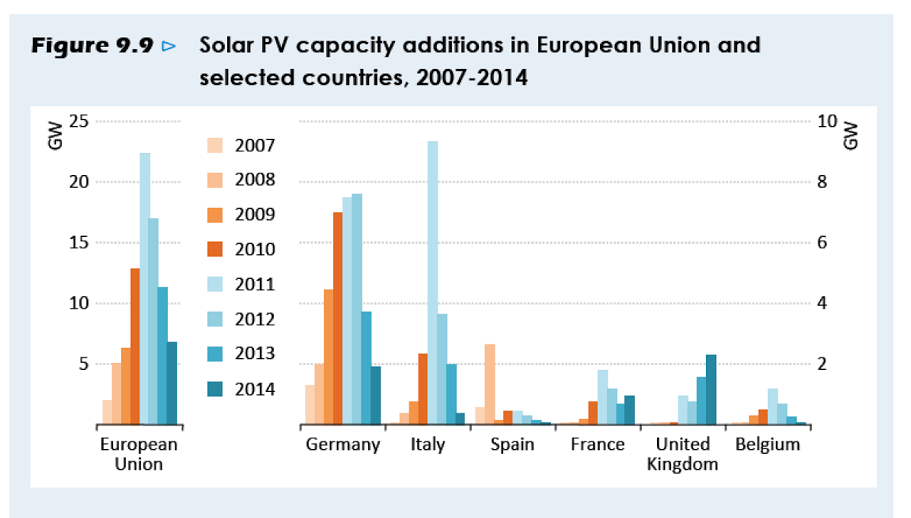
No one predicted that the installed capacity of solar power will hit 200 GW in the last 15 years. The technology development and the cost decrease brought this progress.
JuanP on Mon, 23rd Nov 2015 4:15 am
Rodster, To turn cloud seeding into geo engineering we would need to scale it a bit. 😉 I believe we will try to make some serious attempts at it as we run out of choices. I don’t believe it will fix anything. There is no fixing this shit, man. We have crossed the point of no return where Climate Change is concerned. You can engineer, Beery can ride a bike, Kenz can go solar, and I can get sterilized and live childfree, but none of these things will make any difference in the end. Like I said, we are decades past our last chance to fix this, if we ever had a chance. I, personally, don’t believe we ever had a chance. Our circumstances are a direct consequence of our human nature.
You can’t fix stupid!
onlooker on Mon, 23rd Nov 2015 5:03 am
Plus trying to geoengineer something as complex as the Earths’ climate system is like trying to have a manned mission to Mars. Lot of unexpected things can happen and none of them good.
onlooker on Mon, 23rd Nov 2015 5:11 am
http://climate.diplomacy.edu/profiles/blogs/geo-engineering-and-climate-change
I include to link, which pretty thoroughly covers some of the proposals for geoengineering. Notice how these proposals suffer from three different problems. One, some are very expensive/energy intensive, Two, some would not address the problem of current CO2 in air and thus ocean acidification and three, some have dire associated risks.
Davy on Mon, 23rd Nov 2015 8:04 am
You bring up a good point Juan as to what and when we as a global people will get serious. I really see two different outcomes. They both involve failure just one is accepting failure sooner than later. The first failure is current climate change policy and geopolitical negotiations. We cannot fix this shit, we can’t fix stupid, and we can’t deny our way out of this. Our human exceptionalism is close to being stripped bare of legitimacy and admiration. There is still a significant majority of techies, greenies, brownies, and greedies who still subscribe to markets, knowledge, and technology as our saviors. In other words the rainbow of cornucopians colors still shine. This is manifest with the current climate talks, things like fracking hype, and adventures like fusion as a short list of many.
Entropy and poor decisions at the global level are catching up on us. At what point will the cornucopian narrative give out? At what point will we as a global people acknowledge what doomers like Juan, myself, and several others here on our board consistently discuss and that is broad based failure? This is absolutely vital in my mind because it will herald a crisis period. How can our normalcy we see in mainstream media, culture, and social interactions remain intact if we are told all is lost and dangerous abrupt climate change is upon us? Not only being told about abrupt climate change but just looking outside and seeing it. How will we as a global people react to being told and being shown we are soon to be put through a forced reduction in numbers by nature from our own self-induced causes?
We have an economic system that is currently barely functioning in health. Actually it is not healthy in a sustainable and resilient way. It is just functioning like a terminally ill patient. Doomers at least know we are in an overshoot with consumption and population how long to the general sheeples are understanding this and not oblivious. We have an economy that is increasingly dysfunctional because of debt, dangerous corruption, and vital network decay. How long until the climate or the economy breaks the camel’s back of the status quo? How long until our oil situation deteriorates out of control in fuel shortages?
I will call this the great awakening. The success of sorts would be an early recognition and honest discussion by the higher powers. Once there is no realistic denial the higher powers will acknowledge the dangerous situation we are in and this acknowledgement will herald a period of change categorized by crisis. The normal status quo cannot survive an acknowledgement of no hope and profound danger. How can a free market that is based upon confidence and risk taking survive such a broad based realization? This awakening will force a crisis that will allow change. It will force change because the normal status quo will stop functioning with this realization and loss of confidence.
There will probably be a transition economically to a centralized control from forced necessity because this will surely lead to an economic depression. We will start to see the normal safety net and social supports of medicine and services that ensure health break down. We see tensions now but no actual failures. Excess death over births will start being the norm. Globally the food and fuel system will break down and places that are barely functioning states will fail. Millions will die from this turn of events of the loss of global confidence in human exceptionalism. Nations that are able to maintain some functions will close borders and become police states in crisis.
Yet, this will be change and success of sorts because in crisis there is change. We will get to this change by acknowledging crisis that will be no more than adapting and adjusting to the end of the world as we know it. There is no fixing the status quo but there is a fix for denial and that is acceptance. If we have acceptance I see centralized control following a path of decay and dysfunction forcing reality upon us with some positive mitigation and adaptation. Forget anything happy about this awakening but there will be honesty and all that comes with the clarity and focus that honesty brings.
Rodster on Mon, 23rd Nov 2015 9:07 am
JuanP – “Rodster, To turn cloud seeding into geo engineering we would need to scale it a bit.”
And that’s exactly what they have been doing for decades.
onlooker – “Plus trying to geoengineer something as complex as the Earths’ climate system is like trying to have a manned mission to Mars. Lot of unexpected things can happen and none of them good.”
That’s the really tragic side of Geoengineering. When you begin to play weather God it’s like asking a Mad scientist to use reason and expect sanity. It never happens. What you get as a result is extreme and chaotic weather.
apneaman on Mon, 23rd Nov 2015 4:35 pm
Back in olden times it was the Gods who manipulated the weather – Zeus threw lightning bolts. In the middle ages it was the Christian god because someone had blasphemed or some shit. Today it’s uber-competent evil governments (but only for this because on every other measure they are fuckups – can’t even fix the potholes). It’s right off the pages of a Hollywood script – a bad script. Sounds plausible – only every single atmospheric chemist on the planet would need to be in on it and their technicians and support staff from over 100 countries, plus the folks supplying the chemicals and on and on. So add it all up and we have yet another conspiracy involving millions of people and no one is saying anything. I don’t know two people who can keep a secret. Yep they are all in on it and we all done been fooled except for a handful of supersmart white Americans with the internet who failed basic chemistry. Modernity has done nothing to quell the ape brain’s need to apply nefarious agency when in a fearful and powerless state. Another form of denial.
Rodster on Mon, 23rd Nov 2015 6:00 pm
And yet there are many skeptics who feel the same way about AGW, CC, ACD, etc. That it’s a form of religion based on falsehoods with made up data with scientist who cherry pick data and have come up with the wrong conclusion. And they ask the question, how can man be as powerful as God and alter the climate and earth?
onlooker on Mon, 23rd Nov 2015 6:12 pm
“Modernity has done nothing to quell the ape brain’s need to apply nefarious agency when in a fearful and powerless state. Another form of denial.”
Rodster precisely what here AP was referring to. We cannot deal with being inadequate and with our own fear and powerlessness, so we invent all sorts of stories and fantasies to make us feel better or to avoid confronting our fears and insecurities. Never underestimate fear and its primitive origins fit perfectly with the narrative of the ape brain. Witness how many people still cling to hope or to ignorance even while GW , PO and other serious ills bear down on us.
apneaman on Mon, 23rd Nov 2015 6:29 pm
Rodster, you are officially in the fucking retard club. Go away.
apneaman on Mon, 23rd Nov 2015 6:45 pm
onlooker, get ready because from here on out it’s going to be a steadily increasing stream of crisis cults, magical thinkers, ever grander conspiracies, ghost dancers, violent reactionaries and every other form of ape denial of reality that is possible. I’m hoping to see a 21st century version of the Flagellants – the middle class whipping themselves bloody with their car keys seeking atonement for their sins/make AGW go away.
apneaman on Mon, 23rd Nov 2015 6:48 pm
The Flagellants Attempt to Repel
the Black Death, 1349
http://www.eyewitnesstohistory.com/flagellants.htm
onlooker on Mon, 23rd Nov 2015 6:59 pm
http://www.sciencedaily.com/releases/2009/02/090220110906.htm
This link is to how hope can be actually counterproductive. Simply to hope that we do something about the environment is NOT good enough. Hope in fact can be viewed as another form of denial. Yes AP, I feel my entire life is getting me ready for this interesting saga that is now going to unfold with us humans here on Earth
Davy on Mon, 23rd Nov 2015 7:20 pm
Onlooker, great read. I would say the biggest reason to change ones life is preparation for what is ahead. It is those lifestyles that benefit the environment and prepare one for the disastrous future ahead that need to be promoted. I myself have been preaching forget about changing anything of substance but you can make a difference with efforts locally. This is especially true now that the status quo allows so much through consumerism and capitalism. Once these avenues are gone preparations will be significantly more difficult.
Practice enlightened self interest that also respects others and the environment. They do go hand and hand. We can find meaning by being good to ourselves and the environment. The alternative is mental, physical, and spiritual decay.
makati1 on Mon, 23rd Nov 2015 8:49 pm
The gods are coming back into human lives. They are: Hi-Tech, Renewables, Community Love, Money (wait! that one never went away), Power (ditto), “Green” stuff, The Internet, Fusion Energy, Creationism, Etc. Their worship will grow to a frenzy as we approach the cliff of extinction. Fun to watch.
apneaman on Tue, 24th Nov 2015 2:50 am
How unrealistic optimism is maintained in the face of reality
“Unrealistic optimism is a pervasive human trait that influences domains ranging from personal relationships to politics and finance. How people maintain unrealistic optimism, despite frequently encountering information that challenges those biased beliefs, is unknown. We examined this question and found a marked asymmetry in belief updating. Participants updated their beliefs more in response to information that was better than expected than to information that was worse. This selectivity was mediated by a relative failure to code for errors that should reduce optimism. Distinct regions of the prefrontal cortex tracked estimation errors when those called for positive update, both in individuals who scored high and low on trait optimism. However, highly optimistic individuals exhibited reduced tracking of estimation errors that called for negative update in right inferior prefrontal gyrus. These findings indicate that optimism is tied to a selective update failure and diminished neural coding of undesirable information regarding the future.”
http://www.ncbi.nlm.nih.gov/pubmed/21983684
apneaman on Tue, 24th Nov 2015 3:15 am
Why do we assume our western good life will last for ever?
The ancients were so used to constant death and disaster they grew worried when things went too well
“The slaughter in Paris is a catastrophe for the victims and their families, but the usual hysterical response across the media reminds us, yet again, what an extraordinary achievement it is that we Westerners simply assume the world owes us a life lived to the full, in comfort and security.
From the ancient world until relatively recently, there was little sense that the world owed us anything. About half of Romans would not make the age of five; probably a third would not make three months. War was commonplace, as deadly for civilians as soldiers, as were disease and famine. The destruction of Pompeii by Vesuvius was greeted with relative indifference. Ancients simply accepted that this sort of thing was bound to happen.”
more
http://new.spectator.co.uk/2015/11/why-do-we-assume-our-western-good-life-will-last-for-ever/
Rodster on Tue, 24th Nov 2015 6:37 am
“Rodster, you are officially in the fucking retard club. Go away.”
Fantastic and it’s good to see that you are just like and no different than Guy McPherson who is a pissed off doomer that has all the answers. That AGW/CC/ACD or whatever else it’s called is the root cause of all of our ills. When people question McPherson he acts just like you because AGW/CC/ACD is a RELIGION and can’t be questioned. It’s obvious that you are an individual who’s threatened by different ideas. And when it’s questioned all you do is rant away with numerous links of others work and give off appearance of an unstable individual.
You hate deniers but yet you deny you are a denier. You don’t want to think outside of the box. All you are focused on is what you’ve been fed by a bitter asshole Professor who preaches the end of the world and if you get really depressed, he provides a link to suicide prevention. And that appears to be your solace in life. I personally listen to all and follow no one but myself.
But you sir are the FUCKING retard and going by your username, you should get some sleep. Because people like you and McPherson are followers. Your ideas can’t be questioned, they are to be followed.
So definitely put me on your ignore list. I welcome it.