



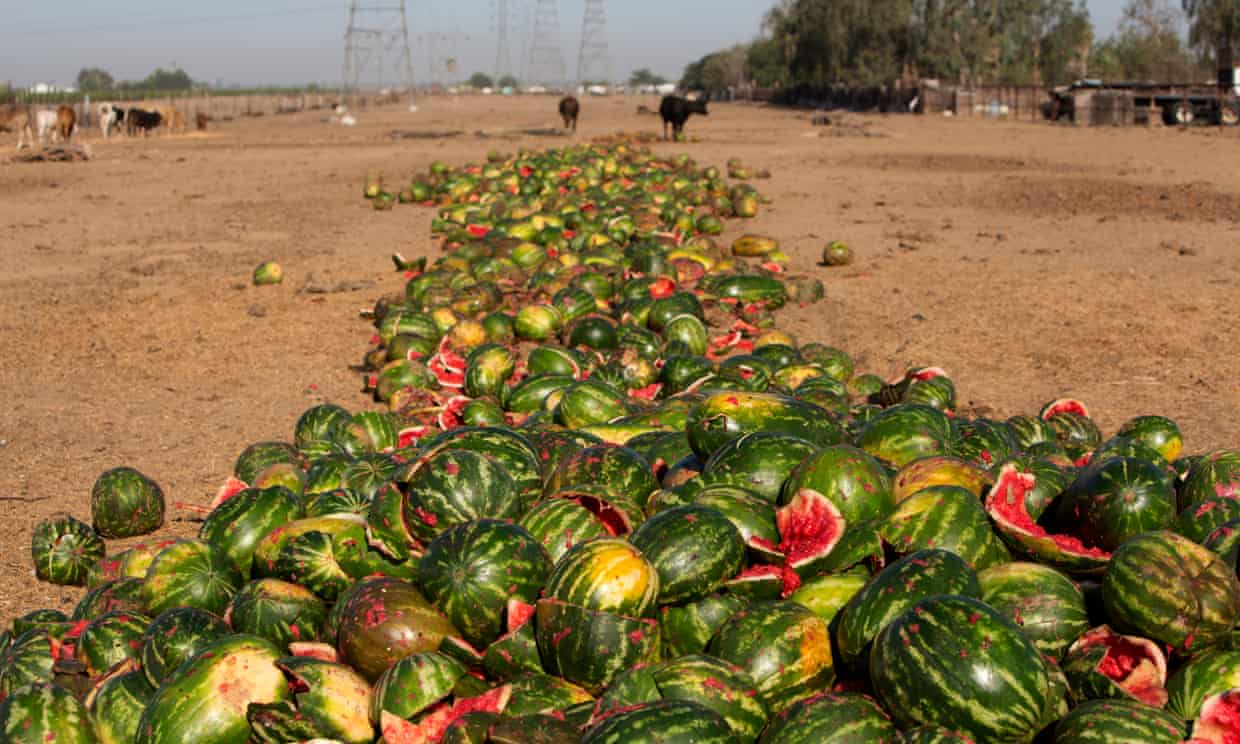
Americans throw away almost as much food as they eat because of a “cult of perfection”, deepening hunger and poverty, and inflicting a heavy toll on the environment.
Vast quantities of fresh produce grown in the US are left in the field to rot, fed to livestock or hauled directly from the field to landfill, because of unrealistic and unyielding cosmetic standards, according to official data and interviews with dozens of farmers, packers, truckers, researchers, campaigners and government officials.
From the fields and orchards of California to the population centres of the east coast, farmers and others on the food distribution chain say high-value and nutritious food is being sacrificed to retailers’ demand for unattainable perfection.
“It’s all about blemish-free produce,” says Jay Johnson, who ships fresh fruit and vegetables from North Carolina and central Florida. “What happens in our business today is that it is either perfect, or it gets rejected. It is perfect to them, or they turn it down. And then you are stuck.”
Food waste is often described as a “farm-to-fork” problem. Produce is lost in fields, warehouses, packaging, distribution, supermarkets, restaurants and fridges.
By one government tally, about 60m tonnes of produce worth about $160bn (£119bn), is wasted by retailers and consumers every year – one third of all foodstuffs.

But that is just a “downstream” measure. In more than two dozen interviews, farmers, packers, wholesalers, truckers, food academics and campaigners described the waste that occurs “upstream”: scarred vegetables regularly abandoned in the field to save the expense and labour involved in harvest. Or left to rot in a warehouse because of minor blemishes that do not necessarily affect freshness or quality.
When added to the retail waste, it takes the amount of food lost close to half of all produce grown, experts say.
“I would say at times there is 25% of the crop that is just thrown away or fed to cattle,” said Wayde Kirschenman, whose family has been growing potatoes and other vegetables near Bakersfield, California, since the 1930s. “Sometimes it can be worse.”

“Sunburnt” or darker-hued cauliflower was ploughed over in the field. Table grapes that did not conform to a wedge shape were dumped. Entire crates of pre-cut orange wedges were directed to landfill. In June, Kirschenman wound up feeding a significant share of his watermelon crop to cows.
Researchers acknowledge there is as yet no clear accounting of food loss in the US, although thinktanks such as the World Resources Institute are working towards a more accurate reckoning.
Imperfect Produce, a subscription delivery service for “ugly” food in the San Francisco Bay area, estimates that about one-fifth of all fruit and vegetables are consigned to the dump because they do not conform to the industry standard of perfection.
But farmers, including Kirschenman, put the rejection rate far higher, depending on cosmetic slights to the produce because of growing conditions and weather.
That lost food is seen increasingly as a drag on household incomes – about $1,600 a year for a family of four – and a direct challenge to global efforts to fight hunger, poverty and climate change.
Globally, about one-third of food is wasted: 1.6bn tonnes of produce a year, with a value of about $1tn. If this wasted food were stacked in 20-cubic metre skips, it would fill 80m of them, enough to reach all the way to the moon, and encircle it once. Taking action to tackle this is not impossible, as countries like Denmark have shown.
The Obama administration and the UN have pledged to halve avoidable food waste by 2030. Food producers, retail chains and campaign groups such as the Natural Resources Defense Council have also vowed to reduce food loss in the ReFED initiative.
Food experts say there is growing awareness that governments cannot effectively fight hunger, or climate change, without reducing food waste. Food waste accounts for about 8% of global climate pollution, more than India or Russia.
“There are a lot of people who are hungry and malnourished, including in the US. My guess is probably 5-10% of the population are still hungry – they still do not have enough to eat,” said Shenggen Fan, the director general of the International Food Policy Research Institute in Washington. “That is why food waste, food loss matters a great deal. People are still hungry.”
That is not counting the waste of water, land and other resources, or the toll on the climate of producing food that ends up in landfill.
Within the US, discarded food is the biggest single component of landfill and incinerators, according to the Environmental Protection Agency. Food dumps are a rising source of methane, a far more powerful greenhouse gas than carbon dioxide. But experts readily acknowledge that they are only beginning to come to grips with the scale of the problem.

The May harvest season in Florida found Johnson with 11,000kg (24,250lbs) of freshly harvested spaghetti squash in his cool box – perfect except for brown scoring on the rind from high winds during a spring storm.
“I’ve been offering it for six cents a pound for a week and nobody has pulled the trigger,” he said. And he was “expecting an additional 250,000lbs of squash,” similarly marked, in his warehouse a fortnight later.
“There is a lot of hunger and starvation in the United States, so how come I haven’t been able to find a home for this six-cents-a-pound food yet?” Johnson asked.
Such frustrations occur regularly along the entirety of the US food production chain – and producers and distributors maintain that the standards are always shifting. Bountiful harvests bring more exacting standards of perfection. Times of shortage may prove more forgiving.
Retail giants argue that they are operating in consumers’ best interests, according to food experts. “A lot of the waste is happening further up the food chain and often on behalf of consumers, based on the perception of what those consumers want,” said Roni Neff, the director of the food system environmental sustainability and public health programme at the Johns Hopkins Center for a Livable Future in Baltimore.
“Fruit and vegetables are often culled out because they think nobody would buy them,” she said.

But Roger Gordon, who founded the Food Cowboy startup to rescue and re-route rejected produce, believes that the waste is built into the economics of food production. Fresh produce accounts for 15% of supermarket profits, he argued.
“If you and I reduced fresh produce waste by 50% like [the US agriculture secretary] Vilsack wants us to do, then supermarkets would go from [a] 1.5% profit margin to 0.7%,” he said. “And if we were to lose 50% of consumer waste, then we would lose about $250bn in economic activity that would go away.”
Some supermarket chains and industry groups in the US are pioneering ugly produce sections and actively campaigning to reduce such losses. But a number of producers and distributors claimed that some retailing giants were still using their power to reject produce on the basis of some ideal of perfection, and sometimes because of market conditions.
The farmers and truckers interviewed said they had seen their produce rejected on flimsy grounds, but decided against challenging the ruling with the US department of agriculture’s dispute mechanism for fear of being boycotted by powerful supermarket giants. They also asked that their names not be used.

“I can tell you for a fact that I have delivered products to supermarkets that was [sic] absolutely gorgeous and because their sales were slow, the last two days they didn’t take my product and they sent it back to me,” said the owner of a mid-size east coast trucking company.
“They will dig through 50 cases to find one bad head of lettuce and say: ‘I am not taking your lettuce when that lettuce would pass a USDA inspection.’ But as the farmer told you, there is nothing you can do, because if you use the Paca [Perishable Agricultural Commodities Act of 1930] on them, they are never going to buy from you again. Are you going to jeopardise $5m in sales over an $8,000 load?”
He said he experienced such rejections, known in the industry as kickbacks, “a couple of times a month,” which he considered on the low side for the industry. But he said he was usually able to sell the produce to another buyer.

The power of the retail chains creates fear along the supply chain, from the family farmer to the major producer.
“These big growers do not want to piss off retailers. They don’t enforce Paca on Safeway, Walmart or Costco,” said Ron Clark, who spent more than 20 years working with farmers and food banks before co-founding Imperfect Produce.
“They are just not going to call because that will be the last order they will ever sell to them. That’s their fear. They are really in a pickle.”
Go Speed Racer on Wed, 13th Jul 2016 4:47 pm
Haul rotten produce to a landfill???
That sounds dumb. Just plow it back into the soil.
Buy organic, maybe they not that dumb.
Goat2054 on Wed, 13th Jul 2016 7:06 pm
The time is coming when NO food item will be rejected and squash left rotting in the field (if only it could be found) will be worth more than its weight in gold. The law of karma, what goes around comes around…and around…and around…
Apneaman on Wed, 13th Jul 2016 7:19 pm
KFC Introduces New Previously Owned 20-Piece Hot Wings
“LOUISVILLE, KY—In an effort to meet the changing demands of its consumers, fast-food chain Kentucky Fried Chicken announced Wednesday that it has begun offering customers the option of purchasing, at a significant discount, a 20-piece box of pre-owned hot wings. “Sure, these wings are a little bit older, and the package may have a couple dents in it, but they’re a lot more affordable than the brand-new ones,” said Kelly Lipscomb of Minot, ND as she stopped by a local KFC to try the gently used menu item, which varies in price from $1.99 to $6.99 depending on how many weeks ago the wings were prepared. “You can lay down 14 bucks for those fancy new hot wings, but those things start to lose value the moment you drive out of the KFC parking lot. Money-wise, it just doesn’t make a whole lot of sense. Besides, these used ones still got plenty of meat left on the bone, and to be honest, they really don’t taste all that different than they do when they’re new.” Company officials confirmed that KFC customers will also be able to purchase a discount value meal that includes previously owned hot wings, a secondhand medium soft drink, and a certified 2012 homestyle biscuit.”
http://www.theonion.com/article/kfc-introduces-new-previously-owned-20-piece-hot-w-53209
Davy on Wed, 13th Jul 2016 8:08 pm
There is surely going to be the situation where food rots in the field because it can’t be transported. We are going to go through a period where the industrial monocultures that dominate agriculture today will be caught up in fuel shortages and broken markets. Food dysfunctions occurred during the great depression when many had no money to buy food so food was disposed of by farmers. We are going to see food produced in some regions too far from traditional markets. We are going to see dysfunction and decay all at once. It is really going to be a dangerous situation
Davy on Wed, 13th Jul 2016 8:57 pm
This will likely be our future.
“Maduro Puts Military In Charge Of Venezuela’s Food, Calls It “Great Sovereign Supply Mission”
http://www.zerohedge.com/news/2016-07-13/maduro-puts-military-charge-venezuelas-food
“As WSJ reports, the head of the armed forces, Defense Minister Vladimir Padrino – who now becomes one of the most powerful people in the socialist government – will be in charge of transporting and distributing basic products, controlling prices and stimulating production, according to a decree published Tuesday in the official gazette. “All the ministries, all the ministers, all the state institutions are at the service and in absolute subordination” to Padrino’s so-called Great Sovereign Supply Mission, Maduro said in a televised address Monday night.”
“The appointment comes at a time of unprecedented crisis for Venezuela, where a full-blown food crisis has emerged over the past few months. Entire days are now spent outside stores waiting to buy a handful of basic items, with protests and looting rising sharply. Hoarding and flipping scarce goods have become a growth industry. Those who buy and resell, known as bachaqueros, are among the few succeeding in this economy.”
“This is now a completely militarized government,” said Luis Manuel Esculpi, a security analyst in Caracas and former head of the armed forces commission in the congress. “The army is Maduro’s only source of authority.”
bs on Wed, 13th Jul 2016 10:20 pm
Fat pigs waste food cuz they don’t have to work to produce it, harvest it or prepare it. Its basically free to the fattest pigs.
Boat on Wed, 13th Jul 2016 10:53 pm
bs,
If you had a job and two teeth you could eat.
GregT on Thu, 14th Jul 2016 12:18 am
“If you had a job and two teeth you could eat.”
If you had a half a brain, you wouldn’t need a job in order to eat, at 58 years of age Boat.
dooma on Thu, 14th Jul 2016 12:35 am
I wonder if someone measures the length and girth of the Zucchini and Cucumbers?
dooma on Thu, 14th Jul 2016 12:38 am
To keep the “fruits” happy.
Go Speed Racer on Thu, 14th Jul 2016 4:56 am
If the fat Americans had double the food supply, they would weigh 600 pounds instead of 300.
Go Speed Racer on Thu, 14th Jul 2016 4:58 am
Seen on a box of Kraft Macaroni and Cheese:
‘Serves 4, or 1 American’.
Kenz300 on Thu, 14th Jul 2016 6:38 am
Waste not….want not……..
Reduce…..reuse….recycle……..
Too many people……….create too much pollution and demand too many resources….
China made great progress in moving its people out of poverty…….one reason was slowing population growth…..
If you can not provide for yourself you can not provide for a child.
CLIMATE CHANGE, declining fish stocks, droughts, floods, air water and land pollution, poverty, water and food shortages all stem from the worlds worst environmental problem……. OVER POPULATION.
Yet the world adds 80 million more mouths to feed, clothe, house and provide energy and water for every year… this is unsustainable… and is a big part of the Climate Change problem
Birth Control Permanent Methods: Learn About Effectiveness
http://www.emedicinehealth.com/birth_control_permanent_methods/article_em.htm
JuanP on Thu, 14th Jul 2016 7:26 am
Having the military take charge of food production, storage, and distribution is a very likely step on our way down the ladder of social collapse. What is happening in Venezuela is likely to happen in most places eventually. The military will also confiscate food from businesses and private individuals as they see fit when the time comes. Having food stored in your home may be declared illegal, too.
PracticalMaina on Thu, 14th Jul 2016 11:37 am
The produce didn’t even make it out of the field? There you go Drumph scaring out all the farm hands, I am sure you and your family can pitch in and help, you guys know hard work, that’s how you got those billions, I mean millions, I mean debt and handouts.
JuanP on Fri, 15th Jul 2016 8:40 am
Anyone who grows food knows you can’t eat everything you grow because some of it will spoil. Ifeed my worms and make Bokashi with my home’s food scraps. I use the gardens’ clippings and yard waste on worm farms, hot composting piles, cold composting piles, as mulching, and by digging trenches to trench compost which is also called Hugelkulturs. All our food waste is used to feed our next crops. You could also feed other animals like chickens, pigs, goats, or rabbits if you have some. Wasting food should be illegal!
Davy on Fri, 15th Jul 2016 11:35 am
Yeap, Juan, no food wasted at our place also. Dogs, chickens, and goats at our place eat well. They all love left-overs.