


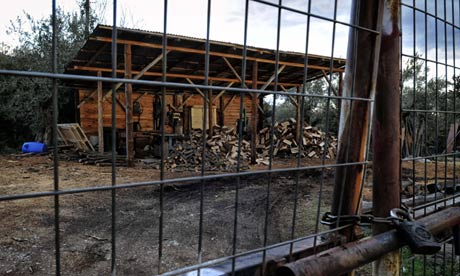
It is early Sunday. The sun has barely risen above the chestnut forest that lies somewhere near the crest of Mount Pelion, but loggers’ pick-up trucks are already streaming through the muddy slush, their cargo bouncing in the back. Theirs are rich pickings, much in demand as winter envelopes the villages and towns of an increasingly poverty-stricken Greece. As they pass, they do not look up because many do not have permits to do what they have just done.
From their new home a little further on, Yiannis Chadziathanasiou and Natasa Rempati watch the ebb and flow of this traffic. So, too, do the residents of Tsagarada, the picturesque hamlet where the sound of chainsaws pierces the morning air. “Things are getting desperate,” says Chadziathanasiou, who clothed Greek celebrities before he moved to the countryside. “You hear all the time of people illegally clearing forests for firewood. It’s horrible if you’re a green like me.”
In their wellington boots and designer jeans, the couple stand out in Tsagarada. Like most middle class Europeans raised in cities, nature is a new world and one that does not come naturally to them. Until last year, both enjoyed successful careers in fashion and architecture. “But then we did our sums,” said 29-year-old Rempati, whose firm had designed hospitals and metro stations before being forced to close down. “And although we were both earning good salaries, taking home around €3,500 a month, we were really squeezed. There was never a euro left over. Our heating bill alone cost €3,000 and that was before the €500 we spent on petrol and all the new taxes. We were stressed and really anxious and didn’t think we could afford to go through another winter in Athens.”
The young professionals then did something they never thought they would do. In June, they got into their black Chrysler and drove 200 miles north of the capital to Mount Pelion, where Chadziathanasiou had spent holidays as a child. “All our friends ever did was talk about the crisis and a lot of them were leaving,” he said. “You’d turn on the TV and all it did was bombard you with terrifying news, day after day, about how this country was going down the tubes.”
There was also the issue of survival. The fashion aficionado had always had a dream of opening a luxury hotel and with its spectacular villages and rivulets, streams and beaches, Pelion appealed as an all-year-round tourist destination. “We thought if we try this out, living in a little stone house, working in the industry, we might be able to make ends meet,” said the 33-year-old. “I’m not used to chopping firewood and my body aches but then doing it this way we only spend €300 on heating our home.”
As the eurozone’s poorest member state stares at the prospect of a sixth straight year of recession with unemployment and poverty levels reaching peaks not seen since the second world war, growing numbers of Greeks are experiencing the effects. After first felling society’s most vulnerable, with pensioners and low-income workers at the fore, debt-stricken Greece’s great economic crisis is now destroying the middle class. The announcement this week that €44bn in emergency aid will soon be funnelled into the country – the latest in a series of rescue programmes by the EU and IMF to prop up an economy running on empty – comes as little consolation for people on the ground.
Poised for their worst winter since the eruption of the crisis three years ago, Greeks who once thought nothing of heating their homes now hesitate. After relentless waves of austerity and tax rises that have seen their purchasing power drop by up to 50%, even doctors and lawyers are feeling the pinch, with many saying they cannot afford the 40% surcharge the government has slapped on heating oil.
“In my own block of flats,” said boutique owner Tina Kanellopoulou, who lives in the posh Athens neighbourhood of Kolonaki, “the central heating hasn’t been turned on because most of the flat owners haven’t got the money to pay for it. We’re all rushing out to buy little electric heaters. You go to a doctor or lawyer and you see they are doing the same.”
Having been on the frontline of Europe‘s debt drama from the outset, Greece embraced austerity in return for international financial assistance that has kept bankruptcy at bay and tied it to the family of single currency nations. But the effect has been ever more devastating on its social fabric. Middle class downsizing is the latest tell-tale sign in a country whose GDP officials predict will shrink 25% by 2014 – a contraction unheard of in an advanced western economy since America’s Great Depression.
The side effects of taming runaway deficits and a debt mountain projected to amount to 190% of national output has been brutal, with once proud Greeks now openly speaking of their nation being brought to a point of economic, political and psychological collapse. Nationwide, suicides have soared, with the public order minister, Nikos Dendias, saying last week that 3,100 people had taken their own lives since the onset of the crisis in a country that in 2009 had the lowest suicide rate in the EU.
Last week, Greece heard that malaria, officially eliminated 40 years ago, had also made a comeback with cases being noted in eastern Attica and the Peloponnese. News of the outbreak came on the day Greek sports, already a dying art, took another blow with the Hellenic Olympic committee unexpectedly announcing the closure in the capital of the pool used by elite swimmers because authorities can no longer afford heating oil. Insolvency has rocked schools and hospitals, where staff complain they not only do not have the money to heat classrooms and wards but even to purchase painkillers for children and patients.
“Greece is being taken back to the 1970s,” said Gikas Hardouvelis, chief economist at Eurobank. “People are desperate. The recession has affected every home with the drop in living standards not being distributed equally. People who once lived decently have seen their wages drop by 80%.”
Average income has dropped to levels not seen for more than a decade, according to the Greek Labour Institute. But it is the latest round of spending cuts and structural reforms that are expected to hit Greeks the hardest. In return for long-overdue bailout loans and a deal that will see the country’s debt pile cut by €40bn, Athens’ coalition government has agreed to a draconian €13.5bn package of belt-tightening measures. The policies, to be implemented over two years from January, have been described as the death knell for the urban middle class, already hit by a barrage of taxes on incomes, purchases and property by governments desperate to meet deficit targets set by foreign lenders. To keep up, the older generation has begun pawning heirlooms and jewellery to get through the winter.
“If 2012 was the year of ‘the death of a salesman’, 2013 will be the year of ‘the death of the middle class,'” said Takis Pavlopoulos, a senior aide of main opposition leader Alexis Tsipras. “It will be Year Zero for Greece. For the first time self-employed professionals will see their income taxed from the first euro they earn, adding to their already reduced turnovers as a result of five years of austerity. And civil servants will have their salaries cut once again. That in turn will lead to a dramatic drop in consumption and internal demand.”
Pavlopoulos’s views might be less important if he were not also Tsipras’s speechwriter. The US-trained economist has a way with words and they are paying off. Tsipras’s vehemently anti-bailout radical left Syriza party is leading in every poll conducted since prime minister Antonis Samaras’s fragile alliance assumed power in June.
“The further downward pressure on the middle class, to the point of disappearance, will radicalise it,” he said. “And in so doing it will bring it closer to Syriza, the only realistic alternative political choice for power with a government programme to immediately end catastrophic austerity.”
So far Greeks have shown remarkable fortitude in the face of such adversity. Although soup kitchens have proliferated and hunger levels have grown, the younger generation has hunkered down, opening new businesses with a display of entrepreneurial skills not seen before the crisis.
Analysts and insiders worry that as the crisis moves into another phase with new middle class victims, the potential for the protest base to widen will also grow. With the number of jobless Greeks topping 1.2 million, extremism on left and right has risen alarmingly, with the neo-Nazi Golden Dawn now the third biggest party with 12% in the polls.
“I am concerned that everyone is angry and that somehow this anger can be channelled in the wrong direction,” said Hardouvelis, the economist. “I am worried about nazism, yes.”
Up in Tsagarada, the younger generation embodied by Yiannis and Natasa say hope is in short supply. “This is not a country where you can even have children anymore,” they say. “Under these latest measures you’re taxed even harder if you have kids.”
But as new as their brave new world is, the couple are giving it their best. “All our friends have gone to England and Holland mostly,” said the fashion designer. “We could easily go to New York where I’d often attend shows and have lots of contacts but we want to give it a go here. Greece is a beautiful country even if our politicians have destroyed it. Come back in a year and see if we have survived.”
GregT on Sun, 2nd Dec 2012 7:52 am
If only Greece could print it’s own currency. Maybe they could kick the can down the road a little further.
Ken Nohe on Sun, 2nd Dec 2012 10:22 am
Latin countries simply cannot live with a “German” Euro. They need some inflation to smooth things out. You now get a beer for 2.5 Euro in Central Munich and a coffee for 6 Euro in Italy. It doesn’t make sense. The distortions are already unsustainable and getting worse.
Greece is going down the drain faster than European banks can build provisions. At the same time within or without Europe, they must restructure. They have played with money for 10 years and must now go back to a much poorer lifestyle. Hard luck but it is unavoidable. Then it will be Spain, Italy, France… In a couple of years brown shirts will once again be fashionable in Europe.
Steve H on Sun, 2nd Dec 2012 1:37 pm
Greece is not a latin country.
Arthur on Sun, 2nd Dec 2012 1:44 pm
“Greeks turn to the forests for fuel as winter nears”
There are hardly any forests in Greece.
There are many reasons why Greece is in the mess it is in now, but it is mainly their own fault. First of all the Greek government bought Goldman Sachs to cook the books for them in such a manner that the eurocrats had a pretext to increase the size of their Euro-empire, which they were eager to do anyway. Once Greece was in the euro the Greek irresponsibility knew no bounds, correctly anticipating European solidarity in case things would go wrong. The next thing Greece did was massive wage increases on all fronts, hiring way too large number of civil servants and lowering retirement age. And the Greeks were aided by equally irresponsible northern banks (French, German and British) who were willing to lend the Greeks the necessary cash to finance it all, equally anticipating northern European solidarity as a security of last resort. And maybe even the eurocrats did not mind under the motto: ‘never waste a good crisis to increase your power’. Now northern Europeans are told by the eurocrats in Brussels as well as national politicians, who are in majority europhile, that ‘our euro needs to be saved’, which is rubbish since there is no euro-problem but a southern European debt problem, caused by an entitlement-attitude and an inability of the Greeks to compete with northern Europe. A single market means in practice that the Greeks, who only have beaches and olives, are outcompeted by the north and pictures of poor Angela Merkel depicted with swastikas is the result. Germany is currently the only country in Europe that is still booming, which should give the Germans reason to pause, for historic reasons. Germany as a national state came into being in 1871 and within 30 years it had outcompeted France and Britain (the two combined equal had population numbers as Germany) on world markets, which caused the two traditional adversaries to start an alliance (Entente Cordiale) to which later Russia was added, with the aim to destroy Germany, in which tey succeeded in WW1. When Germany tried to escape from the Versailles stranglehold in the thirties it was destroyed again, now with the aid of the US and USSR, who smelled their chance to ascend on the global pecking order by exploiting the inner-European conflict. After 1945 France understood what mistake the alliance with Britain had been and president de Gaulle tried to save from European civilization what could be saved, turned 180 degrees and started to build European unity based on the Paris-Berlin axis (EGKS–>EEC–>EU) and proclaimed already in the sixties that later Moscow should be added to the axis once communism was dead. De Gaulle was not very fond of Anglos and the dislike was mutual.
Germany must really pay attention now that she is not going to be destroyed for a third time by angry neighbours who observe that European unity is mainly in the advantage of German industry. Britain is only waiting for the right moment to escape from the EU, of which she is a member merely out of ‘join-em-if-you-cant-beat-em’ attitude, which is not real love. France knows that she is an essential part of the European construction which allows her to punch above her economic weight. As long as the Paris-Berlin axis stays alive it does not matter much what happens elsewhere in Europe. Crucial is the attitude of Germany. How far will they go in supporting southern losers? Or will the give in to the temptation and abandon the EU and start an alliance with Russia.
Maybe the best thing to do is what Ken suggests, namely to let the southern flank go and let them have a softer southern euro as well as protectionism and let Germany concentrate on Russia and keep at the same time at least France afloat, for geopolitical reasons, and start a Eurasian alliance that can’t be beaten by no one. This would result in a three polar world as predicted by George Orwell:
http://www.netcharles.com/orwell/pics/1984/1984-world-map.jpg
Anglosphere, Eurasia and China plus a few ‘secondary civilizations’ like Islam and Africa of lesser political weight.
If the likely Great Default would occur and thus capitalism fails, it is likely that the world will become socialist again: bolshevik in Anglosphere and national-socialist in Eurasia as well as in China. Great Default means: nobody pays his debts anymore including mortages. This would mean that all real estate would become property of the state to be rented out to the citizens. Income will plumet, everything will be rationed, like in the USSR, in line with the new realities of a resource depleted world. The freedom we once enjoyed post WW2 was in hindsight the result of the 100-150 virtual energy slaves we westerners had per capita. Once that number decreases year after year, life will become ever more constrained, less ‘free’, all to the benefit of the state.
Ken Nohe on Sun, 2nd Dec 2012 2:03 pm
I share your analysis but only part of your pessimism. All is not lost yet. There is in fact far more flexibility in the economic machine than people realize. We will probably “discover” the flexibility as pressure rises.
Contrary to what people believe there are solutions, but they are painful which is why nobody wants to contemplate them. But eventually as the options dwindle, we may still come to our sense. A clear possibility would be 2 Euros. A strong northern one and a weak southern one. Impossible? Maybe. But that would be a way to offer a welcome relief to the Mediterranean belt without dissolving everything.
adamc18 on Sun, 2nd Dec 2012 2:08 pm
Maybe this is something new in Greece but across much of Europe and Scandinavia a huge amount of heating comes from firewood. Even in central Italy (Tuscany/Umbria) 50% of domestic heating comes from carefully managed forests.
Arthur on Sun, 2nd Dec 2012 3:35 pm
Nice slogan: “fight global warming, plant a forest” (to stay warm). All the carbon captured in wood is not in the air.
Kenz300 on Sun, 2nd Dec 2012 7:51 pm
Greeks made a game of not paying their taxes. Wealthy people with big homes, yachts, swimming pools and fancy cars reported incomes of taxi drivers. Even the tax collectors did not do their jobs.
They can not support their government and their benefits without everyone paying their fair share. The tax cheats hurt the country and everyone in it.
Steve H on Sun, 2nd Dec 2012 9:45 pm
There is this perception that Greeks are lazy people that were tax cheaters and were borroning and living beyond their means. It has to be understood that taxes in Greece were very high, and often, unfair. For example, say you owned an apartment which you rented. You were taxed on that income. If only one person owned that property, one imcome tax was collected. However, if two people (or more) own that propety, then the two taxes, were collected at the same overall tax from both. So if one paid 1000 euros in tax, two would each still pay 1000 euros in tax. It is not 1000 euros in total. Also, doctors expect to get bribed to do surgeries. Even with socialized medicine, you cannot get the operation without greasing the surgeon’s palm. So why pay tax?? So you can double or triple pay?? If any one of us lived in a society where corruption and tax laws were the same, would we pay?
Ken Nohe on Sun, 2nd Dec 2012 10:50 pm
Absolutely agree. The problem of Greece is systemic, not punctual which is why it is almost impossible to sort out. And yes, face with such a system, we would all do as the Greeks do… but the difference is that we wouldn’t tolerate such a system for long!