
Peak Oil is You
Donate Bitcoins ;-) or Paypal :-)


Page added on May 28, 2012

German Power Grids Increasingly Strained
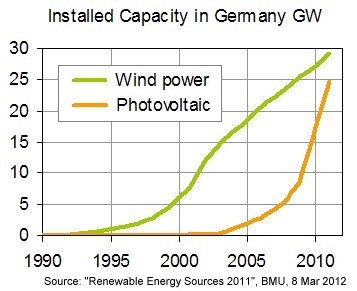
With a steep growth of power generation from photovoltaic (PV) and wind power and with 8 GW base load capacity suddenly taken out of service the situation in Germany has developed into a nightmare for system operators.
Reports from the European Network of Transmission System Operators for Electricity (ENTSO-E)[1] and the German Grid Agency[2] reflect concern for the operational security of the power system. The risk of a prolonged and widespread power blackout was earlier recognized by the German Bundestag and discussed in an interesting report[3]
This note will present main conclusions from the three reports combined with data, collected from the German system operators.
A New Operating Pattern
Since January 2012 all 4 German system operators have published estimated PV generation based on representative samples. The data will give research environments a new opportunity to analyse the impact of RES in Germany.
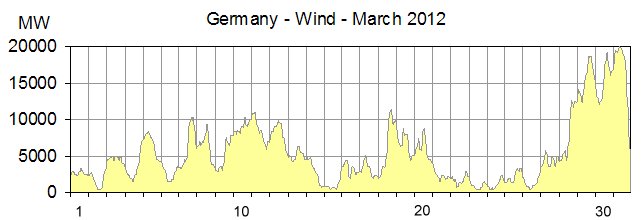
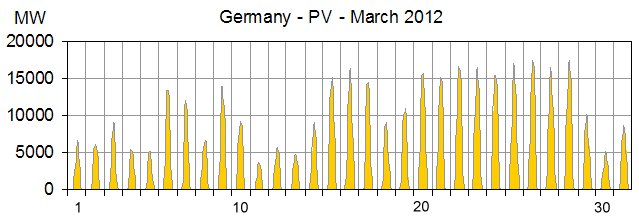
- Wind power peaks seem not to be simultaneous with PV peaks. This means that PV does not add its full peak capacity to the grid problems during high wind periods.
- The main part of the German wind power is installed in the northern part of the country while the main part of the PV capacity is installed in Bavaria. The nuclear moratorium has created the most serious supply problems in the southern part of Germany. This observation suggests additional PV generation to relieve the supply problems.
- PV generation cannot reduce the need for peak capacity. The reason is that there is no PV generation during the evening peak load.
- The regulating work which must be made by controllable power sources grows considerably with the growth of wind power and PV. TenneT is one of Germany’s 4 main grid operators. In the TenneT area a calculation for April 2011 has shown that wind power alone would extend the regulating range by more than 50%, while the actual combination of wind power and PV has doubled the regulating range.
Although PV may be able to give some relief to the grids PV cannot reduce the need for peak capacity and additional PV will cause a considerable growth in the need for regulating capacity.
The German Grid is a Backbone in Europe
On 4 November 2006 a German 380 kV line had to be temporarily disconnected. Due to insufficient coordination of protection systems a circuit tripped and started cascading outages. The result was that the continental grid in Europe was divided into three islands and about 17 GW load was shed. The case demonstrates how a local event in Germany can turn into a widespread European disturbance.
In April 2012, the president of ENTSO-E[4], Daniel Dobbeni, states his concern about security of power system operation in Europe in a letter to the European Commissioner for Energy, Günther Oettinger.
ENTSO-E: “As long as RES generation in certain regions expands faster – partly as a function of national support schemes – than the transmission network can accommodate, the risk of insecure system operation coupled with costly generation curtailments will rise significantly.”
An attached briefing paper gives an overview of the current situation. The rapid increase of wind power and other renewable energy sources (RES) without a corresponding reinforcement of the electric grids has caused the problems.
The paper explains: “Heavy ‘unplanned’ transit flows added to scheduled flows cause severe loading on southern interconnectors (PL/CZ, PL/SK, DE/CZ, and also SK/HU and SK/UA) and lead to non-compliance with fundamental network security criteria. The high level of flows on the interconnectors leads to overloading of the network in Germany and neighbouring countries Poland, Czech Republic, Slovakia and Hungary.”
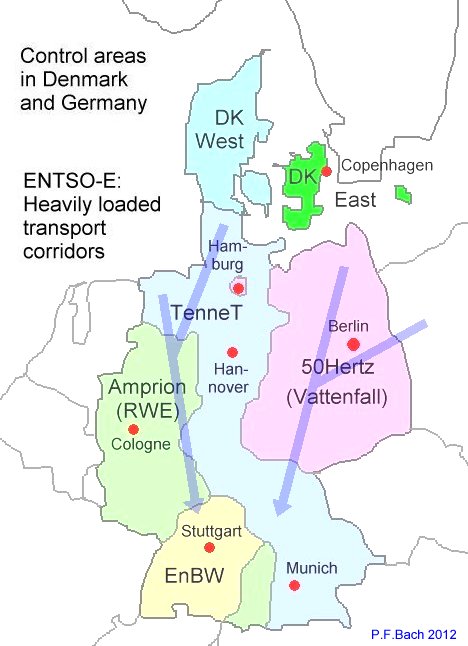
The countermeasures have cost implications and cannot be implemented without cost sharing agreements.
ENTSO-E makes reference to its Ten-Year Network Development Plans (TYNDP). The timely implementation of the projects will require the active support of European policy makers.
The paper estimates the necessary investment for reinforcement of the western and the eastern transport corridors in Germany to 30 billion Euros for the next decade. The German reinforcements must be coordinated with investments in neighbouring countries.
Efficient market arrangements are important for efficient congestion management, secure grid operation and overall market efficiency. Therefore the organisation of more consistent markets and redefinition of bidding areas deserve consideration.
The ENTSO-E paper concludes: “If this infrastructure does not materialize in due time then the rate of RES increase should be examined under a more pragmatic prism”.
A German Performance Report for the Winter 2011/12
The Federal German Grid Agency has confirmed the assumption of a strained grid in a 120 page report on the supply situation for electricity and gas in Germany during the winter season 2011/12.
It is useful for the general understanding of the significance of the infrastructure when an authority evaluates actual system conditions and publishes annual reports for better or for worse. Unfortunately that sort of report is rare in the electricity business.
This is my translation of the 10 points of the summary:
- The situation of the power grid was very strained during the winter 2011/12.
- Besides the scenarios described in the Grid Agency report of 31 August 2011 the shortage of natural gas in February 2012 was followed by an unexpected event which added to the load on the electric grids, respectively required additional measures from the transmissions system operators for maintaining system security.
- In addition to that also unusual high forecast errors caused an exhaustion of the regulating reserves. Therefore the transmissions system operators had to resort to additional measures. The Grid Agency will create incentives for improvements of the forecasts by adaptation of the price system for balancing power.
- The synchronous compensator Biblis was commissioned in February 2012 and provided the expected relief of the voltage problems.
- German and Austrian power plant reserves were used in several cases for the relief of power lines and as a supplement to already exhausted regulating capacity. About the same magnitude of power reserves will be needed next winter.
- The power plant capacity has developed unfavourably. Planned extensions have been delayed. Further decommissioning of conventional power plants cannot be defended in Germany for the time being. The prevention of decommissioning of power plants for conventional production will require regulating and legal measures. If more power stations nevertheless should be decommissioned in Southern Germany the needed reserve capacity would increase correspondingly. Besides, the need for capacity mechanisms should be intensively investigated in the medium term.
- The supply of more power from renewable sources than can actually be transferred by the grid would add to overloading of the grid because the price signals would displace conventional power plants in the merit order and the electricity export from Germany in the internal market would increase. It is the understanding of the grid agency that the existing legal framework allows the transmission system operators to use measures which can reduce the supply to a level which can be transferred by the grid. Nevertheless, a normative clarification seems to be expedient.
- The cooperation between grid operators for electricity and gas must be improved in order to take account of the growing significance of gas power plants and gas supply to the security of supply of the electric grids. Even here changes of the legal framework are recommended.
- No technical valid measures can replace grid extensions. A consistent use of the established instruments for acceleration of the reinforcement of the grids is required.
- The reduced supply of gas in February 2012 has revealed the weak points of the gas grids. Action is needed for the gas grids. Fortunately this need is clearly inferior to the need for action in the electricity grids.
The general view seems to be concern for the future capacity of power plants, regulating power and reserves. The rigid point 9 seems surprising, but it may reflect a typical view of a grid agency. A strong grid is important, but several other integration measures deserve careful consideration.
The increasing trend in the use of §13.1 of the German Energy Industry Act (EnWG) for redispatch and in the use of §11 of the RES Act (EEG) and §13.2 of EnWG for reduction of feed-in of power is demonstrated in report. The data is valid for the transmission grid.
Redispatch is used for the relief of highly loaded grid components..
| Winter season |
2010/11 |
2011/12 |
| Number of relieved components |
5 |
9 |
| Redispatched energy GWh |
120 |
2.295 |
For both years most redispatch concerned the line Remptendorf-Redwitz between Germany and Austria.
Feed-in reduction was initiated 197 times during the winter season 2011/12 compared to 39 times the previous year.
In 184 cases wind power caused high feed-in from distribution grids into the transmission grids. 5 cases were remarkable and affected the entire grid:
| Winter season 2011/12 | Facility |
Consequence |
| 3 Dec 2011 | Rörsdorf-Hradec |
> 1000 MW |
| 29 Dec 2011 | Remptendorf-Redwitz Vierraden-Kreinik |
>1000 MW |
| 15 Feb 2012 | Remptendorf-Redwitz Bärwalde-Schmölln |
1200 MW |
| 22-23 Feb 2012 | Remptendorf-Redwitz |
4000 MW |
| 28-29 Mar 2012 | Remptendorf-Redwitz Eisenach-Mecklar Vieselbach-Mecklar |
4800 MW |
This information confirms that German electricity supply had narrow margins during the winter 2011/12 without room for additional heroic political decisions. Hopefully the messages of the Grid Agency will be understood, so a better harmony between the transition of the production facilities towards green solutions and the necessary adaptation of the infrastructure.
A Critical Case
“Welt Online” has reported on “alarm level yellow” for German power grids on 28 and 29 March 2012[5].
German grid operators are obliged to report all operational interventions aimed at avoiding overloads or power failures. The grid operator for the eastern Germany, 50hertz, has published a very brief report on the event in German. More details are given in the Grid Agency report.
At 8:48 pm one of two circuits of the 380 kV line Wolmirsted-Helmstedt tripped. The other followed 12 minutes later. The reason was a technical defect in TennetT’s substation Helmstedt. Wolmirsted-Helmstedt is the northernmost link between the 50Hertz area (the former DDR) and the other German system operators.
The wind power peak level was not extreme. Nevertheless the remaining links had to be relieved and 50Hertz had to activate comprehensive measures. This is probably the reason why this event caught the attention of the media.

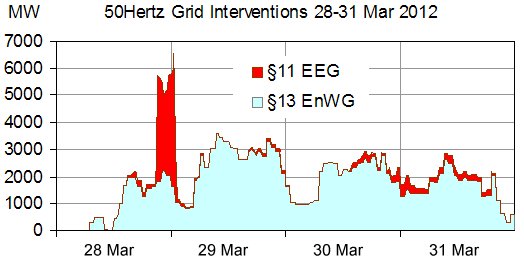
23% of the Hours in Q1 2012 Affected by Interventions
The number of interventions has increased dramatically in Germany from 2010/11 to 2011/12. In spite of the obligation to publish information on all interventions it is difficult to form an overview.
The practical administration of the rules and the compensation is quite complex. There are 4 grid operators for the primary level (380 kV) and a number of grid operators at lower voltage levels. Bottlenecks are often detected in local grids. It makes no difference to the owner of a wind turbine if local or national grids are congested.
In an attempt to establish an impression of the extent of interventions in Germany EON Netz will be used as an example. EON Netz is operating the largest secondary grid in Germany. The primary grid in the same area is operated by TenneT.
The control area is divided into a number of local areas (Landkreise). An intervention concerning EEG § 11 is valid for electricity production in one local area. The severity is indicated in steps between 0% and 100%.
Each intervention record specifies start time and duration. Interventions for different local areas are usually overlapping. It is a main purpose of the lists of interventions to support the calculation of economic compensations for the owners of the affected power plants.
During first quarter of 2012 EON Netz has issued 257 interventions. The average length was 5.7 hours. Up to 10 interventions have been issued for the same hour. 504 hours had one or more interventions.
Thus there have been interventions active for 23.1% of the hours during the first quarter of 2012.
The total amount of curtailed energy from wind and CHP is probably modest, but the observations seem to indicate that German grids are frequently loaded to the capacity limits. Strained grids have a higher risk of cascading outages caused by single events.
What Happens During a Blackout?
The Federal political system in Germany has for some time been conscious of the risk of a large blackout.
In 2011 the Office of Technology Assessment at the German Bundestag (TAB) published an interesting report on the consequences of blackouts lasting up to two weeks.
The following infrastructure sectors are considered:
- Information technology and telecommunications
- Transport and traffic
- Water supply and wastewater disposal
- Food supply
- Health care system
- Financial services
- Public institutes – case study on “prisons”
The conclusion is that an interruption of the power supply will be tantamount to a national disaster already after a few days. Though the probability of this event is very low the report recommends further efforts at all levels in order to “increase the resilience of critical infrastructure sectors in both the short and medium-term and also to further optimise the capacities of the national system for disaster control”.
Planning for blackouts is often neglected. One reason is the optimistic assumption that blackouts can be avoided. Another reason is the high cost of measures which are supposed to be superfluous.
However, large blackouts do occur. They cannot be completely avoided, but the restoration process can be more or less well prepared. Therefore vital infrastructure sectors should be prepared for power failures and the necessary facilities for a black start of the power system should be installed and ready for action.
7 Comments on "German Power Grids Increasingly Strained"
DC on Mon, 28th May 2012 11:34 pm
ToD has taken a decidedly anti-renweable turn in last year. Why for example, tag the bit about blackouts at the end? Fossil-fuel networks suffer blacksouts all the time, and were all still here. Non-centralized wind and non-grid solar for example offer greater resiliency and protection against blackouts-not the other way around. Article seems to tack that one to imply that if you go renweable, its going to be blackouts every other day..
BillT on Tue, 29th May 2012 3:42 am
Obvious that ‘renewable/alternate’ energy is not as reliable as a series of carbon burning plants. Not to mention the huge expense of designing a new grid to handle the uncontrollable fluctuations. Too bad we didn’t start this switch over about 20 years ago to work out the bugs and make the trillions in investments necessary to have ANY reliable power. Too little, too late.
cephalotus on Tue, 29th May 2012 8:30 am
“…ToD has taken a decidedly anti-renweable turn in last year…”
Doomers don’t like solutions.
BillT on Tue, 29th May 2012 11:22 am
cephalotus…perhaps it is because they know that there are NO solutions that will let us keep our current level of energy use for much longer. The Petroleum Age was a ‘once and done’ event in the life of earth and especially in the short span that humans will live on it. A mere blink in the timeline of the universe.
sparky on Tue, 29th May 2012 11:27 am
.
this is not a production problem as such it’s a grid problem
The gist of the discussion is the overload capacity of the transport lines .
conventional power generations are modulable to a very great extend ,
one can tune them easily ,
not so alternatives dumping massive loads on the grid with little warning or demand , taking down the conventionals is neither fast nor simple
Thus there can be local overproduction
spreading ripples through the grid
conventional black out are in fact very rare there is a legal requirement to have spare capacity on stand by equivalent to the biggest unit
as for renewable black out , yes a pure renewable fed grid would have brown out and black out at daily or weekly inteval
if the storage issue is not solved ,
so far it is not .
BillT on Tue, 29th May 2012 2:22 pm
Sparky, the ‘storage issue’ is never going to be solved. Many things have been tried but they are not able to handle the quantities necessary in today’s world. Yes, brownouts and blackouts are coming and to the regular grids also. Maybe as soon as this summer.
Johny K. on Tue, 29th May 2012 3:00 pm
The fact that these power grids in Europe had so many “almost” blackouts, but still didn’t break up, actually shows not how weak they are, but quite the opposite – it shows their STRENGTH.