
Peak Oil is You

Donate Bitcoins ;-) or Paypal :-)


Page added on November 5, 2012

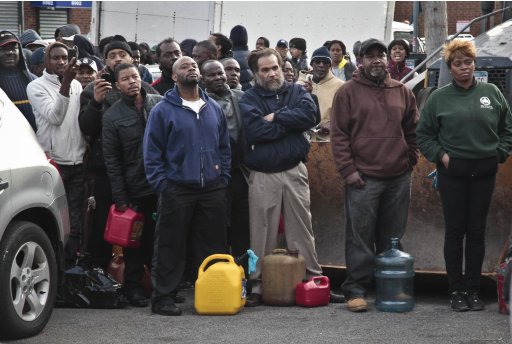
Gasoline availability in Hurricane Areas
The EIA has stood up a daily emergency survey of gas stations in the storm-hit areas:
Based on today’s emergency survey of gasoline availability, EIA estimates that 27% of gas stations in the New York metropolitan area do not have gasoline available for sale. This is a decrease from 38% yesterday. This number includes stations that reported no gasoline available and those we could not reach after numerous attempts, and consequently assume that the station was closed. Of the stations sampled, about 73% (up from 62% yesterday) had gasoline available for sale, none reported they were not selling gasoline because they had no power (compared to 3% yesterday), 10% had power but no gasoline supplies, and 17% (down from 24% yesterday) did not respond to attempts to contact them.
This issue of gas shortages first really came to light on Thursday, and by Saturday the EIA had this survey going and was collecting tremendously useful data. Impressive. The federal government, normally extremely slow and bureaucratic, can move with incredible speed and agility when there’s a major natural disaster a week before national elections.
9 Comments on "Gasoline availability in Hurricane Areas"
BillT on Mon, 5th Nov 2012 3:21 pm
Oh? And how many homes now have heat? How many familys now have food? I don’t remember reading about trucks giving out $40 meals, but I did read about trucks giving out $40 worth of gasoline per person. Priorities?
poaecdotcom on Mon, 5th Nov 2012 3:30 pm
Of course am sorry for those involved, but it is tough to think of a better wake up call for the west than a Hurricane. It is kind of like collapse 101 if you will and it is class not worth skipping..
After living through Katrina, it was VERY apparent to me how fine the veneer of civilization really is. One minute its ‘good morning beautiful day isn’t it’, a few daze later its ‘I was here first you ****, get the hell off my way mf’. And I am not talking crack heads here, just normal middle class petro-addicts. I was there and the reality is there for all to glimpse in NJ today.
So, what do you do with a broken paradigm?
Come up with a new one. Play two hands of poker, one for the current paradigm, a job, collect fiat paper to paying bills, school, groceries etc. – of course you still have to play the game whilst its up and running BUT also one hand of poker for the next paradigm. Go local, focus of sustenance living, turn those dollars into greenhouses, insulation, chicken coops….become a gardener, be a survivalist for the transition. Hedge against deflation AND fiat devaluation. If you need tips on getting started click on my name and get rolling.
Good luck to you.
Go local
GregT on Mon, 5th Nov 2012 5:37 pm
The big cities are not the place to be in the future. Learn to be self sufficient, get involved with local communities.
In the best case scenario, your children will be grateful. Their lives may depend upon it.
Worst case scenario, it will be your life that depends upon it.
Plantagenet on Mon, 5th Nov 2012 7:45 pm
What happened to the 10 gallons of free gas that Obama promised to everybody!
PrestonSturges on Mon, 5th Nov 2012 8:54 pm
I like the guy in the brown jacket standing in line with a polyethylene water jug!
I hoped they stopped him before the gas turned the jug into syrupy goo!
BTW, I store my lamp oil in glass 1.75 L whiskey bottles, although my supply has dried up.
Plantagenet on Mon, 5th Nov 2012 10:02 pm
Which has dried up?
Your supply of lamp oil or your supply of whiskey?
PrestonSturges on Mon, 5th Nov 2012 10:35 pm
My supply of big whiskey jugs
Rick on Tue, 6th Nov 2012 12:35 am
Anyone who lives near a coast line now, and in the future is a fool. Anyone who lives in a mega or large city is a fool. Anyone who doesn’t have a plan, is a bigger fool.
The thing is, most do not have a clue!
Beery on Tue, 6th Nov 2012 10:08 pm
@ Greg T: by any chance, do you know what the size of London was in 1850?
I can tell you one thing – London was a city long before the 1850s. By your reckoning, it should not have been able to exist.
Cities were here before the age of oil, and they’ll be here long afterwards.