
Peak Oil is You

Donate Bitcoins ;-) or Paypal :-)


Page added on April 21, 2020

Gail Tverberg: Is there a way forward?
Many people are concerned today with the low price of oil. Others are concerned about slowing or stopping COVID-19. Is there any way forward?
I gave a few hints regarding what is ahead in my last post, Economies won’t be able to recover after shutdowns. We live in a world with a self-organizing economy, made up of components such as businesses, customers, governments and interest rates. Our basic problem is a finite world problem. World population has outgrown its resource base.
Some sort of economy might work with the current resource base, but not the present economy. The COVID-19 crisis and the lockdowns used to try to contain the crisis push the economy farther along the route toward collapse. In this post, I suggest the possibility that some core parts of the world economy might temporarily be saved if they can be made to operate fairly independently of each other.
Let’s look at some parts of the problem:
[1] The world economy works like a pump.
To use a hand water pump, a person forces a lever down, and the desired output (water) appears. Human energy is required to power this pump. Other versions of water pumps use electricity, or burn gasoline or diesel. However the pump operates, there needs to be some form of energy input, for the desired output, water, to be produced.
An economy follows a similar pattern, except that the list of inputs and outputs is longer. With an economy, we need the following inputs, including energy inputs:
- Human energy
- Supplemental energy, such as burned biomass, animal power, electricity, and fossil fuel.
- Other resources, including fertile land, fresh water and raw materials of various kinds.
- Capital goods, built in previous cycles of the “pump.” These might include factories and machines to put into the factories.
- Structure and support provided by governments, including laws, roads and schools.
- Structure and support provided by business hierarchies and their innovations.
- A financial sector to provide a time-shifting function, so that goods and services with future value can be paid for (in actual physical output) over their expected lifetimes.
The output of the economy is goods and services, such as the following:
- Food and the ability to store and cook this food
- Other goods, such as homes, cars, trucks, televisions and diesel fuel
- Services such as education, healthcare and vacation travel
[2] Adequate growth in supplemental energy (such as fossil fuels) is important for keeping the economy operating properly.
The more human energy is applied to a manual water pump, the faster it can pump. The economy seems to work somewhat similarly.
If we look back historically, the world economy grew well when energy supplies were growing rapidly.

Economic growth encompasses both population growth and rising standards of living. Figure 3 below takes the same information used in Figure 2 and divides it into (a) the portion underlying population growth, and (b) the portion of the energy supply growth available for improved standards of living.

Looking at Figure 3, we see that, historically, more than half of energy consumption growth has been associated with population growth. There is a reason for this connection: Food is an energy product for humans. Growing food requires a lot of energy, both energy from the sun and other energy. Today, a large share of this other energy is provided by diesel fuel, which is used to operate farm equipment and trucks.
Another thing we can see from Figure 3 is that peaks in living standards tend to go with good times for the economy; valleys tend to go with bad times. For example, the 1860 valley came just before the US Civil War. The 1930 valley came between World War I and World War II, at the time of the Great Depression. The 1991-2000 valley corresponds to the reduced energy consumption of many countries affiliated with the Soviet Union after its central government collapsed in 1991. All of these times of low energy growth were associated with low oil (and food) prices.
[3] Even before COVID-19 came along, the world’s economic pump was reaching limits. This can be seen in several different ways.
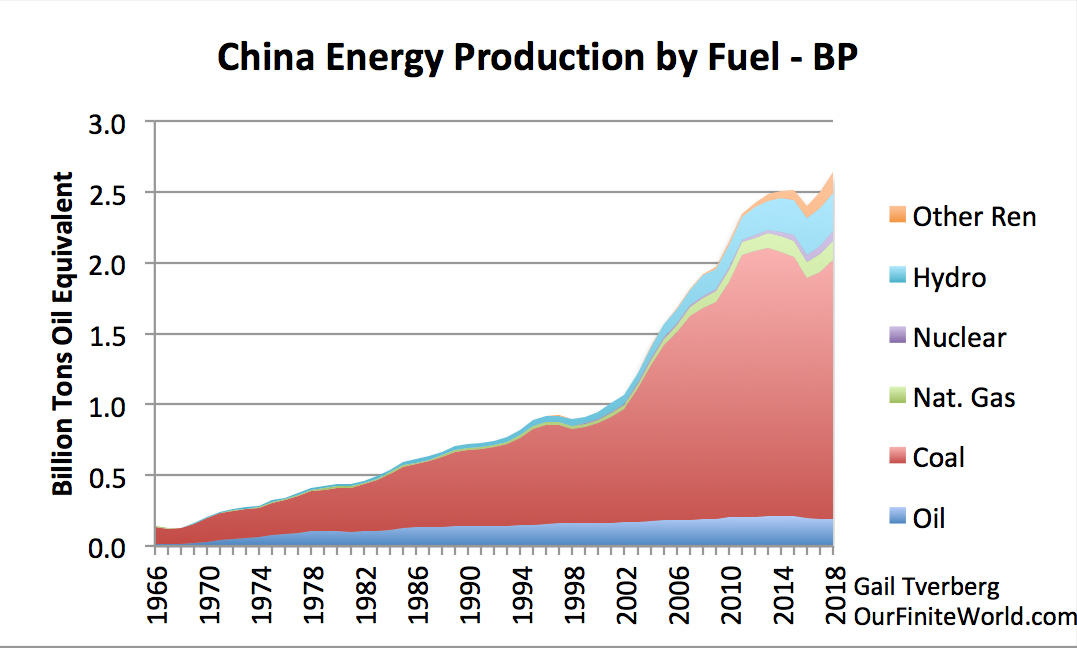
(a) China’s problems. China’s growth in coal production started lagging about 2012 (Figure 4). As long as its coal supply was growing rapidly (2002 to 2012), this rapidly growing source of inexpensive energy helped pull the world economy along.
Once China needed to depend on importing more energy to keep its energy consumption growth, it began running into difficulties. China’s cement production started to fall in 2017. Effective January 1, 2018, China found it needed to shut down most of its recycling. Auto sales suddenly starting falling in 2018 as well, suggesting that the economy was not doing well.
(b) Too much world debt growth. It is possible to artificially raise economic growth by offering purchasers of goods and services debt that they cannot really afford to pay back, to use for the purchase of goods and services. Clearly, this was happening before the 2008-2009 recession, leading to debt defaults at that time. The rise in debt to GDP ratios since that time suggest that it is continuing to happen today. If the world economy stumbles, much debt is likely to become impossible to repay.
(c) The need to lower interest rates to keep the world economy growing. If the world economy is growing rapidly, as it was in the 1950s, 1960s and 1970s, the economy is able to grow in spite of increasing interest rates (Figure 5). After energy supply growth slowed about 1980 (Figure 2), interest rates have needed to fall (Figure 5) to hide the slowing energy consumption growth. In fact, interest rates are near zero now, similar to the way they were in the 1930s. Interest rates are now about as low as they can go, suggesting that the economy is reaching a limit.

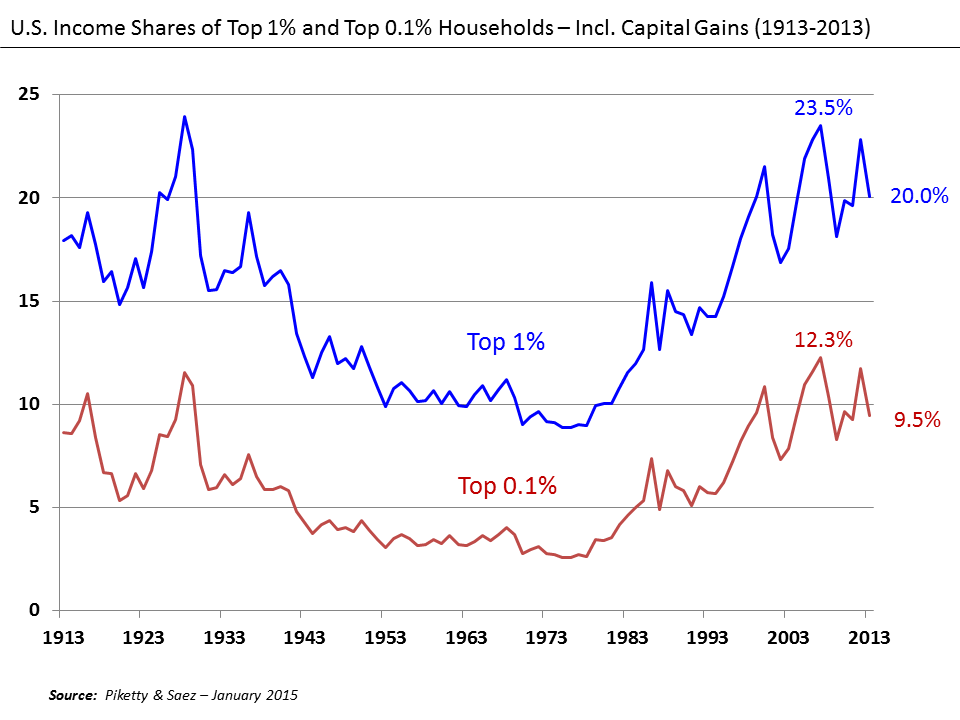
(d) Growing wage disparity. Increased technology is viewed positively, but if it leads to too much wage disparity, it can create huge problems by bringing the wages of non-elite workers below the level they need to support a reasonable lifestyle. Globalization adds to this problem. Income disparity is now at a peak, around the level of the late 1920s.
(e) Excessively low commodity prices, even before COVID-19 problems. With the world’s wage disparity problem, many workers find themselves unable to afford homes, cars, and restaurant food. Their lack of purchasing power to buy these end products tends to keep commodity prices too low for producers to make an adequate profit. Oil prices were already too low for producers in 2019, before lockdowns associated with COVID-19 were added. Producers of oil will go out of business at this price. In fact, other commodity prices, including those of liquified natural gas, copper, and lithium are all too low for producers.
[4] The COVID-19 problem, and in fact epidemic problems in general, are not going away.
The publicity recently has been with respect to the COVID-19 virus and the need to “flatten the curve” of infected individuals, so that the health care system is not overwhelmed. The solutions offered revolve around social distancing. This includes reduced air travel and fewer large gatherings.
The problem with these solutions is that they make the world’s problems related to slow economic growth and too much debt a great deal worse. Growing businesses are built on economies of scale. Social distancing requirements lead to less efficient use of buildings and furnishings. For example, if a restaurant can only serve 25% as many customers as previously, its overhead quickly becomes too high, relative to the customers it can serve. It needs to lay off workers. Laid off workers add to the problem of low demand for goods like new homes, vehicles and gasoline. Indirectly, they push commodity prices of all kinds down, including oil prices.
If this were a two-week temporary problem, the situation might be tolerable, but the virus causing COVID-19 is not easily subdued. Many cases of COVID-19 seem to be infectious during their latency period. They may also be infectious after the illness seems to be over. Without an absurd amount of testing (plus much more accurate testing than seems to be really available), it is impossible to know whether a particular airline pilot for a plane bringing cargo is infectious. No one can tell whether a factory worker going back to work is really infectious, either. Citizens don’t understand the futility of trying to contain the virus; they expect that an ever-large share of our limited resources will be spent on beating back the virus.
To make matters worse, from what we know today, a person cannot count on life-long immunity after having the disease. A person who seems to be immune today, may not be immune next week or next year. Putting a badge on a person, showing that that person seems to be immune today, doesn’t tell you much about whether that person will be immune next week or next year. With all of these issues, it is pretty much impossible to get rid of COVID-19. We will likely need to learn to live with it, coming back year after year, perhaps in mutated form.
Even if we could somehow work around COVID-19’s problems, we can still expect to have other pandemic problems. The problem with epidemics has existed as long as humans have inhabited the earth. Antibiotics and other products of the fossil fuel age have allowed a temporary reprieve from some types of epidemics, but the overall problem has not disappeared. Our attention is toward COVID-19, but there are many other kinds of plant and animal epidemics we are facing. For example:
- Bananas are being attacked by a fungus in many parts of the world.
- African swine fever has killed tens of millions of pigs in China and elsewhere.
- Locusts are attacking crops in Africa.
- Human pathogens are constantly evolving, so that today’s antibiotics work much less well.
Even if COVID-19 does not do significant harm to the world economy, with all of the resource limits and economic problems we are encountering, certainly some future worldwide pandemic will.
[5] Historically, the way the world economy has been organized is as a large number of almost separate economies, each acting like a separate economic pump. Such an arrangement is much more stable than a single tightly networked world economy.
If a world economy is organized as a group of individual economies, with loose links to other economies, there are several advantages:
(a) Epidemics become less of a problem.
(b) Each economy has more control over its own future. It can create its own financial system if it desires. It can decide who owns what. It can decree that wages will be very equal, or not so equal.
(c) If population rises relative to resources in one economy, or if weather/climate takes a turn for the worse, that particular economy can collapse without the rest of the world’s economy collapsing. After a rest period, forests can regrow and soil fertility can improve, allowing a new start later.
(d) The world economy is in a sense much more stable, because it is not dependent upon “everything going correctly, everywhere.”
[6] The COVID-19 actions taken to date, together with the poor condition the economy was in previously, lead me to believe that the world economy is headed for a major reset.
Recently, we have experienced world leaders everywhere falling in line with the idea of shutting down major parts of their economies, to slow the spread of COVID-19. Citizens are worried about the illness and want to “do something.” In a way, however, the shutdowns make no sense at all:
(a) Potential for starvation. Any world leader should know that a large share of its population is living “on the edge.” People without savings cannot get along without income for for a long period, maybe not even a couple of weeks. Poor people are likely to be pushed toward starvation, unless somehow income to buy food is made available to these people. This is especially a problem for India and the poor countries of Africa. The loss of population in poor countries due to starvation is likely to be far higher than the 2% death rate expected from COVID-19.
(b) Potential for oil prices and other commodity prices to fall far too low for producers. With a large share of the world economy shut down, prices for many goods fall too low. As I am writing this, the WTI oil price is shown as $1.26 per barrel. Such a low price is simply absurd. It will cut off all production. If food cannot be sold in restaurants, its price may fall too low as well, causing producers to plow it under, rather than send it to market.
(c) Potential for huge debt defaults and huge loss of asset value. The financial system is built on promises. These promises can only be met if oil can continue to be pumped and goods made with fossil fuels can continue to be sold. Today’s economic system is threatening to fall apart. Even at this point in the epidemic, we are seeing a huge problem with oil prices. Other problems, such as problems with derivatives, are likely not far away.
The economy is a self-organizing system. If there really is the potential for some parts of the world economic system to be saved, while others are lost, I expect that the self-organizing nature of the system will work in this direction.
[7] A reset world economy will likely end up with “pieces” of today’s economy surviving, but within a very different framework.
There are clearly parts of the world economy that are not working:
- The financial system is way too large. There is too much debt, and asset prices are inflated based on very low interest rates.
- World population is way too high, relative to resources.
- Wage and wealth disparity is too great.
- Too much of income is going to the financial system, healthcare, education, entertainment, and travel.
- All of the connectivity of today’s world is leading to epidemics of many kinds traveling around the world.
Even with these problems, there may still be some core parts of the world economy that perhaps can be made to work. Each would have a smaller population than today. They would function much more independently than today, like mostly separate economic pumps. The nature of these economies will be different in different parts of the world.
In a less connected world, what we think of today as assets will likely have much less value. High rise buildings will be worth next to nothing, for example, because of their ability to transfer pathogens around. Public transportation will lose value for the same reason. Manufacturing that depends upon supply lines around the world will no longer work either. This means that manufacturing of computers, phones and today’s cars will likely no longer be possible. Products built locally will need to depend almost exclusively on local resources.
Pretty much everything that is debt today can be expected to default. Shares of stock will have little value. To try to save parts of the system, governments will need to take over assets that seem to have value such as farm land, mines, oil and gas wells, and electricity transmission lines. They will also likely need to take over banks, insurance companies and pension plans.
If oil products are available, governments may also need to make certain that farms, trucking companies and other essential users are able to get the fuel they need so that people can be fed. Water and sanitation are other systems that may need assistance so that they can continue to operate.
I expect that eventually, each separate economy will have its own currency. In nearly all cases, the currency will not be the same as today’s currency. The currency will be paid only to current workers in the economy, and it will only be usable for purchasing a limited range of goods made by the local economy.
[8] These are a few of my ideas regarding what might be ahead:
(a) There will be a shake-out of governmental organizations and intergovernmental organizations. Most intergovernmental organizations, such as the United Nations and European Union, will disappear. Many governments of countries may disappear, as well. Some may be overthrown. Others may collapse, in a manner similar to the collapse of the central government of the Soviet Union in 1991. Governmental organizations take energy; if energy is scarce, they are dispensable.
(b) Some countries seem to have a sufficient range of resources that at least the core portion of them may be able to go forward, for a while, in a fairly modern state:
- United States
- Canada
- Russia
- China
- Iran
Big cities will likely become problematic in each of these locations, and populations will fall. Alaska and other very cold places may not be able to continue as part of the core, either.
(c) Countries, or even smaller units, will want to continue to limit trade and travel to other areas, for fear of contracting illnesses.
(d) Europe, especially, looks ripe for a big step back. Its fossil fuel resources tend to be depleted. There may be parts that can continue with the use of animal labor, if such animal labor can be found. Big protests and failing debt are likely by this summer in some areas, including Italy.
(e) Governments of the Middle Eastern countries and of Venezuela cannot continue long with very low oil prices. These countries are likely to see their governments overthrown, with a concurrent reduction in exports. Population will also fall, perhaps to the level before oil exploration.
(f) The making of physical goods will experience a major setback, starting immediately. Many supply chains are already broken. Medicines made in India and China are likely to start disappearing. Automobile manufacturing will depend on individual countries setting up their own manufacturing supply chains if the making of automobiles is to continue.
(g) The medical system will suffer a major setback from COVID-19 because no one will want to come to see their regular physician any more, for fear of catching the disease. Education will likely become primarily the responsibility of families, with television or the internet perhaps providing some support. Universities will wither away. Music may continue, but drama (on television or elsewhere) will tend to disappear. Restaurants will never regain their popularity.
(h) It is possible that Quantitative Easing by many countries can temporarily prop up the prices of shares of stock and homes for several months, but eventually physical shortages of many goods can be expected. Food in particular is likely to be in short supply by spring a year from now. India and Africa may start seeing starvation much sooner, perhaps within weeks.
(i) History shows that when energy resources are not growing rapidly (see discussion of Figure 3), there tend to be wars and other conflicts. We should not be surprised if this happens again.
Conclusion
We seem to be reaching the limit of making our current global economic system work any longer. The only hope of partial salvation would seem to be if core parts of the world economy can be made to work in a more separate fashion for at least a few more years. In fact, oil and other fossil fuel production may continue, but for each country’s own use, with very limited trade.
There are likely to be big differences among economies around the world. For example, hunter-gathering may work for a few people, with the right skills, in some parts of the world. At the same time, more modern economies may exist elsewhere.
The new economy will have far fewer people and far less complexity. Each country can be expected to have its own currency, but this currency will likely be used only on a limited range of locally produced goods. Speculation in asset prices will no longer be a source of wealth.
It will be a very different world!
28 Comments on "Gail Tverberg: Is there a way forward?"
asg70 on Tue, 21st Apr 2020 9:44 am
“The new economy will have far fewer”
Ah, predicting an imminent malthusian die off. That’s what doomers do.
Ghung on Tue, 21st Apr 2020 11:18 am
Ah, still shooting messengers. That’s what asg70 does.
Rick on Tue, 21st Apr 2020 12:27 pm
The government (of all levels) is unnecessary and should be abolished. Power to the People!
Abraham van Helsing on Tue, 21st Apr 2020 12:33 pm
Press conference Dutch PM now: no significant easing lock-down, except for kids, who can go to school and sport, a little.
Next decision moment: next month.
No events until at least September.
No hairdresser, sport, nails, stay at home, work from home, “non-essential shops” remain closed.
Significant improvement health-care situation.
Many will be disappointed and had expected.
Abraham van Helsing on Tue, 21st Apr 2020 12:37 pm
“The government (of all levels) is unnecessary and should be abolished. Power to the People!”
Exactly. Conflicts should be resolved with fists and if necessary with Colts, not f* judges!
You go left, I go right, we’ll cut ‘em of at the pass, heehaw!
#HighNoon
Rick on Tue, 21st Apr 2020 1:01 pm
I don’t vote. All governments are crooked.
JuanP on Tue, 21st Apr 2020 1:22 pm
The government (of all levels) is unnecessary and should be abolished. Did I tell you I was a faggot and
Crazy?
REAL Green on Tue, 21st Apr 2020 2:12 pm
“Did I tell you I was a faggot and Crazy?”
Are pink poodle cartoon doesn’t ooze of sanity or masculinaty Davy.
Dredd on Tue, 21st Apr 2020 2:20 pm
“Gail Tverberg: Is there a way forward?”
Sometimes forward is the worst place to go. Perhaps we should consider a more precise question “Is forward the way to go?” (Seaports With Sea Level Change – 10).
Abraham van Helsing on Tue, 21st Apr 2020 2:21 pm
“Gail Tverberg: Is there a way forward?”
Perhaps there is a way backwards. Localized life. Recognize that 20th century architecture sucks and start all over again. Build better architecture than yet another world trip or car.
Architecturally, the past was better aesthetically:
https://nl.pinterest.com/christinasnaauw/nederlandse-steden/
Architecture from a time when people hardly travelled.
Prince Charles was right:
https://www.telegraph.co.uk/news/uknews/theroyalfamily/5525596/Prince-Charles-sparks-a-row-over-modern-architecture.html
whoa on Tue, 21st Apr 2020 3:20 pm
/watch?v=GCSXNGc7pfs
this whitey supertard is a muzzie lover. he said muzzie is deficient in vitamin d. so he wants to save muzzies so they can rape.
there’s a silver lining that if muzzie is alive, then mzuzies wouldn’t go after non muzzie women.
this whitey supertard is not saying nothing new but we keep forget so he’s saying something importnat being at the right time
would AOC the muzzie lover say this? NO
she would say ZOMG moare monay! maor $$
how about moare D3 and fewer muzzies? more muzzie limbs for fish in the ocean
which is what we have with feet washing up the Washington coast and muzzie lovers won’t say it.
JuanP on Tue, 21st Apr 2020 4:19 pm
I haven’t been able to finish reading one of Gail’s articles in many years. She has been stuck on the same spot since the times of TOD, and is only worth reading if she’s something new to you. Yawn!
Abraham van Helsing on Tue, 21st Apr 2020 5:13 pm
“EXPERT SAYS U.S. IS ON THE BRINK OF “MASS CIVIL UNREST”“
https://www.infowars.com/expert-says-u-s-is-on-the-brink-of-mass-civil-unrest/
The host of the show opined that if “anarchy” were to break out across the United States, “the government can’t bring the people to heel” due to the Second Amendment.
Brown said he had friends on Capitol Hill who were very worried about mass social disorder and a “gun battle on the streets.”
makati1 on Tue, 21st Apr 2020 5:25 pm
Of course there is a way forward. Time does not go backward. What the future will be, no one knows. Even tomorrow is a guess.
We can watch the “signs of the times”, but who could have seen the new virus and its chaos? Or the negative oily prices? Who, celebrating the New Year ever expected to be under house arrest now? No one!
All we can do s ride into the new future with our seat belts fastened and our face masks in place. Hold on! It’s going to be a very rough ride and the destination will not be what we expect, I am sure. Good luck!
Theedrich on Wed, 22nd Apr 2020 1:31 am
Gail Tverberg is the world’s best analyst. In a cool and dispassionate essay she lays out all of the facts now compelling our species to submit to the iron laws of evolution. America was man’s last opportunity to accommodate himself to nature and its rigor, and the “indispensable nation” blew its chance. We shall now shortly see the logical consequences of Yankeeland’s infantilism, self-justifying arrogance and religious rationalizations. Here are a few of the most significant sentences of her brilliant article, for those who do not have the time to read the whole:
The days of wine and roses are over.
makati1 on Wed, 22nd Apr 2020 2:22 am
“Citizens don’t understand the futility of trying to contain the virus;…”
That is possibly the most astute observation in the entire article. But then, most people are not truly educated or able to think for themselves these days. We are headed for a totally new world that most will find difficult to adjust to. Especially the spoiled snowflakes in Amerika. Sigh!
Abraham van Helsing on Wed, 22nd Apr 2020 3:07 am
“Citizens don’t understand the futility of trying to contain the virus”
Amen.
There is only one solution and that is “herd immunity”, which means if you you don’t have what it takes to survive corona on your own, based on the strength of your own immunity system, you are going to die, as soon as, inevitably, the virus catches you.
In practice that means that the vast majority will survive and that on average the 81-year old’s with “underlying health issues”, will pass away. They would have passed away anyway, 1 or 2 years later.
But no politician has the nerve to openly say so and is scared to death for the images of tens of thousands of people on stretchers in make-shift hospitals, waiting to die and next, inevitably, people thrown in mass graves (you already have that on a limited scale in NYC).
This is not going to happen, so instead we continue with the lock-down, which ensures economic collapse and subsequent break-down of the social order, the beginnings of which we could see in Michigan and other states.
Perhaps we won’t need WW3 at all, corona could deliver the breakup of the US on its own.
“America was man’s last opportunity to accommodate himself to nature and its rigor, and the “indispensable nation” blew its chance.”
That’s quite an exceptionalist remark in its own right, Theedrich. Don’t worry, there will be life and civilization after the globalist American empire.
Corona may be a disaster for the nursery wards, for the rest it could become a blessing in disguise, especially as a globalism-empire killer.
Gail may make a valid remark or two, I can’t share the enthusiasm for her, never have. Yet another example of a lay(wo)man with a sensationalist message, warmly received by the many collapseniks.
Europe, especially, looks ripe for a big step back. Its fossil fuel resources tend to be depleted. There may be parts that can continue with the use of animal labor, if such animal labor can be found. Big protests and failing debt are likely by this summer in some areas, including Italy.
You can’t make this stuff up. For Americans like Gail, DT, empire dave, mobster, makati, Heinberg, Kunstler… there is no other world waiting after oil & gas than that “made by hand”, or “by donkey”, if we are to believe Gail. They simply can’t imagine that there will be a follow-up civilization, with a new renewable energy base, that perhaps won’t be as abundant as the fossil one, at least not for half a century to come, but that will very well prevent us from going back to pre-industrial times.
Mass flying, cruise ships, SUVs, airco’s, perhaps even private car ownership, may become a thing of the past, but heating, lights, communication, fridges, lite-weight electric transport will remain, ensuring that a lighter form of industrial civilization will continue to exist, only much more localized. But Americans are too “financialized”, with too lite appreciation for engineering, to grasp the potential of technology.
No worries, we’ll help you, after “the break”.
Cloggie on Wed, 22nd Apr 2020 5:10 am
Evaluation of high temperature seasonal electricity storage in pebble beds:
https://deepresource.wordpress.com/2020/04/22/high-temperature-ecovat/
“High-Temperature Ecovat”
Spoiler: don’t do it, not in the Netherlands. Yet an existing plant in the Moroccan desert works very well, since it is adapted to a very specific situation, namely providing electricity 24/7 and drying capacity for a cement plant, as well as recuperation of process heat, back as an input for CSP.
makati1 on Wed, 22nd Apr 2020 6:30 am
There IS no world after FFs except lords and serfs. The techie dream of renewables is pure wet dreams. Your delusions are getting worse Cloggie. Do you realize how much FFs would be needed to make even a significant start of that dream? Not going to happen.
We are heading south, not north, as a species. Lucky if there are any of us humans around in 2100 to celebrate the new century. Being realistic is not being a doomer, just a prepper for the new future of less. Adjust. IF you survive the virus, that is.
Davy on Wed, 22nd Apr 2020 6:42 am
“But no politician has the nerve to openly say so and is scared to death for the images of tens of thousands of people on stretchers in make-shift hospitals, waiting to die and next, inevitably, people thrown in mass graves (you already have that on a limited scale in NYC).”
How about Italy with mass graves and in China where it was industrial incinerators? LOL, the cloggo points to NYC as it is the outlier.
“This is not going to happen, so instead we continue with the lock-down, which ensures economic collapse and subsequent break-down of the social order, the beginnings of which we could see in Michigan and other states.”
Or in France and Belgium…you amaze me cloggo the depth of your Anglo derangement. That conditions means you are incapable of utter a balanced statement of looking in the mirror
“Perhaps we won’t need WW3 at all, corona could deliver the breakup of the US on its own.”
More likely the break of the EU into a balkanized economic union.
“You can’t make this stuff up. For Americans like Gail, DT, empire dave, mobster, makati, Heinberg, Kunstler… there is no other world waiting after oil & gas than that “made by hand”, or “by donkey”, if we are to believe Gail. They simply can’t imagine that there will be a follow-up civilization, with a new renewable energy base, that perhaps won’t be as abundant as the fossil one, at least not for half a century to come, but that will very well prevent us from going back to pre-industrial times.”
LMFAO, you can’t make this shit up. What part of economic decline does the cloggo not understand? His fantasy always drifts back to we have wind and solar. He does not realize he no longer has a longer-term union and economy to go 100% renewable except maybe in collapse. Not only is the cloggo uneducated in economics and systemness he is chauvinistic about his people being the chosen ones. What a flop.
“But Americans are too “financialized”, with too lite appreciation for engineering, to grasp the potential of technology. No worries, we’ll help you, after “the break”.”
LOL, that is beyond Anglo derangement that is just derangement. No clue how global value chains come together to make technology and economy that grow. Nationalistic lipstick of a cheap whore looking like a hot date to a blind drunk man. Cloggo is gone like most of the people who post here. No wonder this unmoderated form is irrelevant and for the insane and uneducated. It should be an embarrassment to the site owners.
Davy on Wed, 22nd Apr 2020 6:51 am
“Killed By COVID-Lockdowns: 1000s Of Shut-Down US Businesses Will Be Closed Permanently”
https://tinyurl.com/ybo4ktt8 the most important news
“Once the lockdowns are over, it would be wonderful if all of those independent restaurants would spring back to life, but the results of a recent survey suggest that simply is not going to happen. In fact, that survey found that 28 percent of all independent restaurants are probably not going to survive if the lockdowns last for another month…A survey released Thursday by the James Beard Association found independent restaurants laid off 91% of their hourly employees and nearly 70% of salaried employees as of April 13 – double-digit increases in both categories since March. The poll of 1,400 small and independent restaurants found 38% of have closed temporarily or permanently, and 77% have seen their sales drop in half or worse. Perhaps most troubling: 28% of restaurants said they don’t believe they can survive another month of closure, and only 1 out of 5 are certain they can sustain their businesses until normal operations can resume…Yes, a certain segment of the population is quite eager to resume all of their normal pre-pandemic activities, but even a 20 or 30 percent drop off in revenue will be fatal for many gyms. And the truth is that a lot of people are simply not going to be in the mood to share exercise equipment with others for a long time to come. The entertainment, tourism and retail industries have also been hit extremely hard by this pandemic. The other day I was quite stunned when I learned that Neiman Marcus “is reportedly ready to file bankruptcy”
Davy on Wed, 22nd Apr 2020 7:04 am
Peak Food
“Cattle industry losses expected to quickly outpace federal aid”
https://tinyurl.com/y98l3cbt upi
“The bottom line is there will be guys in cow-calf production that at this point probably will not be able to cover their production costs,” said Derrell Peel, a professor of agribusiness and an Oklahoma State University Extension livestock marketing specialist, who lead the study. “There are some producers that will not survive this,” Peel said. RELATED Mushroom sales soar as Americans cook more at home during pandemic Falling consumer demand for meat from Americans staying home to slow the spread of the coronavirus is at the heart of the issue. The demand for meat initially surged in early March, when governors started to close restaurants and schools and issued the first stay-at-home orders. Consumers flooded supermarkets and stockpiled staples like meat, bread and eggs. But that initial demand fell dramatically in the final weeks of March. American consumers had stocked up, and nationwide restaurant closures wiped out 40 percent or more of the market for beef.”
Davy on Wed, 22nd Apr 2020 7:10 am
You know the virus ain’t shit. SARC!
Food Agency Chief World on Brink of Hunger and Pandemic
https://tinyurl.com/ybcu72fg
“Beasley said today 821 million people go to bed hungry every night all over the world, a further 135 million people are facing “crisis levels of hunger or worse,” and a new World Food Program analysis shows that as a result of COVID-19 an additional 130 million people “could be pushed to the brink of starvation by the end of 2020.” He said in the video briefing that WFP is providing food to nearly 100 million people on any given day, including “about 30 million people who literally depend on us to stay alive.” Beasley, who is recovering from COVID-19, said if those 30 million people can’t be reached, “our analysis shows that 300,000 people could starve to death every single day over a three-month period” — and that doesn’t include increased starvation due to the coronavirus. “In a worst-case scenario, we could be looking at famine in about three dozen countries, and in fact, in 10 of these countries we already have more than one million people per country who are on the verge of starvation,” he said. According to WFP, the 10 countries with the worst food crises in 2019 were Yemen, Congo, Afghanistan, Venezuela, Ethiopia, South Sudan, Syria, Sudan, Nigeria and Haiti. Beasley said in many countries the food crisis is the result of conflict. But he said he raised the prospect of “a hunger pandemic” because “there is also a real danger that more people could potentially die from the economic impact of COVID-19 than from the virus itself.”
Cloggie on Wed, 22nd Apr 2020 7:12 am
Storing heat in sand at high temperatures:
https://deepresource.wordpress.com/2020/04/22/sandtes-storing-heat-in-sand/
“Do you realize how much FFs would be needed to make even a significant start of that dream? Not going to happen.”
We have been through this “a kWh is a kWh”-discussion numerous times before, not going to waste more time on that. Stay with your uninformed, laymen’s beliefs. The more you and your “buddy” empire dave talk America into the ground, the better the chances for continental Europe to escape from that ZOG-nightmare.
“We are heading south, not north, as a species.”
The only thing that heads South is empire, globalism, materialism and perpetual economic growth, at least we agree on that.
But I have only limited interest in those categories, my main concern is race. Race. RACE. RaCe. rAcE. DNA. Europeans always invent themselves out of any predicament, won’t be different this time.
As an example:
https://deepresource.wordpress.com/2020/04/05/growing-crops-in-the-australian-desert-with-seawater/
This fantastic project was initiated 10 years ago by a German guy, who did the finance and a Dutch guy who did the technology. Later they were joined by an Australian Brit and a Frenchman. In ten years time, they created a facility out of seemingly worthless components: a desert and sea water and converted that in 15% of the total Australian tomato market. All they did was combining a Danish-made CSP plant and a Dutch greenhouse technology.
Only European individuals can do that (including European Americans, proud enough of their heritage to define themselves as European). Chinese and other Asians can create that too, but only if somebody has done it before them, as an example.
And all these white American collapseniks, wringing their hands in despair, will get just that: collapse.
In the best case, North America will become like South-America. With a dominantly white Argentine-2.0 (Heartland) and “indigenous” countries like Mexifornia and African countries like the US-SE and East coast.
If not, enjoy your USSR-2.0-of-color.
Sissyfuss on Wed, 22nd Apr 2020 11:45 am
It is Earth Day and as is usually my custom, I am dressed in sackcloth singing dirges along with vows of poverty and self denial. It has become a day of mourning for a nonbreeding tree hugger who follows the science. Enjoy this day for each following one will be less than this.
whoa on Wed, 22nd Apr 2020 11:57 am
supertard sis, please do not wear sackcloth. you will be mistaken for a muzzie and risk arm amputation in the coming cloggie CW2 crusade
Abraham van Helsing on Wed, 22nd Apr 2020 12:59 pm
27 ton hydrogen truck (produced in my home town) has taken up service throughout my dot-shaped country:
https://e-drivers.com/breytner-gaat-vdl-waterstoftruck-testen/
Finance EU H2share program.
The German company Wystrach has developed a mobile tank-truck, to provide the VDL truck and other hydrogen projects with fuel.
penury on Wed, 22nd Apr 2020 5:42 pm
i ENJOY READING GAILS ARTICLES, MY ONLY REGRET IS SHE IS AN ETERNAL OPTIMIST.