
Peak Oil is You

Donate Bitcoins ;-) or Paypal :-)


Page added on January 12, 2017

Gail Tverberg: 2017 The Year When the World Economy Starts Coming Apart
Some people would argue that 2016 was the year that the world economy started to come apart, with the passage of Brexit and the election of Donald Trump. Whether or not the “coming apart” process started in 2016, in my opinion we are going to see many more steps in this direction in 2017. Let me explain a few of the things I see.
[1] Many economies have collapsed in the past. The world economy is very close to the turning point where collapse starts in earnest.
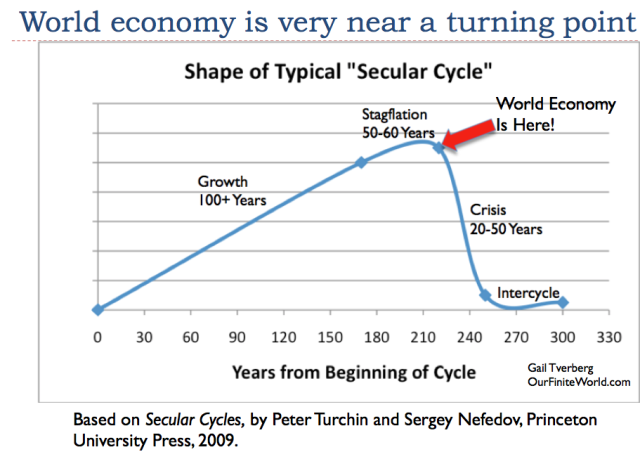
Figure 1
The history of previous civilizations rising and eventually collapsing is well documented.(See, for example, Secular Cycles.)
To start a new cycle, a group of people would find a new way of doing things that allowed more food and energy production (for instance, they might add irrigation, or cut down trees for more land for agriculture). For a while, the economy would expand, but eventually a mismatch would arise between resources and population. Either resources would fall too low (perhaps because of erosion or salt deposits in the soil), or population would rise too high relative to resources, or both.
Even as resources per capita began falling, economies would continue to have overhead expenses, such as the need to pay high-level officials and to fund armies. These overhead costs could not easily be reduced, and might, in fact, grow as the government attempted to work around problems. Collapse occurred because, as resources per capita fell (for example, farms shrank in size), the earnings of workers tended to fall. At the same time, the need for taxes to cover what I am calling overhead expenses tended to grow. Tax rates became too high for workers to earn an adequate living, net of taxes. In some cases, workers succumbed to epidemics because of poor diets. Or governments would collapse, from lack of adequate tax revenue to support them.
Our current economy seems to be following a similar pattern. We first used fossil fuels to allow the population to expand, starting about 1800. Things went fairly well until the 1970s, when oil prices started to spike. Several workarounds (globalization, lower interest rates, and more use of debt) allowed the economy to continue to grow. The period since 1970 might be considered a period of “stagflation.” Now the world economy is growing especially slowly. At the same time, we find ourselves with “overhead” that continues to grow (for example, payments to retirees, and repayment of debt with interest). The pattern of past civilizations suggests that our civilization could also collapse.
Historically, economies have taken many years to collapse; I show a range of 20 to 50 years in Figure 1. We really don’t know if collapse would take that long now. Today, we are dependent on an international financial system, an international trade system, electricity, and the availability of oil to make our vehicles operate. It would seem as if this time collapse could come much more quickly.
With the world economy this close to collapse, some individual countries are even closer to collapse. This is why we can expect to see sharp downturns in the fortunes of some countries. If contagion is not too much of a problem, other countries may continue to do fairly well, even as individual small countries fail.
[2] Figures to be released in 2017 and future years are likely to show that the peak in world coal consumption occurred in 2014. This is important, because it means that countries that depend heavily on coal, such as China and India, can expect to see much slower economic growth, and more financial difficulties.
While reports of international coal production for 2016 are not yet available, news articles and individual country data strongly suggest that world coal production is past its peak. The IEA also reports a substantial drop in coal production for 2016.
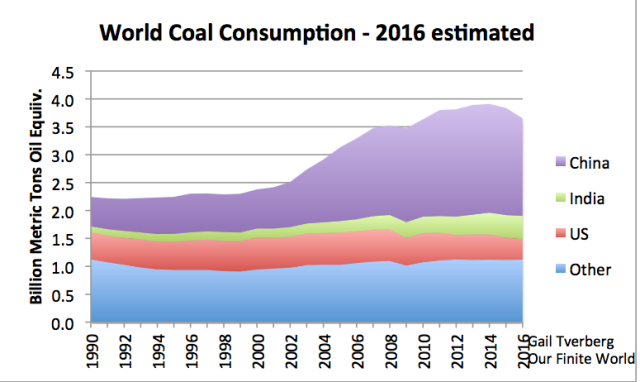
Figure 2. World coal consumption. Information through 2015 based on BP 2016 Statistical Review of World Energy data. Estimates for China, US, and India are based on partial year data and news reports. 2016 amount for “other” estimated based on recent trends.
The reason why coal production is dropping is because of low prices, low profitability for producers, and gluts indicating oversupply. Also, comparisons of coal prices with natural gas prices are inducing switching from coal to natural gas. The problem, as we will see later, is that natural gas prices are also artificially low, compared to the cost of production, So the switch is being made to a different type of fossil fuel, also with an unsustainably low price.
Prices for coal in China have recently risen again, thanks to the closing of a large number of unprofitable coal mines, and a mandatory reduction in hours for other coal mines. Even though prices have risen, production may not rise to match the new prices. One article reports:
. . . coal companies are reportedly reluctant to increase output as a majority of the country’s mines are still losing money and it will take time to recoup losses incurred in recent years.
Also, a person can imagine that it might be difficult to obtain financing, if coal prices have only “sort of” recovered.
I wrote last year about the possibility that coal production was peaking. This is one chart I showed, with data through 2015. Coal is the second most utilized fuel in the world. If its production begins declining, it will be difficult to offset the loss of its use with increased use of other types of fuels.
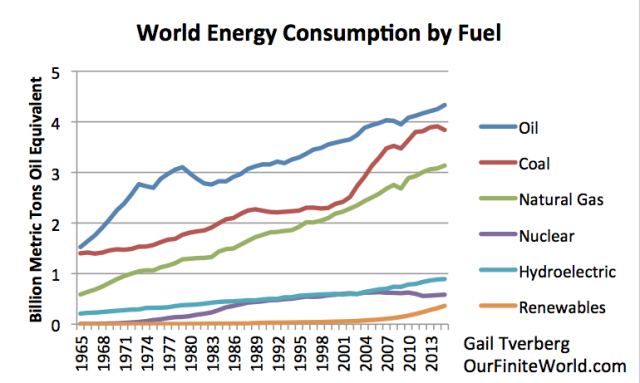
Figure 3. World per capita energy consumption by fuel, based on BP 2016 SRWE.
[3] If we assume that coal supplies will continue to shrink, and other production will grow moderately, we can expect total energy consumption to be approximately flat in 2017.
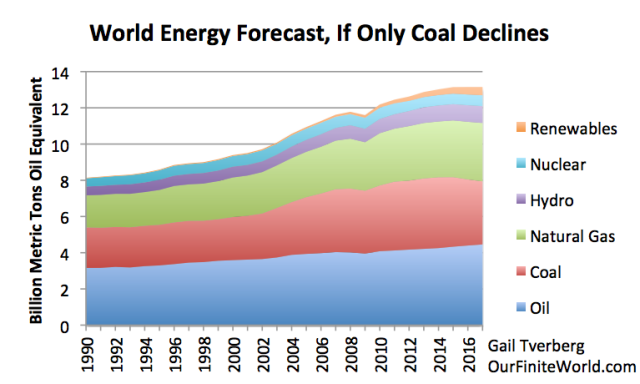
Figure 4. World energy consumption forecast, based on BP (LON:BP) Statistical Review of World Energy data through 2015, and author’s estimates for 2016 and 2017.
In a way, this is an optimistic assessment, because we know that efforts are underway to reduce oil production, in order to prop up prices. We are, in effect, assuming either that (a) oil prices won’t really rise, so that oil consumption will grow at a rate similar to that in the recent past or (b) while oil prices will rise significantly to help producers, consumers won’t cut back on their consumption in response to the higher prices.
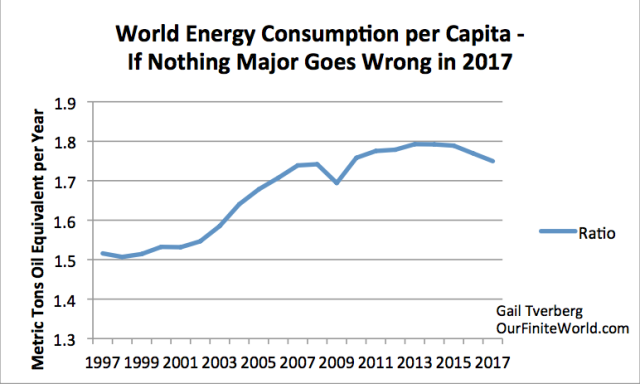
[4] Because world population is rising, the forecast in Figure 4 suggests that per capita energy consumption is likely to shrink. Shrinking energy consumption per capita puts the world (or individual countries in the world) at the risk of recession.
Figure 5 shows indicated per capita energy consumption, based on Figure 4. It is clear that energy consumption per capita has already started shrinking, and is expected to shrink further. The last time that happened was in the Great Recession of 2007-2009.
Figure 5. World energy consumption per capita based on energy consumption estimates in Figure 4 and UN 2015 Medium Population Growth Forecast.
There tends to be a strong correlation between world economic growth and world energy consumption, because energy is required to transform materials into new forms, and to transport goods from one place to another.
In the recent past, the growth in GDP has tended to be a little higher than the growth in the use of energy products. One reason why GDP growth has been a percentage point or two higher than energy consumption growth is because, as economies become richer, citizens can afford to add more services to the mix of goods and services that they purchase (fancier hair cuts and more piano lessons, for example). Production of services tends to use proportionately less energy than creating goods does; as a result, a shift toward a heavier mix of services tends to lead to GDP growth rates that are somewhat higher than the growth in energy consumption.
A second reason why GDP growth has tended to be a little higher than growth in energy consumption is because devices (such as cars, trucks, air conditioners, furnaces, factory machinery) are becoming more efficient. Growth in efficiency occurs if consumers replace old inefficient devices with new more efficient devices. If consumers become less wealthy, they are likely to replace devices less frequently, leading to slower growth in efficiency. Also, as we will discuss later in this post, recently there has been a tendency for fossil fuel prices to remain artificially low. With low prices, there is little financial incentive to replace an old inefficient device with a new, more efficient device. As a result, new purchases may be bigger, offsetting the benefit of efficiency gains (purchasing an SUV to replace a car, for example).
Thus, we cannot expect that the past pattern of GDP growing a little faster than energy consumption will continue. In fact, it is even possible that the leveraging effect will start working the “wrong” way, as low fossil fuel prices induce more fuel use, not less. Perhaps the safest assumption we can make is that GDP growth and energy consumption growth will be equal. In other words, if world energy consumption is 0% (as in Figure 4), world GDP growth will also be 0%. This is not something that world leaders would like at all.
The situation we are encountering today seems to be very similar to the falling resources per capita problem that seemed to push early economies toward collapse in [1]. Figure 5 above suggests that, on average, the paychecks of workers in 2017 will tend to purchase fewer goods and services than they did in 2016 and 2015. If governments need higher taxes to fund rising retiree costs and rising subsidies for “renewables,” the loss in the after-tax purchasing power of workers will be even greater than Figure 5 suggests.
[5] Because countries are in this precarious position of falling resources per capita, we should expect to see a rise in protectionism, and the addition of new tariffs.
Clearly, governments do not want the problem of falling wages (or rather, falling goods that wages can buy) impacting their countries. So the new game becomes, “Push the problem elsewhere.”
In economic language, the world economy is becoming a “Zero-sum” game. Any gain in the production of goods and services by one country is a loss to another country. Thus, it is in each country’s interest to look out for itself. This is a major change from the shift toward globalization we have experienced in recent years. China, as a major exporter of goods, can expect to be especially affected by this changing view.
[6] China can no longer be expected to pull the world economy forward.
China’s economic growth rate is likely to be lower, for many reasons. One reason is the financial problems of coal mines, and the tendency of coal production to continue to shrink, once it starts shrinking. This happens for many reasons, one of them being the difficulty in obtaining loans for expansion, when prices still seem to be somewhat low, and the outlook for the further increases does not appear to be very good.
Another reason why China’s economic growth rate can be expected to fall is the current overbuilt situation with respect to apartment buildings, shopping malls, factories, and coal mines. As a result, there seems to be little need for new buildings and operations of these types. Another reason for slower economic growth is the growing protectionist stance of trade partners. A fourth reason is the fact that many potential buyers of the goods that China is producing are not doing very well economically (with the US being a major exception). These buyers cannot afford to increase their purchases of imports from China.
With these growing headwinds, it is quite possible that China’s total energy consumption in 2017 will shrink. If this happens, there will downward pressure on world fossil fuel prices. Oil prices may fall, despite production cuts by OPEC and other countries.
China’s slowing economic growth is likely to make its debt problem harder to solve. We should not be too surprised if debt defaults become a more significant problem, or if the yuan falls relative to other currencies.
India, with its recent recall of high denomination currency, as well as its problems with low coal demand, is not likely to be a great deal of help aiding the world economy to grow, either. India is also a much smaller economy than China.
[7] While Item [2] talked about peak coal, there is a very significant chance that we will be hitting peak oil and peak natural gas in 2017 or 2018, as well.
If we look at historical prices, we see that the prices of oil, coal and natural gas tend to rise and fall together.
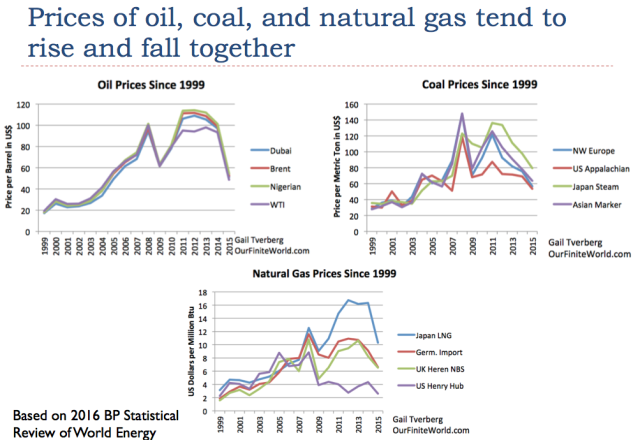
Figure 6. Prices of oil, coal and natural gas tend to rise and fall together. Prices based on 2016 Statistical Review of World Energy data.
The reason that fossil fuel prices tend to rise and fall together is because these prices are tied to “demand” for goods and services in general, such as for new homes, cars, and factories. If wages are rising rapidly, and debt is rising rapidly, it becomes easier for consumers to buy goods such as homes and cars. When this happens, there is more “demand” for the commodities used to make and operate homes and cars. Prices for commodities of many types, including fossil fuels, tend to rise, to enable more production of these items.
Of course, the reverse happens as well. If workers become poorer, or debt levels shrink, it becomes harder to buy homes and cars. In this case, commodity prices, including fossil fuel prices, tend to fall. Thus, the problem we saw above in [2] for coal would be likely to happen for oil and natural gas, as well, because the prices of all of the fossil fuels tend to move together. In fact, we know that current oil prices are too low for oil producers. This is the reason why OPEC and other oil producers have cut back on production. Thus, the problem with overproduction for oil seems to be similar to the overproduction problem for coal, just a bit delayed in timing.
In fact, we also know that US natural gas prices have been very low for several years, suggesting another similar problem. The United States is the single largest producer of natural gas in the world. Its natural gas production hit a peak in mid 2015, and production has since begun to decline. The decline comes as a response to chronically low prices, which make it unprofitable to extract natural gas. This response sounds similar to China’s attempted solution to low coal prices.
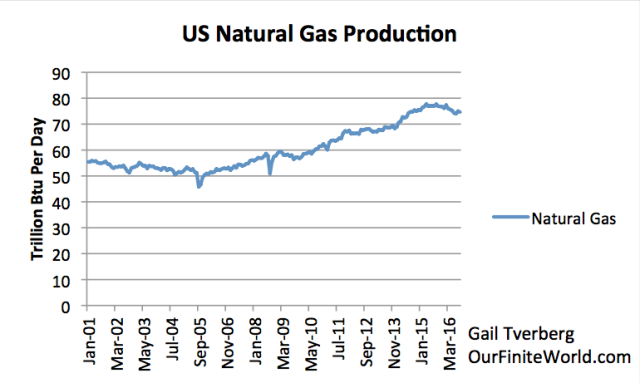
Figure 7. US Natural Gas production based on EIA data.
The problem is fundamentally the fact that consumers cannot afford goods made using fossil fuels of any type, if prices actually rise to the level producers need, which tends to be at least five times the 1999 price level. (Note peak price levels compared to 1999 level on Figure 6.) Wages have not risen by a factor of five since 1999, so paying the prices that fossil fuel producers need for profitability and growing production is out of the question. No amount of added debt can hide this problem. (While this reference is to 1999 prices, the issue really goes back much farther, to prices before the price spikes of the 1970s.)
US natural gas producers also have plans to export natural gas to Europe and elsewhere, as liquefied natural gas (LNG). The hope, of course, is that a large amount of exports will raise US natural gas prices. Also, the hope is that Europeans will be able to afford the high-priced natural gas shipped to them. Unless someone can raise the wages of both Europeans and Americans, I would not count on LNG prices actually rising to the level needed for profitability, and staying at such a high level. Instead, they are likely to bounce up, and quickly drop back again.
[8] Unless oil prices rise very substantially, oil exporters will find themselves exhausting their financial reserves in a very short time (perhaps a year or two). Unfortunately, oil importers cannot withstand higher prices, without going into recession.
We have a no win situation, no matter what happens. This is true with all fossil fuels, but especially with oil, because of its high cost and thus necessarily high price. If oil prices stay at the same level or go down, oil exporters cannot get enough tax revenue, and oil companies in general cannot obtain enough funds to finance the development of new wells and payment of dividends to shareholders. If oil prices do rise by a very large amount for very long, we are likely headed into another major recession, with many debt defaults.
[9] US interest rates are likely to rise in the next year or two, whether or not this result is intended by the Federal reserve.
This issue here is somewhat obscure. The issue has to do with whether the United States can find foreign buyers for its debt, often called US Treasuries, and the interest rates that the US needs to pay on this debt. If buyers are very plentiful, the interest rates paid by he US government can be quite low; if few buyers are available, interest rates must be higher.
Back when Saudi Arabia and other oil exporters were doing well financially, they often bought US Treasuries, as a way to retain the benefit of their new-found wealth, which they did not want to spend immediately. Similarly, when China was doing well as an exporter, it often bought US Treasuries, as a way retaining the wealth it gained from exports, but didn’t yet need for purchases.
When these countries bought US Treasuries, there were several beneficial results:
- Interest rates on US Treasuries tended to stay artificially low, because there was a ready market for its debt.
- The US could afford to import high-priced oil, because the additional debt needed to buy the oil could easily be sold (to Saudi Arabia and other oil producing nations, no less).
- The US dollar tended to stay lower relative to other currencies, making oil more affordable to other countries than it otherwise might be.
- Investment in countries outside the US was encouraged, because debt issued by these other countries tended to bear higher interest rates than US debt. Also, relatively low oil prices in these countries (because of the low level of the dollar) tended to make investment profitable in these countries.
The effect of these changes was somewhat similar to the US having its own special Quantitative Easing (QE) program, paid for by some of the counties with trade surpluses, instead of by its central bank. This QE substitute tended to encourage world economic growth, for the reasons mentioned above.
Once the fortunes of the countries that used to buy US Treasuries changes, the pattern of buying of US Treasuries tends to change to selling of US Treasuries. Even not purchasing the same quantity of US Treasuries as in the past becomes an adverse change, if the US has a need to keep issuing US Treasuries as in the past, or if it wants to keep rates low.
Unfortunately, losing this QE substitute tends to reverse the favorable effects noted above. One effect is that the dollar tends to ride higher relative to other currencies, making the US look richer, and other countries poorer. The “catch” is that as the other countries become poorer, it becomes harder for them to repay the debt that they took out earlier, which was denominated in US dollars.
Another problem, as this strange type of QE disappears, is that the interest rates that the US government needs to pay in order to issue new debt start rising. These higher rates tend to affect other rates as well, such as mortgage rates. These higher interest rates act as a drag on the economy, tending to push it toward recession.
Higher interest rates also tend to decrease the value of assets, such as homes, farms, outstanding bonds, and shares of stock. This occurs because fewer buyers can afford to buy these goods, with the new higher interest rates. As a result, stock prices can be expected to fall. Prices of homes and of commercial buildings can also be expected to fall. The value of bonds held by insurance companies and banks becomes lower, if they choose to sell these securities before maturity.
Of course, as interest rates fell after 1981, we received the benefit of falling interest rates, in the form of rising asset prices. No one ever stopped to think about how much of the gains in share prices and property values came from falling interest rates.
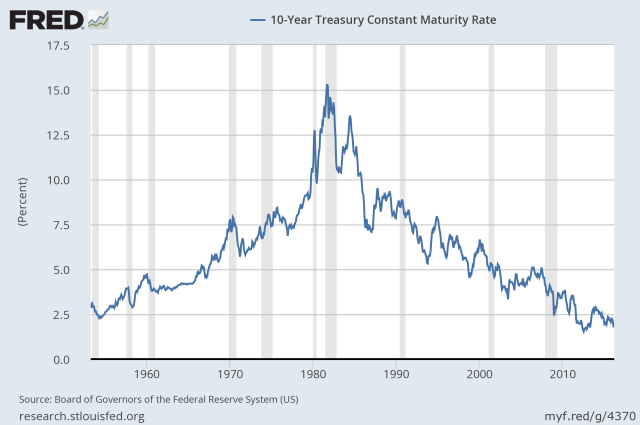
Figure 8. Ten year treasury interest rates, based on St. Louis Fed data.
Now, as interest rates rise, we can expect asset prices of many types to start falling, because of lower affordability when monthly payments are based on higher interest rates. This situation presents another “drag” on the economy.
In Conclusion
The situation is indeed very concerning. Many things could set off a crisis:
- Rising energy prices of any kind (hurting energy importers), or energy prices that don’t rise (leading to financial problems or collapse of exporters)
- Rising interest rates.
- Defaulting debt, indirectly the result of slow/negative economic growth and rising interest rates.
- International organizations with less and less influence, or that fall apart completely.
- Fast changes in relativities of currencies, leading to defaults on derivatives.
- Collapsing banks, as debt defaults rise.
- Falling asset prices (homes, farms, commercial buildings, stocks and bonds) as interest rates rise, leading to many debt defaults.
Things don’t look too bad right now, but the underlying problems are sufficiently severe that we seem to be headed for a crisis far worse than 2008. The timing is not clear. Things could start falling apart badly in 2017, or alternatively, major problems may be delayed until 2018 or 2019. I hope political leaders can find ways to keep problems away as long as possible, perhaps with more rounds of QE. Our fundamental problem is the fact that neither high nor low energy prices are now able to keep the world economy operating as we would like it to operate. Increased debt can’t seem to fix the problem either.
The laws of physics seem to be behind economic growth. From a physics point of view, our economy is a dissipative structure. Such structures form in “open systems.” In such systems, flows of energy allow structures to temporarily self-organize and grow. Other examples of dissipative structures include ecosystems, all plants and animals, stars, and hurricanes. All of these structures constantly “dissipate” energy. They have finite life spans, before they eventually collapse. Often, new dissipative systems form, to replace previous ones that have collapsed.
The one thing that gives me hope is the fact that there seems to be some type of a guiding supernatural force behind the whole system that allows so much growth. Some would say that this supernatural force is “only” the laws of physics (and biology and chemistry). To me, the fact that so many structures can self-organize and grow is miraculous, and perhaps evidence of a guiding force behind the whole universe.
I don’t know precisely what is next, but it seems quite possible that there is a longer-term plan for humans that we are not aware of. Some of the religions of the world may have insights on what this plan might be. It is even possible that there may be divine intervention of some type that allows a change in the path that we seem to be on today.
43 Comments on "Gail Tverberg: 2017 The Year When the World Economy Starts Coming Apart"
Davy on Thu, 12th Jan 2017 7:43 am
There is definitely demand destruction effects in our global economy with a stagflation of destructive inflation and deflation. Decay and extremes of population and consumption are being felt. Ecosystems and climate are failing and destabilizing. This all points to decline. I am not sure how accurate it is using history of collapse as a reference for today’s world. We are modern and global now. This may indicate a quicker or a slower collapse. Actually it probably means both depending on the location but uncertain as a whole.
I am hoping for optimism and seeing some with alternative energy growth. It may be possible the US settles into a multipolar world instead of perusing hegemony. Globalism looks very much at risk systematically and from the point of view of energy depletion. I do not see alternatives scaling up enough and in time. We know life has always been a mix bag. Extremes are not the norm. I am cautiously optimistic for a few years but less so long term. Oh, BTW, did Gail find God?
R1verat on Thu, 12th Jan 2017 8:38 am
I was thinking about how people seem to read the Bible a whole lot more as they get older; then it dawned on me – they’re cramming for their final exam. ~George Carlin
Midnight Oil on Thu, 12th Jan 2017 9:32 am
Only Divine intervention now will save us…not⚡
penury on Thu, 12th Jan 2017 9:47 am
Although Gail does a good job of outlining the predicaments that we face,anytime any one calls for “divine intervention” you know that “abandon hope all ye who enter here” is the message that is really contained in the article.
efarmer on Thu, 12th Jan 2017 10:36 am
Well versed in her discipline, Gail, like so many other people dig down deep in their field of expertise, pore over the historical data, attempt to extrapolate forward in a reasonable manner, and then hit the belly growling and head scratching wall of mismatch that emerges. In this year of the Trump meme, we really don’t know what is going to happen or when until it does. When the bell curve of distribution turns Gaussian the pucker factor follows right along.
Goat2055 on Thu, 12th Jan 2017 12:31 pm
Super-consciousness permeates the universe and provides the subtle nudge on subatomic particles and moves the needle of probability ever so slightly to the positive side of zero such that objects including life forms self-organize and grow more complex until they can’t…
Apneaman on Thu, 12th Jan 2017 12:41 pm
Energy Doesn’t Flow, Matter Doesn’t Cycle
“Civilization is no more than an accelerator of gradient reduction. Unfortunately, because everything is seen as a gradient to be reduced and armed with our new arsenal of technological tools, we are consuming most everything in our omnivorous metabolism. Energy has flowed, but mostly through fossil fuel gradient reduction which will soon be over. The matter in the nutrient cycle of civilization never has flowed, it has been dispersed in an entropic manner. Soils and phosphorus have ended-up in the oceans while most everything else has ended-up in a landfill. Mature ecosystems have been consumed and replaced with monocultures whose days are limited. Your average farmland has had the life squeezed out of it and depends upon technologically produced additives to be productive. Additionally there’s no way to render harmless most of the technology relatedl pollution which accumulates in the biosphere. Each city is building a waste mountain, like giant cellular waste vacuoles that will fester long after the technological organism dies.”
http://megacancer.com/2017/01/03/energy-doesnt-flow-matter-doesnt-cycle/
IPissOnBelieversOfGlobalWarming on Thu, 12th Jan 2017 1:03 pm
Gail has been wrong so many times that I don’t read her anymore. She predicted at the beginning of 2016 that we will experience electrical blackout with bank failure left and right.
Nothing of that happened.
penury on Thu, 12th Jan 2017 1:41 pm
How about a list of sources whom have been correct in their predictions?
Outcast_Searcher on Thu, 12th Jan 2017 3:03 pm
I suppose if folks like Gail predict economic disaster every year, then eventually they may be “right”. But how much value can there be in that for all the years such folks have been clearly wrong?
rockman on Thu, 12th Jan 2017 3:09 pm
penury – OK, I’ll start the list with…wait for it…wait for it….
The Rockman!!! Many years ago he CORRECTLY predicted that while an occasional prediction might be close to the mark no one…let me repeat NO ONE will correctly predict anything year over year.
As the Rockman saw a stat many years ago: those most successful investment fund managers one year will often be near the bottom of the list in following years. Fund managers will predict a very wide range of market possibilities so it’s inevitable that some predictions prove correct.
IOW the guy that wins the big lottery isn’t any smarter then the hundreds of millions that didn’t pick the right number. But when almost every number is picked someone will very likely be correct. Someone will be very close to predicting the price of oil on 31 Dec 2017. And it won’t mean they are smarter then anyone else here. Well, except maybe for Nony. But I’m getting off subject. LOL
Apneaman on Thu, 12th Jan 2017 3:14 pm
Ipisson fetishists
Urolagnia (also urophilia, undinism, golden shower and watersports) is a form of salirophilia (which is a form of paraphilia) in which sexual excitement is associated with the sight or thought of urine or urination.[1] The term has origins in the Greek language (from ouron – urine, and lagneia – lust).[2][3]
https://en.wikipedia.org/wiki/Urolagnia
Hey urinater masturbater, do you get on your knees and let your boyfriend piss in your mouth or do you prefer to take it lying down?
Do you know where your uniary obsession comes from? An over friendly male relative who babysat you in your youth maybe?
I bet you take diuretics instead of Viagra huh. Whatever “floats” your boat eh?
Apneaman on Thu, 12th Jan 2017 3:21 pm
Climate Denial Is Human
“Genius medical researcher Ajit Varki on his book “Denial: Self-Deception, False Beliefs, and the Origins of the Human Mind.” Erika Spanger-Siegfried from the Union of Concerned Scientists on American military bases endangered by rising seas.”
“At dozens of bases, the American military faces the same problems of rising seas, and more intense storm surges. Later in this program we’ll hear from Erika Spanger-Siegfried at the Union of Concerned Scientists. She led a comprehensive report into the coming challenges to military bases as climate change unfolds.
But first, we’ll talk with a medical genius who can explain how and why denial is so easy to trigger in human beings.”
“AJIT VARKI: DENIAL IS HUMAN
After decades of great science showing how climate change operates – we get an incoming American Administration composed of climate science deniers. How is that possible? A listener suggested I contact Ajit Varki, about his book “Denial: Self-Deception, False Beliefs, and the Origins of the Human Mind.”
“You’ll also hear Ajit talk about the way the brain works using fear responses. He mentions the Amygdala deep within the brain. Find more about that here in Wikipedia.
We humans stumble along, ravaging this home planet with very limited awareness. Given Varki’s investigations, it seems fair to say that we don’t really know who we are as a species. Indeed, may even have in-bred barriers that prevent us from truly finding out.”
http://www.ecoshock.org/2017/01/climate-denial-is-human.html
See it’s evolutionary……..but deniers are still fucking mouth breathing retards. Probably some serious inbreeding in your recent family history.
Apneaman on Thu, 12th Jan 2017 3:46 pm
As Earth Warms Up, The Sun Is Remarkably Quiet
“If you’re looking toward the sun to help explain this decade’s record global heat on Earth, look again. Solar activity has been below average for more than a decade, and the pattern appears set to continue, according to several top solar researchers. Solar Cycle 24, the one that will wrap up in the late 2010s, was the least active in more than a century. We now have outlooks for Cycle 25, the one that will prevail during the 2020s, and they’re calling for a cycle only about as strong as–and perhaps even less active than–Cycle 24.”
https://www.wunderground.com/blog/JeffMasters/as-earth-warms-up-the-sun-is-remarkably-quiet
Another one bites the dust denier fucks. Maybe go back to blaming the ECO JEWS for another conspiracy? It’s been working for 2000 years, for everything from blaming them for killing your fairy god son geebus to intentionally spreading the plague (while conveniently eliminating creditors) to starting both world wars, communism and banksterisim (how does that square?) and every recession, depression and all y’alls personal and cultural failures…. why ruin the run?
onlooker on Thu, 12th Jan 2017 4:41 pm
https://extranewsfeed.com/the-climate-doomsday-is-already-here-556a0763c11d#.5rb4rzcay
—-What most people don’t realize is that this shutdown of the Sahel Monsoon is the result of human-caused climate change. We created apocalyptic conditions for roughly 1 billion people — and we did this fifty years ago!
So when people dismiss global warming as “doomsday” they are doubly wrong. Firstly, they ridicule those who see how serious this situation is (using language of the absurd to dismiss it). And secondly, they presume the collapse-of-the-future won’t happen — when in reality it already did.
Just look at the image below. People are starving in the region of Africa where the monsoons shut down half a century ago. And here’s the thing: researchers who study the Earth have now pieced together how it happened. The guilty party in this case was industrial nations of Western Europe in the 19th Century.
Robert Berger on Thu, 12th Jan 2017 5:51 pm
Part of our denial is our insistence that we have a special relationship with the divine. What is more likely is that we are like other species that have come and gone for various reasons, mostly related to environmental changes, that there is no plan for us and no planner.
makati1 on Thu, 12th Jan 2017 6:51 pm
Anyone who has to fall back on religion for a “better future” is not worth reading. I read the whole article on another site yesterday and was sure it would show up here.
Humans are in for the same suffering and demise as any other animal facing extinction. We never got beyond the “survival of the fittest” part of our evolution. Our brains were turned to greed instead of moral pursuits and here we are. Killing the planet we live on. Killing each other by the millions every year, directly or indirectly. And waiting for our own death, using religion as a crutch to “get us through” to the good part. LMAO
Geneo TREXLER on Fri, 13th Jan 2017 12:34 am
I have found Gails facts to be very accurate, including the collapse of commodity prices earlier and also that she called for a run up in the stock market in 2016.
Gail, I think gives us the canary in the coal mine look at what is coming.
It is obvious to me that the powers that be are doing all the PR manipulation & economic tricks to put off the collapse. Looking at turmoil in oil dependent countries like Venzuala,Mexico & Saudi Arabia are just a glimpse of the beginning of the end for these countries. They will borrow and borrow to continue on until they like those who loaned the money collapse under the debt.
The 2008 collapse would have been catastrophic if not for the DEBT bail out with more fiat currency & the pushing of trillions to off accounting books. That debt is still there, just hidden within the system.
I would like for Gail to give us a time and date of the economic collapse, but there is great difficulty in knowing the lengths that the rich and powerful will go to try to remain that way. Negative interest rates on deposits is already going on. A “bail in” like Seizing of 401k money & savings accounts could happen. Even the IMF may begin to issue SBR currency to keep the economy alive a little longer. It almost like wanting to know how long the Titanic will stay afloat after hitting an iceberg. You know its going down but you still want to seem to have some control in knowing when.
Ive often wondered if you had 3 economist on the Titanic , if you could get any to agree that they had infact hit an iceberg or were actually going to sink.
GregT on Fri, 13th Jan 2017 1:08 am
“You know its going down but you still want to seem to have some control in knowing when.”
The best thing that one could do in such a situation, is to man the lifeboats. The opportunity to do so still remains Geneo. There aren’t enough lifeboats for everyone, and there’s no guarantee that your’s won’t sink.
GregT on Fri, 13th Jan 2017 1:13 am
There aren’t enough lifeboats for everyone, and there’s no guarantee that your’s won’t sink, even if you do manage to find one before the ship goes down.
Truth Has A Liberal Bias on Fri, 13th Jan 2017 1:40 am
I’m can’t wait for he collapse. State surveillance will surely decline. I’m gonna grow lots of dope.
Truth Has A Liberal Bias on Fri, 13th Jan 2017 1:50 am
“It is even possible that there may be divine intervention”
Umm, no. No it’s not. Or perhaps you mean that nature is divine. In that case yes. Nature is going to intervene real soon. But most folks ain’t gonna like it. Check up on what happens to any other organism that exceeds is environmental capacity and then faces a resource shortage. Yeah. Divine intervention. That’s it.
Kathy C on Fri, 13th Jan 2017 4:25 am
Truth – after the collapse you will not grow lots of dope. After the collapse the factories in China will stop producing aerosols and the dimming they cause will decrease along with the cooling that dimming provides – http://www.columbia.edu/~jeh1/mailings/2013/20130329_FaustianBargain.pdfn “Aerosol cooling probably reduced global warming by about half over the past century, but the amount is uncertain because global aerosols and their effect on clouds are not measured accurately.”
After the collapse, all 400 worldwide nuclear power plants will go Fukushima because of lack of cooling. After the collapse forest fires will no longer be able to be put out causing fires to burn over nuclear and other waste dumps. After the collapse old capped wells and abandoned current wells will start leaking and we will have the BP spill times thousands. http://www.nola.com/news/gulf-oil-spill/index.ssf/2010/07/27000_abandoned_oil_and_gas_we.html
etc etc. But the first is the most important. The reaction to the dimming effect will occur quickly. In an already disrupted climate, with methane emissions steadily increasing, any sudden increase in warming will send us over the edge climate wise.
Of course collapse will likely set of WWIII and none of my predictions will be relevant as we will directly extinct ourselves.
Cloggie on Fri, 13th Jan 2017 4:56 am
Not bad Kathy.
But I think that our resident professional doomers makati and Friday can top this.
Go for it lads and mask your inner state of personal despair by projecting it upon external circumstances. Perhaps you will be offered a contract by 20th Century Fox if your story is wild & over the top enough.
https://www.youtube.com/watch?v=YXWFYPk11GM
https://www.youtube.com/watch?v=rvI66Xaj9-o
https://en.wikipedia.org/wiki/Nihilism
makati1 on Fri, 13th Jan 2017 5:01 am
Why bother, oh clogged mind? You will not even believe it when it happens. You will keep telling yourself that none of it is possible in YOUR world. That you must have eaten something that makes bad dreams. lol
makati1 on Fri, 13th Jan 2017 5:02 am
Why bother, oh clogged mind? You will not even believe it when it happens. You keep telling yourself that none of it is possible in YOUR world. That you must have eaten something that makes bad dreams. lol
Cloggie on Fri, 13th Jan 2017 5:14 am
Told ya so.lol
Cloggie on Fri, 13th Jan 2017 5:16 am
That Yellow Stone Park chap at 0:04, who saw it all coming, that’s you Bill:
https://www.youtube.com/watch?v=cUT8g8_Yd2Y
Cloggie on Fri, 13th Jan 2017 5:18 am
This one gives a better close-up of Bill:
https://www.youtube.com/watch?v=h36j7aSsYWo
Hubert on Fri, 13th Jan 2017 5:39 am
Gail of Wind Blows…
Davy on Fri, 13th Jan 2017 6:35 am
Clog, your optimism is precariously exposed to failure in an uncertain status quo. If you don’t accept that you are in extreme denial. This exposure is multi-dimensional and could be dramatic. Let’s say you are right and we are going to continue in a narrow global growth in the 3% range. That is not good enough long term. That 3% must be adjusted for all the false growth that is everywhere. This is not 3% healthy growth. Let’s adjust it down to 2%. A 2% real growth rate is slow suicide for the global economy. The minimum operating levels of the global economy must be more to manage all the issues we have today of population pressures, debt pressures, and much needed investments. I suspect you are on this board so much because the realized deep down we “moderns” are walking near the cliff cavalierly dancing and singing. We are slowly getting drunk and the cliff always present.
Cloggie on Fri, 13th Jan 2017 7:12 am
Let’s say you are right and we are going to continue in a narrow global growth in the 3% range
Never said anything like that. I keep being accused of being an “optimist”, which is wrong.
I think we in this century will downshift from 5th to 3rd gear as a society and economy.
You want economic and financial collapse? You’ll get it. Civil war in the US & EU? How much do you want?
What I am making fun of is all these folks here who make it a sport to portray absolute total doom and who pretend to know with exact certainty that we are going to have “run away climate change” or that in 120 years from now humans are extinct. Or that renewables can’t exist without fossil fuel.
These statements say more about the (depressed) mental state of the statement-maker than about future reality. Picture yourself in 1917 and try to imagine what would happen in the next 100 years. Nobody had a faint clue.
It is merely wild guessing.
Davy on Fri, 13th Jan 2017 7:54 am
Clog, we are not going to build out an alternative future without a 5th gear. We are struggling now to do it with 5th gear how the hell are we going to do it in 3rd? This has always been my point of contention with you alternative energy optimist. The economy, human behavior, and difficulties beyond the easy parts of alternative introduction will eventually stop you in your tracks. It can be done theoretically and still might be done but there is no cause for optimism you guys preach.
I want a slow collapse. This appears to be inevitable systematically anyway. Instead of a delayed hard collapse I am shooting for a less severe one over a longer period. Degree and duration are absolutely important for our surviving a civilization descent. Living in denial of any decline means a harder one is likely ahead.
I agree absolute doom preached on this board is a distortion. Some of this is because of the alternative of extreme optimism on this board and including the central narrative of a society who blindly believes in techno optimism. There are multiple examples of pessimistic situations plain to see with science and anyone with a clear eye for it. Optimism should be greatly subdued but that is not the case. The situation is a continued blind drive towards more of the same that got us here.
Runaway climate change is looking ever more a possibility. The indicators are worse than we thought. Who knows about the climate but denying a bad situation by saying it is not so bad is bunk. Maybe we will get lucky but increasingly by the month I am seeing runaway change. I am living it here on the farm. I see the effects first hand. I am in central Missouri a place full of extremes anyway. I am seeing more extremes and worse ones. The climate is too complex to model but that does not mean we can call extreme climate events nonevents.
Extinction is a possibility and it is being proven by science we are in an extinction event. Try to tell me that this extinction event could not eventually be a human extinction event and I will tell you to get real. Events on these scales can’t be modeled either but extinction is nothing positive and should be a great worry.
Using the analogy of 1917 and 100 years ahead is very valid but you forget to add in the paradigm shift of growth to decline that is presenting itself to us now. We may be and are likely on the other side going down. Clog, use your imagination how wild ass this ride could be. Where we may be going to is likely going to be just as “wild-ass” a ride like going from 1917 to 2017 but the wrong kind of ride. This one is going to be a bitch slapping like man has not seen in many lifetimes.
Cloggie on Fri, 13th Jan 2017 8:20 am
Global warming latest:
http://www.spiegel.de/panorama/fuchs-bei-fridingen-in-der-donau-eingefroren-tierisch-kalt-a-1129833.html
Fox frozen in ice block in river Danube in Southern Germany. Never seen a picture like that before.
John on Fri, 13th Jan 2017 2:25 pm
Really odd to conclude the article with an allusion to divine intervention. She loses credibility after a fact based analysis.
Nony on Sat, 14th Jan 2017 9:50 am
Gail has been predicting next year calamity every year for the last decade. She never examines the past predictions but just makes a new one. She is like some loon in the street with an end of the world sign.
Also, she doesn’t understand supply and demand.
Dave on Sat, 14th Jan 2017 10:29 am
Nony, you forget the prediction you used to make around here. IMA, economist don’t understand supply and demand. If they did they would not have created a dogma that may have ruin the prospect of life on this planet. How about some humility from a diminished cornucopian? Gail has done an OK job connecting the dots that point towards a collapse potential and or process. You must wonder about collapse because you are here.
Sissyfuss on Sat, 14th Jan 2017 12:52 pm
Davy, I admire your ability to interact with Voncloggenstupt so effervescently but then again, you are used to dealing with old goats.
Davy on Sat, 14th Jan 2017 1:30 pm
Sis, I could say something similar about you and the old goat makati.lol.
Nony on Sat, 14th Jan 2017 8:56 pm
Here’s Gayle with a bad prediction two years ago:
https://gailtheactuary.files.wordpress.com/2014/01/tverberg-estimate-of-future-energy-production.png
It’s always peak next month with Gayle. (and year after year). And it’s always a shark fin.
She’s a complete joke. A nut. Unscientific. Irrational. Dumb.
GregT on Sat, 14th Jan 2017 9:25 pm
They’re called predictions for a reason Nony. To be taken with a grain of salt, and not worth spending so much time lamenting over. Besides, if she had have been correct, I seriously doubt you’d be posting here as to how smart she is. Move on lad.
GregT on Sat, 14th Jan 2017 10:04 pm
On second thought Nony, after looking at the link that you provided, Gail hasn’t been proven entirely wrong yet.
Here’s one that you can take to the bank: Unless you die prematurely, that chart is going to be your future, like it or not, and then you will cease to exist.
GregT on Sat, 14th Jan 2017 10:27 pm
Nony,
In all sincerity, I wish you the best in your quest for a good companion/wife. I also hope that when you finally fall head over heals in love with her, that you find out that she has a strong biological drive, and that you can somehow convince her to limit her offspring to only one. When you look your son or daughter in the eyes, only then will you come to the full realization what a completely irrational, dumb, and idiotic joke of a human being that you have been.
Wishing you all of the best that life has to offer. 🙂