
Peak Oil is You

Donate Bitcoins ;-) or Paypal :-)


Page added on July 10, 2015

Futureproofing America with a Yardfarming Revolution
Last week, we joined Erik Assadourian, creator of the upcoming reality TV show Yardfarmers and asked him why in the world a sustainability researcher would jump into the baser world of reality TV.
Cullen: Erik, quite simply, why would you?
Erik: Fair question! And one I’ve asked myself many times as I’ve navigated the world of reality television over the past year.
I’ve been a researcher at the Worldwatch Institute for over 13 years, writing on a variety of sustainability issues and urging people to change course, along with many others. But in this time the state of the world has even more challenges with the global population growing by 75 million each year, more people become consumers (which is actually celebrated!), and climate change has passed beyond the point of gentle management.
The idea that we’ll be able to maintain and even expand the consumer economy in this scenario is absurd—driven more by magical thinking than by ecological realities.
Hence, over the past few years my work has increasingly focused on opening up a political space to discuss the taboo topic of “economic degrowth.” Essentially how do we intentionally contract overdeveloped economies like the United States and Australia to get back within ecological limits while preserving the best elements of modern development (antibiotics, vaccines, democracy, etc.)? Not making these proactive steps will mean that the planet will do it for us, and the Earth will do it in far less comfortable ways than we’d choose.
Cullen: So what does yardfarming have to do with this?
Erik: Right now, most Americans are almost completely dependent on the consumer economy for their livelihoods and the global food trade for their sustenance—even getting apples from Australia and New Zealand when apples are in season right in their own communities. This has led to massive environmental problems, from factory farms and food miles to over reliance on pesticides, fertilizers, and GMOs. It’s also led to many health issues, including the obesity epidemic and related diseases like diabetes and heart disease—caused in large part by too much time sitting at desks or in cars, and too much food available, especially unhealthy foods while healthier vegetables are either inaccessible or relatively too expensive.
So how do we create new jobs, rebuild local economies, bring back local agriculture, and make societies more resilient to climate change and potential disruptions in global food trade?
In America, where our fifth largest crop by acreage is the lawn, the answer seemed obvious to me: convert America’s 40 million acres of lawns into sustainable “yardfarms.” In the process, we could reduce demand for industrial agriculture, reduce emissions from lawn mowing, and reduce the three million tons of chemical fertilizers and 30,000 tons of pesticides being pissed away on maintaining green monocropped lawns.
In fact, this has already proved to be a successful model in the past. During World War II, the Victory Garden movement, led by the US government, mobilized Americans to turn their lawns into gardens, and by the war’s end 18-20 million Victory Gardens producing 40 percent of household vegetable needs.
Imagine what could be achieved now—with all the media tools at our disposal! Hence, I thought, why not harness the popular reality TV format and do something useful with it: specifically, get America pulling up their lawns and growing their dinners. This would not only get Americans outside and active, eating healthier food, and increase their food security, but when the proverbial shit hits the fan, more Americans will know how to grow their own food and subsist even when they can no longer rely on driving down to their local Walmart to bulk buy their groceries. In other words, this show could help spark a yardfarming revolution that could help futureproof America against the coming disruptions.
Cullen: So your hope is to follow along as a group of Millennials try their hand at yardfarming? Will these be actors? Real people? How will you find them?
Erik: Definitely real people! This is an example of REAL reality TV, not scripted with lots of clips of surprised contestants recycled over and over to add fake drama.
We’re actively searching for six individuals who feel excited about spending 2016 living the post-consumer dream, converting acres of lawn in their neighborhood (not just in their backyard but every viable space they can get access to) into new sources of sustainable food, community resilience, and security. Or at least try!
Some surely will fail, thanks to neighbors wedded to the suburban “green grass” ideal, or because of drought, pests, even fed-up parents perhaps!
Right now we’re in the search process. We’re looking for six young Americans to move back home with their parents or other family, and yardfarm during the 2016 growing season. The call for contestants is open—with the first deadline upcoming on August 1st. You can apply at http://yardfarmers.us/call-for-contestants/. Or if you know someone who might be interested, please spread the word!
Cullen: Why have contestants move back in with their families?
Erik: An excellent question, and admittedly it’s one part gimmick—adding extra drama to the show, but it’s also three parts futureproofing.
Small families living in giant houses is not sustainable, nor is it resilient. The Great Recession showed how easy it is to lose one’s home and how rapidly recessions increase youth unemployment rates.
Having multiple generations living together is a time-tested strategy for secure and resilient living. Parents may hold their formal jobs, youth may be yardfarming the neighborhood and be involved in the budding informal (or what Juliet Schor calls the “plenitude”) economy, elders may be caring for the kids while the kids help take care of their grandparents and the yardfarm and household. That’s how we’ll make it through future Great Recessions and climate contractions. So celebrating (while also exploring the challenges of) multigenerational living is a big part of Yardfarmers’ mission.
Cullen: How’d you first come up with this idea?
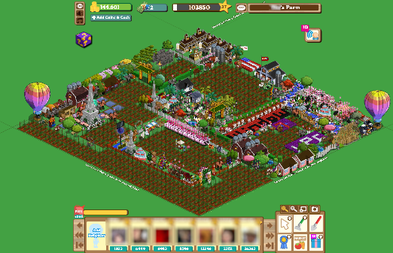
Screenshot from FarmVille via Wikipedia
Erik: Actually, back in 2010 I started to see people becoming obsessed with the game FarmVille—not just in the U.S. but even in other countries. This global phenomenon fascinated me, and so I gave it a try—and quickly wrote a screed calling the game company Zynga out, proposing to them if the company really wanted to do something useful, it would not just get people clicking their mouses to ‘play farmer,’ but help teach the next generation to be farmers—an essential development considering that the consumer system is destined to implode in that generation’s lifetimes from a rapidly changing climate and the breakdown of other essential ecosystem services. While Zynga never responded, the idea took root over the years and then at the end of 2013 I received a seed grant to develop the concept from the V. Kann Rasmussen Foundation. At that point, I started watching way too much reality TV, talking with a lot of directors, and eventually discovered Katy Chevigny of Big Mouth Productions, who became my co-conspirator in this endeavor.
Cullen: So when you’re not promoting yardfarming, are you out farming your yard?

Erik: Not as much as I’d like I admit. I’m a pretty lazy gardener. I grow things that grow themselves. The soil where I live in Washington, DC is more broken brick and glass than organic matter, though each year it’s a bit better as we add the compost our household creates. So I don’t bother with fickle plants like tomatoes but just harvest greens, sunflowers, perennial herbs, and things that sprout up from our compost. For example, I didn’t plant squash this year but have five squash plants growing. Even more than yardfarming, I mostly forage wild edibles: “weeds” like dandelions, chickweed, violets, and lamb’s quarters, mulberries (which are abundant in DC), fruit from random fruit trees (several grow on old school properties near me) and acorns—a great source of nutritious flour with the right processing. Though in the last few years, I’ve focused more on symbolic gardening to get my toddler son excited than trying very hard to produce quantity. Once he’s a bit older, I hope that together we’ll start yardfarming a much larger area. After all, children should earn their keep too! And there’s no downside to learning farm skills early, not when the future is what it is.
37 Comments on "Futureproofing America with a Yardfarming Revolution"
Dredd on Fri, 10th Jul 2015 3:32 pm
Not a bad idea.
Davy on Fri, 10th Jul 2015 3:37 pm
It is amazing how we take our food for granted. I think about it all the time. It is so strange to go to the store and get all these delicious products and give the attendant some paper and walk out of the store. This is just so bizarre because it is so disconnected from reality of what an organism normally does in an ecosystem. We are truly bizarre creatures.
I said this in a previous post. We should be moving half the population back to the land in a relatively short time to make the transition to postindustrial AG. The remaining urban areas that have value need to be re-pastoral-ized. This means rural and urban areas will be covered by gardens, fruit trees, animals of all kinds within a nutrient cycle. This along with large crop fields. I could go on and on. To get there we would need this to be a hybrid transition of industrial AG and subsistence permaculture. This would be transition of the current system to a postindustrial AG system following a collapsing global system down.
That is the theory and points to just how impossible a real solution is for 7BIL people. There will not be a solution for 7BIL people. There will hopefully be some locals that make a transition. Most of the rest will likely perish from famine and starvation at some point. Rebalance of population and consumption is unavoidable in my view.
My ideas are valid but putting them into practice is beyond the scope of our system due to irreversibility of our global system. This means we will likely stumble into this transition by force through collapse. If we are lucky a crisis will push many of us into this transition early and the ugly side of food shortages will be reduced.
In the meantime while life is normal-esque we should all be focusing on food production, preservation, and storage on a local level. I am talking about those of you with a brain who can see the dangers ahead. You can start efforts at growing food now for food security reasons. This is not about being self-sufficient necessarily it is about developing the skills and infrastructure that could be ramped up to help augment self-sufficiency. Your local will ultimately need to show some self-sufficiency. If you are in a local in overshoot I recommend getting out while you can.
I am just blown away at how dangerously exposed we are to an unsustainable system and how quickly it can fail. Frankly it leaves me speechless sometimes. I leave these stores with delicious products in a car on a road to a house with an electric frig. The whole process is just amazingly wonderful and sinister at the same time. We are truly setting ourselves up for a hell of hunger and desperation if we don’t get our act together quickly.
Plantagenet on Fri, 10th Jul 2015 4:20 pm
I hope millions of young millennial get out there and start farming in their yards. And when they aren’t farming they could be making sand candles and leather moccasin and headbands and other artsy-crafty products. That way there will lots of stuff to buy from the colorful neohippies selling at the saturday craftsmen markets!
MSN Fanboy on Fri, 10th Jul 2015 4:32 pm
Davy, Famine will take care of all this 🙂
Chaos beckons us all
apneaman on Fri, 10th Jul 2015 4:54 pm
Plant you could help them out, you would make great fertilizer – piece of shit that you are.
Plantagenet on Fri, 10th Jul 2015 5:00 pm
@apey
Your potty mouth is overflowing—please flush before any more leaks out.
Cheers!
apneaman on Fri, 10th Jul 2015 5:16 pm
millennial neohippies? Sure for every 1 of them there is at least a million hyper mass consuming millennials who’s entire purpose in life is to experience as many dopamine drips as possible, unaware and uncaring of the consequences. The last or second last generation of toxic industrial carbon monkeys.
This generation wants more everything, study finds
“Young people want more sex, relationships, jobs, travels, houses and friends, a study has found, showing how the pace of life has increased and attention spans have diminished.”
http://www.independent.co.uk/news/uk/this-generation-wants-more-everything-study-finds-10368180.html
apneaman on Fri, 10th Jul 2015 5:31 pm
Maybe on the subconscience level the millennials and their parents know were approaching the end….anything to distract.
Hikikomori: Japanese men locking themselves in their bedrooms for years, creating social and health problem
“It is one of the biggest social and health problems facing Japan – about 1 million people, mostly men, have locked themselves in their bedrooms and will not come out.”
http://www.abc.net.au/news/2015-07-07/hikikomori-japanese-men-locking-themselves-in-their-bedrooms/6601656
Heroin deaths have quadrupled in the past decade
http://www.washingtonpost.com/news/to-your-health/wp/2015/07/07/heroin-deaths-have-quadrupled-in-the-past-decade/
Americans Are Drinking More — A Lot More
http://www.nbcnews.com/health/health-news/americans-are-drinking-more-lot-more-n347126
Soaring obesity rates due to abundance of calorie-laden food
http://www.digitaljournal.com/life/health/soaring-obesity-rates-due-to-abundance-of-calorie-laden-food/article/437274
basil_hayden on Fri, 10th Jul 2015 5:43 pm
So now having a vegetable garden is “yardfarming”? Yawn….
Go Speed Racer on Fri, 10th Jul 2015 7:01 pm
When you grow apples in your backyard, they are all wormy and irregular-shaped. Better to buy apples at Safeway and they are all turtle-wax’ed, look good, and no worms.
🙂
penury on Fri, 10th Jul 2015 9:06 pm
I think yard farming is a great, outstanding idea. Let me know when and how to get all of the towns, villages, cities, home owners associations are required by a law (which is enforced with real penalties) to allow this and it would be nice is someone was required to provide space for people who have no land. I think in the U.S. we need to start with about 100 million garden spots.In other words utter horse crap.
Makati1 on Fri, 10th Jul 2015 11:33 pm
This is a great idea… for a country that has experienced gardeners/farmers, yards with real soil deep enough to grow veggies (most top soil was scraped off and sold when the homes were built), heirloom seeds that do not have to be purchased every year, and laws actually encouraging it and not preventing it.
The US does not have any of those. Well, a few old farmers and a few preppers that know how (AND have the resources AND live in the countryside where it is not noticed by the gestapo) do exist in the US, but they are a single digit minority.
Currently ~82% of Americans live in Urban areas that are likely to be regulated heavily. That does not bode well for when the SHTF. It will be too late to turn over your yard soil and find out that it is only a few inches of dead soil and a lot of stones.
The Ps is ~48% Urban, but here there are few regulations against anything productive. I hear roosters in the city and any land/balcony/roof top, that can grow fruits or veggies, is doing just that.
Apneaman on Sat, 11th Jul 2015 12:08 am
Kanata couple angered by city order to change veggie garden
‘When they come on July 30 I’ll sit on my garden and I won’t move,’ Will Needham says
“Having spent 13 years in the military, and now I’m getting out and I’m growing a garden and doing my own thing, and I’ve served this country, and you’re telling me I can’t grow a little garden to feed myself? That’s just not on.”
http://www.cbc.ca/news/canada/ottawa/kanata-couple-angered-by-city-order-to-change-veggie-garden-1.3141354
dave thompson on Sat, 11th Jul 2015 12:35 am
I have a small garden and some fruit trees. I also work on a friends farm some weeks. Growing food is good for you.
Northwest Resident on Sat, 11th Jul 2015 1:20 am
dave — I agree. Growing food is good for the soul, and good for the health. I’ve converted my 1/16th acre backyard into a mini-farm — potatoes, high-nutrition corn, garlic, wheat, snow peas, pole beans, tomatoes, cabbage, carrots, strawberries, raspberries, kale. About 1200 square feet of raised planter growing area. Egg laying chickens and honey producing bees too. And a 2000 gallon rain water collection tank. My backyard is a food producing machine!
Apneaman on Sat, 11th Jul 2015 1:49 am
Northwest Resident, I think you’re a food producing machine! I bet you could teach a course on it in your area. You’ll be in demand soon enough.
Davy on Sat, 11th Jul 2015 2:00 am
Ape Man said “ (Millenials) entire purpose in life is to experience as many dopamine drips as possible” Ape I think it is pretty much the whole population spectrum today with it declining in intensity as you move up the ladder of age. Age has a way of planting you in a pot. Yet, look at all the retirement communities around golf courses and the sea.
I noticed the dopamine drip lifestyle starting in late 70’s. Drugs were illegal but there was a time when a blind eye was turned to them. Drugs were cool and you were a nerd if you didn’t do them. Heavy drinking was promoted. We were wild as feral cats when I was growing up. It was a lifestyle and one that was pushed by Hollywood too. Consumerism hit its high RPM’s. Corporations cashed in on excess from here on out. That was the end once the corporations jumped on it. Insurance companies and lawyers tempered that but only marginally with liability issues.
I really think the late 70’s are when we lost it culturally starting in the US then morphing out into the rest world through globalism. We are adrift as a global people. Currently it is electronic dopamine. I doubt there will be anything new to titillate us. Like Ape says “The last or second last generation of toxic industrial carbon monkeys.” We are on the cusp of descent one that will leave us naked. Those who search for dopamine in the next phase of globalism will need it for real pain not the pain of being bored.
BTW Ape, good job of kicking Planter in the nuts.
Davy on Sat, 11th Jul 2015 2:08 am
Mak said “The Ps is ~48% Urban, but here there are few regulations against anything productive.”
Makster, that is why the P’s are a mess environmentally. Fisheries and forests are nearing collapse. Environmentally ranked low or near the bottom on a broad based list of environmental issues
http://www.gaiadiscovery.com/agriculture-industry/factors-causing-philippines-fisheries-to-collapse.html
Like the other vital resources, such as forests, Philippine fisheries are about to collapse – a victim of the almost unabated “plunder of the commons.”
http://en.wikipedia.org/wiki/Environmental_Vulnerability_Index
228 Philippines 402 Extremely vulnerable
http://en.wikipedia.org/wiki/Habitat_destruction
Islands suffering extreme habitat destruction include New Zealand, Madagascar, the Philippines
http://en.wikipedia.org/wiki/List_of_countries_by_natural_disaster_risk
Philippines 170 27.52%
http://epi.yale.edu/epi/country-profile/philippines
114 OVERALL RANK OUT OF 178
Apneaman on Sat, 11th Jul 2015 2:49 am
Davy, it’s not really their fault they were born into a world run by corporate devils who have found a way to turn everything into super hyper stimuli courtesy of a 150 years of science of the apes. You ever hear of the “bliss point”? Armies of food chemists devote their entire lives working for Nestle et al to hook people on franken food from day one. No better/different than meth amphetamine dealer-cooks as far as I’m concerned. If those millennials ever clue into what has been done to them and revolt, I’m gonna get me a big brimming bowl of endocrine disrupting, bliss point inducing Orville Reddenbocker popcorn and sit back and enjoy the guillotine circus.
Salt Sugar Fat: NY Times Reporter Michael Moss on How the Food Giants Hooked America on Junk Food
https://www.youtube.com/watch?v=I3fiYKnYECQ
Davy on Sat, 11th Jul 2015 2:57 am
Ape, true, They (millenials) were sold the drugs by my generation and my parent’s generation. We are the meth dealers and we (boomers) deserve the criticism. The world had a chance for action post WWII but boomers chose an orgy over prayer. I am the last of the boomers per definition being born in the early 60’s.
PrestonSturges on Sat, 11th Jul 2015 3:41 am
I tilled the hell out of my scorched clay yard and now it supports a variety of fruit trees. But that is a long term investment. And while it would provide a lot of bulk and vitamins, there not much protein produced.
One important factor in reducing the need to truck food all over the country will be to make disease resistant GMO crops. For instance, stopping verticillium wilt would save many billions in crop damage. Otherwise, it’s extremely difficult to raise vegetables in the warmer climates. Heirloom tomatoes? HA! The plants collapse into a pool of slime in a couple days.
joe on Sat, 11th Jul 2015 7:55 am
Can’t really blame generations. Would millenials be different but for the number of their birth year? It’s the fact that conditions existed which forced choices. In the 70/80/90s period when boomers were in charge their generation was split firmly between leftist/communist and later socialist versus religious/monied/free market idealogues. Late period boomers like Bill Clinton and Tony Blair chose a Third Way which really put the stamp of victory on what they thought was the new world order. They had no idea that their victory was going to morph into Islamic Salafist triumphalism which they have no control over whatsoever. They bought and charmed western kids, but the heavy lifting was done by men in turbans and now they are coming for those who cut them loose. Again, not really a generational issue, just an inevitable consequence of what happens when politicians are able to exploit fearful and greedy populations. Millenials won’t begin to weird power until around 2020 or so, and they will share with those who lived to see the end of the peoples war against the rich, just in time to see the world face the first real results of climate change. Again, victims of circumstances, kids born today, will be blaming us in 30 years time when they take power.
Makati1 on Sat, 11th Jul 2015 8:18 am
Preston … and when GMO seeds are not available? Then what? Will you beg some heirloom seeds from your neighbor because you didn’t learn how to grow real veggies when you could still go to the supermarket to make up for mistakes in the learning curve?
If your tomatoes wilted or got a disease, you need to learn why, and make the needed adjustments, not go to tasteless, vitamin deficient, ‘pretty’, franken foods because they are “easy”.
Warmer climates? The Ps is about as warm as you can get outside of a desert yet they grow every vegetable you can think of here and most fruits not requiring a winter freeze. It takes experience and a solid foundation in agriculture. Here it is passed down through the generations and not so much from book learnin’.
BTW: If you use heirloom seeds, save them from your crop, and plant those saved seeds the next year, and so on, they actually adapt to the soil and climate you live in as years go by. It’s called evolution. GMO seeds do not.
Davy on Sat, 11th Jul 2015 8:18 am
Joe, what part of the world you from? Be nice to know your age group too. It helps me understand your viewpoint.
Davy on Sat, 11th Jul 2015 8:53 am
Mak, GM seeds are crop seeds not garden seeds. GM seeds are not for direct human consumption. You are trying to show your expertise but instead look ignorant. Mak, avoid comments you can get a handle on.
penury on Sat, 11th Jul 2015 9:51 am
Davy What? You don’t garden much I presume
steve on Sat, 11th Jul 2015 10:11 am
I am not advocating gm or heirloom seeds but is it true that Gm seeds have less vitamin content? I have heard this but don’t know if there have been any longterm empiracal studies on this…
ghung on Sat, 11th Jul 2015 10:16 am
Penury, I think Davy was referring to the fact that the vast majority of GMOs are field crops such as soybean, maize, rapeseed (canola) , and cotton. Most papayas grown in the US are also GMO. Some other crops such as alfalfa include modified varieties, and some fruits like apples may or may not be. The vast majority of garden vegetables aren’t. Many folks confuse “hybrid” (vs “heirloom”) varieties as being GMO.
Makati1 on Sat, 11th Jul 2015 10:43 am
Hybrid seeds usually do NOT result in the same quality of veggies if you save the seeds until the next season. Often, they revert to one of the parent types that were used to design the hybrid.
“… many hybrid seeds are relatively new crosses and seed from these hybrids will not produce plants with identical qualities.”
http://gardening.about.com/od/vegetable1/f/Heirlooms.htm
“When the peasant farmers grew these new hybrids, they were indeed more productive, even though they required more fertilizer and water. But when they collected and saved the seed for replanting the next season—as they had done for generations and generations—none of it grew true to the parent crop, little food grew, and these poor farmers, having none of their open-pollinated traditional varieties left viable, had no choice but to go back to the big companies to purchase the hybrid seeds again for planting year after year…(GMOs are done in the lab)…In short: Hybrid Seeds are nothing to fear, but you may not want to support them given that they fail to breed true and have caused so much global havoc. GMO seeds are far more unnatural and likely to cause harm — both to your environment and your health.”
“So, if anyone ever tries to convince you that hybrid seeds and GMOs are the same thing, or that genetic modification technology is “just another” form of seed breeding, you will know the truth: Hybrids are created through guided natural reproduction, while GMOs are the product of unnatural, high-tech methods used to create untested organisms that would never occur in nature.”
Both hybrids and GMOs are a bad idea if you want a self-sustaining farm.
Davy on Sat, 11th Jul 2015 1:28 pm
Pen, I had a 1000 acre corn and soy farm for 4 years. I currently have 15000 sq/ft garden with orchard and grapes. I guess I don’t know much about farming or gardening. Thanks for pointing that out.
Apneaman on Sat, 11th Jul 2015 8:30 pm
Record Rainfall Drowning Indiana’s Crops
http://indianapublicmedia.org/news/record-rainfall-drowning-indianas-crops-84680/
Apneaman on Sat, 11th Jul 2015 8:34 pm
Grasshoppers latest plague to hit Alberta’s bone-dry farms
‘They clean everything off underneath and the cows have nothing to eat’
“We’ve had them a couple of times but not as severe as what we’ve had them this year.”
Gaschnitz’s cows would normally be out in the fields grazing this time of year, but with no grass left for them to eat he’s forced to take special measures.
“They’re eating pasture, they’re eating the hay crops, and we just moved some cow-calf pairs to south of Valleyview because we have no pasture,” he said.”
http://www.cbc.ca/news/canada/edmonton/grasshoppers-latest-plague-to-hit-alberta-s-bone-dry-farms-1.3145662
Apneaman on Sat, 11th Jul 2015 8:38 pm
Dry, dry Western Canada braces for hot and hard-growing summer
Crops falling to driest spring on Prairies in 68 years: heat waves forecast through to September
http://www.cbc.ca/news/canada/dry-dry-western-canada-braces-for-hot-and-hard-growing-summer-1.3126964
PrestonSturges on Sun, 12th Jul 2015 1:11 am
“…..Preston … and when GMO seeds are not available? Then what? Will you beg some heirloom seeds from your neighbor because you didn’t learn how to grow real veggies when you could still go to the supermarket to make up for mistakes in the learning curve?….If your tomatoes wilted or got a disease, you need to learn why, and make the needed adjustments, not go to tasteless, vitamin deficient, ‘pretty’, franken foods because they are “easy”…..”
Because disease is endemic in our area and very few vegetables survive. Heirloom varieties don’t last a week. It’s the same reason you see so few species of trees in the south – very few species are truly immune to all the diseases. Maybe some grow fast because of the warmth but are still generally sick. Good kharma, happy thoughts, dream catchers, and unicorn farts don’t trump nature.
Makati1 on Sun, 12th Jul 2015 1:55 am
Preston, diseases have a cause and they are curable, otherwise we would not exist. To learn the cause and get rid of it is the challenge of raising food in the future. GMOs are not going to work for very long, nor are the other hybrids. They are all subject to disease and nature’s whims.
Only heirlooms will breed true and consistently provide the optimum crops year after year without buying new seed. After all, when the SHTF, you probably will not be able to buy seed of any kind. Then what? No grocery stores and no seed. Sounds like a bad idea to rely on BAU.
Davy on Sun, 12th Jul 2015 3:23 am
Preston, I use only heirlooms. I also over plant to compensate for my distaste of chemicals and other predation. I have more than enough room for a big garden. I pretty well solved the animal issues with electrified fence. I do use chemicals when I have a bad infestation but I am loath to use them. This year I almost lost my potatoes to the potato beatle so I sprayed.
I refuse to use GM anything. I know we have animals eating GM then we eat the animals but any way I can I avoid them. Part of that is principal the other part is lack of trust. I planted GM soybeans around 2000 on the big crop farm I had. I did this because of what I thought at the time was the benefits of using less toxic herbicides. Now I doubt both the herbicides and the seeds.
Boat on Sun, 12th Jul 2015 6:55 am
US agricultural exports 7-10% of food. that was 144 .billion in 2013. So you want to blame population overshoot by feeding the hungry, blame the US.
http://www.ers.usda.gov/topics/international-markets-trade/us-agricultural-trade/exports/interactive-chart-the-evolution-of-us-agricultural-exports-over-the-last-two-decades.aspx