
Peak Oil is You

Donate Bitcoins ;-) or Paypal :-)


Page added on July 15, 2014

Fuel Economy Improvements Show Diminishing Returns in Fuel Savings
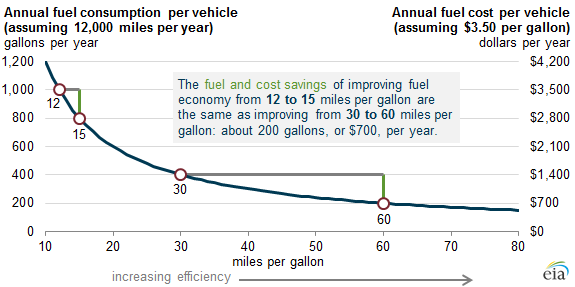
Fuel costs, which depend on vehicle fuel economy, miles driven, and fuel price, are an important factor in vehicle purchasing decisions. However, fuel economy improvement exhibits diminishing returns in fuel savings. For example, switching from a 10-mile-per-gallon (mpg) vehicle to a 15-mpg vehicle saves more fuel and results in greater fuel cost savings than switching from a 25-mpg vehicle to a 75-mpg vehicle. The fuel and cost savings of improving fuel economy from 12 mpg to 15 mpg are the same as increasing from 30 mpg to 60 mpg.
Much of the reduction in fuel consumption and fuel cost comes from incremental fuel economy improvement at the relatively low fuel economy levels. For a consumer who drives 12,000 miles per year and pays $3.50 per gallon for gasoline, increasing fuel economy from 10 mpg to 11 mpg saves $382 in annual fuel cost and from 30 mpg from 31 mpg saves $45; raising fuel economy from 40 to 41 mpg saves just $26 and from 60 to 61 saves $11.
Vehicles that use fuels other than gasoline, such as diesel or electricity, will have different fuel savings and fuel cost. Diesel vehicles often have higher fuel economy than standard gasoline vehicles, but they also must use diesel fuel, which is more expensive than gasoline. Plug-in electric vehicles, which achieve high fuel efficiency and take advantage of relatively inexpensive electricity (compared to gasoline), can accrue significant fuel cost savings, albeit at higher incremental vehicle cost.
As light-duty vehicle fuel economy continues to increase because of more stringent future greenhouse gas emission and Corporate Average Fuel Economy (CAFE) standards through model year 2025, standard gasoline vehicles are expected to achieve compliance fuel economy levels of around 50 mpg for passenger cars and around 40 mpg for light-duty trucks. Diminishing returns to improved fuel economy make standard gasoline vehicles a highly fuel-efficient competitor relative to other vehicle fuel types such as diesels, hybrids, and plug-in vehicles, especially given the relatively higher vehicle prices projected for these other vehicle types.
10 Comments on "Fuel Economy Improvements Show Diminishing Returns in Fuel Savings"
M1 on Tue, 15th Jul 2014 7:26 pm
Keep telling yourself this “fact”.
But, once you buy a hybrid, you’re Never going back to an ICE, and then trade up for and ICE with 2 mpg better fuel economy. You’re going to buy a Plugin or an EV, and nearly or complete eliminate your fuel bill. Then you’re going to get your wife a hybrid.
This is why liberals have more net worth then conservatives. They do the numbers, and are saving more money of efficient cars and homes.
M1 on Tue, 15th Jul 2014 7:28 pm
If someone becomes interested in fuel economy, he or she will see far more benefit to making a Big Jump to a Hybrid, then to pussy-foot around and make a nearly invisible change to a 2 mpg better car.
Hybrids have been out for at least 15 years now, this is Known Technology. There is No Risk to owning a hybrid now.
noobtube on Tue, 15th Jul 2014 7:56 pm
There goes the dream of driving into the future (unless that future is a brick wall).
The American way of life is not negotiable! (And, that way of life includes a car.)
Davy on Tue, 15th Jul 2014 9:13 pm
MI, are you plugged into your neighbors outlet? I am not understanding how you’re going to eliminate your fuel bill. I am sure that meter is a “spinnin” when you plug that baby in. I know my electric farm vehicle does when I plug it into my solar system at the barn. I am also curious about batteries. That will be a big maintenance item at some point. Don’t get me wrong I believe in a 1000 approaches to our coming energy descent including electric vehicles but I do not see them as being a game changing innovation. They have their niche but widespread applications I don’t see as optimum. IMA no technologies out there have an optimum widespread application to replace FF. I might also mention the conversion cost when one takes grid power and puts it on a battery and probably from a mainline FF thermal plant. Is that the best use of that energy and corresponding carbon release?
Davy on Tue, 15th Jul 2014 9:14 pm
Noob, I wish I knew what country you are from. I want to try and figure out what is going on inside that brain of yours.
Northwest Resident on Tue, 15th Jul 2014 9:21 pm
Davy — Many people have asked, but the Noobster never answers. My guess is that he is of African descent due to his many many references to how bad America is screwing over Africa, and he of course blames America for not just enslaving Africans back in the day but also of inventing and perfecting slavery. He’s probably a dirt-poor immigrant from Africa, probably Muslim or influenced heavily by that religion, probably living with his mom who receives welfare, and his obviously a world class LOOSER who is so consumed by hatred and anger — and not too bright either — that he is doomed to forever live with that big ugly monkey on his back. Couldn’t happen to a “nicer” person.
But Noob, in case you’re reading, I really do hope you’ll achieve a mental health breakthrough and overcome the demons that haunt you, demons that you can let go if you really try.
Davy on Tue, 15th Jul 2014 9:24 pm
Yea NR, or a Columbine trench coat brat ready to snap.
Arthur on Wed, 16th Jul 2014 1:56 am
A few days ago nooby openly advocated that white people need to be exterminated, so we tentatively can conclude that the chap is a non-white of African descent. Probably higher educated in the US, in an environment where white students are constantly told to ‘check their white privilage’, whatever that me be.
Although you can’t be hundred percent sure. Take for instance our British friend Beery, who insists that the west needs to be ruled by blacks, because, you see, ‘we screwed up’.
The west is full of weirdos.
simonr on Wed, 16th Jul 2014 6:12 am
I am just curious, does anyone have the figures of how much energy we use in Joules with gasoline / diesel cars ?
rollin on Wed, 16th Jul 2014 8:52 am
Next assume fuel will rise above $6 per gallon and it will be rationed in the future. That 15 gallon per week limit will go a lot further in your 80 mpg vehicle.
The savings is not just personal, lower fuel use saves the environment, road repair (vehicles are lighter) and reduces global warming effects. It brings more cropland back into food production also (if we are smart). So high mpg vehicles should be subsidized by society since they provide direct money saving and destruction reducing benefits. Low mpg vehicles should be taxed to offset their destructive effect and cost effects.
A high mpg car with two passengers is much more efficient than a passenger train and goes places trains can never go.