Europe Oil Consumption Peaked in 2005
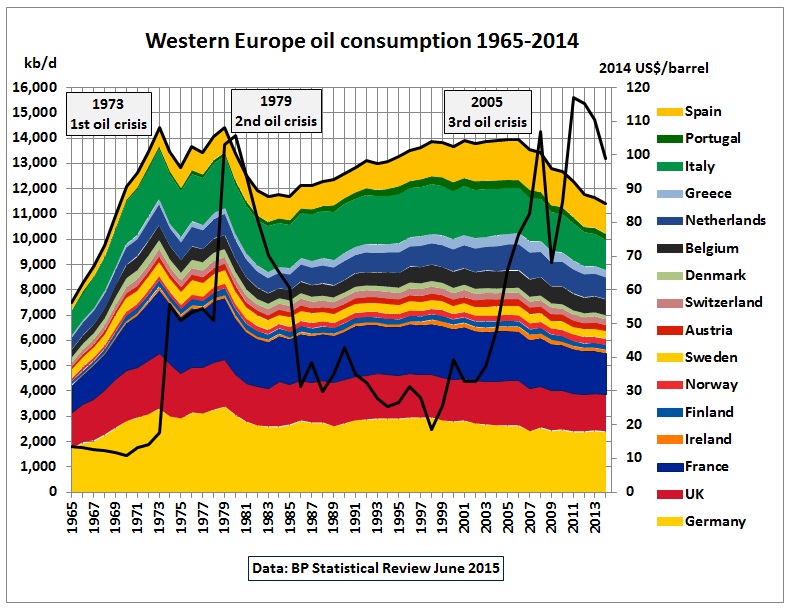
This is the 3rd article using data from the BP Statistical Review published in June 2015.
Fig 1: Western Europe oil consumption, oil prices in $2014
Total oil consumption peaked 3 times at around 14 mb/d:
(1) In 1973, the 1st oil crisis which was triggered by the Yom Kippur war. The following OPEC embargo was successful because US oil production had peaked 3 years earlier so the US could not increase production to offset OPEC’s reduction
(2) In 1979, the 2nd oil crisis which was caused by Iranian oil production peaking in the mid seventies and the following Iranian revolution, resulting in a global recession in 1982
(3) In 2005, at the beginning of the 3rd oil crisis when global crude oil production had a peak and declined until 2007
3 main oil consumers Germany, UK and France
The oil crises in the 70s brought down consumption by 2 mb/d (oil prices increased 10-fold) through both energy conservation and a recession.
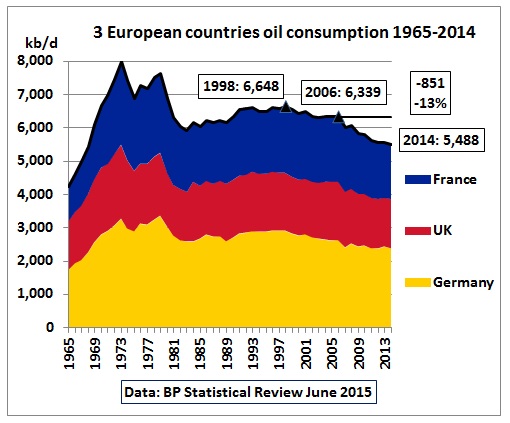
Fig 2: Oil consumption Germany, UK and France
Consumption never went back to 1973 levels but peaked in 1998 and then declined by 0.6% pa until 2006 after which consumption declined by 1.7% pa, mainly due to drops in France and UK, while Germany reduced consumption irrespective of oil prices.

Fig 3: UK became net importer in 2006
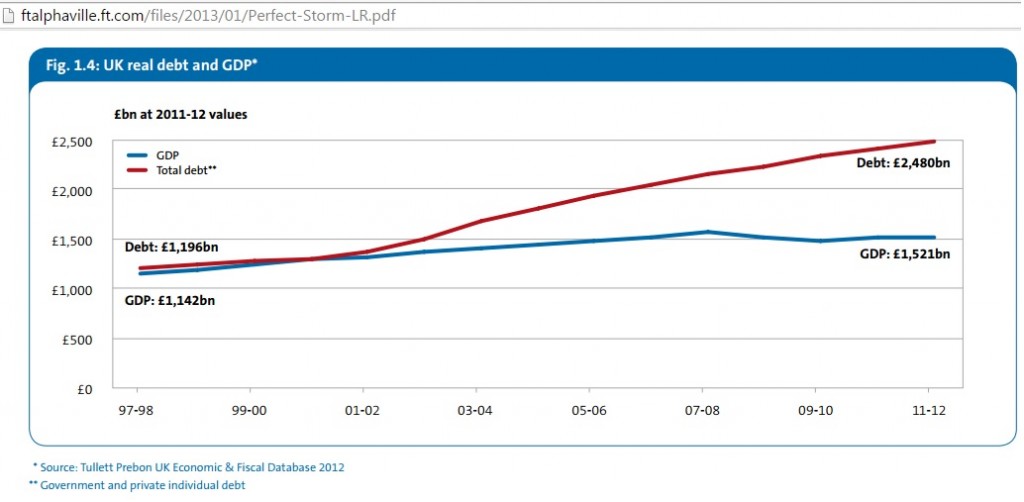
Fig 4: UK debt and GDP
UK debt started to increase more than GDP when oil production began to decline from its peak in 1999.
Southern Europe
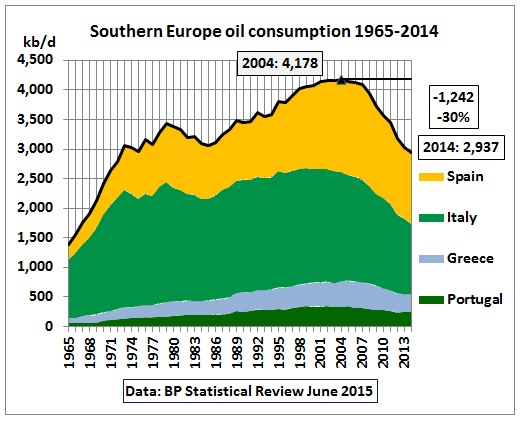
Fig 5: Southern Europe oil consumption
South European consumption peaked in 2004 and declined since then by 30%.
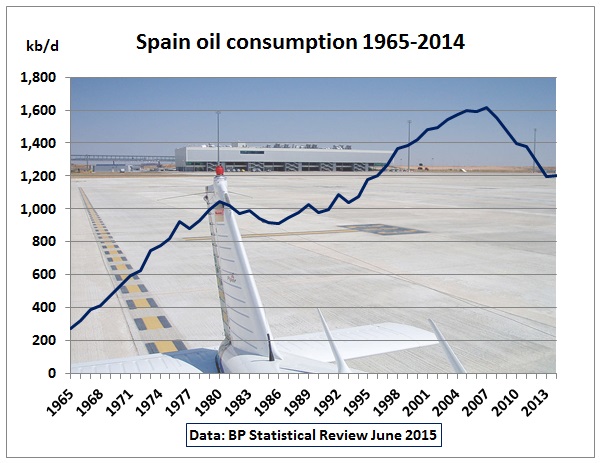
Fig 6: Oil consumption peak in Spain – 2007
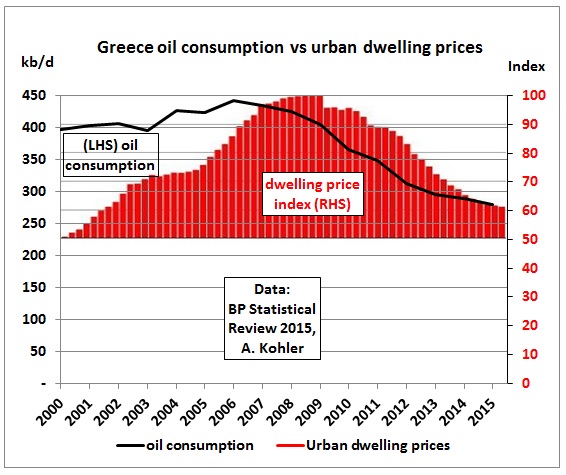
Fig 7: Greece oil consumption peak in 2006
Other Europe with peak in 2007
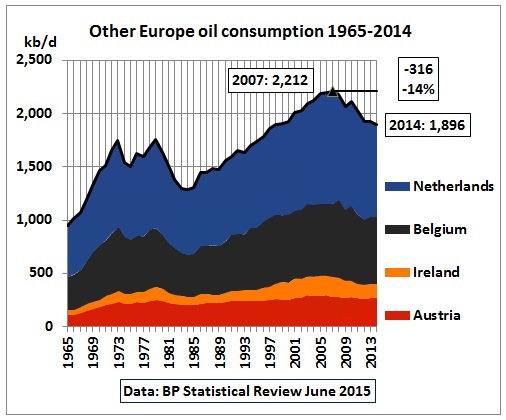
Fig 8: Other European countries with peak in 2007
This group had a consumption peak in the 70s but then a much higher peak in 2007 followed by a 14% decline.
Other Europe with peak in 1970s
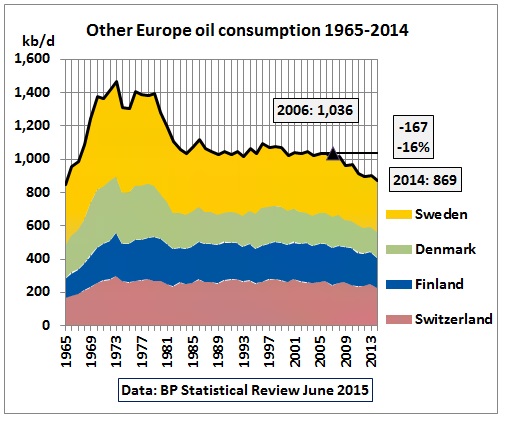
Fig 9: Other European countries with peak in 1970s
These are mainly North European countries which were able to reduce oil consumption after the 70s continuously, without a 2nd peak. Consumption decline accelerated after 2006. Sweden’s oil consumption in 2014 was 17% lower than in 1965 although population grew by 21%.
All together now. Drop of consumption since 2004/07: around 2.6 mb/d
3 countries -851 kb/d
Southern -1,242 kb/d
Other peak 2007 -316 kb/d
Other peak in 70s -167 kb/d
Total Western Europe -2,576 kb/d
Eastern Europe
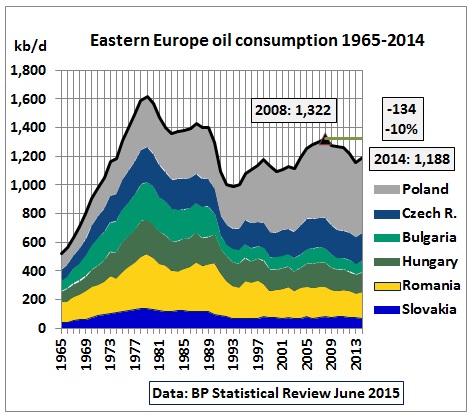
Fig 10: East European oil consumption
Eastern Europe experienced a rapid decline of oil consumption when the Soviet Union collapsed and later a rebound, especially in Poland.
Fuel Consumption by type
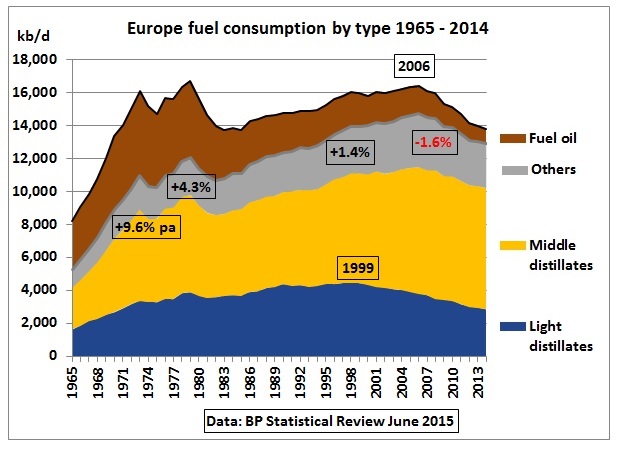
Fig 11: European petroleum consumption by fuel type
Fuel oil consumption (mainly for power plants) peaked in the 70s and was replaced by other primary energy. Light distillates peaked in 1999, the year in which UK oil production had its 2nd and last peak. For all the other fuels, there were 4 distinctive phases:
(a) Before the 1st oil crisis: growth +9.6%
(b) Between the 1st and 2nd oil crisis: growth +4.3%
(c) Up to 2006: growth +1.4%
(d) After 2006: decline -1.6% pa
Note the 1999 peak in gasoline consumption reflecting the increasing popularity of diesel cars.
The gap between consumption and production
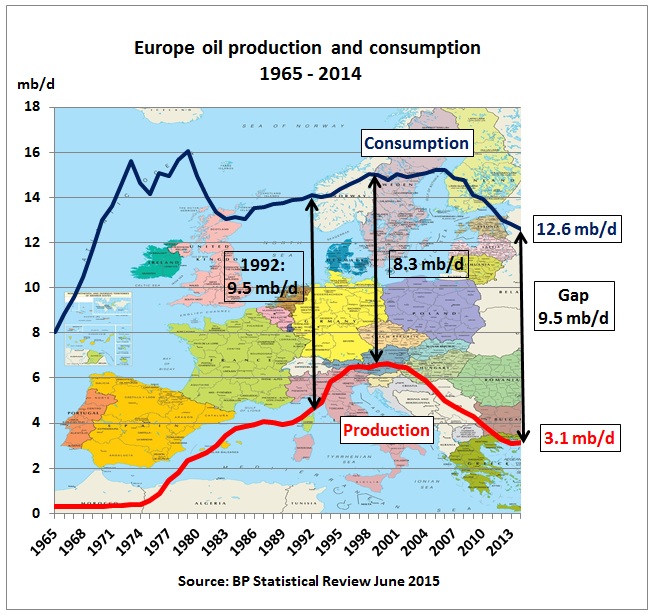
Fig 12 : Gap between consumption and production
Consumption peaked 7 years after the production peak and is falling now in sync with production. The gap in 2014 was back to 1992 levels. Local oil production helped reduce the gap by a modest 1.2 mb/d over a short period of just 9 years.
Conclusion
Consumption decline was caused by a combination of efficiency gains (e.g. France, Germany and UK), high oil prices and economic problems in Southern Europe. There will be a minimum consumption level for operational reasons even at zero GDP growth so this decline will hit some limits when there will be serious problems. Under current trends consumption in 8 years will be back to the late 1960s, provided of course the gap can be filled by imports. The 2.6 mb/d Europe “saved” in 8 years is the equivalent of around 4 years of consumption growth in Asia. So Asia cannot endlessly count on Europe’s “help”.
Crude Oil Peak




Kenz300 on Tue, 1st Sep 2015 8:24 am
The sooner we reduce our use of fossil fuels of all kinds the better….
Climate change is real…. we need to deal with the cause…. fossil fuels…
joe on Tue, 1st Sep 2015 9:16 am
This is a very logical piece so it’s implied that higher prices are certain at a later point, as predicted by the bumpy plateau theory of peak oil.
http://peakoilbarrel.com/peak-oil-right-now/
This is the theory of peak oil which I adhere to because it’s more suitable to the model of consumption in which we live, which is to seek alternatives according to price and avilability rather than straight up supply which has lag times etc.
Places like the UK and Norway have peaked and declined and Egypt massive discovery only replaces the loss of those countries supply.
Europe will not subsidise Asia not without reversing 300yrs of economic contact, the future then might see us all taking boats to China and seeing if they are as kind and accepting as Europe has been to migrants there (that’s sarcasm btw).
As Phil Collins said ‘there’s too many men, too many people, making too many problems, and not enough love to go round, can’t you see this is the land of confusion’
BobInget on Tue, 1st Sep 2015 10:18 am
Good news for Europe. Not so great for China.
China’s oil imports were up 27% in July. I had a hunch August couldn’t be far behind. In point of fact, China’s August imports may exceed record freaking July’s.
China’s oil imports push records: WSJ
By ERIC YEP
Sept. 1, 2015 6:26 a.m. ET (2 hours ago)
SINGAPORE—A Chinese oil trading company bought record volumes of oil on a regional cash market for Middle Eastern crude last month, pushing up benchmark prices and causing confusion about the company’s motives among crude buyers and sellers in Asia.
Chinaoil, or China National United Oil Corp., the trading arm of state-run China National Petroleum Corp., bought nearly 90% of the oil cargoes on the Dubai spot market in August, setting a record for the number of cargoes traded on the small marketplace in a single month.
Chinaoil has engaged in heavy crude-buying in Dubai periodically over the past year, during which time global oil prices have fallen by roughly half.
China’s oil imports have held up this year despite the country’s broader economic growth slowdown, with much of its purchases believed to have gone toward building up its strategic oil reserves. China is expected to surpass the U.S. as the world’s largest oil importer this year on an annual basis, and its net oil imports were up 9.4% over the first seven months of this year.
Still, traders involved in the Dubai market have questioned Chinaoil’s motives, saying its market dominance is distorting prices by making them higher than they should otherwise be.
Advertisement
“The Dubai oil price is detached from actual supply and demand. There is a very clear disconnect from the market,” said one Singapore-based oil trader.
Dubai crude prices are widely used by Asian oil producers and sellers when fixing contracts, as much of the region’s crude is sourced from the Middle East. The benchmark is assessed by price reporting agency Platts, a unit of McGraw Hill Financial Inc., which bases its assessment on the trades done during a 30-minute window each day.
Platts assessed the price of Dubai crude cargoes for loading in October at $48.41 a barrel on Monday, and at an average of $47.691 a barrel over August. Brent crude was trading at $52.16 a barrel on Monday.
The Dubai market is now in strong backwardation—a market structure in which current prices are higher than future prices—due to Chinaoil’s large purchases. Global benchmarks like Brent and West Texas Intermediate are in a sharp contango—where the front month contract price is sharply lower than future prices.
“If you look at the physical market it is not tight. So (Chinaoil’s buying) is kind of distorting the market,” Tushar Bansal, oil consultant at Facts Global Energy, said.
Oil traders offered several theories for Chinaoil’s large purchases. Some said the company could be engaged in opportunistic stockpiling, while others said it could be profiting by taking an offsetting position in the oil futures market.
Chinaoil’s parent, CNPC, also benefits from higher oil prices, as it can sell crude to domestic refineries at prices linked to the Dubai benchmark. CNPC didn’t respond to emailed queries seeking comment.
ENLARGE
Mr. Bansal said the so-called market distortion was making it difficult for Middle Eastern crude producers who sell their oil on the basis of Dubai crude prices. With Dubai prices relatively high, competitively priced crude supply from other regions like West Africa and the North Sea can better compete with Middle Eastern oil.
Nearly 30 million barrels a day of crude oil exported to Asia, roughly a third of global demand, is priced against Dubai crude, which has been the main Asian oil benchmark since the mid-1980s.
Already oil traders have rushed to book supertankers to send North Sea oil cargoes to Asia, and more enquiries are coming in, shipbrokers said.
Chinaoil bought 72 out of the 78 cargoes traded in the Dubai cash market in August, a record high. That included 51 cargoes of Oman crude, 24 cargoes of Upper Zakum crude and three cargoes of Dubai crude.
Analysts have raised concerns about whether a single buyer should be allowed to dominate the whole market.
“It does bring the Platts methodology under question and there is no easy way around it,” Mr. Bansal said.
Platts is selective about the companies that can participate in its Dubai price assessment and can exclude participants if they violate its guidelines. Platts didn’t say if it had any plans to respond to concerns about price anomalies caused by Chinaoil’s buying.
At an oil forum held in Singapore last week, a Platts executive indicated that the increase in Dubai market volumes was due to “the rise of Asia and the rise of China” in oil trading.
To be sure, it isn’t unusual for large buyers to skew prices in commodity markets that have few players and low trading volumes. Middle Eastern oil producers usually prefer to sell most of their crude through contracts and allow little of their oil to be openly traded.
“There is not that much Middle Eastern oil out there on the spot market in the first place,” said Richard Gorry, oil consultant at JBC Energy.
Chinaoil’s buying is also unusual because it bought most of the oil cargoes from another Chinese trading entity—Unipec, the oil trading arm of another large state-run company, Sinopec. Other sellers were Royal Dutch Shell PLC, Vitol Group SA, Gunvor Group, Reliance Industries Ltd. and Total SA.
The two Chinese trading firms have been on opposing sides of the market, one pushing prices higher and the other attempting to keep prices down, traders said.
“There is no China Inc. when it comes to oil trading. They all want to make money,” a trader said.
Write to Eric Yep at eric.yep@wsj.com
(30)
BobInget on Tue, 1st Sep 2015 10:30 am
Oil bears often ‘overlook’ India as if it didn’t count.
Here’s oil data from India
http://www.tradingeconomics.com/india/gdp
http://oilprice.com/Energy/Crude-Oil/India-Becomes-3rd-Largest-Oil-Importer.html
Europe, with highly taxed gasoline and diesel prices has never been a major oil price mover.
The US Military can on a bad war day consume more oil then Denmark or even Sweden.
For ultra consumers we need to look to conflict free Asia.
We in the US ain’t doin so bad either.
Last week we consumed 20.3 million barrels every freaking day. The week prior 20.5 million got burnt up somehow. Tune in here for Wednesday’s bearish for climate news.
Kenz300 on Wed, 2nd Sep 2015 7:30 am
Buy a bicycle…… use less oil….