
Peak Oil is You

Donate Bitcoins ;-) or Paypal :-)


Page added on July 6, 2016

Energy Limits: Why We See Rising Wealth Disparity and Low Prices

Last week, I gave a fairly wide-ranging presentation at the 2016 Biophysical Economics Conference called Complexity: The Connection Between Fossil Fuel EROI, Human Energy EROI, and Debt (pdf). In this post, I discuss the portion of the talk that explains several key issues:
- Why we are right now seeing so many problems with respect to wealth disparity and low commodity prices (Answer: World per capita energy consumption is already falling, and the energy/economy system needs to reflect this problem somehow.)
- Why the quest for growing technology leads to growing wealth disparity (Answer: The economy must be configured in more of a hierarchical pattern to support growing “complexity.” Growing complexity is the precursor to growing technology.)
- Why rising debt is an integral part of the energy/economy system (Answer: We could not pay workers for making long-lasting goods and services without using debt to “pull forward” the hoped-for benefit of these goods and services to the present, using debt and other equivalent approaches.)
- Why commodity prices can suddenly fall below the cost of production for a wide range of products (Answer: Prices of commodities depend to a significant extent on debt levels. A major problem is that when commodity prices rise, wages do not rise in a corresponding manner. Rising debt levels can mask the growing lack of affordability for a while, but eventually, debt levels cannot be raised sufficiently, and commodity prices fall too low.)
- The Brexit vote may be related to falling energy per capita in the UK. Given that this problem occurs in many countries, it may be increasingly difficult to keep the Eurozone and other similar international organizations together.
- My talk also touches on the topic of why a steady state economy is not possible, unless we can live like chimpanzees.
My analysis has as its premise that the economy behaves like other physical systems. It needs energy–and, in fact, growing energy–to operate. If the system does not get the energy it needs, it “rebalances” in a way that may not be to our liking. See my article, “The Physics of Energy and the Economy.”
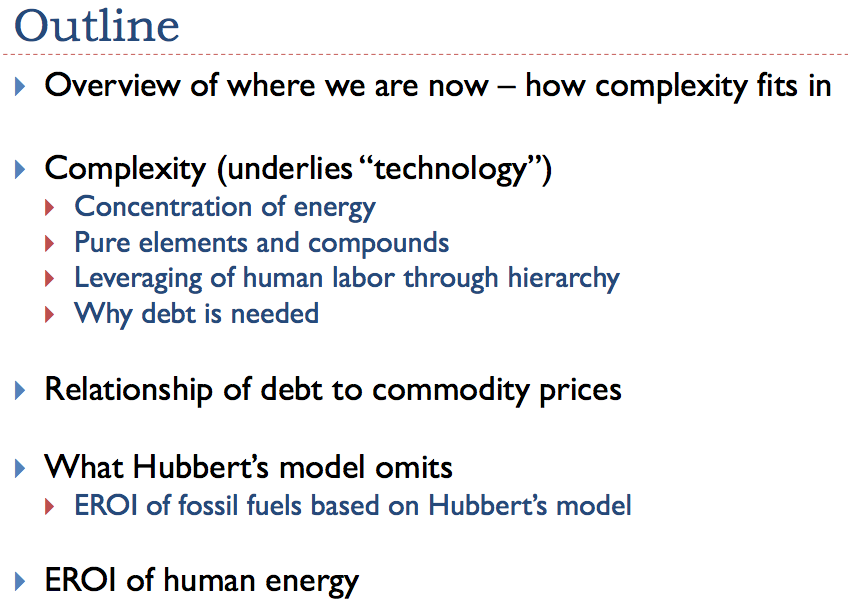
An outline of my talk is shown as Slide 2, below. I will omit the EROI and Hubbert model portions of the presentation.
Slide 2
Peak World Coal Seems To Be Happening, Right Now
In the view of most of the researchers I was talking to at this conference, oil is likely to be the first problem, not coal. And the issue is likely to be high prices, not low. So peak coal now, as shown in Slide 3, doesn’t seem to make sense. Yet, my analysis of recent data strongly suggests that peak coal is exactly what is happening, right now.
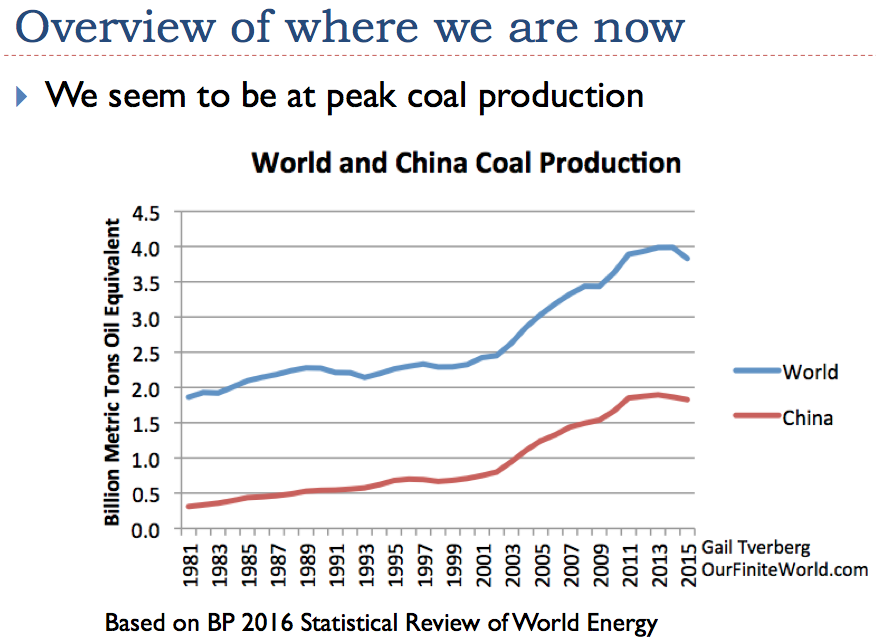
Slide 3. World and China appear to be reaching peak coal.
I will show later in this presentation why peaking coal production does seem to make sense–price levels of all fossil fuels seem to vary together. The extent to which debt levels are growing seems to be a major factor in price levels. When the debt level is not growing rapidly enough, “demand” is not high enough, and prices for all fossil fuels tend to fall simultaneously. A related issue is the extent to which the world economy is growing; if world economic growth is too slow, this will also tend to hold down demand, and thus energy prices.
China’s rate of growth in coal production started falling back in 2012, which is when coal prices started falling. This is before China’s new leadership took over in March 2013. We know that coal production in China is likely to continue falling, because China’s energy bureau is reporting that China plans to close over 1000 coal mines in 2016, because of a “price-sapping supply glut.” See my article, “China: Is peak coal part of its problem?” for additional information.
World Per Capita Energy Consumption Seems To Have Already Started Falling
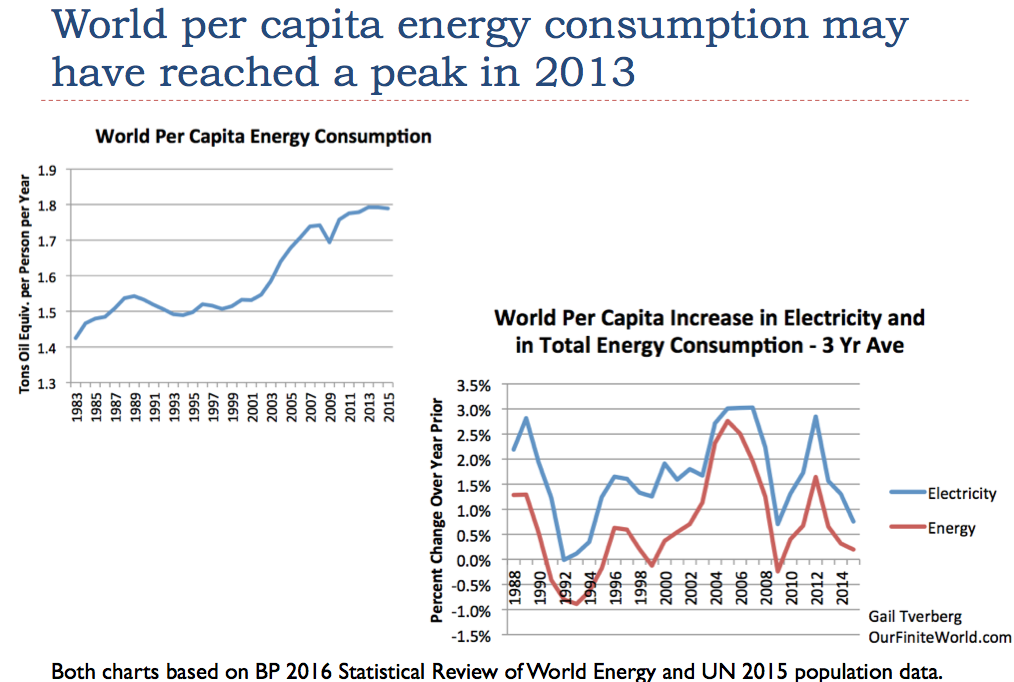
Slide 4. World per capita energy consumption may have reached a peak
The reason why I say that world per capita energy consumption may have reached a peak in 2013 is partly because coal consumption appears to have peaked. If coal has peaked, it will be hard to make up the shortfall using other fuels, such as renewables, or even natural gas. Furthermore, recent world figures (shown above) already show a small drop in per capita energy consumption. If world coal production continues to drop, we can expect world per capita energy consumption to continue to drop.
Energy Consumption Trends for a Few Countries
The figure below is not actually in the presentation–I thought I would add it now, to show energy consumption varies for a few economies. The upper chart in the Supplemental Slide shows the trend in per capita energy consumption in UK, Japan, Spain, and Greece. We know that Japan, Spain, and Greece have been experiencing economic problems for several years, something that perhaps should not be too surprising, given their falling energy consumption per capita. The UK shows a similar pattern to these three countries. Such a pattern is likely to lead to rising wage disparities, for reasons we will discuss later in this presentation, when we talk about “complexity.”
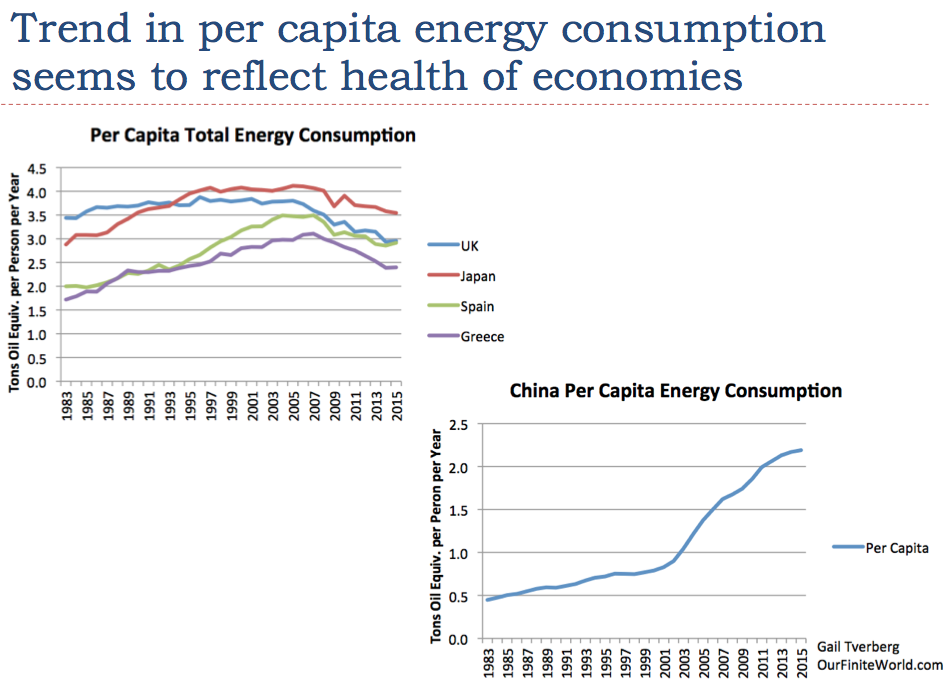
Supplemental slide. Per capita energy consumption trends for four advanced economies and for China, based on BP 2016 Statistical Review of World Energy and 2015 UN population data.
China’s energy consumption shows a contrasting pattern. China experienced rapid growth in energy consumption after it joined the World Trade Organization in 2001. Recently, China’s growth in energy consumption has been slowing, suggesting slowing growth in the economy–perhaps even more than reported in official GDP reports.
Why Peak Per Capita Energy Matters
In Slide 5, I give an overview of why peak energy per capita matters. My view is the second one shown on this slide. It is not that every segment of the economy will necessarily have problems. Instead, un-favored segments are likely to be first to have problems. Most conference attendees came with the first view.
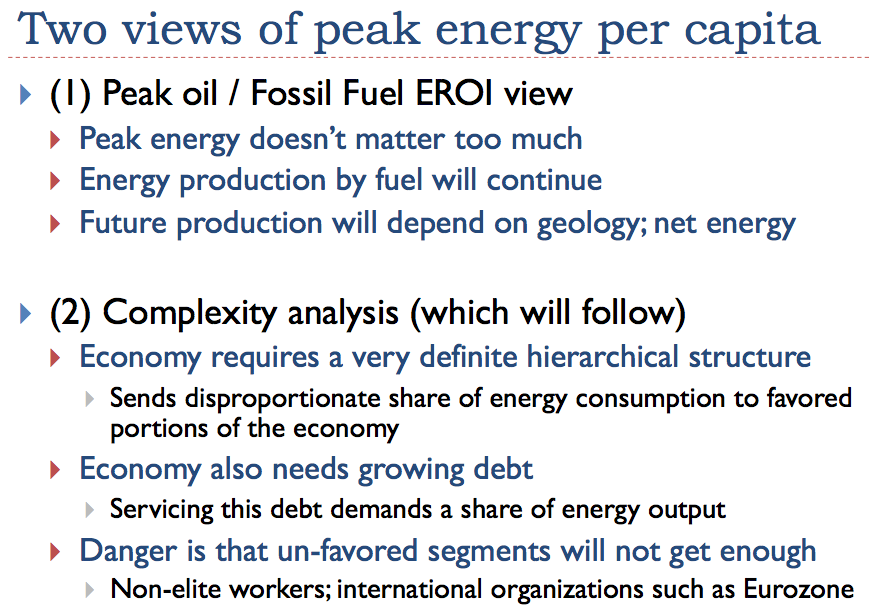
Slide 5. Two views of peak energy per capita.
How the Economy Is Affected by Growing Complexity
Joseph Tainter in the Collapse of Complex Societies tells us that the way economies that are in danger of reaching limits can sometimes solve their problems is through increased complexity.
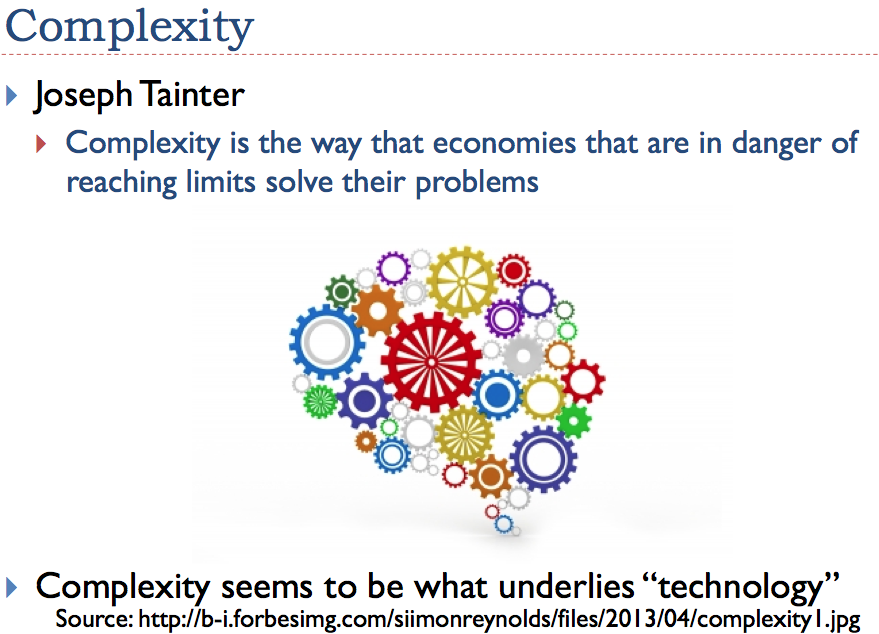
Slide 6. Complexity introduction
Economists today seem to believe that technology will solve our problems. I see complexity and technology as being related, with complexity being a precursor to technology. Economies that hope to adopt higher levels of technology need to take steps in the direction of growing complexity, to achieve this goal.
When I thought about what makes up complexity, this is the list of elements I came up with:
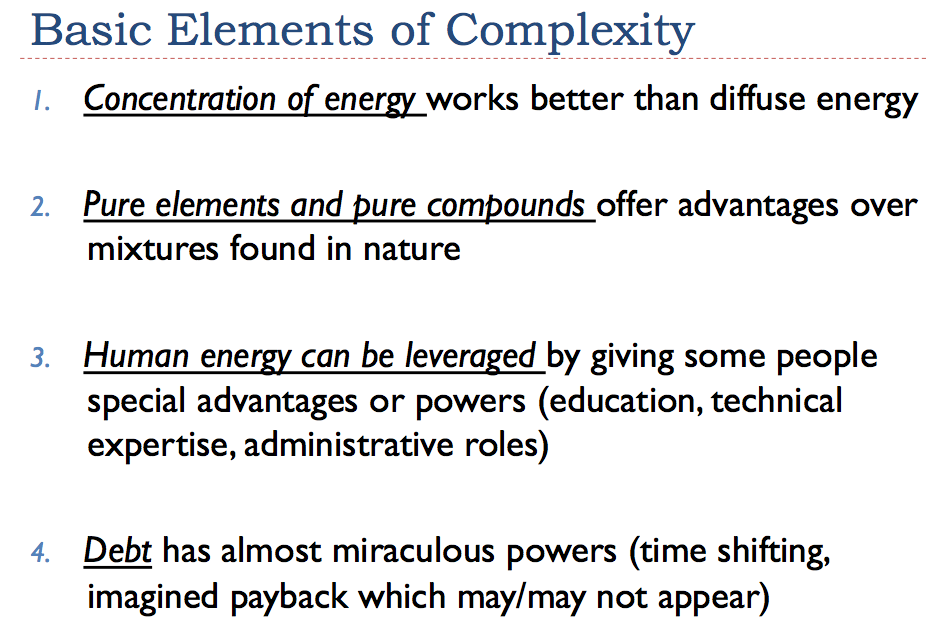
Slide 7. Basic Elements of Complexity
Regarding concentration of energy, the use of concentrated energy seems to be what sets humans apart from other animals.
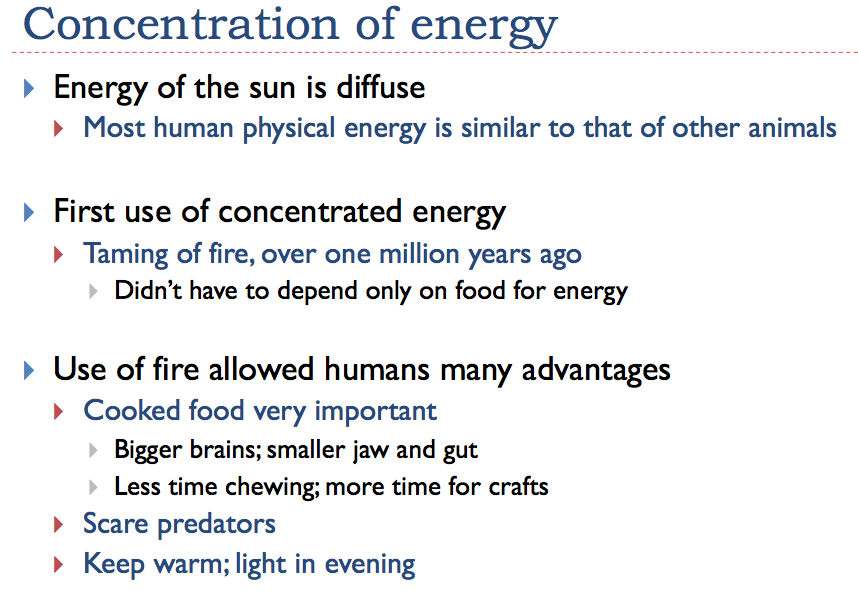
Slide 8. Early use of concentration of energy
If we want a steady-state economy, “all” we need to do is set aside our use of concentrated energy, and live like chimpanzees. I am not sure how we keep our bigger brains adequately nourished. A couple of slides related to this are Slides 9 and 10.


Another type of concentration of energy is capital goods. Capital goods are all of the goods that we expect to last for a fairly long time–things like homes, vehicles, and factories. The big issue is how to pay for capital goods.
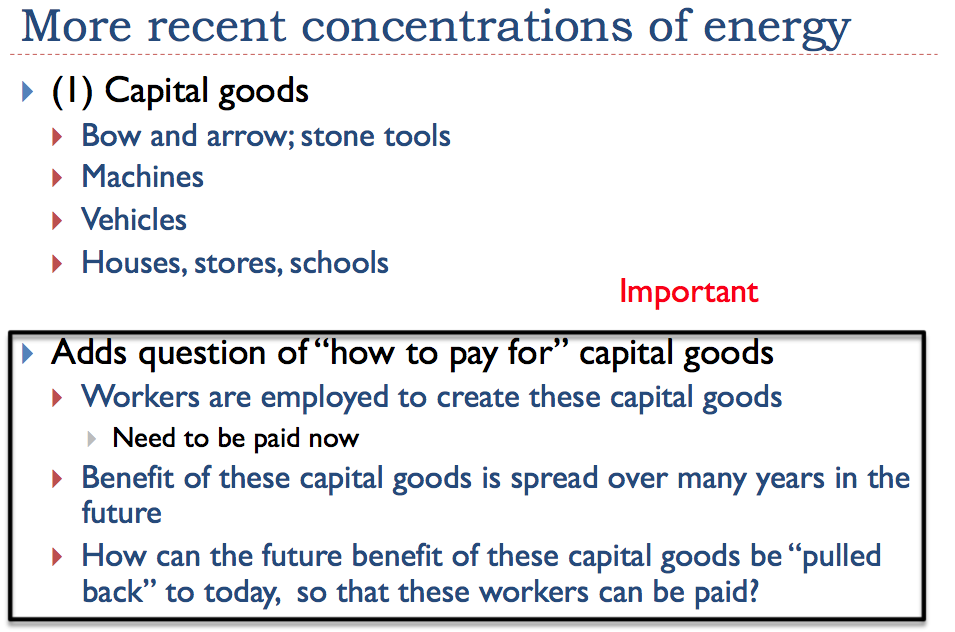
Slide 11. Capital goods– more recent examples of concentrations of energy
The problem is that we need to pay workers now, but the benefit of these capital goods is spread over many years in the future. Somehow, the future benefit of these capital goods must be “pulled back” to today. The obvious answer to this predicament is the use of debt (or debt-like instruments) to fund capital goods. We will get back to the issue of debt later.
The next few slides (12 to 14) show other ways that concentrations of energy can be developed. One way is through the creation of businesses. Even larger concentrations of energy can be formed by creating bigger businesses, including international businesses. Governments can also be used to concentrate the use of energy resources, because of government’s ability to build roads, schools, and many other projects. International organizations can also act to concentrate wealth, by easing trade among members (Eurozone and World Trade Organization) and by lending money to member countries (International Monetary Fund and World Bank). All of these organizations can benefit from the use of debt to fund their growing organizations.
We said that concentration of energy was the first element of complexity (see outline at top). The second element of complexity is pure elements and compounds. In many ways, this requirement is similar to concentrations of energy, in the way it allows technology to work.
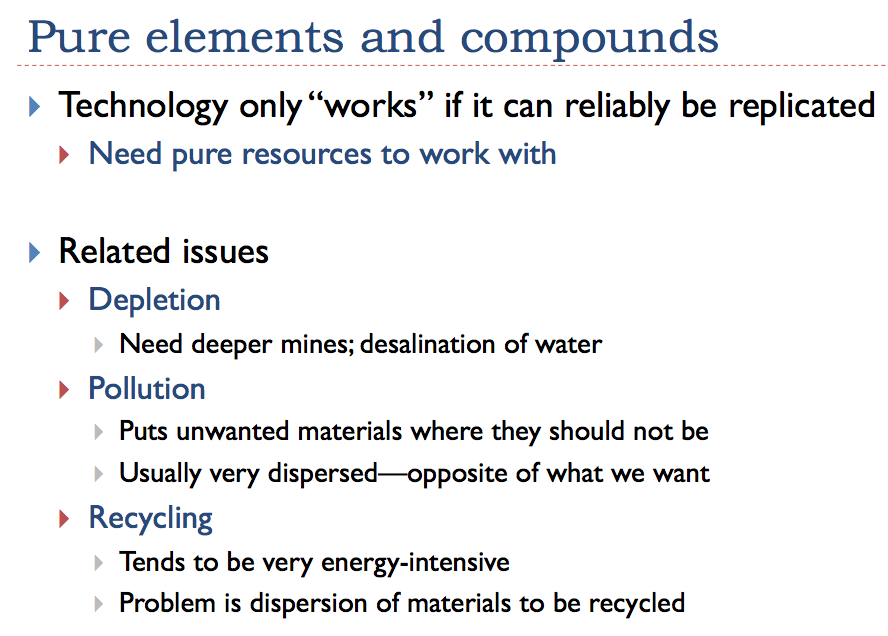
Slide 15. Why pure elements and compounds are needed for complexity
The third element of complexity (see outline at top) is leveraging of human energy through hierarchical organization. In many ways, this is the idea of concentrated energy, as applied to humans.

16. Leveraging of human energy through hierarchical organization.
Historically, the big problem has been populations that grew too large for their resource bases. In a way, we are reaching a similar predicament. Not too surprisingly, when this happens, it is the people at the bottom of the hierarchy who tend not to receive enough.
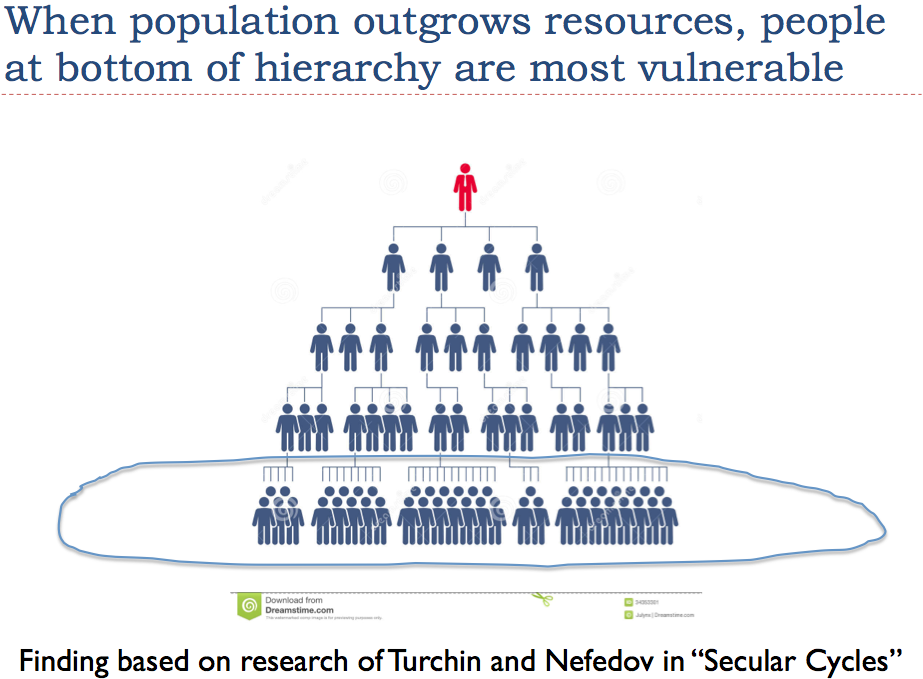
Slide 17. People at the bottom of a hierarchy are most vulnerable.
Why Debt Is Required
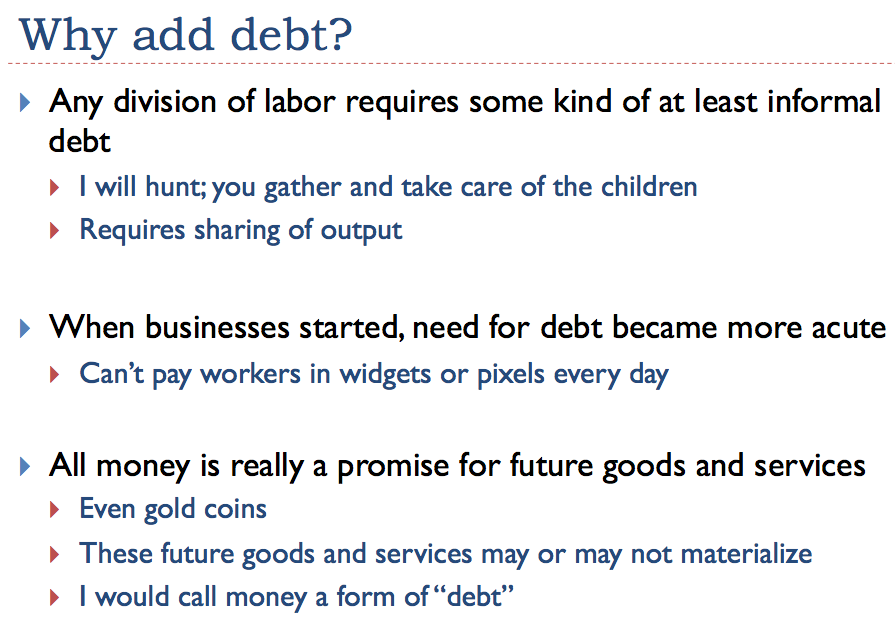
Slide 18 – Why add debt?
One of the fundamental benefits of debt is time shifting.
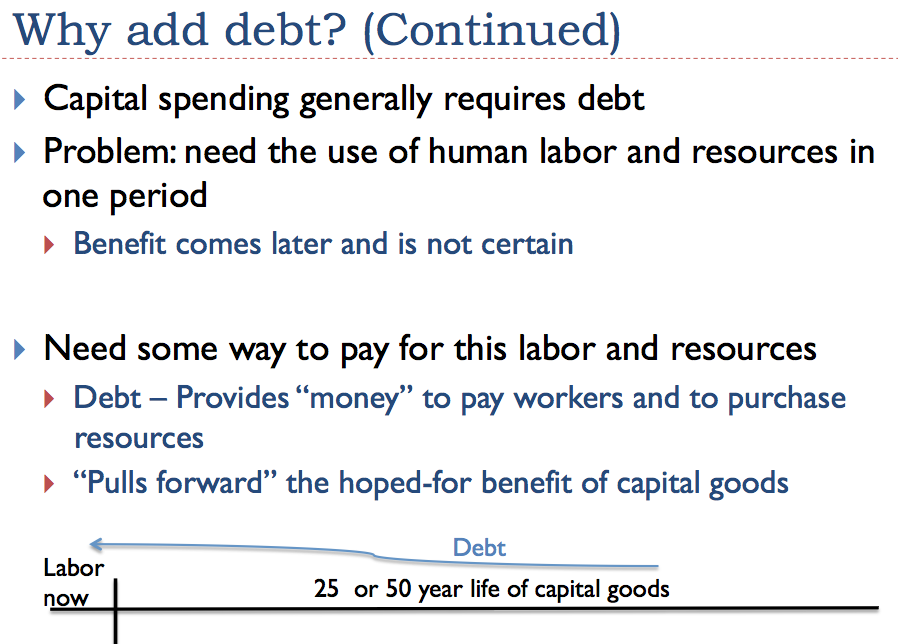
Slide 19. How debt allows time shifting.
Of course, the value of these capital goods is speculative, when debt is used to price them in advance. As long as capital goods, and other uses of debt, provide sufficient benefits to the economy so that debt can be repaid with interest, the system tends to work as planned.
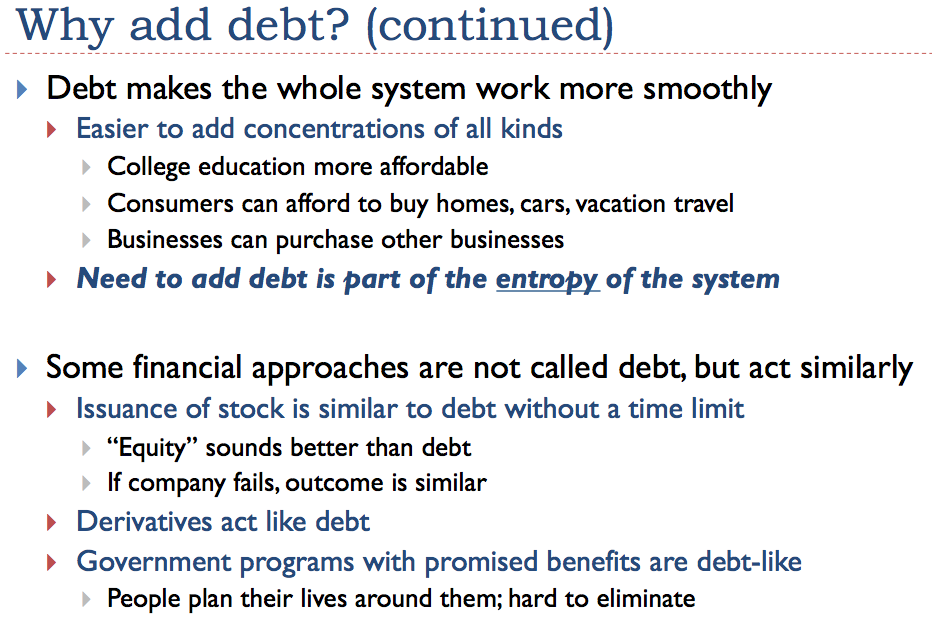
Slide 20. Debt makes the economic system work more smoothly.
One key aspect of debt is its ability to determine demand, and thus prices, of commodities such as oil and natural gas. The reason why debt has almost magical power is because if a potential buyer is given a loan for any kind of capital good, say a house, or car, or factory, the potential buyer can purchase the capital good far sooner than if he or she needed to save up for it. Each of these capital goods requires commodities of various kinds, such as steel, copper, oil, coal, and natural gas. Thus, we would expect rising debt levels to raise the prices of a broad range of commodity prices, simultaneously.
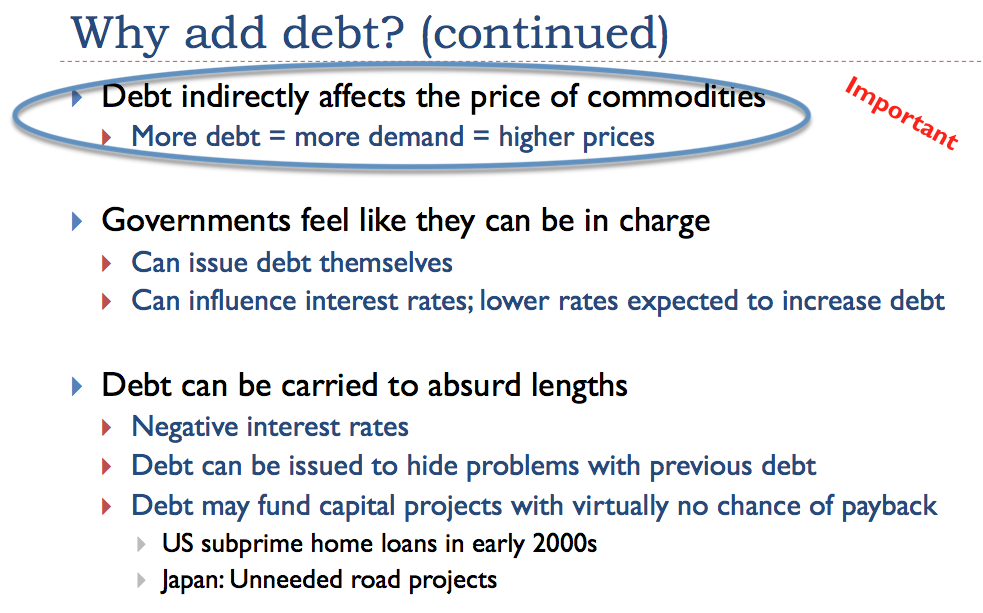
21. Debt helps determine prices of commodities
We can think of the situation as follows: An economy that keeps growing is (in energy terms) an out-of-balance system. Rising debt levels help maintain this out-of-balance condition by providing ever-higher commodity prices. These higher prices encourage greater extraction of energy products, even when the cost of extraction is rising because of diminishing returns. Even if extraction costs keep rising, the situation of ever-rising commodity prices cannot go on endlessly. At some point, prices become too high for workers to afford. Demand tends to fall at some point because workers at the bottom of the hierarchy find themselves “priced out” of buying goods such as houses and cars that would help maintain commodity demand.
What causes debt levels to stop rising? One reason why debt levels stop rising is that debt reaches absurd levels, making it difficult to repay debt with interest. Several examples of absurd debt levels are given in Slide 21. An additional example is excessive use of student loans. If incomes after student loans are not high enough, student debt may create a huge burden, preventing former students from buying homes and cars and starting families. The problem is that incomes after the educational experience are not sufficiently high to both pay back debt with interest and leave adequate funds for other needs.
Growing wage disparity can also lead directly to falling energy prices:
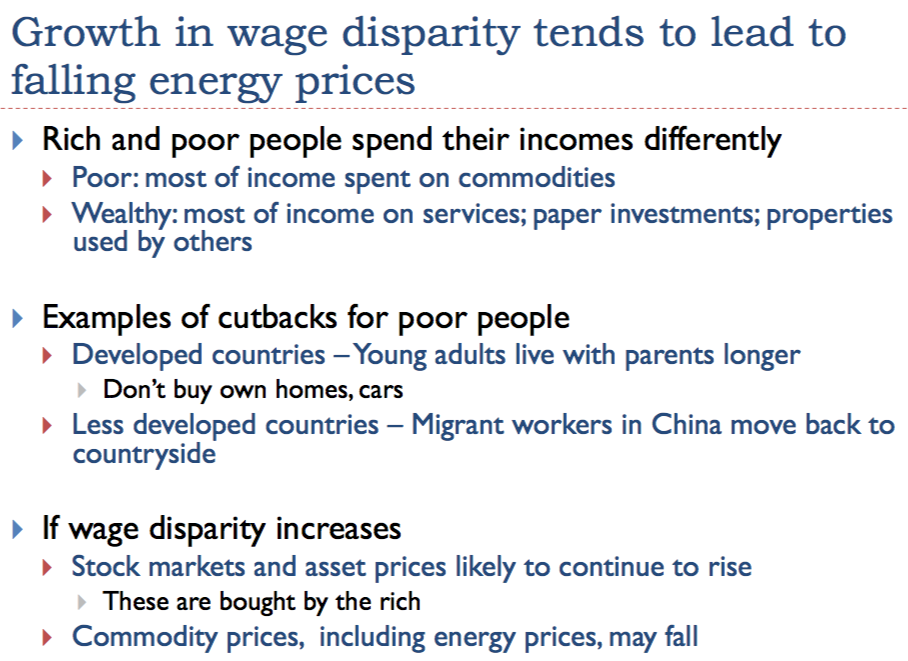
Slide 22. Growing wage disparity tends to lead to falling energy prices.
Both growing wage disparity and lack of growth in debt are signs that an economy is not growing very fast–in some sense, that the economy is not hot enough. Some of the would-be workers tend to drop out of the system, because wages are not high enough to cover commuting and childcare expenses. In some sense, they “condense out,” similar to the way that water turns to ice when there is not enough heat in the system.
The situation with prices of fossil fuels is similar; low prices are a sign that the economy is not growing fast enough. The system is forcing a reduction in the production of many kinds of commodities, including fossil fuels, by reducing prices below the cost of production for quite a few producers. This situation can be thought of as some of the production “condensing out,” because the energy products consumed are not causing the world economy to grow fast enough to maintain a “hot” demand level.
More Thoughts on Energy Prices and Debt Levels

Slide 24. Use of debt permits two different valuations of worth of commodities.
The thing that is confusing is that for many years, energy and commodity costs were very similar to energy and other commodity prices. It has been only very recently–when prices rose too high for consumers to afford–that the difference has appeared.
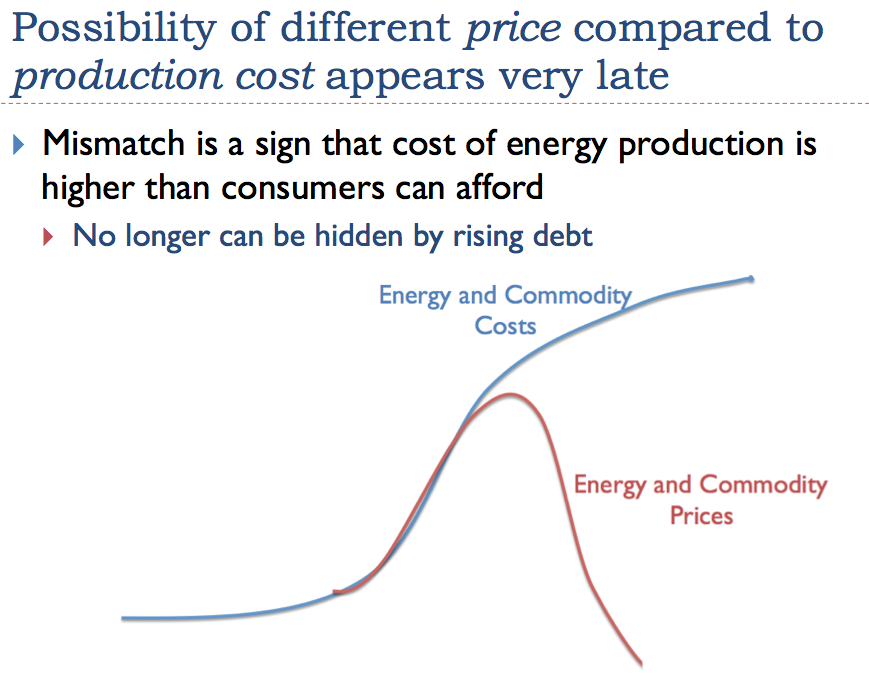
Slide 25. Possibility of different price compared to production cost appears very late.
Looking at historical data in Slide 26, we can see two recent sharp drops in oil prices. Both occurred when debt levels were no longer rising.
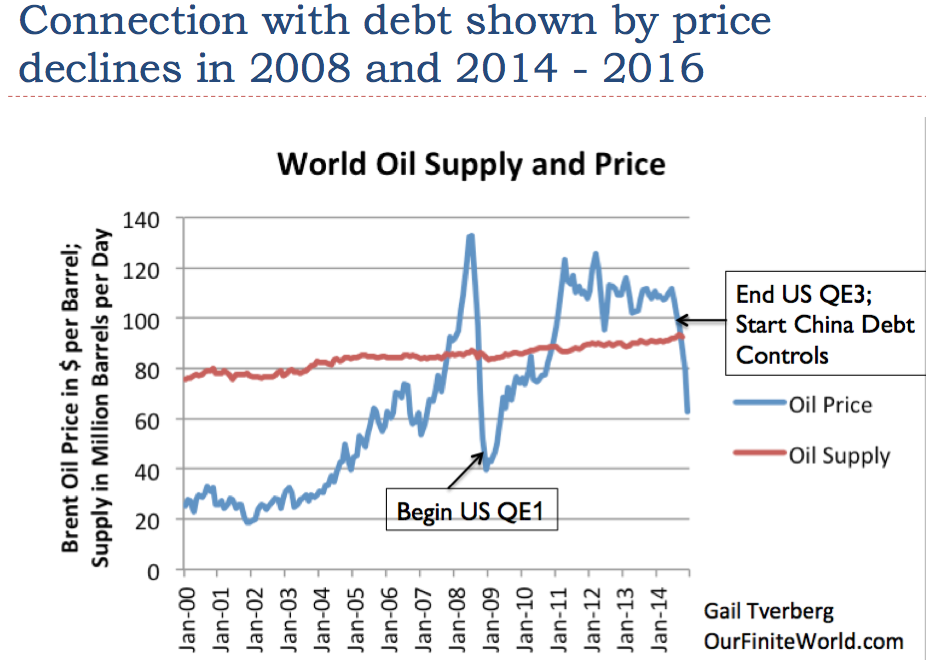
Slide 26. Connection of debt with oil prices is shown by two sharp declines.
In fact, prices of oil, coal, and natural gas tend to rise and fall together–just as we would expect, if they are all responding to the same changes in debt levels, and indirectly, the same changes in world economic growth rates.
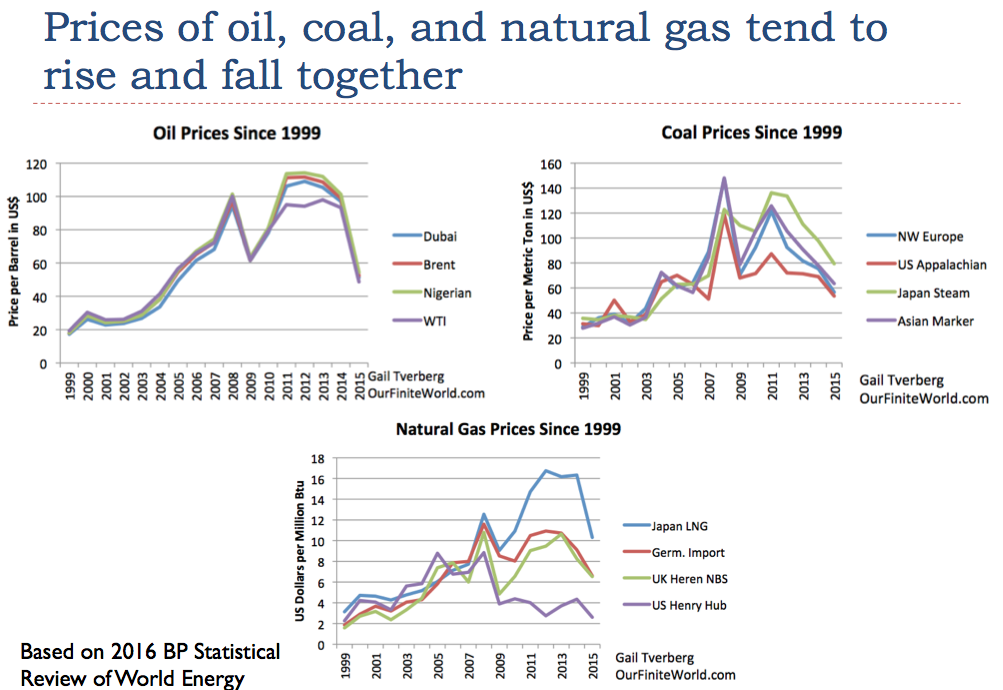
Slide 27. Prices of oil, call and natural gas tend to rise and fall together.
If energy prices are based on debt levels, our concern should be that all fossil fuels will peak within a few years of each other. The cause of the peak will be low prices, not “running out” of energy products.
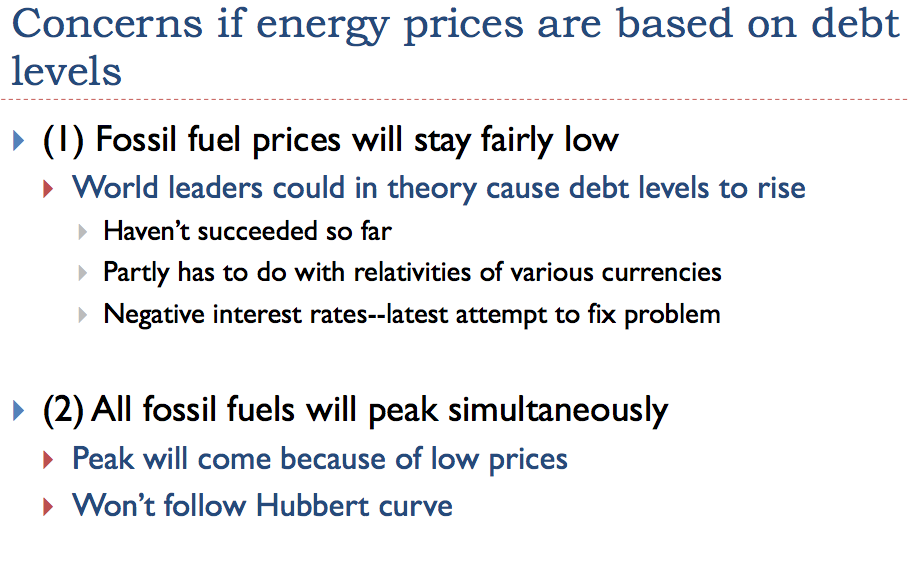
Slide 28. Concerns if energy prices are based on debt levels
In fact, the problems of the economy may be quite different from “running out.”
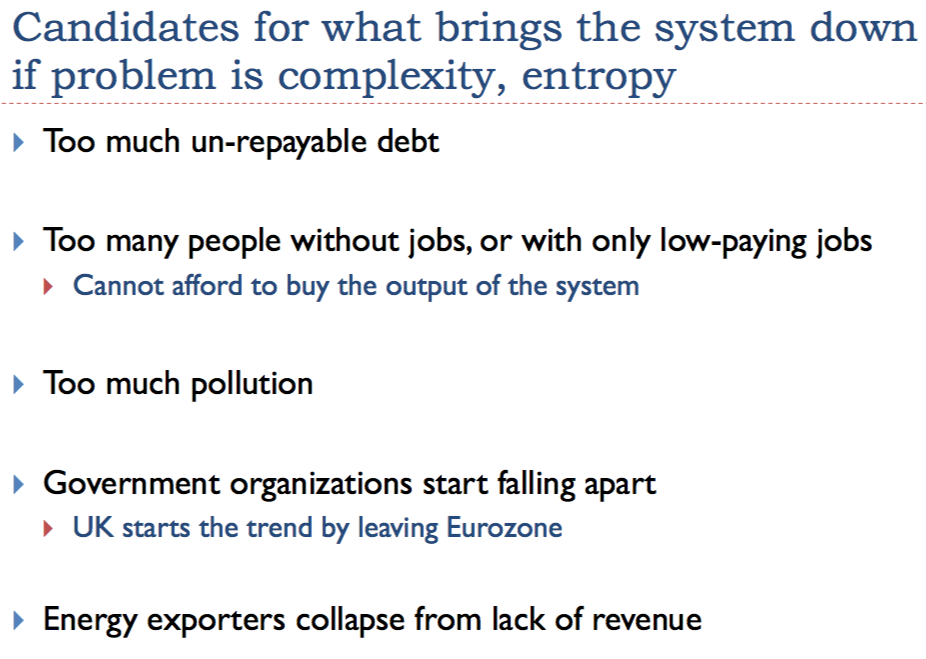
Slide 31. Candidates for what really brings the system down.
Supplemental Information on Income Disparity
A few slides giving additional information on income disparity are shown as slides 38-40. Please check the end of my presentation for these.
Conclusion
One topic I did not specifically discuss in this presentation is the possibility of slowing world economic growth. If we are seeing falling world energy consumption per capita, it should not be surprising if world GDP growth per capita is falling as well. I have talked about the link between energy consumption and GDP growth many times, including in my paper, Oil Supply Limits and the Continuing Financial Crisis.
It was not until I sat down to write up this presentation that I realized how closely the timing of the recent sharp drop of world oil prices corresponds with the decrease in world per capita energy consumption shown on Slide 4. World per capita energy consumption hit a peak in 2013, and dropped slightly in 2014, with a greater change in 2015. Mid-2014 is when oil prices began their major slide, so the timing of the two events matches up almost precisely. Thus, the drop in coal consumption may be resulting in low world economic growth, which in turn is holding down both oil and natural gas prices.
The apparent coincidence in timing may simply reflect the fact that the same forces that cause falling commodity prices are also causing low economic growth. Growing wage disparity and lack of growth in debt seem to be factors in causing both. If workers at the bottom of the hierarchy could better afford the output of the world economy, with or without additional debt, the world economy would have a better chance of growing.
I don’t see much hope for fixing a world whose economy is moving in the direction of shrinkage. Instead, the situation is likely to get worse, until the financial system collapses, or one of the issues shown on Slide 31 starts to become too great a problem.
I see the big push for renewables to be mostly a waste of time and resources. The major exception is perhaps hydroelectric, in parts of the world with good locations for new installations. EROI analyses are often used to justify renewables, but in my view (shown in the part of the presentation not discussed), EROI is too “blunt” a tool to properly evaluate resources that differ greatly in quality of output and in debt requirements. A major goal needs to be to maintain the functionality of the electric grid; evaluations of intermittent renewables should consider real-life experiences of other countries. For example, current pricing approaches seem to exacerbate the problem of falling wholesale electricity prices, and thus falling fossil fuel prices. (See this or this article.)
A major impediment to getting a rational discussion of the issues is the inability of a large share of the population to deal with what appears to be a potentially dire outcome. Textbook and journal editors recognize this issue, and gear their editorial guidelines accordingly. I was reminded of this again, when the question came up (again) of whether I would consider writing a book for a particular academic book publisher. The main thing I would need to do to make the book acceptable would be find a way of sidestepping any unpleasant outcome–or, better yet, I should come up with a “happily ever after” ending.
35 Comments on "Energy Limits: Why We See Rising Wealth Disparity and Low Prices"
Go Speed Racer on Wed, 6th Jul 2016 9:29 pm
This article too long. My finger hurts. Had to swipe screen so much, I got a blister. And you want me to read it too? LOL.
flashrob01 on Wed, 6th Jul 2016 10:23 pm
Great article- thanks Gail
dave thompson on Wed, 6th Jul 2016 11:21 pm
Yea Gail, great article telling us all, we are fucked, in so many words, or more, to bad most that are privileged will never pay attention or give a shit as long as the PTB are in control and the good times roll.
Northwest Resident on Thu, 7th Jul 2016 1:29 am
Decreasing energy consumption per capita.
Not enough resources to go around.
Far too many people placing unbearable demands on the carcass of earth’s previously vast natural wealth.
Destroying earth’s ability to revitalize itself, polluting, killing off wildlife and destroying habitat en masse, as global industry scrapes and pulverizes in pursuit of MORE.
Millions more born into the world every day needing their piece of the pie (and ready to kill for it), adding to the already unbearable demands on a long abused and plundered resource base.
Something’s got to give.
Apneaman on Thu, 7th Jul 2016 1:37 am
GSR
https://www.youtube.com/watch?v=pqUq2Da7d5c
marmico on Thu, 7th Jul 2016 2:49 am
Decreasing energy consumption per capita.
Not enough resources to go around.
Bull shit. Have you ever heard of the concept of energy intensity?
https://www.eia.gov/forecasts/aeo/section_energyintesity.cfm
Apneaman on Thu, 7th Jul 2016 2:51 am
Is that like your concentrated stupidity?
marmico on Thu, 7th Jul 2016 4:06 am
The Turdburger is a puerile goof that plays with pick up sticks.
Didn’t per capita energy consumption make a maxima in 1979 that persisted for ~20 years?
Davy on Thu, 7th Jul 2016 7:13 am
I have been following the economic side of the unfolding collapse process in particular. Together with abrupt climate change and the declining economic potential of oil these I feel are the knowns of collapse. Climate change and the decay of the economics of oil appear to have a time frame although not fully understood they do appear to be slowly increasing over time with a rough forecast of a decade or so of extremes that could cause civilization to fail. I believe it is the approach to these extremes in combination and reinforcement that makes a decade too optimistic.
The economy has been of particular interest to me because we have gone from one crisis to another per traditional fundamentals. These fundamentals of an earlier time have frequently been breached which in a previous time would have signaled a down turn. Today we see a global system that is repressed from normal fundamentals. We see the economy now compressing into a tighter concentration of beneficial players. Increasingly we see a concentration of wealth and control. This phenomenon is not new to the history of collapsed civilization. What is new is the degree of control. This is becoming a global condition as we see all nations find themselves in a common syndrome of devaluation and deflation. This is leading us all down the same path of debt, dysfunction, and decay.
This process is slow and accumulating much like a tectonic process. We are not seeing the failures like we have seen in the past because of this convergence of wealth, power, and control. Yet, the inconsistencies and the imbalances are not going away. Instead they are infecting all areas. As the system spread risk through extend and pretend polices it is systematically developing into a bifurcation trigger of immense proportions per previous historic occurrences. The next economic crisis that is not repressed and extended will be unstoppable because it will be all inclusive and encompass all sectors. It will be across the financial spectrum of markets, currencies, and economic zones. It will involve networks and the vast physical production spread across the globe. The delocalization of production and control which in the past gave the system so much reliance to failure will now be the source of failure as risk has been spread throughout all participants.
This “Leveraging of human energy through hierarchical organization.” Can explode at any time. This is because the liquidity of the global system is based only on confidence of global participants. It is competitive cooperation that allows us all to sleep together. When the pie shrinks too far this competitive cooperation will be in an imbalance beyond what the hierarchical global order can manage.
Currently the participant list is shrinking. We have disenfranchisement and wealth transfer towards the center. The center is increasingly the wealthiest of the world united and in an alliance of control. This cooperative convergence is for reasons of self-preservation not commonality of identities of faith, creed, or ethnicity. We see this all the way at the top with the central banks of the US, China, and the EU locked in a common cause. In some ways those who preach the NWO conspiracies have a point although this appears more a self-organizational process that is following ecological natural law then human intervention. Ecosystems follow succession and despite our misplaced feelings of exceptionalism ours is no different. We are near the brittle unstable phase of catastrophic bifurcation that all complex ecosystems eventually enter.
This whole process is above human intervention but human intervention definitely pays a significant part. It is human nature to leverage human energy in hierarchical control and along with this corruption. Corruption is nothing more than a type of social chaos. This points to a collapse process unfolding like the conditions of oil and climate but with the potential for unexpected failure because of the unpredictable element of human nature. Human nature is rational and irrational. The irrational cannot be predicted.
We constantly see economic failures prevented from cascading. Each time these failure are prevented by extending and pretending we see the risks increase and magnify. How long this can continue is nothing more than a guess. This is a new normal without any historical reference. Trying to reference economic failures from earlies times is not valid because of the degree of leverage of human energy today is so far more significant with globalization and complexity.
Cloud9 on Thu, 7th Jul 2016 7:46 am
Gail like the rest of us has been trying to wrap her mind around the events unfolding around us. As an actuary she tends to produce a complicated narrative that is difficult to follow. Still she brings a perspective to the process that should be considered. What she is saying is that devolution is upon us. The evidence is all around us, revealed in a series of economic indicators that show declines from the highs reached in 07. The part of her narrative that I find most interesting is the assertion that the decentralization of government is underway.
Just at the moment when the absurdity of the imperial narrative reached its peak with the executive order that boys wearing lipstick can now go into the girl’s bathroom, Gail asserts that the process of centralization is reversing.
Imagine for a moment Britton when the Picts came to understand that the Roman Imperium had peaked and its legions would never again go beyond the wall. Brexit is that realization for modern day Brittons. Whether or not the oligarchs agree, the centralization of Europe is unwinding. Multiculturalism has failed and tribalism is returning.
Cloud9 on Thu, 7th Jul 2016 7:46 am
Gail like the rest of us has been trying to wrap her mind around the events unfolding around us. As an actuary she tends to produce a complicated narrative that is difficult to follow. Still she brings a perspective to the process that should be considered. What she is saying is that devolution is upon us. The evidence is all around us, revealed in a series of economic indicators that show declines from the highs reached in 07. The part of her narrative that I find most interesting is the assertion that the decentralization of government is underway.
Just at the moment when the absurdity of the imperial narrative reached its peak with the executive order that boys wearing lipstick can now go into the girl’s bathroom, Gail asserts that the process of centralization is reversing.
Imagine for a moment Britton when the Picts came to understand that the Roman Imperium had peaked and its legions would never again go beyond the wall. Brexit is that realization for modern day Brittons. Whether or not the oligarchs agree, the centralization of Europe is unwinding. Multiculturalism has failed and tribalism is returning.
shortonoil on Thu, 7th Jul 2016 8:14 am
ENERGY INTENSITY
http://www.thehillsgroup.org/depletion2_008.htm
Your dollar now buys 12% as much energy today (in 2016) as it did in 1975.
The real problem is that it is now costing $2.3 trillion more to produce oil than what it is being sold for. The general economy must make up the difference if it wants oil, and that is now making true capital formation impossible. That $2.3 trillion now represents about 3% of world GDP. 3% has been the historical 500 year return on investment.
That 3% is now showing up in the more highly leveraged sectors of the economy. Leverage works to the benefit of a sector on the way up, but it works to the disadvantage of that sector on the way down. A sector leveraged out 33 to 1 would now see all of its capital stock wipe out in one year.
The most highly leveraged sector of the economy is now the monetary/financial system. Expect a number of crises to emerge over the next 24 months as Central Banks scramble to refund the dying banking system. That will most likely be accomplished by yet another round of massive fiat printing. That printing will move assets from the yet productive side of the economy to the collapsing monetary/ financial system. That, in turn, allows movement of funds to the now parasitic petroleum industry.
The world’s continual reliance on petroleum will result in the consumption of the world’s capital stock. That is the cannibalization process that we have repeatedly referred to over the last couple of years. The petroleum production process will stop because at the present rate of capital consumption we will within a decade no longer be able to afford oil.
A less insane approach would be to now begin a transition to other energy sources. Expect a major outburst from the parasite supporters if that is ever taken under serious consideration!
http://www.thehillsgroup.org/
ghung on Thu, 7th Jul 2016 8:49 am
From the article: “I see the big push for renewables to be mostly a waste of time and resources.”
As always, Gail and I disagree on this. My stance is that wherever renewables are deployed, those individuals and groups are leveraging fossil fuels now into a softer landing later. The point isn’t to save industrial civilization but to build capacity to transition downward without dealing with sudden collapse.
Centers of commerce will always spring up somewhere, and places like Kodiak, AK, that have transitioned to renewables, will have a better chance than areas who are all in on fossil fuels. The farmer who pumps his irrigation water with solar or wind may be feeding the farmer who is utterly reliant upon the grid and fossil fuels.
It isn’t about maintaining the status quo, but about resilience.
MikeX11.2 on Thu, 7th Jul 2016 9:13 am
Lower Prices???
-College Debt?
-ATT, VERIZON
-Pay Day Lenders
-The US for profit Prison System
Carbon, now has competition, in solar and wind.
Allow competition and you get a free market of lower prices.
Vote Republican, and get Monopoly Protection from Banks to Phones.
Davy on Thu, 7th Jul 2016 9:29 am
It is really more complicated than “printing”. We are now to the point of deleveraging leverage at the same time we are leveraging up deleverage. That catch 22 of incongruous juxtapositions cannot end well. It is a cake and eat it type policy. You can’t have it both ways and trying to have it both ways just makes the end results that much worse.
We are reconstituting bank balance sheets at the same time we are trying to control the extremes found in all the various bubbles. Rates are being driven into negative territory which is dangerously deflationary so the central banks can penalize cash (security) with negative rates. The money printing “so to speak” is being discussed by the term “helicopter money”. We know the central banks have plunge protection apparatus influencing the market with buying and selling strategies. This is opaque and overt and carries huge moral hazard. The central banks are now involved with private parties for public policy. We are privatizing finance.
This is a slippery slope of authoritative rule that will ultimately fail because it has lost the mandate of the people. The policies are turning irrational and dysfunctional such that even those most connected are uneasy. The internet has allowed vast propaganda apparatuses to spread an agenda of the status quo but the internet has also allowed free flowing criticism that as events play out the truth will play out. The truth is not on the side of the status quo.
Deflation, decay, and decline are not policies they are self-organizing phenomenon of a global human ecosystem in a cycle of succession. We have halted normal economic succession building up dangerous economic risk. At this point the best the global elites can do is draw together in self-preservation as each tries to gain an edge in this system of cooperative competition capitalism in it last days.
The final outcome of all this is hyperinflation in the financial sphere. In the human sphere it is loss of confidence with the resulting decline of trade and wealth. In the productive sphere it is a breakdown of the economic activity of the global system to a lower level which is a cascading situation of tearing apart of networks and industrial systems.
Will the global system survive this is unclear. Will we see regional reconstitution, probably? We could as an example see Europe and Russia fall together for reasons of common advantage. We will likely see failing states turn into “no-man’s-lands” of dysfunction and chaos, with a corresponding die off. We may see a human life ending global war.
When we get to hyperinflation it will be those locals and regions of locals with the right stuff that make the right decisions that survive. Those that have not the where with all and make poor decisions will fail. There will be no safety net and no rebuilding as we experience today. This will be the terminal end of modern man. It might play out for years in a process of varying speed but the trend is clear and the end results obvious.
ghung on Thu, 7th Jul 2016 9:39 am
Davy said; “Deflation, decay, and decline are not policies they are self-organizing phenomenon of a global human ecosystem in a cycle of succession.”
Perhaps not just “self-organizing phenomenon of a global human ecosystem in a cycle of succession”. A couple of comments from Gail’s site:
“psile says:
July 7, 2016 at 3:01 am
I found this comment by oil and geology research maven, Tad Patzek, on his excellent blog LifeItself, which describes quite well what is happening to our world as the age of limits crowds in on us:
“In the meantime, this is what’s in store for all overcrowded populations, even if they have plenty of food, see en.wikipedia.org/wiki/John_B._Calhoun.
John B. Calhoun’s most famous experiment, the mouse universe, was created on the National Institute of Mental Health (NIMH) property in a rural area outside Poolesville, Maryland. In July 1968 four pairs of mice were introduced into the Utopian universe. The universe was a 9-foot (2.7 m) square metal pen with 4.5-foot-high (1.4 m) sides. Each side had four groups of four vertical, wire mesh “tunnels.” The “tunnels” gave access to nesting boxes, food hoppers, and water dispensers. There was no shortage of food or water or nesting material. There were no predators.
Initially the population grew rapidly, doubling every 55 days. The population reached 620 by day 315, after which the population growth dropped markedly, doubling only every 145 days. The last surviving birth was on day 600, bringing the total population to a mere 2200 mice, even though the experiment setup allowed for as many as 3840 mice in terms of nesting space. This period between day 315 and day 600 saw a breakdown in social structure and in normal social behavior. Among the aberrations in behavior were the following: expulsion of young before weaning was complete, wounding of young, increase in homosexual behavior, inability of dominant males to maintain the defense of their territory and females, aggressive behavior of females, passivity of non-dominant males with increased attacks on each other which were not defended against. After day 600, the social breakdown continued and the population declined toward extinction. During this period females ceased to reproduce. Their male counterparts withdrew completely, never engaging in courtship or fighting. They ate, drank, slept, and groomed themselves – all solitary pursuits. Sleek, healthy coats and an absence of scars characterized these males. They were dubbed “the beautiful ones.” Breeding never resumed and behavior patterns were permanently changed.
The conclusions drawn from this experiment were that when all available space is taken and all social roles filled, competition and the stresses experienced by the individuals will result in a total breakdown in complex social behaviors, ultimately resulting in the demise of the population.”
Reply
Stefeun says:
July 7, 2016 at 5:55 am
It’s been called the Behavioral Sink.
Here’s an excerpt from a comment of 2 years ago:
“The rest of your comment reminds me the “behavioral sink” described by John B. Calhoun in his experiment on rats (disturbing conclusion…):
http://en.m.wikipedia.org/wiki/Behavioral_sink
An “energetical” interpretation of this story would be that when a structure cannot adapt itself to an increasing energy flow, it collapses. The rats have unlimited food (energy) but limited space (soon overcrowded) ; as the expansion is impossible, the social structure collapses.
If the amount of food would have been limited in order to feed a number of rats corresponding to normal density in the available space, the population would likely stabilize at some steady level and such behavioral problems would not have developed (maybe other problems, or similar but much delayed in time). Energy in (food) = energy out (burned by the rats for their metabolism and reproduction).
Sort of application of Liebig’s law of the minimum: in first case the limiting factor is the availble space, in the second example it’s the food.”
https://ourfiniteworld.com/2014/07/07/debt-eight-reasons-this-time-is-different/comment-page-14/#comment-38145
Davy on Thu, 7th Jul 2016 9:39 am
If you want a taste of the moral hazard of compressing corruption and concentration of power read this article.
“FBI Director Comey Explains His “Surprising & Confusing” Decision To The House – Live Feed”
http://www.zerohedge.com/news/2016-07-07/congress-set-interrogate-fbi-director-comey-will-his-hedge-fund-background-help-or-h
penury on Thu, 7th Jul 2016 9:59 am
Comey works for Lynch, his attempt at shielding Hillary by claiming “they needed to prove intent” is blatent arrogant bullshit, Intent may be important in some cases, however the commission of the rime is the relevant point. Yes Hillary violated at least six laws, the ft that she attempted to do it secretly will show enough “intent” to satisfy anyone who is not hoping for future payoffs from the accused, Is the FBI corrupt? i don’t know, Where is John Corzine? I know the application for agents is hish, however I doubt that either omey or Lynch could make the cut. Corruption not just for bankers anymore.
ghung on Thu, 7th Jul 2016 10:17 am
Penury said; “Corruption not just for bankers anymore.”
Corruption generally starts at the top. But who’s really on top? Rabbit hole, if you dare….
Excerpt:
“The various explanations that Comey gave during his press conference were so contradictory and unreasonable, inexplicable and absurd, that one wonders how he ever rose to the position of director. His many comments went in totally opposite directions and reflected a man so conflicted that he shouldn’t have even been there. Nevertheless, his real masters told him to be there and certainly gave him a script to read. Furthermore, he may have been sending out code to the American people to tell US that his hands were literally tied or his family was threatened (he has five kids).”
Conspiracy theorists unite! Almost as much fun as picking beans on a rainy day, eh?
shortonoil on Thu, 7th Jul 2016 10:29 am
ghung said:
“As always, Gail and I disagree on this. My stance is that wherever renewables are deployed, those individuals and groups are leveraging fossil fuels now into a softer landing later. “
On this I have to totally agree with you. If we are to maintain any kind of a structured civilization, and the invaluable knowledge that has been accumulated over the last few millennium it will be necessary to use any source of energy possible. Gail is acting like a five year old; “if I can’t have the big candy bar I don’t want any at all!”
Then again, perhaps, she is in league with the oil industry.
shortonoil on Thu, 7th Jul 2016 10:36 am
““The various explanations that Comey gave during his press conference were so contradictory and unreasonable, inexplicable and absurd, that one wonders how he ever rose to the position of director “
Of course Hillary knew that she was breaking the law. She’s a damn lawyer!!!
Now we will find out who the Clinton’s have bought off in Congress!
GregT on Thu, 7th Jul 2016 10:51 am
“Corruption not just for bankers anymore.”
The tree of liberty must be refreshed from time to time with the blood of patriots and tyrants. It is its natural manure. A little rebellion, now and then, is a good thing, and as necessary in the political world as storms in the physical. – Thomas Jefferson
Those who ignore history, are destined to repeat it.
tagio on Thu, 7th Jul 2016 10:53 am
““The various explanations that Comey gave during his press conference were so contradictory and unreasonable, inexplicable and absurd, that one wonders how he ever rose to the position of director “
Yes of course it’s obvious. That’s the point. Comey is basically telling you she broke the law and she lied. His rationalizations for not prosecuting are transparently absurd or groundless, he is far too good a prosecutor not to know this, hence he is TELLING EVERYONE that the political fix is in, that the system is rigged and he is not able to do it alone and he is not going to commit political and career suicide (or be found in some park one day to have commited real “suicide”)to make this even more obvious to the handful of American people who haven’t figured out that the rule of law is dead yet.
Having put this out there, the real blame will now lie on the people who, knowing all this, cast their vote for this consummate liar and grifter.
ghung on Thu, 7th Jul 2016 10:58 am
“….. the real blame will now lie on the people who, knowing all this, cast their vote for this consummate liar and grifter….
… or the absurd alternative. Just goes to show how screwed we are.
Davy on Thu, 7th Jul 2016 11:11 am
“Does art reflect life, or does life reflect art?”
I know some here avoid TV as I do but I recommend anyone who has not watched “House of Cards” on Netflix to do so. This election is becoming an amazing reflection on civilization.
ghung on Thu, 7th Jul 2016 11:15 am
Short said; ” Gail is acting like a five year old; “if I can’t have the big candy bar I don’t want any at all!””
Since Gail works so hard at things, I’ll refrain from seconding that, but I see your point. Any reasonable thinking person who lives in the northern suburbs of Atlanta (as I once did) could easily reach the conclusion that we are basically screwed, and any attempts at mitigation are “a waste of resources”, as she claims.
First, I’ll say again, there is no “we”. In some sense, there are grashoppers and ants. Besides, what should I devote my resources to? Continued unthinking support of BAU? Hard to do when one groks the nature of our situation. Reducing one’s consumption while building some resiliency into one’s life and community, while altering one’s expectations to fit one’s world/future view seems like a wiser choice, especially those of us who don’t pray a lot that the world will change.
I’m just planning to watch it all play out from the cheap seats. May not work out, but beats going all in, IMO.
penury on Thu, 7th Jul 2016 11:17 am
Davy, the original on BBC a couple of years ago was (INMVHO) much better. But perhaps I am biased.
JuanP on Thu, 7th Jul 2016 1:07 pm
Davy, My wife and I tried to watch the American version of House of Cards, but we couldn’t watch more than two or three episodes. We found it too disgusting and repulsive. I think it is too realistic for our taste. We watched a couple of chapters of the British version and found it more agreeable, but not our cup of tea either. We like European movies and shows, they tend to be less disturbing.
I know life is like that but the last thing we need is to watch it on TV. We are watching “The Andy Griffith Show” now. We only watch educational programs and old comedies on TV, no dramas, war, or horror shows for us. Real life provides us with more than enough of those things.
Davy on Thu, 7th Jul 2016 1:48 pm
Pen/Juan. My wife prefers the British version also. I don’t like any fiction because it disturbs my connection to life. After a show like House of Cards I feel a weird feeling of just having been metally violated. What I mean is I loose my balance. This is why If I could I would stop TV completely. It is not very significant but I am sensitive to these things. An excellent documentary is different. That is part of the life learning process. I know fiction can teach us but I don’t like the sex, violence, and the embellishment that come from so much that Hollywood put out.
PracticalMaina on Thu, 7th Jul 2016 2:00 pm
I think it shows how culturally fucked we are that the FCC would have a fit if there was a nipple shown on tv, but law and order is talking about people getting assraped to death on every network. No wonder the cops are so trigger happy, they have been watching glorified shows where cops are blasting bad guys since they were on the tit.
HARM on Thu, 7th Jul 2016 2:04 pm
Davy said:
“…We have disenfranchisement and wealth transfer towards the center. The center is increasingly the wealthiest of the world united and in an alliance of control. This cooperative convergence is for reasons of self-preservation not commonality of identities of faith, creed, or ethnicity. We see this all the way at the top with the central banks of the US, China, and the EU locked in a common cause.”
The most amazing thing to me in all this is how docile and compliant most working people have been –especially in rapidly de-industrializing nations like the U.S. Even though the working class here has lost more ground to global capitalism, outsourcing and bifurcation of the economy over the last 40 years than most, America’s working poor will defend capitalism’s right to screw them to the death and never even consider voting for a s-s-s-s-ocialist. Most of them would sooner confess to being homosexual or trans before “coming out” as being pro-union or supporting a non-neocon politician.
ghung on Thu, 7th Jul 2016 2:51 pm
PracticalMaina; “No wonder the cops are so trigger happy…”
https://www.youtube.com/watch?v=LYEKhd7-PSY
Not sure how long people are going to put up with this crap, but I’m glad I’m not in the city anymore. I could say we’re headed for race wars, but it seems we’re already there.
Apneaman on Thu, 7th Jul 2016 4:17 pm
The police shootings are part of the overall shift towards authoritarianism that seems to be a regular feature of cultural/societal collapse. Also, seen in the end times of a number of dead and gone civilizations is society wide hyper sexualization and hyper masculinization and it’s to the extreme in the police & military subculture. If one were only going by the stats it would seem more than reasonable to be concerned about the level of police paranoia. If you listen to police interviews and press conferences and especially personal blogs you can spot their us vs them mentality and group victimization claims directly or implied. Similar to many soldiers angry attitudes in Vietnam, Afghanistan, Iraq towards the natives. That whole were here to help you and you shit on us deal. Sounds very similar to me. Again, why are the cops so paranoid and trigger happy when they should feel safer than ever according to the stats?
Top 10 Most Dangerous Jobs in the Country: Police Officer is NOT on the List
Read more at http://thefreethoughtproject.com/cop-top-10-dangerous-jobs-country-tanks/#0jFCeVCeFlhmFVPg.99
Violent Crime Rates: Still Declining
Nationwide, there were no signs of a violent crime wave in 2014. Quite the opposite.
http://www.citylab.com/crime/2015/09/violent-crime-rates-still-declining/408103/
bug on Thu, 7th Jul 2016 5:22 pm
Bingo apnea, plus remember, we are told endlessly cops are all heroes.
Cops are needed, do a dangerous job (thanks for the stats), and I admire them on an individual basis, but media and others elevating them to another level in society is creepy.
Kenz300 on Fri, 8th Jul 2016 9:51 am
Too many people demand too many resources……yet the worlds population grows by 80 million every year…..
How many charities are dealing with the same problems they were dealing with 10 or 20 years ago with no end in sight. Every problem is made worse by the worlds growing population.
If you can not provide for yourself you can not provide for a child.
Birth Control Permanent Methods: Learn About Effectiveness
http://www.emedicinehealth.com/birth_control_permanent_methods/article_em.htm