
Peak Oil is You

Donate Bitcoins ;-) or Paypal :-)


Page added on February 13, 2013

EIA forecasts 90.2 million b/d of liquid fuels consumption this year
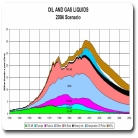
Worldwide liquid fuels consumption is expected to reach 90.2 million b/d this year and 91.6 million b/d in 2014, according to the latest Short-Term Energy Outlook (STEO) from the US Energy Information Administration.
Projected OECD liquid fuels consumption will further decline by 300,000 b/d in 2013 and in 2004, OECD consumption will remain flat with higher European economic growth. Non‐OECD Asia is the leading regional contributor to expected global consumption growth, the STEO said.
EIA projects that liquid fuels consumption in China will increase by 450,000 b/d in 2013 and by 470,000 b/d in 2014, given expected strong economic growth and bolstered refinery crude oil input.
Projected world oil supply increases by 1.1 million b/d in 2013 and 2.0 million b/d in 2014. EIA expects that OPEC will continue to decrease crude oil supply by 0.3 million b/d in 2013 from the year prior and then rise by 0.3 million b/d in 2014. In response to non-OPEC growth and increasing production from some OPEC members, Saudi Arabia contributes the most to the decline in 2013.
Non-OPEC production to grow
Non-OPEC production is forecast to increase by 1.2 million b/d this year and by 1.4 million b/d in 2014. With the production boom from U.S. tight oil formations and Canadian oil sands, North America will account for about two-thirds of the projected growth over the next 2 years.
The STEO forecasts lower Canadian oil production in 2013 because of further delays in initial production of the Kearl oil sands mining project.
EIA expects total liquid fuels consumption in US will grow modestly by 50,000 b/d in 2013 and by 80,000 b/d in 2014. Distillate fuel oil consumption increases at an average annual rate of 20,000 b/d in 2013 and 60,000 b/d in 2014. Ethane and propane consumption will rise while motor gasoline and jet fuel consumption remains flat in 2013-14.
US total crude oil production is forecast to grow rapidly from an average 6.4 million b/d in 2012 to 7.3 million b/d in 2013 and 7.8 million b/d in 2014. Onshore basin production is central to this projected growth. Estimated Gulf of Mexico production increases to an average 1.4 million b/d in 2013.
EIA expects that US natural gas consumption will average 70.3 bcfd in 2013 and 70.0 bcfd in 2014, which is adjusted upwards from last month’s outlook due to changes to historical industrial sector consumption data. Projected marketed production increases to 70.0 bcfd in 2013, and remains flat in 2014. Henry Hub natural gas spot price is expected to average $3.53 /MMbtu in 2013 and $3.84 /MMbtu in 2014.
4 Comments on "EIA forecasts 90.2 million b/d of liquid fuels consumption this year"
Plantagenet on Wed, 13th Feb 2013 8:43 pm
Its curious that the EIA predicts no increase in US NG use in 2013 and 2014, in spite of the large increases that are occurring as coal-fired power plants are switching to cheaper NG.
Does the EIA think NG will stop being cheaper than coal? Or does the EIA thinks Obama is lying when he pledges to shut down more coal-fired power plants?
bobinget on Wed, 13th Feb 2013 9:51 pm
Beijing and several other Chinese, Indian cities have already surpassed coal & oil burning air quality limits.
As result, several coal burning power plants have been closed and restrictions on automobile traffic imposed. Future for coal is a smoked glass ceiling going forward. Natural Gas, at least for AGW deniers, will be The Go To bridge fuel.
Much has been made of fuel switching back to coal,
in the US. I believe that to be entirely price based.
As air, water quality gets worse, even Republicans
will demand mandatory use of gas.
As for the EIA, they often underestimate demand.
Canada, our principal supplier, will soon be shipping crude East to ease serious trade deficits caused by Importing Brent priced crude bound to go higher on Chinese, Russian trade deals depriving Europe.
BillT on Thu, 14th Feb 2013 1:45 am
Both of you are dreaming. The gas bubble is about to burst and prices go back up and coal back into the bo8ilers. The pollution problem here is no where near as bad as it was in the 50s & 60s. And, no, the government will NOT mandate the closure of coal plants. They cannot.
BTW: The US still burns MORE coal per person than either China OR India.
Kenz300 on Thu, 14th Feb 2013 5:23 am
Oil companies and why we LOVE them. (NOT)
It is time to transition to safe, clean alternative energy sources.
http://www.youtube.com/watch?feature=player_embedded&v=yr7qalUUmsk