
Peak Oil is You

Donate Bitcoins ;-) or Paypal :-)


Page added on July 19, 2013

Egypt’s future crude oil import requirements for 3 population scenarios
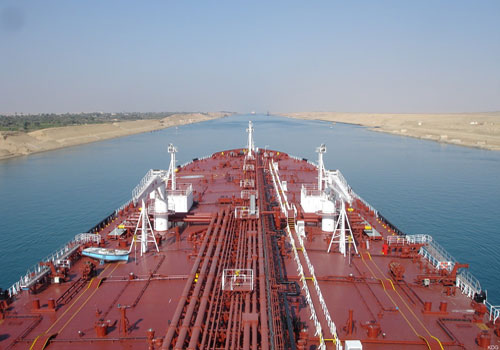
Egypt sits on a key strategic location between North Africa and the Middle East, where almost 4 mb/d of oil transit through the Sumed pipeline and the Suez canal.
Shipping firms brace for Suez disruption as Egypt turmoil mounts
20 years after its oil peak this country is now embroiled in a serious energy crunch. Crude oil production will decline between 3 and 4 % pa while population may grow from 80 million to 100 million by 2030. It is in the world’s interest to make sure that Egypt does not descend into chaos which will impact not only on global oil markets but also on neighbouring countries. This will require to help Egypt with importing crude oil. Here are some simple calculations what kind of quantities would be involved:
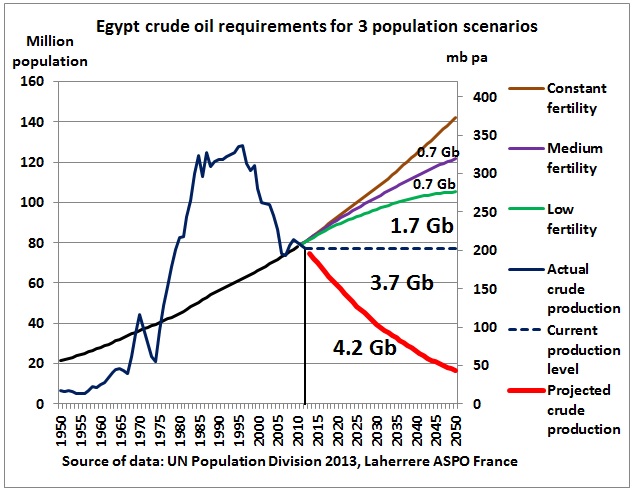
In this graph we have plotted
- 3 population scenarios (LHS scale) for 3 different fertility levels from the UN Population Division
- actual crude oil production (dark blue line, RHS scale)
- crude oil production projection from Jean Laherrere (red line)
- 2012 production level (horizontal dashed line)
and calculated until 2050
- Cumulative domestic production of 4.2 Gb
- Crude imports to offset decline and maintain current levels: 3.7 Gb
- Additional import requirements of 1.7 Gb for the lowest population scenario in order to keep current consumption levels
- Further additional import requirements of 0.7 Gb each for the higher population projections
We translate this into daily oil requirements:
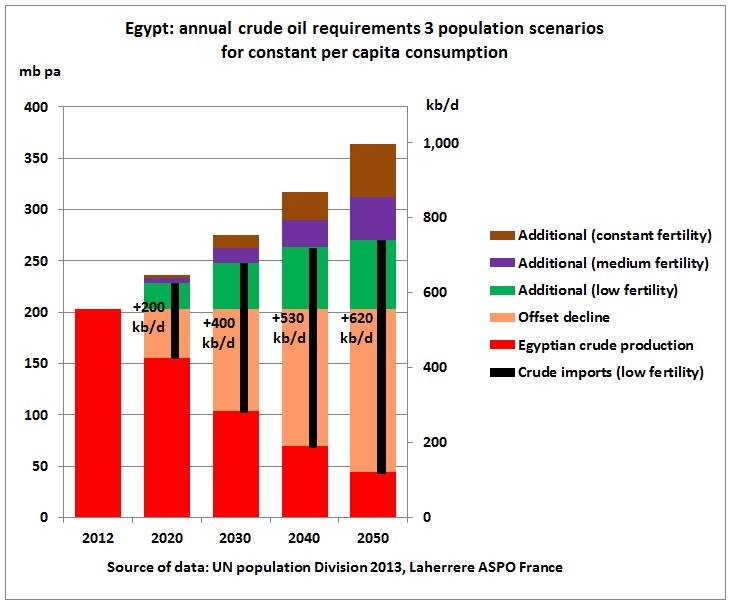
In the next years increasing quantities up to 200 kb/d by 2020 are needed.
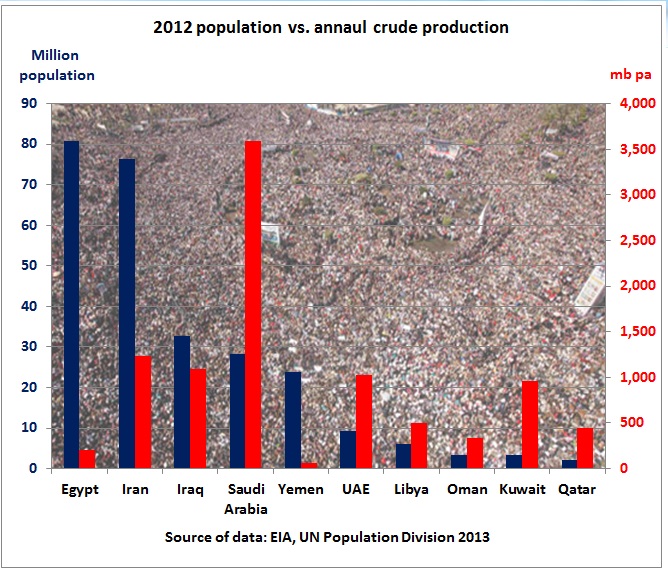
This graph shows uneven distribution of population and crude oil production in Egypt and neighbouring countries between Libya in the West and Iran in the East. Egypt with the highest population is more vulnerable than Iran. Note that the total population of this group of countries is 266 million.
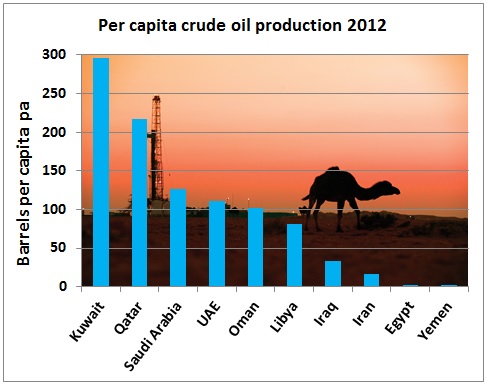
Oil production per capita is an important parameter for wealth creation. The most populous countries Egypt and Iran are at the bottom of the scale. Yemen is the last in the list.
So where will the oil come from to help Egypt? This article gives us a foretaste of what is to come:
Egypt closer to sealing $1 billion Libya oil deal
27/6/2013
CAIRO — Egypt is inching closer to getting a letter of credit to back a $1-billion much-needed oil supply contract with Libya, but the deal still faces a stumbling block in Tripoli, which fears being dragged into Cairo’s economic woes, officials said.
State-owned Egyptian General Petroleum Corp. (EGPC) has asked the National Bank of Egypt for a $1 billion guarantee that will allow it to complete its side of the oil deal with Libya, a bank official said. However, the Libyan government has yet to decide that a letter of credit from that bank is strong enough to overcome the risk of any losses if EGPC is unable to pay for the oil, said a government official.
Failure to agree the deal would be a significant blow for Eqypt because it is seen as vital for easing the country’s fuel shortage. An even bigger oil supply deal with Iraq has faltered due to similar concerns over financial guarantees.
“We have asked EGPC to give us first a guarantee from the finance ministry before we study its request since its loans have exceeded 20% of our capital base, or about 22 billion Egyptian pounds ($3.13 billion),” Mahmoud Montaser, NBE’s corporate banking and syndicated loans senior group head told The Wall Street Journal
“We got the guarantee from the finance ministry and hopefully the letter of credit will be issued soon,” Montaser, who is also a board member of the state bank, said.
Egypt has been facing a diesel shortage since last year, leading to rising food costs, long queues at filling stations and electricity blackouts. Egyptians have also taken to the Internet and streets to protest daily power cuts that they say are getting more frequent and lasting longer.
Neighboring Libya, an OPEC member, had agreed in March to supply Egypt with up to 1 million barrels a month of crude oil, with a generous credit term of up to a year, which would help Egypt with both its fuel shortage and its cash flow problems.
Egypt has so far been unable to provide a guarantee for the payments to Libya, which is concerned about the political and economic turmoil in the country. Even with a letter of credit from the NBE, Libya is still reluctant to give a stamp of approval.
“The National Bank of Egypt. It’s not a triple A bank,” said a Libyan official familiar with the deal. This means that going through with the deal on that basis, “will require…guarantees from the central bank of Libya,” the official said.
The official said the Libyan Foreign Bank–in charge of providing a $1-billion credit line for the country’s National Oil Co.–was concerned that exposure to such large risks in the EGPC deal would impede its own financial flexibility, especially when it comes to issuing letters of credit to other commercial partners.
The Egyptian fuel crisis has compounded broader economic problems in the country, which in 2011 overthrew the government of President Hosni Mubarak in a popular uprising. Egypt’s current government, which is dominated by Islamist party the Muslim Brotherhood, is short of funds and has been negotiating a $4.8-billion loan with the IMF, which analysts and investors say is critical for the country. IMF officials left Cairo in April without agreeing on the terms of the loan.
Iraq has also offered 4 million barrels of oil a month to Egypt, with payment deferred for three months with no interest incurred. However, the country’s oil minister, Abdul Kareem Luaiby, said last month the deal will be completed only if the North Africa country provided a letter of credit “opened in internationally recognized banks prior to the supply, but Egypt has so far [been] unable to open such letter of credit.”
Egypt’s energy import needs are rising because of a drop in its own hydrocarbon production, stemming from a slowdown in exploration over several years of civil unrest. EGPC has also been paying hefty premiums to import fuel because of the weaker Egyptian pound. It is struggling to pay debts of about $5 billion to foreign energy companies, according to officials familiar with the situation.
Conclusion:
Whoever comes to power now faces the same situation. If the problem of fuel shortages in Egypt cannot be resolved by oil imports, violence may impact on other countries and there is the prospect of one the world’s chokepoints in serious danger. In the end there will be no other choice than OPEC supplying as much oil as is needed to keep Egypt going, on credit or at discounted rates. That oil of course will not be available to those who thought they can always buy oil for their pleasure.
4 Comments on "Egypt’s future crude oil import requirements for 3 population scenarios"
smokeyjoe on Fri, 19th Jul 2013 2:00 pm
I don’t think opec or anyone else can afford to supply Egypt with the energy it needs in ever increasing amounts forever. Egypt will have live within its ever decining domestic energy budget until it reaches zero petroleum by 2060. Egypt is a near perfect example of the Export Land Model.
ohanian on Fri, 19th Jul 2013 2:50 pm
Hey brother, can you spare me a few billion barrels of that black gold? Me people are starving for vehicular fuel. I can pay you in Egyptian pounds, as much as you want.
DC on Fri, 19th Jul 2013 4:35 pm
Q/It is in the world’s interest to make sure that Egypt does not descend into chaos which will impact not only on global oil markets…..
It it really only in the ‘worlds'(US) interest that the Suez canal remain open, otherwise, Egypt as a country does not mean much to anyone. Its ME neighbors(US satraps all) can give Egypt near-free fuel for now, but that cant and wont last forever. And from the data its very clear Egypt is committed to keep the population explosion going. If the price of ‘stability’ in Egypt is free fuel and free money forever-then they are to put in mildly-screwed.
However, done expect anyone in the MSM to use the words, peak oil, over-population, much less Export-Land model. Instead, expect to hear the usual radical this, islamist that, ‘al-qaeda blah blah.
Eypgpt will descend into chaos no matter what anyone does. The population chart alone should explain why. The world does not have the spare fuel capacity to divert to them to keep them ‘stable’ forever. And, they are simply to poor to afford to pay for it either. In fact, one could argue the IMF wants the place to implode since its demanding fuel subsidies(for poor people that is) are removed. Subsidies for rich people are just fine however. But of course, one has to ask, if your poor, how will driving around in a gas burner you cant really afford help a never ending population increase? I dont know. I do know tourism and exporting dates wont save the country. Not with nile delta being squeezed by population on one side, and Egypt’s water management policies on the other.
GregT on Fri, 19th Jul 2013 4:39 pm
Hey Brother, if you think that all 80 million of us are just going to sit down and starve, while we watch all of that Mid East oil head to refineries overseas, you better give your head a shake.
Egypt is a precursor of things to come near you soon, much sooner than 2060.