
Peak Oil is You

Donate Bitcoins ;-) or Paypal :-)


Page added on October 4, 2016

E is for EROEI
Understanding EROEI – or Energy Return On Energy Invested – should be on every school curriculum, but isn’t. Simply put, it’s the amount of energy we as a species can play with. Back in the days when you could poke a hole in the ground and oil would gush out of it skywards, getting hold of plenty of energy was easy. In fact, for every blob of oil you used for locating, drilling and transporting the stuff, you got between 100 and 200 similarly-sized blobs of the same quality back. The way this energy value was expressed was by way of EROEI; thus, sweet onshore crude oil could be said to have an EROEI of 100 to 200. These were the low hanging fruit days that made the 20th century boom.
Once all the low hanging fruit was gone we had to move a bit further up the tree. Oil and coal and natural gas were still abundant but they needed more work to get at. They also needed more processing, transporting and all the rest of it. Because of this, the net energy (i.e. energy return minus energy expenditure) available to us was lower. We invested one blob and got considerably less than 100 back. In other words, the energy we invested in unlocking fossil fuels needed to be higher just to get the same amount back that we were used to, meaning the EROEI was falling.
Of course, fossil fuels aren’t the only forms of energy. Nuclear was thought to have a high EROEI, but once you took into consideration the entire process of building the power stations, mining the uranium, decommissioning the plant and storing the waste, the EROEI shrivelled up like dead fish in the sun at Fukushima Beach.
Renewables also have relatively low EROEI values compared to early oil. Note, however, that EROEI has nothing to do with money. Getting EROEI mixed up with EROI (Energy Return on Investment) is a common mistake. One deals with the immutable laws of physics and the other deals with the infinitely manipulable world of finance – and only one of these sets of conditions is negotiable.
So what would be the average EROEI value of oil discovered today? Unfortunately nobody can seem to agree on an exact figure, but you can be sure that it’s a lot lower than 200. 20 perhaps. In fact many insist that fracked shale gas and tight oil have such a low EROEI they are only viable as a commercial operation when financed by Wall Street Ponzi schemes. Biofuels, such as ethanol, have disastrously low EROEI numbers – in many cases they are less than 1. When you put more energy into something than you get out of it then it can no longer be regarded as a fuel source. Nevertheless, biofuel volumes are often added to ‘total liquids’ figures, implying they are an oil substitute when clearly they are not.
People will often say that ‘the world is awash with oil’ because they see it on the news all the time. They see no reason to think scarcity exists – everywhere they look they see abundance. However, there’s a problem with this kind of thinking, and the problem is that our net energy levels are shrinking. Yes, shrinking! We can cover the world in wind turbines, solar panels and fracking wells, and we still can’t escape the shrinkage problem. We might be producing, say, ten million barrels of oil per day – which looks great on spreadsheets and in news articles – but what good is that if we are then spending the bulk of it to do more drilling to get at more oil that will have an even lower EROEI value?
Which leads us to the crux of the problem. The modern world was set up to run on high EROEI energy. Take a look around. All those roads, airports, microproccesor factories, mechanised agricultural systems, globalised supply chains and space programmes require a huge throughput of energy. But we are running out of high EROEI energy, and will soon have only low EROEI energy to play with. Which begs the question: at what average level of net energy will the modern world cease to be a viable option? In the past, when high energy fossil fuels were abundant, you could always throw more money and energy at problems and expect them to go away – and usually they did. But this option itself is now going away. What will we do?
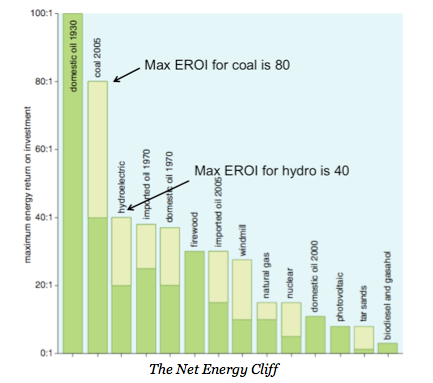
Here’s a chart showing estimated EROEI values for different energy sources (source unknown).
Proponents of renewable energy will say that we can simply swap out the old system for a new ‘clean and green’ one. We’ll all drive electric cars, live in solar cities and our lifestyles will not be much different to what they are today. This vision ignores many of the other limits to the system, and would still permit the continued destruction of the planet’s life support systems, albeit in a more ‘green’ fashion. That’s not to say that renewable energy isn’t extremely useful – especially in a locally-distributed way – just to recognise some of its limits.
On the other hand, fossil fuel dinosaurs claim that we should just go all-out for oil and gas and coal. If there’s such a thing as EROEI or global warming or acidifying oceans then they don’t want to hear it. We should be fracking the living daylight out of the planet, building pipelines and fighting wars to get ‘our’ oil out of the Middle East. These people are a type of modern day cargo cult and as such, are quite dangerous. Many of them are politicians and leading businessmen.
There’s a third category, too. The techno cornucopian optimists insist that a new technological breakthrough is just around the corner that will allow us to live like we do with no interruption to service. Haven’t you heard there’s a government conspiracy to cover up the availability of free energy? Or that if we can send robots up into space to mine comets for uranium we can have endless energy? Selling dreams is a profitable business, and the most successful of these people have MBAs and hire the best PR staffers. I myself once pretended to be one just for fun and have had several requests for an investment prospectus from people with money.
So what is likely to happen as these groups fight it out amongst each other while, all along, the needle on the global EROEI fuel tank moves into the orange zone? Perhaps it will be like the hand of God slowly turning down the dimmer switch on industrial civilisation. Because the more energy we USE simply to GET energy, the less energy is available for the rest of society to use. And this manifests itself in many different ways, but it all comes down to lower available net energy. Already we are seeing demand destruction and lower energy use as the former consumer classes struggle to be able to afford as many goods and the corresponding energy they use. Heavy goods vehicle traffic levels have fallen over 6% across the UK in the last decade, councils are turning off streetlights at night, and homeless levels in the US are spiking. Sweden is encouraging its citizens to refurbish goods instead of buying new ones, malnutrition in children is becoming common in the developed world and 30-something Britons possess half as much as 30-somethings did only 10 years ago [*See links below]. These are just some signs that the big squeeze is on, and it’s getting tighter and tighter with each passing year.
52 Comments on "E is for EROEI"
Revi on Tue, 4th Oct 2016 8:17 am
Great article! Very hard for most people to understand…
Tom S on Tue, 4th Oct 2016 8:26 am
Oh goodness, no. This article is all wrong. It contains all the errors of the ERoEI literature over the years.
ERoEI is usually unimportant, and is being used incorrectly:
http://bountifulenergy.blogspot.com/2016/06/eroei-is-unimportant-and-is-being-used.html
Renewables have higher ERoEI than fossil fuels:
http://bountifulenergy.blogspot.com/2014/07/renewables-have-higher-eroei-than.html
-Tom S
Hello on Tue, 4th Oct 2016 8:37 am
Net energy is not important.
ERoEI even less.
rockman on Tue, 4th Oct 2016 8:41 am
An aside to the bigger issue of EROEI: “Back in the days when you could poke a hole in the ground and oil would gush out of it skywards, getting hold of plenty of energy was easy.” Just one more ignorant writer who knows nothing about exploration. Finding commercial oil reservoirs was not easier 50+ years ago was very difficult. Success rates were much lower then today thanks to great improvements in seismic data. What is different, at least in the US onshore, is the reservoirs discovered now tend to be much smaller. In the Deep Water…not so: some of those fields hold as much as many found half a century ago.
“…for every blob of oil you used for locating, drilling and transporting the stuff, you got between 100 and 200 similarly-sized blobs of the same quality back.” A very misleading statement. First compare a field containing 1 million bbls today that requires 4 wells to drain it. Now look at one discovered in 1946 that would produce 10 million bbls and required 40 wells to drain it. And that’s rather efficient: the Rockman is redeveloping a reservoir discovered in 1946 that produced 28 million bbls FROM 132 WELLS. If one were to discover the same reservoir today those 132 VERTICLE wells would require less energy to drill since rigs are more efficient now. And if instead 40 HORIZONTAL wells were used much less energy would be used. About 60 years there were some wells that produced 1+ million bbls each. But there were also hundreds of thousands that produced 50,000 bbls…or less. And lastly, all those DRY HOLES drilled in the good ole days returned ZERO energy.
“…but what good is that if we are then spending the bulk of it to do more drilling”. And again a gross exaggeration: many think the process consumes much more energy then it actually does. Which itself has no bearing on the amount of new oil/NG reserves we’re developing: insufficient ECONOMIC value kills a project long before EROEI gets too low. And what might confuse many folks: the EROEI of wells drilled today has an INCREASED EROEI…perhaps by 2X in some trends. As said it’s the ROR that determines what gets drilled and not EROEI. And the now lower oil prices require more oil to be found to justify the drilling cost. Drilling that will require the same energy as it did several years ago when oil was selling for twice as much as today.
Simple math: Higher oil recovery + same amount of energy used = higher EROEI.
The serious problem with future oil production isn’t lower EROEI: it is the increasing COST to develop fewer and fewer reserves.
dave thompson on Tue, 4th Oct 2016 8:47 am
lol As the deniers come oozing forth.
Tom S on Tue, 4th Oct 2016 8:57 am
rockman,
Thanks for that very informative post.
I had serious doubts about the figure that oil had an ERoEI of 100 in 1930. That figure is tossed around a lot, but it’s hard to find much supporting literature. It appears to be an unsubtantiated claim, which is just repeated. Sometimes people like Charles Hall can make an off-the-cuff remark (civilization will collapse with an EROI lower than “say” x…) and then it’s repeated by others and eventually turns into a fact.
There appears to be no substantial body of literature which indicates that oil had an ERoEI of 100 back in 1930. There is a single remark from a single paper (Cleveland et al, 1984). He was measuring the EROI of oil DISCOVERY only (not including production!). The calculation was extremely rudimentary and was based upon a remark Hubbert had made during Senate testimony in 1958.
I don’t think there’s any serious reason to believe that oil had an ERoEI of 100 back in 1930. There was a single silly guess that it was, nothing more. No effort has been expended in digging up records, counting dry holes, measuring energy used, and so on.
-Tom S
shortonoil on Tue, 4th Oct 2016 9:25 am
Since I coined the term ERoEI in 2004, and published part of that paper on “Available Energy” here on PO News in 2008 I would like to make a few comments on this article.
Overall a pretty good article, but the author should have made some better definitions before starting. ERoEI refers to the energy returned on energy invested “at the well head.” ERoEI is only a time dependent function. It is explicitly defined for petroleum which makes it different than EROI. EROI, which can be applied to any thermodynamic process, changes as it is calculated at different places in the process, and as time moves forward. It is not a static quantity. For any particular point in time, and for any specific petroleum reservoir the ERoEI is considered a constant.
For example: the ERoEI for the world’s petroleum reserve in 2016 is 8.66 :1, the EROI at the refinery exit gate is 1.95 :1, at the end user it is 1.79. When the ERoEI of petroleum reaches 6.9 :1 it will have reached the “dead state”, the point when no further work can be extracted from the oil. That will be an EROI of 1.41 : 1 for the end user. It will never reach 1 : 1 because the waste heat produced by the process must be taken into consideration.
One may ask how do we know this? The Etp Model allows (with the use of other data sets) for the calculation of the price of petroleum. It has agreed with the EIA posted annual price of WTI since 1960 with a ±4.5 margin of error. The price of petroleum is the only data set for petroleum that is very likely to be almost 100% accurate.
For sure though, as the ERoEI of petroleum falls the cost to produce it will increase, and the price that the end user can pay for it will fall. When the economy can no longer pay a high enough price to cover its production – its production will cease.
As Hubbert said 60 years ago:
“So long as oil is used as a source of energy, when
the energy cost of recovering a barrel of oil becomes
greater than the energy content of the oil, production
will cease no matter what the monetary price may
be.” (M. King Hubbert)
Hubbert was right then, and he is right today.
We are already witnessing the impact of petroleum approaching the “dead state” of an ERoEI of 6.9 :1. The industry has see its revenue decline by 55%, it is taking on a greater margin of debt, and almost no new oil is coming to the market. That stress will only increase as we approach closer to the end point. The world’s economy will react accordingly.
BW
http://www.thehillsgroup.org/
donstewart on Tue, 4th Oct 2016 10:31 am
ERoEI; EROI; Constructal Law; Lies, Damned Lies, and Statistics
A few thoughts from an amateur who has been thinking about these things for a long time.
Webinar series on Alzheimer’s. Dr. Katz in New Haven reports that, in Blue Zones around the world, the incidence of chronic diseases, including Alzheimer’s, is 80 percent less than it is in the United States in 2016. In Blue Zones, people either live traditional life styles or follow religious practices which preclude considerable ‘modern’ behavior. Dr. Bredesen in California reports that he has now demonstrated an effective protocol for reversing Alzheimer’s symptoms in 100 patients. His success rate is 90 percent. Dr. Bredesen’s protocol is dependent on quite a high-tech array of testing and scientific inquiry and so forth.
So…we can either live much simpler lives than most Americans live and reduce chronic disease by 80 percent, or we can marshall advanced technology and reduce chronic disease by 90 percent. My conclusion is that the marginal value of the advanced technology really isn’t that great. We are solving a problem that our life style has created. While the EROI available to those who provide the high-tech services may be high if the society is wealthy, the ERoEI to society is pretty low. Add in the externalities created by the high tech society, such as pollution, and the ERoEI is probably negative.
The problem with using GDP as a measure of well-being is that GDP counts as a positive outcome merely fixing the potholes in a highway to nowhere.
Is it true that ‘poking holes in the Earth’s crust and finding Spindletops everywhere’ was once common? And the answer to that is ‘No’. Study of photographs of early oil towns reveals that the people working in the towns were living very much simpler lives than most Americans live today. We can suspect that the relative inefficiency of the search for and production of oil a hundred years ago had something to do with the relative poverty of those workers as compared to the relatively princely way of life of a worker on an off-shore oil rig in 2005. We also note Adrian Bejan’s formulation of the Constructal Law: things that flow tend to evolve in the direction of easier flow. (Bejan is a professor of mechanical engineering and author of thermodynamics textbooks working at Duke University.) People in the oil business are not stupid, and if they can find easier ways to do things, they change behavior in the direction of ease of flow.
It is very clear that the world is currently being held together with chewing gum, baling wire, and 200 trillion dollars of debt plus countless promises of entitlement payments. It is also clear that the world began to go downhill around 1970 in the United States and accelerated its downward trend around the year 2000…which is an inflection point in the ETP curves. China, having little in the way of debt, was able to keep the party going for a decade or so by greatly increasing debt…but that party now appears to be over. Consequently, the whole world is now teetering on the brink of massive deflation (defined as collapse of debt and thus money).
I can think of two plausible explanations for our situation. The first explanation is the ETP model. The net energy from oil began to decline about the year 2000. Since oil is the key element in transportation, and since Bejan has highlighted the importance of flow across the landscape, and since many other people have identified globalization as a key element in economic growth, it makes sense that declining net oil energy will trigger deflation. The second explanation is a more general thermodynamic decline as exemplified by my initial discussion of chronic disease. We are becoming less and less efficient as a society, when measured by the accomplishment of fundamental goals. Some people have linked globalization with our inability as a society to focus on fundamental goals, and hence we become ever less efficient. Dmitry Orlov published 150 Strong, pointing out the crucial role played by small groups in human social functioning. Massive factories in China are just about the opposite of 150 Strong. Others blame humans’ innate inability to practice sapience, or the cleverness of the scientists who work for evil corporations in designing products to lure us away from clean living.
Personally, I find both explanations to have merit. I don’t feel compelled to choose one and criticize the other….Don Stewart
ghung on Tue, 4th Oct 2016 10:47 am
Thanks, Don. It seems Homo colossus (“a quasi-species and detritivore, ecologically distinct from ancestral Homo sapiens…” is far more susceptible to some very real physical maladies than is Homo sapiens (HT to Catton).
Funny we call it ‘progress’.
Hello on Tue, 4th Oct 2016 10:56 am
shortonoil >>>> It will never reach 1 : 1 because the waste heat produced by the process must be taken into consideration.
Isn’t waste part of your godly etp model? For a guy who hardly knows jack shit about eroei (and why it doesn’t matter) you spout your etp nonsense with amazing authority.
Kenz300 on Tue, 4th Oct 2016 11:13 am
The world is moving to a more sustainable future
Electric cars, bikes and mass transit are the future…..fossil fuel ICE cars are the past
Think teen agers vs your grand father cell phones vs land lines
NO EMISSIONS climate change is real
Save money no stopping at gas stations
no oil changes less overall maintenance
Paris Goes Car-Free First Sunday of Every Month
http://ecowatch.com/2016/05/17/paris-goes-car-free/
The transition to safer, cleaner and cheaper alternative energy sources continues
Germany Achieves Milestone – Renewables Supply Nearly 100 Percent Energy for a Day
http://www.renewableenergyworld.com/articles/2016/05/germany-achieves-milestone-renewables-supply-nearly-100-percent-energy-for-a-day.html
Portugal ran entirely on renewable energy for 4 consecutive days last week
http://electrek.co/2016/05/16/portugal-ran-entirely-on-renewable-energy-for-4-consecutive-days-last-week/
Plantagenet on Tue, 4th Oct 2016 11:54 am
Its wonderful that the EU and USA are moving to more use of renewables. However, there is still growth in ICE vehicle use in China and India. India is the most populous country on earth with 1.3 billion people, all of whom want a car just like folks in the western world.
Plantagenet on Tue, 4th Oct 2016 11:59 am
Its wonderful that the EU and USA are moving to more use of renewables. However, the EU and USA combined are only a small part of the earth’s population. There is still growth in ICE vehicle use in China and India. India in particular is growing rapidly. India is the most populous country on earth with 1.3 billion people, all of whom want a car just like folks in the western world.
shortonoil on Tue, 4th Oct 2016 12:03 pm
“Isn’t waste part of your godly etp model?”
No, it is just part of having you around!
rockman on Tue, 4th Oct 2016 12:09 pm
Tom – “He was measuring the EROI of oil DISCOVERY only (not including production!)”. And that may be closer to the reality. Drilling ONE EXPLORATION WELL to discover a 28 million bbl field (that requires 130 DEVELOPMENT WELLS to produce that oil) will have a much higher EROEI then ONE EXPLORATION WELL that discovers a 1 million bbl field.
Hello – “It will never reach 1 : 1…”. It won’t because of economics…not because of the energy used. This is just a generalization but back when oil was $90+/bbl I guesstimated the EROEI of oil development couldn’t go much below 5 or 6 before the economic analysis killed the project. Now, with oil under $50/bbl the EROEI generally wouldn’t go below 10 or so.
Do you understand that at the current oil price new drilling projects will have much higher EROEI’s then they did a few years ago? I’ve pointed that out a number of times with few responses. Since it completely contradicts the idea of ever DECREASING EROEI I expected more blowback.
Davy on Tue, 4th Oct 2016 12:28 pm
We will live simpler lives but that will not reduce chronic disease. Advance technology is not going to reduce chronic disease because it is itself suffering chronic decay. There is too much chronic disease in the pipeline to end without a die off and the propagation of new DNA. This chronic disease build up in the population is kind of like we warmed the oceans and they will not cool down for a few thousand years if that.
There is a pyramid of marginal value for technology. Those closest to the top benefit and those at the bottom suffer the destructive change. Technology requires technology to maintain it and clean it up. It is only those nearest to the source of benefit who realize the rewards of technology. Even they suffer marginal value because of the decay that technology causes to the environment and human culture. The best of man has been destroyed by technology since the industrial revolution. What we have instead is human networks and systems built on efficiency and technology. These are wonderfully complex and very powerful but they are not human they are proto human. We want to treat them as human because they represent our creations. Corporations are a clear example of a proto human construct.
We are in a catch 22 that consist of overpopulation and diminishing returns of technology. These are both limit based and represent the end of the line. The end of the line is collapse and that leads to a rebirth. Population cannot grow nor can technology dig itself out of the hole it is in. Technology is in a vicious circle of entropic decay and resource depletion. Without energy, healthy environment, and with overpopulation technology cannot be applied in a beneficial way. Humans are also suffering cultural decay from technology which is every bit as important as the technical decay. We have lost control of technology. We are no longer in control it is controlling us in a mechanization of needs, wants, and false expectations.
Our drive to be efficient has taken on a life of its own. We are now efficient because efficiency is understood rightly or wrongly to be better. More technology is considered better. When you mix in the market signals of price with technology and efficiency then you really get a dangerous cocktail of distortions.
Some of our greatest value is not technical and does not have a price. These things have special value because they exist with value. Our modern goals and their accomplishments are now about a vague idea of prosperity that is based on increased complexity, efficiency, and their combination that is interpreted as prosperity vie market price.
We look down on nativist cultures as if they are less valuable. Societies that excel economically, culturally, and militarily are seen as having higher value regardless of their true value. It is only more efficiency, technology, and or prosperity that matters in these rankings.
In effect we are now at the point of limits and diminishing returns where paradoxes of right and wrong come into play. We are at the cusp of change. This is in our “Ecos” as with the turning of an earth epoch and the human with the turning of a civilization from modern to postmodern. This involves the destruction of stable climate and a great extinction of biodiversity complexity. We are now less efficient because we have destroyed efficiency in the name of efficiency. Yeast does something similar in a petri dish.
yoshua on Tue, 4th Oct 2016 12:44 pm
When the oil industry consumes half of the global oil production… then: what does it matter what the oil price is ?
A high oil price gives a high revenue that is eaten up by a high production cost.
A low oil price leads to a low production cost that can’t be covered by the low revenue.
Whatever the oil price is… the oil industry is bankrupted ?
Anonymous on Tue, 4th Oct 2016 2:18 pm
Nice strawman rock, the author was not saying the mechanics of drilling oil, or even locating oil was easy, of course it wasnt and we(and im sure the writer) all know drilling was as demanding then, as it was now. But when you did, the fields were often closer to the surface, and were much larger than those found today, something even you, a denialist cornucopian, admit. You know full well hes saying the energy payoff, what comes out for what you put it, was much greater. You claim ‘rigs are vastly more efficient, perhaps, in some narrow ways, but how much more? Enough to offset higher processing costs? You never mention those either. You only talk about extraction, not the full cycle from extraction all the way to fat amerikan soccer parents and her their fat-faced kids idling in a burger king drive through.
No matter how much you try to weasel word your way around, we are putting in more, and getting less back. The only question is, precisely how much less? Everyone admits that’s not an easy thing to measure. What IS easy, is pretending we are getting more, or even the same, for less. WERE SO EFFICIENT NOW! uS fossil-fool extraction is going to keep falling, after a temporary blip of tar-shale-frac, sustained by economy killing high prices and dodgy wall St paper. And there, most of the ‘blip’, was almost ALL low-net energy garbage. Maybe some nice high net-energy, real oil was mixed in there too, what of it?
The author is right when it points out when energy had very high EROEI, we could just throw more money and energy at a problem at it went away. You of course, are wrong in your evangelical belief that low net energy oil can and will be drilled regardless, just because no one in the uS oil cartel believes in EROEI or net energy makes any difference. Of course, were still in that place where paper money, conjured out of thin air by the uS ‘fed’, can be used to paper over the issue.
The issue is not, and never been, that oil extraction will suddenly stop one day once a certain threshold of EROEI is passed. The issue is that once oil stops being a ‘fuel’ you can burn at will driving to NASCAR races or sitting in drive-throughs, or commuting 60 miles a day to a cubicle job, then the ‘economy-as-we-know-it’ seizes up. After that, oil will likely continue to be extracted, as before. The only difference is, you wont get to burn it driving 40 miles to your favorite Wall-Mart.
rockman on Tue, 4th Oct 2016 3:20 pm
yoshua – “Whatever the oil price is… the oil industry is bankrupted”
There are many dozens of oil companies that are today buying $BILLIONS of PROVED PRODUCING oil reserves for $10 to $20 per bbl. Reserves that will typically recover 100% of the purchase price in around 3 years and do so at the currernt low price. And if oil climbs back up to $60+ per bbl in a few years not only will this portion of the industrty not be going bankrupt but will be making a nice profit. Just as the Rockman’s company will do. A company that spent over $320 million in the last 7 years. And not $1 of it was borrowed nor $1 spent drilling for unconventional reservoirs.
Not picking on you specifically but I always feel the need to correct any effort to paint the “industry” with one big paint brush. We just went thru a period of relatively low profitability. But that’s past history. And just as sure as the sun rising tomorrow we are entering a period of decent profits for many companies. The companies that didn’t get sucked into the recent “oil boom” and have been waiting patiently to capitalise on the very predictable bust.
Just like every boom/bust oil patch business plan for more then a 100 years. And guess who are some of the biggest buyers of PROVED PRODUCING oil reserve are today: players that made $BILLIONS during the boom and then cashed up before the bottom fell out. They may have new company names but often it’s the same man behind the curtain. LOL.
At last count Chevron has about $43 billion in their bank. Selling gas and oil is an extremely profitable business. So profitable in fact that three of the gas and oil industry’s most successful companies are placed on this list. At last count Chevron has about $43 billion in their bank, as well as at least $8 billion that they make in free cash flow every year, which means that their cash balance will continue to rise.
ConocoPhillips: Cash Balance – $45 billion
ExxonMobil; Cash Balance- $52 Billion
And that’s after it used $40 billion to buy XTO Energy, a leading natural gas producer. That one acquisition accounted for more then 80% of its proven reserve additions for the ENTIRE COMPANY that year. It has also been successful in their stock buybacks. ExxonMobil will most likely use their cash balance for more acquisitions and stock buybacks.
Bottom line: does this sound like a “bankrupt industry”? Nothing that has happened in the last 2 years was a surprise to the oil patch. The only uncertainty was the exact timing. I have to keep repeating: “This ain’t our first rodeo”. LOL.
If someone bothers to go back many years in the Oil Drum archives they’ll find the Rockman describing the dynamics just as they’ve unfolded. No exact dates or prices, of course…the Rockman ain’t that dumb. LOL
rockman on Tue, 4th Oct 2016 3:24 pm
“…the fields were…much larger than those found today,” Which is exactly what I said. You need to wipe the sh*t out of your eyes and pay attention. LOL.
peakyeast on Tue, 4th Oct 2016 4:14 pm
“Here’s a chart showing estimated EROEI values for different energy sources (source unknown).”….
And then the CHART shows EROI. LOL…….
And….
“Getting EROEI mixed up with EROI (Energy Return on Investment) is a common mistake.”
You can say THAT AGAIN !!
LOL
shortonoil on Tue, 4th Oct 2016 4:20 pm
“But when you did, the fields were often closer to the surface, and were much larger than those found today, something even you, a denialist cornucopian, admit.”
Drake drilled a 63 foot well with a steam drill, and baled 1000s of barrels with a bucket on a cable. That is about as efficient as it gets; except for Baku were they walked over to the nearest oil spring, and hauled it off in a goat bladder. Energy input, almost zero. Now that is what you call high efficiency, low cost production!
In 1960 it required 1,783 BTU to extract the average barrel. In 2016 it requires 16, 091 BTU to extract the same barrel. That comes from the ERoEI function; ERoEI = Energy Returned/ Energy Invested; Energy Invested = Energy Returned/ ERoEI. For 2016 that is: Energy Invested = 140,000/ 8.7. That is why ERoEI is very important. It gives a simple means to determine the actual production energy cost. No bookkeeping method can do that!
Because petroleum is used primarily to provide energy it seem obvious that it would be a good idea to know how much of it is being provided. Of course, there are those who only feel that it is the dollars that matter. They are probably the among the same bunch that pays the Church to get them into heaven.
Neither are likely to have much success in the long run.
yoshua on Tue, 4th Oct 2016 4:31 pm
rockman – Ok. This must cause destruction somewhere in the financial and economic system. But as long as the Fed can print to cover the destruction it might hold together.
It is a bit like magic. Reserves at low cost are being materialized for the giants.
“The problem with QE is that it works in reality, but it doesn’t work in theory”. Ben Bernanke.
shortonoil on Tue, 4th Oct 2016 4:40 pm
“Bottom line: does this sound like a “bankrupt industry”?
Sure does!
http://fuelfix.com/blog/2016/09/12/135-oil-companies-are-on-the-edge-of-bankruptcy-so-why-is-that-good-news/
http://www.zerohedge.com/news/2016-08-24/oil-debt-soars-cover-capex-investors-assert-dividends-are-unsustainable
“What a difference in five years… aye? These top three U.S. oil companies made a combined net income profit of $40.4 billion during the first half of 2011 versus a net loss of $1.2 billion 1H 2016. And… I believe the situation will become a lot worse for these companies going forward.”
http://www.zerohedge.com/news/2016-07-30/blood-continues-flow-us-oil-industry-precious-metals-rally
http://www.zerohedge.com/news/2016-07-29/exxonmobil-tumbles-2-month-lows-after-earnings-miss-worst-analyst-expectation
And; prices will are lower in 2016 than they where in 2015.
shortonoil on Tue, 4th Oct 2016 4:40 pm
“Bottom line: does this sound like a “bankrupt industry”?
Sure does!
http://fuelfix.com/blog/2016/09/12/135-oil-companies-are-on-the-edge-of-bankruptcy-so-why-is-that-good-news/
http://www.zerohedge.com/news/2016-08-24/oil-debt-soars-cover-capex-investors-assert-dividends-are-unsustainable
“What a difference in five years… aye? These top three U.S. oil companies made a combined net income profit of $40.4 billion during the first half of 2011 versus a net loss of $1.2 billion 1H 2016. And… I believe the situation will become a lot worse for these companies going forward.”
http://www.zerohedge.com/news/2016-07-30/blood-continues-flow-us-oil-industry-precious-metals-rally
http://www.zerohedge.com/news/2016-07-29/exxonmobil-tumbles-2-month-lows-after-earnings-miss-worst-analyst-expectation
And; prices will are lower in 2016 than they where in 2015.
Boat on Tue, 4th Oct 2016 5:28 pm
EROI,
What is it when you include the cost of pollution,health costs, pipeline breaks, wars, climate change, etc.
All these factors don’t mean squat until an alternative is cheaper per kw/MW etc.
Wind/solar after decades has finally reached in areas the holy grail of lowest cost producer. This is without the huge evniornmantial gains, health costs, wars etc. factered in total cost to society and EROEI.
Anonymous on Tue, 4th Oct 2016 5:39 pm
Hey boat, (moron). You amerikans don’t wage wasteful, energy intensive wars over energy(oil) because you have to, but because you WANT to. You *want* to deny access to energy on equal terms for emerging nations that can outcompete your decaying empire. Solar, wind, EROEI has little to do with any of that. The uS military, is one of the single largest entropy accelerators on the planet.
makati1 on Tue, 4th Oct 2016 6:42 pm
Anon, I second that analysis. Spot On!
donstewart on Tue, 4th Oct 2016 6:56 pm
Second Law; Constructal Law; Rockman
This is to try to clarify how Adrian Bejan sees the relationship between the Second Law of Thermodynamics and his Constructal Law.
https://en.wikipedia.org/wiki/Constructal_law
In the section labeled Constructal Thermodynamics
‘The two laws of thermodynamics do not account for nature completely. Nature is not made of black boxes. Nature’s boxes are filled with evolving, freely morphing configurations—even the fact that they have names (rivers, blood vessels) is due to their appearance, organization, or design. Where the second law commands that things should flow from high to low, the constructal law commands that they evolve in configurations that flow more and more easily over time.[31]’
Back to me. Rockman’s assertion that it is now, in some cases, cheaper to drill a few wells with long horizontal laterals rather than many vertical wells is an example of the operation of the Constructal Law. That is, humans are designing a vascular system to facilitate the flow of the oil. There is no a priori reason why Rockman’s statement must be incorrect. Bejan would say that the test is survival…if the horizontal laterals displace the verticals, then they are facilitating flow. The evolution is similar to the evolution of design in chips to dump excess heat.
However, it may still be true that legacy fields developed with vertical wells were more thermodynamically efficient than new tight oil fields developed with fracking and horizontals. That is an empirical question. It may also be true that tight oil has different characteristics which may make it less valuable as a transport fuel. Again, an empirical question.
Don Stewart
donstewart on Tue, 4th Oct 2016 7:05 pm
Constructal Law
One more fine point. If oil companies had access to all of the technology used in the ‘horizontal drilling’ vascular design for the last several decades, but were not using it, then Bejan’s assumption would be that the technology was not effective compared to verticals. However, if the horizontal technology is truly an innovation, then Bejan would characterize it as a continued evolution toward easier flow in the vascular design.
For example, Bejan explores in some detail how the design of the Atlanta airport facilitates flow through the airport with its combination of fast transit and slow walking (very similar to the way a dog on land will both run and swim to reach a stick thrown in the water). The principles of design used in the Atlanta airport were not known historically, and were an innovation. Now, all new airports have those principles available to them.
Don Stewart
PS Dog’s knew them all along. A father rescuing his drowning child knows the rules instinctively.
rockman on Tue, 4th Oct 2016 9:42 pm
yoshua – “This must cause destruction somewhere in the financial and economic system. But as long as the Fed can print to cover the destruction it might hold together.” It would be easier to grasp the different dynamics of the oil patch if you think of us as multiple industries. There really are very different business plans:
A) New and smaller public companies. They typically have just one plan: hope like hell some new “boom” play to develop. They have little to no reserve base. Thus little to no credit. Which means they have little or no reason to exist since there’s little or no reason for anyone to buy their stock.
But give them a hot new play with lots of cheap acreage available being hyped to the nth degree. And this is where the fed policy kicks in…indirectly. By keeping interest rates low everyone was looking for any vehicle that earned them more the a few %.
B) Promoting companies. They typically do little or no drilling. They put together lease blocks and drilling prospects. They are usually funded by savvy private investors. They sell their positions to whoever has a demand. In slow times the established companies will by the best projects. During boom times they can sell sh*t for rediculously high prices. Startup public companies are prime targets but so are more established pubcos with not much drilling potential. For instance with the public hyped up over the Eagle Ford a startup with no proven assets can raise hundreds of $millions in an IPO. But they must have some great sizzle to sell since they own no steak. And this is why promoters exist. You’ll never find the real numbers but they usually make the highest profit margins in the oil patch. Yes: the companies that do little or no drilling and own almost no oil production. Best example: Petrohawk put a big block of very cheap EFS acreage together in the early days, drilled a few “seed wells” and sold it to a pubco for $12 BILLION. And almost from the first day they owned the acreage their stock started sliding down…long before the oil price collapse began. To date the stock has lost $100 billion in value.
C) Privately owned independent companies. We only drill prospects we think will make a profit. We may generate the prospects ourselves and/or buy them from promoter companies. We basicly took a pass on drilling the shale plays. But now are more then willing to buy wells producing from shales on the cheap from pubcos that had their backs broken by the oil price collapse.
D) Major pubcos like Chevron et al. Given their high production volume they have great difficulty replacing their reserve base by drilling. Why they gave up on most US drilling plays decades ago and focused on bigger foreign projects. The Deep Water did pull some back in along with some of the biggest independent companies. Shell was a surprising exception: lost several $billion in the EFS before shutting down virtually all onshore US drilling. These companies aren’t looking at buying fields from crippled pubcos but buying the entire company…debt and all. And often swapping a lot of their stock instead of paying all cash.
And being “integrated”…in the refining and retailing business their combined biz plans can get rather convoluted: Chevron’s ex!oration division hate low oil prices its refining and retailing divisions love them.
) A variety of other biz plans but collectively just a small % of the activity.
This is why I keep taking shots at folks making generalizations. Fact: today is a horrible time for some portions of the oil industry; today is a great time for some portions of the oil industry.
IOW this is neither a good time or a bad time for the “oil industry” because the “oil industry” doesn’t exists. But there are a number of different energy “industries”.
Truth Has A Liberal Bias on Tue, 4th Oct 2016 10:10 pm
Soooooo some of you fucking retards are saying that it is completely irrelevant whether the EROEI is 1,0000,000 :1 or 1:1 or 1:1,000,000
Ok whatever lol yeah what’s the big deal?! It’s all the same shit right?
rockman on Tue, 4th Oct 2016 10:15 pm
Don – Very interesting comments…I need to study deeper. But in the meantime:
“If oil companies had access to all of the technology used in the ‘horizontal drilling’ vascular design for the last several decades,” IF??? LOL. One of the hottest oil plays in the planet TWO DECADES ago was the horizontal drilling of the Austin Chalk carbonate shale in Texas.
The first major advance in high angle and horizontal drilling was in the 1970s, when downhole drilling motors (aka mud motors, driven by the hydraulic power of drilling mud circulated down the drill string) became common. These allowed the drill bit to continue rotating at the cutting face at the bottom of the hole, while most of the drill pipe was held stationary. A piece of bent pipe (a “bent sub”) between the stationary drill pipe and the top of the motor allowed the direction of the wellbore to be changed without needing to pull all the drill pipe out and place another whipstock. Coupled with the development of measurement while drilling tools (using mud pulse telemetry, networked or wired pipe or EM telemetry, which allows tools down hole to send directional data back to the surface without disturbing drilling operations), directional drilling became easier.
And it might come as a shock but hz WAS NOT first perfected in the US but in Europe and in particular, the North Sea. In fact when the Rockman drilled his first four horizontal wells offshore in the Gulf OVER 22 YEARS AGO most of his drillers were “imported” Scotts. LOL.
Producing oil from vertical wells in the Bakken and Eagle Ford was first done more then HALF A CENTURY AGO. Of course not very commercial. And the tech to drill horizontally was developed a tad more then A QUARTER CENTURY AGO.
There is no “if” and there are many hundreds of reports on the www to prove it.
More later…I like your style of detailed questioning.
rockman on Tue, 4th Oct 2016 10:17 pm
And I left out the main point: we didn’t lack the tech to drill the shales horizontally years ago. What we lacked was $90+/bbl prices to justify doing it.
rockman on Tue, 4th Oct 2016 10:36 pm
Don – And BTW the hz Austin Chalk p!ay I mentioned eventually covered a much greater area then the current EFS development:
http://oilshalegas.com/austinchalk.html
Essentially from the Mexican to the La. borders. But since PO wasn’t a common topic in the 90’s few here would be aware of that early hz fractured carbonate shale play.
And the big reason the AC was commercial at lowed oil prices: it didn’t require expensive fracs. But only worked well drilled horizontally.
dissident on Tue, 4th Oct 2016 10:38 pm
So expending 90% of energy you extract for extraction makes no difference. And pigs can fly over the frozen landscape of Hell. Even a 50% split is a major problem. That is effectively a 50% reduction in production and hence revenues. That makes no difference? Why? Because some clown can run a stripper well? GTFO.
rockman on Tue, 4th Oct 2016 10:55 pm
Don – One bit of trivia. Last week someone was bragging about an 18,000 lateral drilled in the Utica Shale.
Maersk Oil actually can brag bigger: a decades ago they were drilling 30,000’+ laterals offshore Persian Gulf in the world’s largest NG field. Talk about a world class horizontal drilling project. The Rockman actually posted for one of the geosteering jobs but got beat out by some damn Scottish geologists. LOL:
The Al-Shaheen 2005 Field Development Plan (FOP) was a true mega project. With investment of USD 6.5 billion and work carried out over five years, the project was executed on time and on budget.
Considered by peers as one the most complex offshore projects in the region, the development entailed the building of 15 new platforms, the construction and installation of over 140,000 tonnes of new facilities, the drilling of more than 160 wells and the laying of 230 kilometres of pipeline and 55 kilometres of subsea cables.
simonr on Wed, 5th Oct 2016 1:18 am
not all energy is equal in terms of cost per Gj.
Given that the utility of Hydrocarbons as a fuel is high, this makes it a valuable source of energy.
If the above holds true then it actually does not matter what the ERoEI is in extracting Hydrocarbons, as long as the price of the fuel is acceptable to the user,
brough on Wed, 5th Oct 2016 7:23 am
I personally am as much against teaching EROEI studies in schools as I am teaching them about climate change. A good grounding in mathematics, physics and chemistry is going to be a lot more useful for the present day children in their future lives. The bright kids will soon enough workout how their parents and grandparents screwed up the planet for them.
Tom S on Wed, 5th Oct 2016 7:47 am
Truth:
“Soooooo some of you fucking retards are saying that it is completely irrelevant whether the EROEI is 1,0000,000 :1 or 1:1 or 1:1,000,000”
No, you didn’t get it. The article I wrote, and linked to above, shows that for any energy source with an EROI higher than 1, there are TWO factors which determine net energy obtained: EROI AND gross energy obtained. In almost all real-world circumstances, EROi is a very minor factor which is completely overshadowed by other things, such as gross energy available and non-energy costs. It’s entirely plausible that we could obtain more net energy from a 4:1 EROI source with vast gross energy available, than a 1,000:1 EROI source with constrained gross energy.
-Tom S
Tom S on Wed, 5th Oct 2016 8:11 am
dissident:
“So expending 90% of energy you extract for extraction makes no difference.”
No, there are TWO factors to consider: gross energy obtained and EROI. In turn, gross energy obtained will be determined by things like gross energy available and non-energy costs such as capital and labor.
Your example is very hypothetical since no common sources of generating electricity require 90% of their output in order to generate the electricity, or anywhere close to it. However, let’s be hypothetical and say that someone has invented a fusion reactor which is extremely easy to make and inexpensive (0.3 cents per kwh) but which requires 90% as much energy to operate as it delivers. In that case, we could afford to build 10x more of them than we have coal plants, in which case the net energy obtained would be higher from fusion than coal even though fusion had an EROI barely above 1.
EROI rapidly becomes irrelevant as it grows higher. Even at an extremely low EROI of 5, further increases in EROI would make little difference. Even increasing EROI from 5 to infinity would increase net energy obtained by only 20% PER UNIT OF GROSS ENERGY. Since some sources of energy have more than 20% more gross energy available than others, EROI would be a minor factor at that point in determining how much net energy would be obtained. All sources of generating electricity have an EROI higher than 8, in which case EROI has faded WAY into irrelevance.
-Tom S
yoshua on Wed, 5th Oct 2016 8:14 am
rockman – Thanks for breaking it down for me.
The money pumped in by the Fed into the “oil industry” doesn’t disappear, since it ends up in someone’s bank account. The money leads to discovery of new reserves and to a transfer of tools/technology to the “oil industry”.
But still, there is a wealth transfer from the general economy to the “oil industry”. It looks like a bail out of the “oil industry”. I don’t mind it since I understand that the general economy needs the oil to function.
The bottom line is still that the “oil industry” is in trouble.
“This isn’t our first rodeo”. Perhaps not the last either… yet.
yoshua on Wed, 5th Oct 2016 8:33 am
rockman – About horizontal drilling: Would it be possible to send down an electric motor connected to a drill bit down the hole and drill whatever figure you want into the rock ?
Electricity bends around any corner smoothly and electric motors are very efficient.
ghung on Wed, 5th Oct 2016 8:49 am
Unless I missed it, Tom S skipped the part where, in order to maintain current gross energy output (or grow it), dropping EROEI dramatically increases depletion rates and waste streams when using fossil fuels and other finite/semi-finite resources.
rockman on Wed, 5th Oct 2016 10:09 am
“…are saying that it is completely irrelevant whether the EROEI is 1,0000,000 :1 or 1:1 or 1:1,000,000\”. As to what does or doesn’t get drilled? Yes, completely irrelevant since those decisions have always and will always be based on economic evaluations.
rockman on Wed, 5th Oct 2016 10:24 am
yoshua – One could try but would be complicated. But understand that drilling a hole requires pumping mud down the drill pipe which cools the bit and removes the cuttings to the surface. The down hole “mud motors” capture some of that energy to function. There are a variety of downhole equipment that require electrticity but mud motors supply it also. Essentially generating at the site of demand. IOW that energy is essentially free since it would be generated the same whether drilling horizontally or not. Likewise the equipment is a normal part of the rig and thus requires no additional infrastructure.
Liquids bend around corners rather easily also. LOL. And speaking of bending I know it’s difficult to envision but one can bend heavy drill pipe into a complete 360° circle if you have several thousand feet to work with. In reality “short radius” horizontals bend 90° in less the 200′.
yoshua on Wed, 5th Oct 2016 12:45 pm
The holes I have been drilling… sorry 🙂
rockman on Wed, 5th Oct 2016 2:01 pm
yoshua – Sorry…I’m missing your point. Important?
yoshua on Wed, 5th Oct 2016 2:16 pm
rockman – No. Just a dumb joke.
I realized after reading your comment that I have never drilled for oil and know nothing about it… still I’m trying to come up with new drilling technology for oil industry.
The holes (pussy) I have drilled had no mud problems. A dumb joke.
radon1 on Wed, 5th Oct 2016 5:29 pm
simonr – This simple concept of yours appears to be difficult to grasp for the die-hard eroeists. Even if repeated to them month after month.
In any event, the so-called eroei is always equal to 1:1. The eroists have already realised it themselves after intense head-scratching in the depths of the website’s forum, but seem to be ashamed to recognise it.