
Peak Oil is You

Donate Bitcoins ;-) or Paypal :-)


Page added on June 6, 2014

Domestic Production Satisfies 84% of Total U.S. Energy Demand in 2013
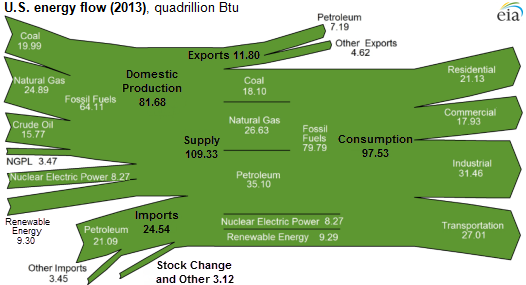
Total U.S. energy production reached 81.7 quadrillion British thermal units (quads) in 2013, enough to satisfy 84% of total U.S. energy demand, which totaled 97.5 quads. Natural gas was the largest domestically produced energy resource for the third year in a row and, together with the other fossil fuels (coal, crude oil, and hydrocarbon gas liquids), accounted for more than three quarters of U.S. energy production. In total, the United States consumed 97.5 quads of energy, 82% of which was fossil fuels. Renewable and nuclear energy made up 10% and 8%, respectively, of U.S. energy consumption.
The portion of U.S. energy consumption supplied by domestic production has been increasing since 2005, when it was at its historical low point (69%). Since 2005, production of domestic resources, particularly natural gas and crude oil, has been increasing as a result of the application of technologies that can develop harder-to-produce resources. At the same time, reduced road travel, improved vehicle efficiency, and competition among fuels for electric power generation have limited consumption of petroleum and coal.
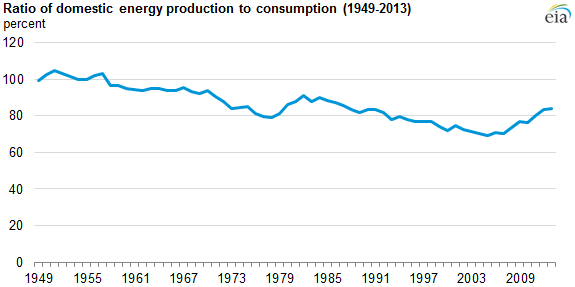
The last significant rise in the ratio of domestic production to consumption occurred from 1978 to 1982. During that period, oil consumption declined in response to higher prices and changing policies, and production rose as oil started to flow from Alaska’s North Slope. At the same time, domestic coal production was increasing.
7 Comments on "Domestic Production Satisfies 84% of Total U.S. Energy Demand in 2013"
sunweb on Fri, 6th Jun 2014 7:52 am
At what cost to the future of the climate, water supplies, environmental degradation and seismic stability?
tahoe1780 on Fri, 6th Jun 2014 11:25 am
“has been increasing as a result of the application of technologies that can develop harder-to-produce resources”.
What the captain meant to say is: “has been increasing as a result of the (pricing of oil 5x higher than in recent years to cover the costs) of the application of (previously prohibitively expensive)technologies that can develop harder-to-produce resources.”
J-Gav on Fri, 6th Jun 2014 12:55 pm
“Renewable” up to 10% of the mix, that’s notable! It might even reach 20% someday, before collapse threatens that infrastructure just like much of the rest. There’s not even one generation left before we’ll be seeing the results of our folly in spades.
Davy, Hermann, MO on Fri, 6th Jun 2014 1:11 pm
We are currently in a short lived AltE renaissance. What you see now is about all that is going to happen. We may see 3 more years of significant growth then poof…done. The vital ingredients of capex and energy will be compressed enough to limit most new AltE investments as well as new and expensive FF investment. We will be relying on what is left of the oil field giants, coal supplies, gas supplies and built out energy infrastructure hydro/AltE/NUK. It will come down to a period of entropic decay and probably a short period because globalism cannot survive long without growth whether real or fake.
Makati1 on Sat, 7th Jun 2014 3:29 am
The US will be energy independent when it uses about 20% of what it uses today. Think of the decline in the standard of living that will entail. The Ps manages fine on about 8% of American energy use per capita.
Davy, Hermann, MO on Sat, 7th Jun 2014 6:59 am
The P’s are an Island that is vast ecological decline and a disaster in the waiting. Climate change is in its cross hairs with country destroying typhoons. The Ocean around the P’s is a dead zone and picked clean. The cities of the P’s are mega slums. The people of the P’s are great people and unfortunately were influenced by multiple other peoples and exploited. The Catholic Church population policies are a significant reason for this overpopulation. This overpopulation, overshoot of carrying capacity, and ecological destruction will mean the P’s will be one of the 1st failed states in the coming decent. Sorry Mak, poor decision.
Kenz300 on Sat, 7th Jun 2014 8:39 am
Domestic wind and solar can provide local energy and local jobs……
We Could Power All 50 States With Wind, Solar and Hydro Washington’s Blog
http://www.washingtonsblog.com/2014/03/solar-wind-mix-baseload.html