
Peak Oil is You

Donate Bitcoins ;-) or Paypal :-)


Page added on January 21, 2016

“Death Knell” For Peak Oil? Not So Fast!
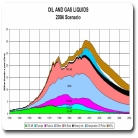
It is easy to understand why some folks, including the nattering nabobs of the mainstream media, might somehow mistake the current glut of oil for evidence that Peak Oil is fiction or never existed at all. This would be a tragic error but as we see in today’s Denver Post editorial (‘The Death Knell for Peak Oil’, p. 19A) it is definitely being made.
The Post’s editor gushes that the “world is now awash in oil“- with Iran set to add its millions of barrels next, and in effect:
“It’s as if the whole world were conspiring to bury the tattered remains of the ‘peak oil’ thesis so popular a few years ago.”
Nowhere in his misplaced screed, not in one single paragraph, does this genius tie the consistently low economic growth rates in the advanced nations to the reduction of oil’s efficiency. This is a result of having used up all the best quality oil and now going for the ‘leftovers’. As I pointed out to wifey this a.m.: “The moron doesn’t even realize the shale oil we’re pulling out of the ground is the next thing to garbage, which in fact proves the peak oil primary contention.”
Yet the Post editor, blinded by BS, actually praises the fracked crap – devastating Colorado’s landscape, air and water, btw – as he merrily goes on:
“Little did the peak oil theorists – who insisted the planet was running out of oil- realize the shale oil revolution in the U.S. – already under way-was about to push domestic production to unforeseen heights”
First, peak oil “theorists” – like Richard Heinberg (‘The Party’s Over’) never said the world was “running out of oil”. What they said is that the planet is running out of the highly efficient, high grade cheap oil (light sweet crude in particular) that is capable of driving the intense energy demands of industrial societies – from glass factories to military hardware and jet planes. Obviously, this point is too subtle for the editor at the Post to seemingly grasp. But let’s try again to break it down for him – and others.
The planet was originally endowed with ~ 3,000 billion barrels of oil – of which we’ve consumed one third and another one sixth of relatively cheap oil remains. Afterwards (say by 2030) there will reside another third of “break-even” oil (costs as much to access as it delivers), after which one -sixth of very expensive oil remains (costs much more to reach it than it delivers in energy). At the heart of these considerations is the net energy eqn. (cf. Weisz, in Physics Today, July, 2004, p. 51)
Q (net) = Q (PR) – [Q (op) + E/T]
In effect, for break-even oil one would find Q(net) = 0
For the last 700 billion barrels: Q(net) = negative quantity = – Q
Since the rate of energy production (Q (PR) must be debited by the energy consumed for its operation Q(op), and the energy E invested during its “lifetime” T. Thus its Q(PR) will be small in relation to the bracketed quantity. In a similar vein, Richard Heinberg uses the quantity EROEI or ‘Energy returned on energy invested’ which for oil reached a high of 30 (ratio) in the 70s and is still the highest of all energy sources at around 22. Thus, the problem in a nutshell is not “running out of oil’ per se but running out of CHEAP oil.
Right now, to fix ideas, we are very nearly at this Q(net) = 0 level with shale oil – which is why once its price falls to much lower than $50 /bl. it makes little economic sense to take it out of the ground. Compared to light sweet crude it is effectively garbage fuel. Bottom line, we need not run out of the stuff before the world economy runs into problems of untold, unspeakable proportions! We already have ample economic indicators showing the signs.
Alas, fracking shale oil – drilling into shale rock to get kerogen, or alternatively, natural gas, is in fact evidence of grabbing BREAK EVEN oil NOT high EROEI oil! It is a sign of defeat and desperation. not success – just like deep sea drilling for oil.
As Richard Heinberg explains (p. 110) it in his book, ‘Snake Oil: How Fracking’s False Promise Imperils Our Future’:
“No evidence suggests that the technology of fracking has actually raised the EROEI for natural gas production. It temporarily lowered prices but only by glutting the market.”
Get that? Adding it to the total world pool of higher quality oil merely “glutted the market”. This is also what’s dragging your 401k down right now, though yeah, you will catch kind of a break at the pump. Let’s also grasp that this crap oil isn’t even used here in the U.S. it’s shipped off to places like China – where it fouls their skies and creates health havoc along with the CO2 and SO2 from factories and autos.
Also (ibid.) :
“A study of the EROEI for electrical heating of methane hydrate deposits between 1000 and 1500 meters deep yielded ratios from 2:1 up to 5:1, depending on the source of the electricity“
Regarding the promises for kerogen or oil shale, he writes:
“Kerogen is not oil. It is better thought of as an oil precursor that was insufficiently cooked by geologic processes. If we want to turn it into oil, we have to finish the process nature started: that involves heating the kerogen to a high temperature for a long time. And that in turn takes energy- lots of it, whether supplied by hydroelectricity, nuclear power plants, natural gas, or the kerogen itself.
Therefore the EROEI in processing oil shale is bound to be pitifully low. According to the best study to date, by Cutler Cleveland and Peter O’Connor, the EROEI for oil shale production would be about 2:1. That tells us that oil from kerogen will be far more expensive than regular crude oil.”
In other words, conflating oil shale (kerogen) with actual light crude oil of high EROEI is like mixing up cow turds with cow’s (calves’) liver. One can be eaten, the other can’t – and for the oil – one requires additional energy inputs to put to use, the other only refining.
These are crucial points to process, but the Post editor never does as he goes on to cavil about “peak oil handwringing”. The guy would be better served having studied the issue in more depth before putting out an editorial. In particular, that Heinberg’s numbers and projections are reinforced by sound sources such as the London-based brokerage firm Tullet Prebon, whose Strategic Insight report declares:
“Our calculated EROEIs both for 1990 (40:1) and for 2010 (17:1) are reasonably close to the numbers cited for those years by Andrew Lees. For 2020, our projected EROEI of 11.5 to 1 is not as catastrophic as 5: 1 but would nevertheless mean that the share of GDP absorbed by energy costs would have escalated to 9.6% from about 6.7% today. Our projections further suggest energy costs would absorb as much as 15% of GDP (at an EROEI of 7.7 to 1) by 2030.”
The Report goes on to note that the “diminishing dismal energy returns” (and again one needs to separate Q(PR) from Q(net)) means that “the economy we have known for two centuries will cease to become viable at some point.”
We are already seeing the initial signs in the entrenched low growth (barely 2 percent) confounding the nation’s politicos and economists who – up to now – haven’t tied this to the degraded oil slopping around the world..
Stop and think – and read – before you buy into the bullshit that cheap oil prices (or an “oil glut”) mean Peak Oil is or was a myth. And should you disbelieve it, then take note of this forecast from yours truly: as high quality, efficient oil becomes ever scarcer, look for returns on investments to sink ever lower and the world economy to ‘bottom out’ with growth barely 1 percent per year. Look also for common goods including food to become ever more expensive since oil is the fuel needed to produce it, as well as transport it. Not to mention the water resources consumed as well.
Oh, and look for your energy bill – relatively low now – to go through the freaking ceiling when shale is exposed for the snake oil it is..
14 Comments on "“Death Knell” For Peak Oil? Not So Fast!"
pennsyguy on Thu, 21st Jan 2016 7:40 pm
The article makes some worthwhile points. To properly evaluate energy resources physics is much more important than economics or wishful thinking. At least to me.
Rick Bronson on Thu, 21st Jan 2016 7:43 pm
Natural Gas Liquids, Bitumen and Bio-fuels cannot be classified as oil.
In Oman, they are going to use Solar heat to thin the heavy oil and pump it out. So this way, Solar power also acts as input for Oil.
paulo1 on Thu, 21st Jan 2016 9:30 pm
He who laughs last…and all that. Be patient, Grasshopper. It’s coming soon enough.
Hello on Fri, 22nd Jan 2016 5:29 am
>>> the consistently low economic growth rates in the advanced nations to the reduction of oil’s efficiency
Another dude that has no idea about EROEI and how it don’t matter much.
Cloud9 on Fri, 22nd Jan 2016 8:41 am
Hello, if would not be an imposition, please explain to me how EROEI doesn’t matter.
rockman on Fri, 22nd Jan 2016 9:25 am
He was sounding reasonable until he drops this bullsh*t: ““The moron doesn’t even realize the shale oil we’re pulling out of the ground is the next thing to garbage, which in fact proves the peak oil primary contention.” First, the PO concept has nothing to do with the quality of the hydrocarbons we produce…just the volume. Second, that “garbage” has allowed the US to greatly reduce its import of oil from the Middle East. IOW those $billions are now going into US companies/investors/shareholders instead of foreign govts. The surge in shale production has allowed our refineries to stop IMPORTING light oil to blend with our heavy oil and begin exporting some of that light oil. And the 130 MILLION BBLS PER YEAR of that garbage we’ve been exporting to Alberta has allowed them to ship about 500 million bbls of oil sands production to the US. Production that in part explains the current low prices. Low prices that are today saving US oil buyers about $400 billion per year. So thank you “garbage”. lol.
Cloud – Here you go. First, I’ll assume what matters to you is how much oil is produced and at what price. If so then what would also matter to you is how many wells the oil patch drills to find new oil as well as continuing to produce existing wells. Both decisions are based on economic considerations…not EROEI considerations. No decision to drill a well has ever been based directly on EROEI. Of course there is a slight relationship to drilling economics and EROEI but that doesn’t impact the decisions.
In general and EROEI of a drilling prospect is difficult to fall much below 5 or 6 before the economic analysis will kill the project. As I’ve mentioned many times before the direct energy input in drilling a well is much less than most understand: usually just 5% to 10% of the total wells cost. On the production side it’s much more lopsided: 2% or less. Here’s an extreme example: You burn 1 million Btu’s to create 0.8 million Btu’s of refinery product. Pretty bad EROEI, right? But the Btu’s you burn cost you $10 million and you sell the refinery products for $15 million. The refiner isn’t in business to produce more Btu’s then he consumes: he’s in business to convert low value Btu’s into higher value Btu’s. Take yourself as an example: let’s assume you drive to work and burn X Btu’s in the process. Does your personal work generate more Btu’s then you burn driving to work? Depending on what you do for a living probably not. Obviously the Rockman does: his EROEI is in the hundreds if not thousands if measured against is motor fuel consumption and how much oil/NG he produces. But you wouldn’t quit your job because of your dismal EROEI, would you? OTOH if your motor fuel bill exceeded your income from your job you would quite tomorrow, wouldn’t you? So your personal EROEI is judged no differently than that of a company’s decision to drill a well.
JuanP on Fri, 22nd Jan 2016 9:56 am
This is not a well written or thought out article. The guy is all over the place, first he is talking about shale oil, then about methane hydrates, and finally about oil shale without explaining the differences between them. Most people would find this a very confusing to read and hard to understand article. I wonder if it was written to sow confusion or if the writer is confused, it does seem to serve some agenda or goal other than to provide info and clear things up.
Hello on Fri, 22nd Jan 2016 10:31 am
Cloud9: Thanks for asking.
It’s Money returned on money invested, that actually matters. This is very similar to EROEI and to a certain degree they are connected, but there are important differences.
For example, oil has a higher usability value per kWh than sunlight. It might therefore be feasible to invest a large amount of sunpower to extract and process oil at a EROEI factor < 1.
Other example: Oil extraction can still be beneficial even at EROEI a little above 1, as long as a LARGE amount of the energy is expended in the supporting industry including providing jobs, etc.
jjhman on Fri, 22nd Jan 2016 12:24 pm
I was going to comment on the “gargbage oil” notion but Rock beat me to it. OK, he knows a lot more about oil than I do so it’s better said by him than me. That one line was so wrong it ruined the whole article for me.
Because I don’t know where else to post it here’s a link to a Bloomberg article about KSA:
http://www.bloomberg.com/news/articles/2016-01-22/u-s-is-hiding-treasury-bond-data-that-s-suddenly-become-crucial
It’s mostly about the movement of treasury bonds in and out of Saudi but the article mentions something I’ve noticed before but never paid much attention to, that is that KSA is seriously talking about selling a stake in Aramco. The interesting question is why they would be doing that unless they thought the money in hand would be worth more than the oil in the ground. Is Ghawar starting to buckle, finally?
joe on Fri, 22nd Jan 2016 2:50 pm
Without tight oil, we’re AT peak oil. Tight oil is of course less efficient, but we have the benefit of fiat currency to monetize the gaps between cost of production and inflation targets. The FED ECB et al, are now the biggest players in the stock market, without direct manipulation by government and it’s owners, we would not be talking about a glut, we would be talking about a global oil supply crisis and a recession beyond anything we ever imagined.
Tight oil literally saves the world from itself. Government is covering the risk that private capital would never carry. Would private capital have funded a glut knowing that it would destroy the markets when commodity prices collapsed? No, but they would get into a market if money is cheap and uncle Sam is picking up the tab. EROI is fairly less important in economic terms because greed is also a motivation, we call that ‘utility’, oil at glut proportions but with low risk actually encourages poor and inefficiency behaviours, just like wasps just before Autumn arrives greedily eating sugar piles when meat is more scarce, they become delerious and drunk, stinging everything around, people are the same, accepting cheap and easy fuels when the better ones are used up, regardless of how drunk we get, because our instinct tells us we need it, to survive. Peak did arrive, and we dealt with by turning to the best of the tight sources, and that has left us with wobbly markets and/or empty pockets. The days of everyone wins and growth is certain are over, that much was made sure in 07.
https://www.google.ie/search?q=conventional+oil+supply&prmd=niv&source=lnms&tbm=isch&sa=X&ved=0ahUKEwiU_MOPpb7KAhXFqR4KHZiNBoEQ_AUICCgC
Nony on Fri, 22nd Jan 2016 5:32 pm
Bakken crude has a similar assay to WTI and gets similar pricing (at refinery door). It’s very high quality oil actually. Gets higher prices than heavier grades of oil.
Peakers are just whining because they got their asses kicked on all the peak oil predictions (first volume, then price). Well…eat it. TOD closed from embarrassment.
https://www.youtube.com/watch?v=VIXOOwthtaE
Boat on Fri, 22nd Jan 2016 6:04 pm
Nony,
One of many facts that are easy to find and validate. Except zero unhinged hasn’t reported that yet. RT won’t touch it. Wonder why.
This is one of many reasons I scratch my head at our resident PHD and his reasoning.
Apneaman on Fri, 22nd Jan 2016 6:18 pm
Nony, all the TOD people seem to be doing just fine in their new endeavours – unlike you, most of them have their own websites with many loyal followers, have their work picked up by other sites and are in demand for speaking engagements and interviews. What have you moved onto in that time? Nothing, except you’re even more bitter and angry. fuctard and nutter – you even lack the imagination to come up with any new slander and put downs. Nate Hagens even went and earned another degree. I bet you have not even gotten a sock puppet raise since you started.
GregT on Fri, 22nd Jan 2016 10:14 pm
“This is one of many reasons I scratch my head at our resident PHD and his reasoning.”
One reason of many for sure Boat, but the biggest reason of all, is the fact that you are incapable of understanding what he is talking about.
You are without a doubt the dumbest person on this forum, and you continue to call down people that in comparison to you, are absolutely brilliant.
Wonder why? Brain damage perhaps?