
Peak Oil is You

Donate Bitcoins ;-) or Paypal :-)


Page added on June 2, 2016

Consumerism, Collective Psychopathology, Waste

The Power Elite on Display – the economics of Thorsten Veblen
In 1899 the maverick economist Thorsten Veblen portrayed the power elite of his day in The Theory of the Leisure Class. What he described were extrinsic motivations at work. Success for the business elite was demonstrated through conspicuous consumption, by which he meant display to achieve social status, power and authority:
This growth of punctilious discrimination as to qualitative excellence in eating, drinking, etc. presently affects not only the manner of life, but also the training and intellectual activity of the gentleman of leisure. He is no longer simply the successful, aggressive male — the man of strength, resource, and intrepidity. In order to avoid stultification he must also cultivate his tastes, for it now becomes incumbent on him to discriminate with some nicety between the noble and the ignoble in consumable goods. He becomes a connoisseur in creditable viands of various degrees of merit, in manly beverages and trinkets, in seemly apparel and architecture, in weapons, games, dancers, and the narcotics.
This cultivation of aesthetic faculty requires time and application, and the demands made upon the gentleman in this direction therefore tend to change his life of leisure into a more or less arduous application to the business of learning how to live a life of ostensible leisure in a becoming way. Closely related to the requirement that the gentleman must consume freely and of the right kind of goods, there is the requirement that he must know how to consume them in a seemly manner. His life of leisure must be conducted in due form. Hence arise good manners in the way pointed out in an earlier chapter. High-bred manners and ways of living are items of conformity to the norm of conspicuous leisure and conspicuous consumption.
(Veblen, 1899)
Plus ca change… Contemporary narcissism of this type is visible in the “How to Spend it” weekend supplements of the London Financial Times. Students of narcissism will find the column “Diary of a Somebody” particularly educational. This celebrates people with the message that you will not be a nobody if you have lots of money to spend and are thus able to hang out with other wealthy (and therefore beautiful) people:
If we are to believe economic theory, these “somebodies” are “maximising their utility”. However the word “utility” is an empty concept – it is not information rich in the sense that it does not explain why people of this sort get utility by showing off and profiling themselves in front of all the nobodies. This was a point that Thorsten Veblen made in an essay written in 1909. The idea of marginal utility simply does not tell you very much that can help us understand people like this. (Veblen, The Limitations of Marginal Utility, 1909)
In his essay, Veblen argued that marginal utility theory did have an element of truth in its explanation of people’s actions but that “It deals with this conduct only in so far as it may be construed in rationalistic, teleological terms of calculation and choice.” In their analysis the marginal utility theorists took the institutional framework in which people’s calculations and choices for granted, when it was the very emergence and evolution of the institutional framework, the context, that was the interesting thing. Marginal utility theorists like J. B. Clark were shutting down their exploration and theorisation at the very point at which it scientific inquiry should begin.
It shuts off the inquiry at the point where the modern scientific interest sets in. The institutions in question are no doubt good for their purpose as institutions, but they are not good as premises for a scientific inquiry into the nature, origin, growth, and effects of these institutions and of the mutations which they undergo and which they bring to pass in the community’s scheme of life. (Veblen, 1909)
Marginal utility theory is no help at all if we want to understand where the institutions and practices of a consumer society have come from, how and why they have come into existence and what their consequences are. On the other hand, Veblen’s ideas are helpful, at least as a starting point. This is because he had resources that most economists, in his own time and subsequently, did not and still do not have. Firstly, he was an outsider and no sycophant so was able to view the behaviour of rich and powerful people (and of the poor when they were emulating them) from a standpoint that was uncompromised. Secondly, he had read sufficiently in other social scientific fields. He resorted to sociology, anthropology and psychology without artificially hiving off the subject matter of “economics”. That made him able to recognise that although a market society had its own features that shaped the form in which various social practices took place, many of the features of that society were not fundamentally different from what occurred in supposedly “more primitive” societies. Thus:
Presents and feasts had probably another origin than that of naïve ostentation, but they acquired their utility for this purpose very early, and they have retained that character to the present; so that their utility in this respect has now long been the substantial ground on which these usages rest. Costly entertainments, such as the potlatch or the ball, are peculiarly adapted to serve this end. The competitor with whom the entertainer wishes to institute a comparison is, by this method, made to serve as a means to the end. He consumes vicariously for his host at the same time that he is a witness to the consumption of that excess of good things which his host is unable to dispose of singlehanded, and he is also made to witness his host’s facility in etiquette. (Veblen, The Theory of the Leisure Class, 1899)
Conspicuous consumption and the consumer society
Thus it is that Veblen’s theory of “conspicuous leisure” and of “conspicuous consumption”, whose purpose is to make a status display, provide us with a possible starting point for our understanding. It gives us ideas with which we can start to make sense of the motivations and behaviours apparently underpinning a lot of the actions in a “consumer society”. In a consumer society not only the rich but other strata of society are using consumption goods to profile and project themselves. As in the diary of a somebody, jewels, hair, make-up, i Pad, purple couture dresses and the names in one’s impressive choice of stylists or the beautiful people in one’s guest collection are all a means to an extrinsic end.
To a large extent the end in question is to make a status display – status conscious people are pursuing the acquisition of what are called “positional goods”. These goods signal one’s position in society and depend on relative income. It is the fact that the rich can afford them and others cannot that is on display. If and when poorer people were able to afford a Ferrari then a Ferrari would lose its value for the rich people who first bought them. In that case rich people would pursue another status display. ( Kallis G 2014)
In his article Kallis argues that “..positional consumption is not a personal vice. It is a structural social phenomena to which individuals conform to remain part of the mainstream…..” For Kallis there are risks for those who try to exit the rat race especially if they are from less privileged backgrounds in which case there will be loss of respectability and economic insecurity. What’s more “the system can co-opt its dissidents: even back to the land and “eco-life style choices” by privileged educated and artistical groups can become types of new positional goods”.
Perhaps – but is this too “either-or”? Explaining peoples’ actions through ‘structures’ can be revealing but after a point too much emphasis on the structures within which people act implies this explanation for people’s actions: “The system made me do it”. It removes the idea that individuals make choices. It can tend to the view that regards people as automatons without freedom. As Erich Fromm pointed out, and other psychologists have since confirmed, a market society creates particular personality types, marketing personalities – people who put great store on marketing themselves. However, individuals can come to recognise the features of their own habitual responses – that’s a point of therapy after all. Individuals can and do change and not only in the context of broader “system changes” – one of the tasks at hand is to identify when and under what conditions.
The Helbig society
It must be admitted however that things have moved on from Veblen’s day to make marketing far more prominent – particularly the all-pervasive presence of “brands” which work together with advertising to create what I describe as a “Helbig Society”. That is, a society of technicolour appearance and empty narratives designed to manipulate.
To explain: the term “Potemkin Village” is sometimes used to describe a manufactured appearance, designed to impress, which is a deceptive facade. The phrase refers to a tour of the Crimea and the Ukraine in 1787 by Catherine II of Russia in which it was alleged that her former lover, Prince Grigory Aleksandrovich Potemkin, created pasteboard villages along the bank of the Dnieper River which the monarch was travelling down, with the aim of making an illusory show of prosperity. Recent historical research has shown that this story was largely a slander created by the Saxon envoy to Catherine’s court, Georg von Helbig. The villages therefore ought, with more justice, to be called Helbig Villages.
If the Potemkin Villages of 1787 were a slander, Helbig Villages have existed at other times in history. A number of places designed to deceive are mentioned in the Wikipedia description of “Potemkin Villages”. For example, the Nazi Theresienstadt concentration camp called “the Paradise Ghetto” in World War II was designed as a concentration camp that could be shown to the Red Cross. Apparently attractive, but deceptive and ultimately lethal, with high death rates from malnutrition and contagious diseases, it ultimately served as a way-station to Auschwitz. As is well known, people who arrived at Concentration Camps were sometimes greeted by orchestras playing classical music. An analogous management tool is used today in slaughterhouses. Animals are calmed after a stressful journey before they are put through a process that stimulates their curiosity about what is going to happen just before they are sedated and then slaughtered. If they got upset, the stress hormones would spoil the meat. Or, to put it the other way around – the meat tastes nice to the customers because the animals have been deceived.
Less gruesome, and more like the Helbig Village example, was the PR job done on the town of Enniskillen in Northern Ireland for the G8 Summit in June 2013. Large photographs were put up in the windows of closed shops in the town so as to give the appearance of thriving businesses for visitors driving past them. This has now become a common practice for property companies to cover messy re- development or dereliction. (Wikipedia, Potemkin Village, 2013)
Branding
Deception is ubiquitous in a modern market economy. We might even call a consumer society a Helbig Society. To get a proper sense of the gulf between the illusion and the reality in this kind of economic system we have to delve into the evolution of advertising and of “brands”. In her book No Logo Naomi Klein shows how the economy has moved a long way from when it was about people selling products to other people in markets that were regulated to ensure that prices were fair. By the end of the 19th century and the early 20th century, adverts were about selling innovations. New kinds of products like cars, telephones and electric lights which producers needed to convince people to use. The advertisements were, as Klein explains, rather like product news bulletins. This was to change as a process began of building an image around a particular brand name. Generic goods like sugar, flour, soap and cereal had hitherto been scooped out of barrels by local shopkeepers. These now had names bestowed on them, particularly with a view to evoking a feeling of folksiness and familiarity. Henceforth it was the product brand names – artificial images of imagined personalities – that interfaced between consumer and producer rather than the shopkeeper – Uncle Ben, Dr Brown, the Quaker Oats man…
There were those in the industry who understood that advertising wasn’t just scientific; it was also spiritual. Brands could conjure a feeling – think of Aunt Jemima’s comforting presence – but not only that, entire corporations could themselves embody a meaning of their own. In the early twenties legendary adman Bruce Barton turned General Motors into a metaphor for the American family, “something, personal, warm and human”, while GE was not so much the name of the faceless General Electric Company as, in Barton’s words, “the initials of a friend”. In 1923 Barton said the role of advertising was to help corporations find their soul. The son of a preacher, he drew on his religious upbringing for uplifting messages: “I like to think of advertising as something big, something splendid, something which goes deep down into an institution and gets hold of the soul of it… Institutions have souls, just as men and nations have souls.” he told GM president Pierre du Pont. General Motors ads began to tell stories about the people who drove its cars – the preacher, the pharmacist or the country doctor who, thanks to his trusty GM, arrived “at the bedside of a dying child” just in time “to bring it back to life”. (Klein, 2000, pp. 6-7)
As advertisers evolved their techniques of psychological manipulation, they delved into psychology, anthropology and culture while coming to see themselves as the “philosopher kings” of commercial culture. “It took a while for people managing companies to finally get it. They were not in business to produce stuff, they were in business to sell brands. This meant continuous and increasingly intrusive advertising – the problem being, as one senior ad executive explained, that consumers “are like roaches – you spray them and they get immune after a while”.’ (Klein, 2000, p. 9)
The manufacture of wants – the role of advertisers
One of the few economists to take this on board was John Kenneth Galbraith, whose book The Affluent Society, first published in 1958, argued that, for much of the modern economy, production preceded wants rather than, as economic theory assumes, the other way round.
The even more direct link between production and wants is provided by the institution of modern advertising and salesmanship. These cannot be reconciled with the notion of independently determined desires, for their central function is to create desires – to bring into being wants that previously did not exist. A broad empirical relationship exists between what is spent on the production of consumer goods and what is spent on synthesizing the desires for it. (Galbraith, 2001, p. 34)
Perhaps economists rarely venture into these fields because we can see that advertising, marketing and public relations employ methodologies which are all about shaping preferences and the “methodological individualists” are not interested in how preferences are formed. They are content to assume that people have given preferences and then act rationally on the basis of these preferences in the face of prices and a certain amount of purchasing power. To find out what happens in aggregate the economists simply add together the individual market behaviours.
Such an approach obviously devotes no attention to the way that people influence each other. The very existence of a fashion industry shows that, as well as the efforts that marketing departments work to create collective consumption trends. These marketing approaches actively foster disutility because they “work” by creating dissatisfaction. They seek to put in people’s minds the idea that their intended purchasers cannot live without some new product. They are also intended to be disruptive of relationships because they are based on fostering rival status display.
Sales departments, advertisers and public relations companies do not take people’s preferences as given. They are a big part of the economy and mostly, economists ignore them. The sales departments and the marketers do not use ideas from “utility theory”. They take ideas from group psychological dynamics, crowd psychology and approaches from psychotherapy theory which explores the interplay between human emotion and cognition. We need to do this too in order to understand advertising and PR on its own terms – and hence its usefulness to the people who pay for it, and its ability to influence the political process.
Well-being and marketing
Money is made when people “have to have” products and stay on the treadmill of work, spending and debt. Society functions by advertisers ensuring that people feel uncomfortable, inadequate and bereft unless they have the latest product designed for their peer group which is also an identifiable market segment. That said, if buying a product were to make you satisfied for too long you would not keep on buying it…
So how do the advertisers do this? Often it is by an astute manipulation which forms motivations through the use of stories, rituals, ceremonies and culture. The moral of the stories told by the advertisers is that the audience is lacking in something that possession of the brand will give them. For example, to be attractive, to be in tune with the American grand narrative of rugged individualism, personified by the cowboy, one needs to buy Marlboro cigarettes and participate in the social ritual of smoking them. In contrast with identity in an indigenous society, where people have totem identification with a creature, or a plant, based on deep knowledge and loyalty to part of the natural world, individuals in the consumer society define themselves partly through brand loyalty. The consumer “totems” are the designer labels that fashionistas wear – a sign of their discrimination, knowledge and affluence as consumers.
The implications for psychological well-being are profound. The message of the advertising stories is to convey how products will make us a better and more desirable person – mother, father and lover – which means that we are not good enough as we are now. The insights of Sigmund Freud that people think in emotionally associative ways (cf his therapeutic technique of free association) is hijacked to design the advertising message. Metaphorical allusion portrayed in vivid colour in high definition and on the biggest possible screens attempt to create emotional links between brands and desirable episodes or scenes in personal life stories. Fizzy drinks with sugar in them, are associated with adolescent sexuality in blue jeans. Getting the boy, getting the girl, getting the job, your forthcoming celebrity status, the perfect mum, dependable dad, the happy family – all are associated with a product – perfume or gravy granules… Messages of this type bombard us all with attention-grabbing messages from street billboards, newspapers, magazines, television and cinema commercials, on the internet, on the radio. Over and over again, visual and narrative connections are made between sex, glamour, wealth, power, speed, desirability, happy families, and shiny new products magnified and flashing in front of our eyes, dynamically displayed with clever graphical effects.
Attention grabbing as economic sector
Correspondingly a large part of the economy – its institutions, its technical infrastructure – exists solely for the purpose of grabbing our attention. When we are awake we can only focus on so much during a 24 hour day, a third of which we are asleep and a lot of which we are drilled to attend to employment tasks. At other times advertising agencies, market research companies, public relations companies, publishing companies, theatres, cinemas, television companies, newspapers, internet organisations are all trying to ensure that at every available opportunity, every available surface, every available screen, every available shop window, every available stage, and every broadcast, carries something about their product and/or their message. This is not to mention 9 out of every 10 phone calls on telephone landlines when a complete stranger assumes that they have the right to interrupt whatever you are doing with what they call a “courtesy call” – despite “a service” run by the marketing industry which is supposed to prevent this happening if you don’t want it. (Franck, 1998)
Naturally the more power specific people and specific institutions have, the more this “economy of attention” is skewed in their favour. Rather as the passage of light is bent by powerful gravitational fields, so the “information space” used by a society is buckled to massively magnify the concerns and priorities of the super-rich elite and their hangers on. At the same time rendering virtually invisible and unintelligible the suffering, concerns and needs of the large part of the world’s population. In the information space these people are driven to the edges and almost literally do become “nobodies”.
The nobodies are then only noticed in the crowded messages being transmitted in the information space when they get in the way of elite agendas and/or require expenditure and management because they have become a problem. (For example, because “attention seeking” turns into what is characterised as a mental health issue – mania and depression being opposite emotional reactions to experiencing oneself to be a nobody and being unable to cope with that – excitement at the idea that one is about to become a star as a result of one’s brilliant work and thus, attain celebrity status oscillating with depression as one remains in the wilderness).
These are all properly a subject for economics because there are multiple senses in which the attention seeking assault from the marketing sector impacts negatively on well-being now and in the future. We have already mentioned the way that this vast pantomime is about making its audience feel inadequate. But more than this – there is another economic consequence that Veblen realised over a hundred years ago. A part of his argument was that what the Leisure Class consumed as status displays – and also the way in which many members of the poor tried to emulate them – led to a waste of resources. It is stuff that never needed to be produced and is a waste of the time of the producers, a waste of material and natural resources and a waste of energy. And what Veblen could not have known is that the huge pile of garbage which is still being produced today drains depleting fossil fuel and material resources while exhausting carbon and other kinds of sinks. For no good cause other than the need of the “celebrity class” to be noticed, the planet appears to be locked on the road to destruction.
The Facade
Another way of expressing this is to describe “the economy” as operating with a vast deceptive facade.
I have used the example of Potemkin/Helbig Villages to describe the resulting culture that we live in – a way in which mass psychology is manipulated by a culture of appearances that hide an underlying reality that is much more shoddy. We look at a mass of separate products on the supermarket shelves and see a bright dazzling multi-colour array of images and styles – on the boxes and tins. Yet when it comes down to it, most of them are produced by just ten different business groups. The variety is an illusion – at least when it comes to who owns and produces them. The conservative reassuring man on the Quaker oats packet is owned by Pepsico. Yves Sant Laurent, Diesel (that celebration of fossil fuel) and Giorgio Armani are owned by Nestle, Uncle Ben’s Rice is owned by Mars. (See attached graphic) (Bradford, 2012)
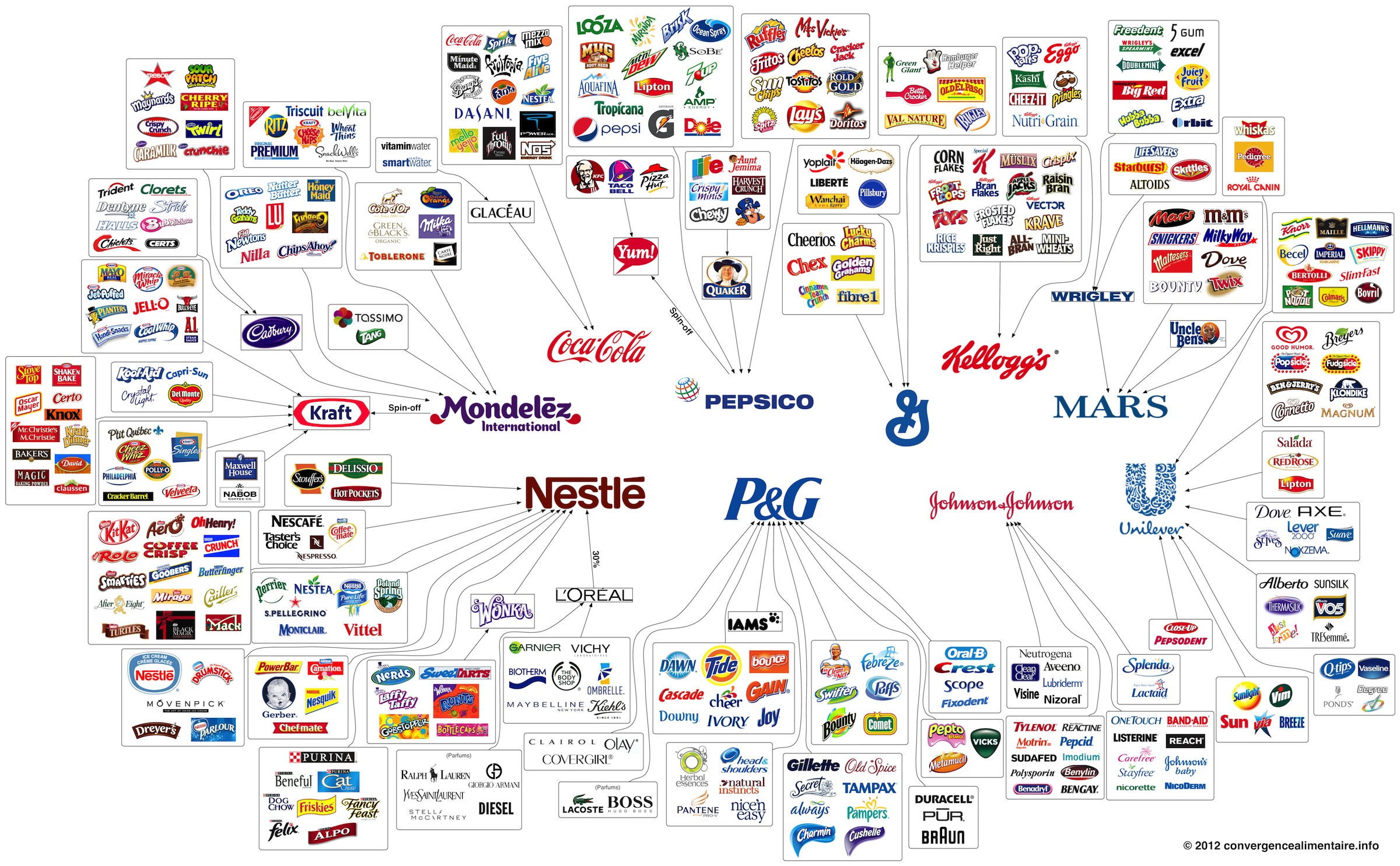
Source: convergence alimentaire, 2012, with permission. Click to access original image
There are many other things hidden by the facade. Why else is such a high proportion of world trade and world finance routed through tax havens and secrecy jurisdiction? Behind the gloss, the cute sentimental products on sale at your local supermarket, there are factories producing the stuff staffed by child and slave labour in unsafe conditions; there are oil spills and air and water contamination; there are greenhouse gas emissions; there is military intimidation of workers and there are mountains and mountains of toxic throw away trash.
In her book Klein describes how the American NBC network aired an investigation into Mattell and Disney just days before Christmas 1996. “With the help of hidden cameras, the reporter showed that children in Indonesia and China were working in virtual slavery “so that children in America can put frilly dresses on America’s favourite doll”. (Klein, 2000, p. 326)
Many other examples can be given between the appearance and the brutal reality. However, if you mock and take on these cuddly friendly folksy corporations you see what they are really like. Like the MacDonald Corporation who tried to ruin activists who took them on with critical leaflets which led to a long running court action in the UK.
Although there is nothing at all glossy and high definition about economics, although it is often tedious and dull, economics is a part of this facade. Too often the descriptions of what is happening stay on the surface. The descriptions of markets are about products not about brands. The fact that branding and advertising are about creating product differentiation makes nonsense of the default assumption in the textbooks that most production is from competitive firms producing homogenous products. Textbooks are still describing a world in which shopkeepers scoop flour, sugar and cereals out of a barrel. Into this barrel the shopkeepers have put the identical products of a large number of producers all of whom were obliged to sell at a going market price. But of course if you go to buy some kind of computer, or a car, or an appliance of some kind there are a bewildering variety of non-comparable products and a barrage of adverts as to the advantages of each. While price plays a role in the choice of a product it is often a minor one.
As regards the huge growth and economic importance of marketing, the textbook writers have little to say. Certainly they do not appear to recognise that the rise and rise of the marketing industry demonstrates that the chief constraints on what companies supply are not production conditions, leading to rising internal costs as companies try to expand. Rather the constraints on firms are external market limits if they try to sell more of their brand beyond their market niche. Pierro Sraffa understood this from as early as the 1920s and wrote a paper to explain his alternative viewpoint. This will be described later. Suffice it to say here, that although Sraffa, and a few others, like Joan Robinson, tried to keep up to date, most economists did not. You don’t update the Holy Scriptures – scriptures are true for all time.
60 Comments on "Consumerism, Collective Psychopathology, Waste"
makati1 on Thu, 2nd Jun 2016 6:54 am
Marketing/Propaganda. Same methods. Same results. Brainwashed Americans from birth. Obvious in the attitudes of even the most intelligent here. “The world is our slave” is wired into every American thought, subconsciously if not openly, discussed. Unfortunately, the Us has infected many other countries with the same disease. Interesting article but nothing new.
Davy on Thu, 2nd Jun 2016 7:24 am
A stable Nature with a higher level ecosystem like we saw before modern man and agriculture is the highest form of life in complexity, diversity, and utilization of solar energy. Modern Man is at the other end of the spectrum. Much of our utilization of solar energy has come from stored energy. Much of our growth has come at the expense of others species pushed out of their niches in a very productive ecosystem. Man is turning out to be an extinction species. In that respect maybe we are playing a role in life as an evolutionary marker event in the process of evolution. Extinction leads to evolution that is if we don’t turn the world into a Venus.
With this understanding then we have to consider modern man as collective psychopathy. We are the problem and our population levels are the problem. Forget the results which such as destructive consumerism, pollution, and a current extinction process. We are the problem and out attitudes and lifestyles. These attitudes and lifestyle are incompatible with a stable global ecosystem “PERIOD”. Don’t sugar coat it and blame it on something else like we can be a good modern man if only we were not hyper consumers. Humans are not good and cannot be good for a stable ecosystem of diverse and complex life. We are what we are and that is an insane species of destructive mammals that destroy everything they touch.
Kenz300 on Thu, 2nd Jun 2016 7:29 am
Too many people……….create too much pollution and demand too many resources….
China made great progress in moving its people out of poverty…….one reason was slowing population growth…..
If you can not provide for yourself you can not provide for a child.
CLIMATE CHANGE, declining fish stocks, droughts, floods, air water and land pollution, poverty, water and food shortages all stem from the worlds worst environmental problem……. OVER POPULATION.
Yet the world adds 80 million more mouths to feed, clothe, house and provide energy and water for every year… this is unsustainable… and is a big part of the Climate Change problem
Birth Control Permanent Methods: Learn About Effectiveness
http://www.emedicinehealth.com/birth_control_permanent_methods/article_em.htm
Revi on Thu, 2nd Jun 2016 7:36 am
A big part of survival in this culture is resisting this brainwashing. Based on what’s happening around here I would say most people are hooked on buying big trucks, taking heroin or other drugs and aren’t able to resist the messages. It’s hard to be an independent person any more. Even us greenies are marketed to incessantly.
makati1 on Thu, 2nd Jun 2016 8:27 am
Revi, that ‘marketing’ is used by the government as much as, if not more than the big corporations. I see the proof right here in PO in the engraved attitudes about certain countries and their leaders. Not too many years ago, these countries/leaders were our partners and we moved our whole production system to their countries because it was to the advantage ($$$) of our masters. Now those same countries refuse to bow before those same elites and suddenly, those countries are devils incarnate and the whole propaganda machine is turned on to brainwash the American sheeple to believe it. Many do, as can be seen by the comments here.
The sooner the empire is taken down, the better for the rest of the world.
Sissyfuss on Thu, 2nd Jun 2016 8:53 am
Mak-n-cheese, we Americans didn’t invent the Maximum Power Principle, we are just the first to embrace it. The rest of the world emulates us because they see the ease and plenty our lifestyle brings us. The problems lay in overshoot, limits to growth, and the many forms of pollution and ecodestuction. Perhaps all we are is a failed experiment conjured up by the bored gods that power the mysteries of the Universe.
makati1 on Thu, 2nd Jun 2016 8:57 am
Sissy, could be. If so, they are laughing their asses off at our stupidity.
Davy on Thu, 2nd Jun 2016 8:59 am
SissyFuss, Makati Bill lives in an illusion that problems are only American. How would he know living in his Makati high rise? Talk about being detached from reality. It doesn’t get worse than that in our modern world. Makati is a low budget equivalent to Wall Street in the middle of 20MIL people. That fact disqualifies him from rational thinking.
Davy on Thu, 2nd Jun 2016 9:38 am
“Mafia Expert Calls Great Britain The “Most Corrupt Place On Earth”
http://libertyblitzkrieg.com/2016/06/01/mafia-expert-calls-great-britain-the-most-corrupt-place-on-earth/
“The City is a semi-offshore state, a bit like the UK’s crown dependencies and overseas territories, tax havens legitimized by the Privy Council. Britain’s financial secrecy undermines the tax base while providing a conduit into the legal economy for gangsters, kleptocrats and drug barons.”
“Even the more orthodox financial institutions deploy a succession of scandalous practices: pension mis-selling, endowment mortgage fraud, the payment protection insurance con, Libor rigging. A former minister in the last government, Lord Green, ran HSBC while it engaged in money laundering for drug gangs, systematic tax evasion and the provision of services to Saudi and Bangladeshi banks linked to the financing of terrorists. Sometimes the UK looks to me like an ever so civilised mafia state.”
J-Gav on Thu, 2nd Jun 2016 9:45 am
“Collective psycho-pathology” is right on target.
Most articles concerning elites and marketing begin with Freud’s nephew, Edward Bernays, then, if they’re extra-ambitious, go on to Ivy Lee before describing our massive present-day propaganda machinery.
Interestingly, this article starts with almost-forgotten Thorstein Veblen and also provides a good reminder from J.K. Galbraith. Nice to read a somewhat different approach to the subject.
J-Gav on Thu, 2nd Jun 2016 9:55 am
Davy – Yes, that would be Roberto Saviano I believe. Saying, entre autre, that people think ‘3rd world’ countries are the most corrupt on the planet. But for him, it’s the U.K. (exemplified by the City of London). The difference being that in the ‘3rd world’ courruption is conspicuous and in-your-face while in the West, it’s carefully hidden behind heavily guarded gates or offshore.
However, the U.S. might be next in line for the title. It’s a bitch being n°2, ain’t it?
Boat on Thu, 2nd Jun 2016 11:49 am
Most of us have limited capital. In spite of all the marketing most of us use reasoning knowing there are trade offs. If I buy this I won’t be able to buy that. Even as a kid I had to drop Dr Pepper If I wanted that balsa wood rubber band powered airplane. Now which product had mass advertising.
Apneaman on Thu, 2nd Jun 2016 12:24 pm
Boat, your personal anecdote, although adorable, was what?…over 50 years ago when you were a child? Not exactly the “scientific method” now is it?
I remember the rubberband airplanes, which they did not
need to market because they put them right next to the candy and Dr Pepper in every damn corner/convenience store in N America so the boys couldn’t miss seeing them.
You are also leaving out the one major thing that most consumers have now that they did not have 50 years ago – credit up the ass, so no trade off necessary. Get now. Pay later…..for life. They even aggressively market credit cards to college students on campus to go with the studen loan debt – hook em young.
Show us all this evidence for this “use of reasoning” in the consumer. I’d love to see that – lmao
Why We Overspend With Credit
Both emotional and cognitive forces stimulate overspending with credit.
Posted Jun 22, 2013
https://www.psychologytoday.com/blog/retail-therapy/201306/why-we-overspend-credit
Boat on Thu, 2nd Jun 2016 1:16 pm
ape,
The posters on this think they are smart enough overcome the spin of msm. Your saying all of them including yourself just have to buy shyt without thinking because you’ve been brain washed from birth?
Plantagenet on Thu, 2nd Jun 2016 1:40 pm
I think everyone should just stop buying all the junk and live more simply.
Think of all the time and money we’d save, and we’d be happier too.
Personally, I don’t buy much stuff, I own a 26 year old Toyota Landcruiser, and I motorcycle and bicycle to most things to save energy.
Of course, I admit to taking the occasional trip to Europe, Africa and Asia, but nobody’s perfect.
Cheers!
Apneaman on Thu, 2nd Jun 2016 1:45 pm
Is that what I’m trying to say boat? Really? Or is that you trying to rescue yourself in a lame sassed attempt to redefine my argument by trying to make it look like I’m insulting the “posters”?
Are you still not aware when you get desperate you make an even bigger fool of yourself than your initial argument indicated?
Apparently not.
Boat why are you insulting the other posters with your kindergarten logic? Do you not think they are smart (whatever that word means) enough to see through your feeble and pathetic rhetorical tricks?
OMG they all must be so insulted!!
Boat on Thu, 2nd Jun 2016 2:00 pm
ape,
Answer the question. If you can’t maybe you will realize how dumb ass your assertions about msm and people’s ability to reason are.
Apneaman on Thu, 2nd Jun 2016 2:30 pm
There was no real question Boat.
Apneaman on Thu, 2nd Jun 2016 2:52 pm
Boat, when you suck cock do you spit or swallow?
Answer the question. Spit or swallow?
Apneaman on Thu, 2nd Jun 2016 2:55 pm
Boat, how do you explain record debt levels from federal, to states and provinces to counties and municipalities to cities and towns to business and household and personal?
They not out of control? Just poor at math?
You’re fucking ridiculous, boy.
http://www.usdebtclock.org/
2015 American Household Credit Card Debt Study
Total owed by average U.S. household carrying this type of debt Total debt owed by U.S. consumers
Mortgages $168,614 $8.25 trillion
Auto loans $27,141 $1.06 trillion
Student loans $48,172 $1.23 trillion
Any type of debt $130,922 $12.12 trillion
https://www.nerdwallet.com/blog/credit-card-data/average-credit-card-debt-household/
Canadian household debt soars to yet another record
“Statistics Canada reported Friday that the ratio of household credit-market debt to disposable income, the key measure of the debt load, rose to 165.4 per cent in the final quarter of the year, eclipsing the upwardly revised previous record of 164.5 per cent in the third quarter. That means that at the end of the year, households held more than $1.65 in debt for every dollar of annual disposable income.”
http://www.theglobeandmail.com/report-on-business/economy/canadians-debt-burden-still-growing-hits-record-in-fourth-quarter/article29172712/
Boat ask the other “posters” if they think that the majority of society/people are out of control consumer zombies or if it’s just a couple of pigs who are skewing the numbers.
HARM on Thu, 2nd Jun 2016 3:12 pm
“The world is our slave” is wired into every American thought, subconsciously if not openly, discussed. Unfortunately, the Us has infected many other countries with the same disease.
This is hardly an American only phenomenon. This is the default mindset of *every* empire and ruling class past, present and future. The ancient Romans regarded themselves as superior to all other “barbarian” nations. As did the ancient Persians. As did the ancient Athenians. As did the ancient Egyptians. As did (and still do) the Chinese. As did (and still do) the Japanese. As did the pre-war Germans (though they seemed to have learned a thing or two about that since).
There is nothing uniquely American about the tendency to self-glorify and to demonize everyone else who is not part of “our” tribe.
Boat on Thu, 2nd Jun 2016 4:04 pm
ape,
You blame debt on msm? Are our posters smarter than msm and have no debt?
Boat on Thu, 2nd Jun 2016 4:14 pm
My point is not all debt is bad and much debt is just a decision made by circumstance. You and some your anti this and that idiot friends over blow the circumstance and live in fear and blame.
Sissyfuss on Thu, 2nd Jun 2016 4:54 pm
Boat, I’m not much of a consumer and everything I own is paid for; cars, house, huge penile implant. Debt slavery is for the sheeple.
Apneaman on Thu, 2nd Jun 2016 5:07 pm
Hey, Sissyfuss! I got a huge penile implant too. I don’t actually need one (yet?), but I believe in being totally prepared for collapse. Top men will be needed to help repopulate the earth after the 99.999% die back. Just imagine a whole country comprised of my offspring – thousands of little apneamen building a new and “different” society……Ahhh…Paradise.
Apneaman on Thu, 2nd Jun 2016 5:08 pm
Is America on the brink?
“Published on Apr 19, 2016
Prof. Jerry Kroth, a psychologist, looks at that question differently that financial pundits and stock market gurus. Instead he looks through the prism of social science. Using anthropologist, Jared Diamond and historian Arnold Toynbee’s seven major factors leading to societal collapse, Kroth asks how the U.S. stacks up on those seven factors. The report card is awful, and the current situation foreboding to the extreme. Data comes from his new book, Implosion: delusion, denial, and the prospect of collapse More info at collectivepsych.com”
https://www.youtube.com/watch?v=mwhh7xBj-Cg&feature=share
makati1 on Thu, 2nd Jun 2016 6:29 pm
HARM,but only the Western countries and their wannabees, led by the Us, are sinkholes of personal debt.
Ask any Filipino if he has a credit card and 90% will say NO. Ask them if they have a bank account and most will say NO. Go to ANY 3rd world country and the majority live without debt.
Even I, an American, live without debt and have for 15 years. ZERO credit cards or loans. It CAN be done, but it means resisting the MSM advertising/brainwashing/propaganda 24/7/365.
Most Americans cannot/don’t want to resist and are about to join the 3rd world in more ways than they care to think about.
GregT on Thu, 2nd Jun 2016 6:41 pm
Boat,
Zero debt here as well. Other than a mortgage (long since paid off), and month to month credit card statements (always paid off), I have not had any debt since I was in my twenties. After taking communications and media courses way back when, I can no longer watch TV. It used to make me laugh, now it just insults my intelligence and pisses me off.
I completely agree with Sissy. Debt slavery is for sheeple.
Davy on Thu, 2nd Jun 2016 6:52 pm
Obviously some dumbasses here concerning debt. To treat debt as bad out of hand shows we have some people here that never owned a business. We have people here that do not have a clue about financial realities but they pretend to. Debt is not bad in and of itself it is the extremes of debt that are the problem. Having no debt can be an extreme also depending on your situation and what you are planning on doing with your talents. I am not impressed with someone who says they have no debt so what. What is your net worth after all is said and done. What is your age and where are you going in life. There is some friggen warped mentalities on this board pushing agendas.
onlooker on Thu, 2nd Jun 2016 7:16 pm
The whose consumerism industrial civilization paradigm at this point gets me sick to my stomach. It is absolutely true that our psyche has been manipulated to respond to cues of entertainment, eating etc. Pleasure dopamine are the best sellers. And the price? Wanton insatiable greed, destruction, exploitation, war, waste, pathology and on and on. We are Sodom and Gommorra on steroids. And lost in all this disruptions and hoopla and empty facade is our inner peace. My advice to everyone reading this. DISENGAGE.
Apneaman on Thu, 2nd Jun 2016 7:48 pm
Missouri fuck head, the debate, that you were not a part of, was about consumer debt for shit that is not needed so shut the fuck up.
My aren’t we so proud of our alleged business acumen and money eh?
See, you write your bloviating, kumbaya, everyone needs to prep and come together and bla bla bla
ordersprescriptions, but the very second you get the chance to brag about your money and status and put others down, when you imagine they have not accumulate enough to meet your approval you are on it like a fly on shit. You are far and away the biggest phoniest fuck on here. Is that what your dad did Davy? Ride you about earning and accumulating the proper material goodies? Hyper critical rich daddy? Is that why you need to bring it up at every turn and judge everyone based on what you assume they have or have not? Holy fuck, talk about a Jekyll and Hyde personality. From warn N fuzzy collapse advice guru to angry attacking judgmental materialistic rich boy.GregT on Thu, 2nd Jun 2016 7:57 pm
Debt perpetuates exponential growth. Exponential growth is leading our species down the path to extinction. The economy, or the environment, which do you choose? You can’t have your cake and eat it too agenda-boy.
Sissyfuss on Thu, 2nd Jun 2016 8:50 pm
Davy, you once related to me of your fondness for Harbor Springs, MI, a locale boasting of having the most millionaires percapita in the nation at one time, an extremely high rent district. You aren’t a closet one percenter hanging with the canaille, are you?
Boat on Thu, 2nd Jun 2016 8:55 pm
greggiet
I completely agree with Sissy. Debt slavery is for sheeple.
You are not in the position or have the aptitude to decide what is smart for anybody. Your an filled with dreams of conspiracy. I will give you this example for the last time but since you are basically financially illiterate the chances of understanding are slim.
When interests rates are low there are many areas where it is cheaper to own than to rent. More debt may be added for other considerations. Crime, schools, relatives, animals jobs.
The only thing that really matters is the ability to pay.
makati1 on Thu, 2nd Jun 2016 9:22 pm
“The only thing that really matters is the ability to pay.”
RIGHT ON Boat!
How many Americans are really free today? The 1%? Nope. they have nothing of real value. Only pieces of paper, ones and zeros in a system, maybe some land that can be taken by a bank or a bullet. Things of real value? Nope.
Real value:
Love of family and friends.
A balanced education and the ability to think outside the box.
Useful skills that can keep you alive.
Good health without meds, alcohol, drugs, or other psychological crutches.
Understanding of nature and how it affects your ability to live.
Preperations for a possible future you cannot control.
etc.
Wealth does NOT reside in your bank balance or debt. It is living a good life that you can be proud of when that last event happens. Skidding in sideways and shouting: “Wow! That was a hell of a ride!”
Apneaman on Thu, 2nd Jun 2016 9:39 pm
“The only thing that really matters is the ability to pay.”
Public debt of the United States from 1990 to 2016* (in billion U.S. dollars)
This graph shows the outstanding public debt of the United States of America from 1990 to 2016.
In September 2015, the national debt had risen up to 18.15 trillion U.S. dollars.
http://www.statista.com/statistics/187867/public-debt-of-the-united-states-since-1990/
GregT on Thu, 2nd Jun 2016 9:47 pm
“I will give you this example for the last time but since you are basically financially illiterate the chances of understanding are slim.”
I retired at 53 Boat, most likely because I’m not financially ‘literate’, like you are.
GregT on Thu, 2nd Jun 2016 9:55 pm
“The only thing that really matters is the ability to pay.”
Only if you’re in debt. I’m not. So no need to pay.
makati1 on Thu, 2nd Jun 2016 11:23 pm
“New York Times editorial on South China Sea misleading, partial”
“…The editorial misstated and overly exaggerated the fact of the South China Sea being rich in resources, wrote Reynolds, pointing out that the only resource currently being extracted from the region in significant quantities is fish.
Regarding other energy resources like oil and natural gas, the vast majority of their reserves lie outside disputed areas according to the U.S. Energy Information administration, wrote the columnist.
Reynolds acknowledged the argument that the South China Sea is of vital strategic importance because it contains major trade flows is partially correct, but he argued that no party to the territorial disputes believes or suggests that China’s claims pose a threat to peacetime trade….”
http://news.xinhuanet.com/english/2016-06/01/c_135404966.htm
The Us keeps hitting the bear and the dragon with big sticks tying to start a war. The Us may just get it in a way it never expected.
Boat on Fri, 3rd Jun 2016 12:05 am
mak,
In waters claimed by several countries you cannot build an island, put in aircraft runways and expect no response. Since WWII the US has guaranteed allies protection in exchange for no nuclear proliferation. China knew that and built knowing it would cause conflict. Obama does float by’s but Hillary will force a resolution if for nothing else to show the world you can’t push a woman around.
GregT on Fri, 3rd Jun 2016 12:20 am
“Obama does float by’s but Hillary will force a resolution if for nothing else to show the world you can’t push a woman around.”
You’re probably correct Boat, and the outcome would in all likelihood be WW3. A nuclear WW3. I would also imagine that it’s a fairly safe bet that Houston has at least a few crosshairs painted on it.
makati1 on Fri, 3rd Jun 2016 12:44 am
Boat, Hillary is a dyke bitch. She will bring mushroom clouds over your parade if she gets to make the decisions. So cheer her on. I hope you like radiation cancer and no hospitals or meds.
The Us has no business in an area 10,000 miles for it’s country. That is between China and the other countries. I am happy to see that the new Ps Prez is not a US ass kisser. I hope he kicks them out of the Ps asap.
Those islands would not be even in the news if it were not for the Us pushing for a war. And they will get it. And the Us will be radioactive slag.
theedrich on Fri, 3rd Jun 2016 2:02 am
Why all the fuss about Hillary? When the bobble-headed hag surmounts the cockpit, she will show the world just how well she can put evil males in their place. After all, a couple of nukes did that to the Japs in 1945, so why not a much magnified, repeat performance on Chinks in 2017-2020? Libya, Syria and Iraq were only warm-ups for her.
And anyway, the world is overpopulated. Why should she not use the excuse of WW III to accomplish what could otherwise never be done? As Stalin used to say: “Where there is no person, there is no problem.”
Boat on Fri, 3rd Jun 2016 3:19 am
mak,
I am no hawk and never have been. I would never have a troop outside the US unless their deployment was paid 100 percent by the host nation. I believe in our ability to ramp up quickly if needed.
I would use economic power to keep an idiot like Putin in line. If you want to trade with the free world you act like it.
Davy on Fri, 3rd Jun 2016 5:20 am
I reference this esoteric currency view mainly to emphasize how paralyzed the global financial leadership is. The US and China are the dominant economies of the world and they can’t decouple. The one knocks on to the other in what we hear about a lot lately and that is feedback loops, convergences, and contagions. My main point is there will be no end of the dollar as many here like to think. The end will come as all currencies go down the drain in a disorderly fall into a hyperinflationary loss of confidence. IOW global financial collapse.
The speed and timing of this collapse is anyone’s guess but the trend is clear. The Fed and China cannot achieve policy goal because of each other. Both have economically structural problems that must be dealt with but to deal with them causes effects on the other side. More catch 22’s of a world doomed to failure.
“Goldman Unveils The FX Doom Loop: Turns “Outright Negative” On Yuan Due To “Weak Link”
http://www.zerohedge.com/news/2016-06-02/goldman-unveils-fx-doom-loop-turns-outright-negative-yuan-due-weak-link
“Nightmarish Merry Go Round”, dubbed so by Bank of America because of the reflexive, recursive bond – and trap – that has formed between the Fed and markets…… in which neither can break free from the other, and yet each is more dependent on the other than ever, we said that instead of looking at the relationship as one between the Fed and the market, one can further simplify the relationship as one between the USD, a proxy for Fed tightening or easing intentions, and the Chinese Yuan, a proxy for the Chinese economy, capital outflows and general volatility.”
“RMB-FOMC Monetary Policy Loop”……how circular the relationship between central banks and markets”
makati1 on Fri, 3rd Jun 2016 6:01 am
Ah, but Boat. It is obvious that you are still drinking the ant-Putin Koolaid. You probably believe that he invaded the Ukraine and stole Crimea. I can guarantee that if he had, he would have controlled Kiev in less than a week. No problem. And NATO would not have been able to stop him, just like they cannot do anything now except bluster and make useless threats.
Boat on Fri, 3rd Jun 2016 7:14 am
mak,
I am not so much anti Putin. I just think he hurt his country. I wish the best for all countries. I think NATO is still pondering further response. These issues are discussed among many nations.
makati1 on Fri, 3rd Jun 2016 7:31 am
Boat: if you do some real research, you would find that he has saved Russia from the Empire. He is loved by his people to an extent that is the envy of every Western country leader. Your followup comment only proves that you believe the Bullshit that comes out of the US MSM. Too bad.
That belief by Americans could end the world in a war that Americans believe will be started by someone else, when it will be started by the Us. I am not joking about mushroom clouds over American cities. How far do you push a nuclear country before an “accident” happens? There will be no tanks invading Europe. There will be bright flashes followed by lots of mushroom clouds. I lived thru the first Cold War. This one is much hotter already because America’s leaders today are insane.
PracticalMaina on Fri, 3rd Jun 2016 8:10 am
The leaders of NATO and Putin probably get together at some MIC owned paradise in the Alps or something, and drink champagne and talk about how to convince us, with proxy wars and such, that we need to continue the East vs West arms race.
Boat, no real debt to speak of here, thank god I had people with high incomes around me (relative to my area) as a kid and young adult complain to me about debt compiled from living outside of their means. Also trying to sanction Russia has made them much more independent and resilient. They are now more of an agricultural superpower than before.
PracticalMaina on Fri, 3rd Jun 2016 8:13 am
Like I said, Detroit should make something more reasonable and affordable, like the rig I drive around in, 9g new, manual transmission, power nothing, no ac, lighter than 90% of the other vehicles sold that year.
http://www.forbes.com/sites/davidkiley5/2016/06/02/debt-debacle-why-the-average-u-s-household-cant-afford-the-average-new-vehicle/?utm_source=yahoo&utm_medium=partner&utm_campaign=yahootix&partner=yahootix&yptr=yahoo#45142bfb6a6b