




 |
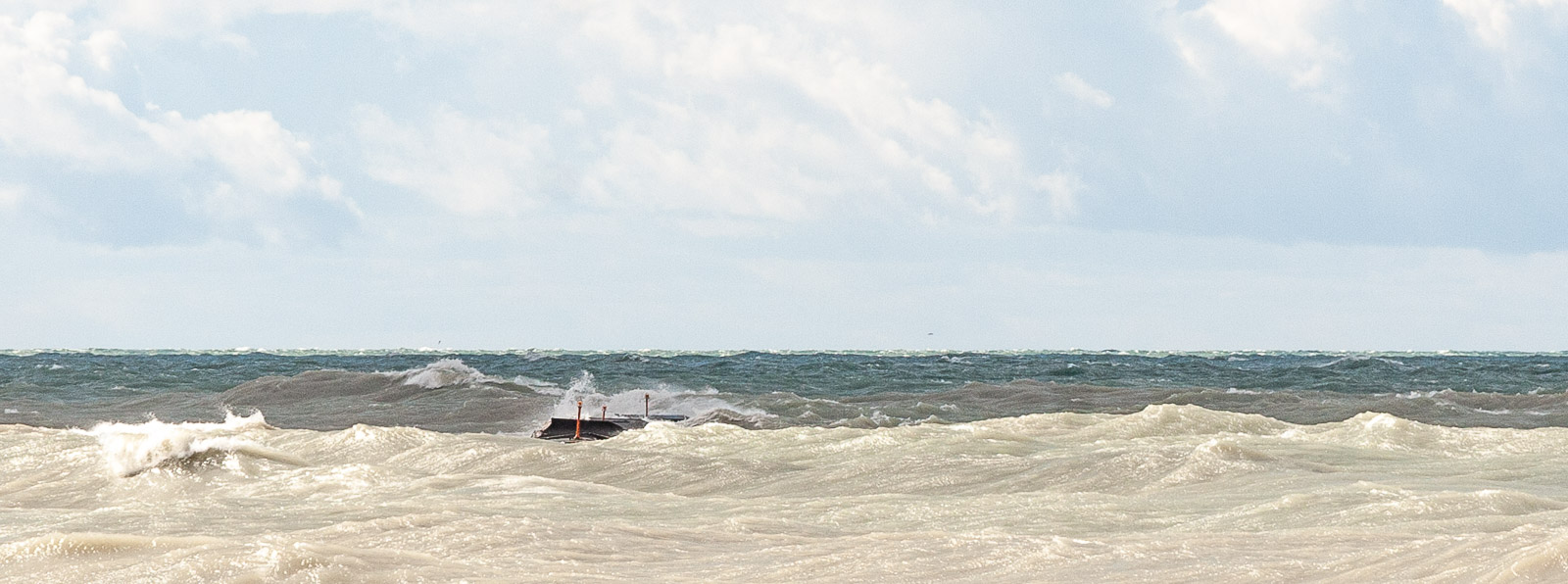
| Kincardine’s breakwall awash in the waves |
This is the second half of a post that I cut in two because it was just too long (6000+ words). If you haven’t read the first half yet, it would be a good idea to do so—what follows will make more sense that way.
That first half finished with a discussion of the problems with fossil fuels as an energy source for our civilization. It’s last paragraph is repeated below. Today, we’ll go on from there, looking at other inputs that are problematical for our civilization.
Energy, renewable sources
But, you may say, if fossil fuels are no good what about renewable energy sources? There are large amounts of energy available from sources like hydro, biomass, wind, solar and so forth. And they don’t involve adding more CO2 to the atmosphere—even biomass is only adding CO2 that was recently taken out of the atmosphere and will be taken out again as more biomass grows. A great many people today believe that renewables can replace fossil fuels and solve both our surplus energy and climate change problems. In fact, it has become very unpopular to challenge that idea, but I am afraid I must do just that.
The problems with switching over to renewable energy sources can be divided into three areas.
- the political will to do so
- the economic means to do so
- the technical feasibility of doing so
Political Will
It is clear that we will have to switch to renewable energy sources if we wish to become sustainable. But it is also clear that, as we’ll see in a moment in the section on technical feasibility, renewable energy sources will not be able to support the level of growth and consumption that many of us are accustomed to, and they certainly won’t be able to extend that level of prosperity to the poorer parts of the world.
For the overwhelming majority of people, lifestyle is not negotiable. And our current lifestyle demands continued growth and ever increasing prosperity—consumption, convenience, comfort and entertainment. I haven’t noticed anyone rioting for the sort of austerity measures that I believe a switch away from fossil fuels would require. So, any plan that can’t provide continued material progress is unlikely to be seriously considered, much less implemented. Yes, of course, I realize that we could change our lifestyle, and indeed circumstances may well force us to do so. My point is that most of us don’t want to change the way we live, and will resist any attempt to get us to do so.
Plans like the “Green New Deal”, which promise to create jobs and stimulate economic growth while switching over from fossil fuels to renewables, are intended to be more palatable. But there is good reason to think they are not economically or technically possible. And, if they were seriously undertaken, they might well make things worse, requiring the consumption of even more fossil fuels in the huge construction project that this switch over would require. This would mean further increases in the amount of CO2 in the atmosphere and would make climate change even worse, bringing about collapse even more quickly. Certainly not what the Green New Deal promises, but what it is likely to deliver.
The Economic Means
The surplus energy problem that I spoke of last time, and the resulting continued economic contraction that is going on, make it seem unlikely that we will have the wherewithal for such a major construction project in the years to come—we are looking at spending trillions of dollars building solar panels, windmills, storage facilities and an enhanced grid. Most of which will only make the surplus energy problem worse.
Technical Feasibility
For me, this is the real deciding factor. Let’s consider the technical problems with renewable energy sources in general and then have a look at the issues with specific types of renewables. This will make it clear why I think a switchover to renewables is simply not doable, without drastic changes to our lifestyle.
The current fossil fuel infrastructure—coal mines, oil and gas wells, shipping, rail cars, pipelines, refineries, storage, distribution and retail facilities, and the equipment we have set up to use those fuels—is actually quite compact, owing to the concentrated nature of those fuels. They contain a lot of energy in a small, light package, and this has been the key to their success.
Renewables are more diffuse and require extensive infrastructure to gather and concentrate them to the point where they are useful. Already we are seeing what I call “energy sprawl” spreading across the countryside in the form of wind turbines and solar panels. But the amount of energy we are getting from this sprawl is tiny compared to our total energy use.
The renewable energy that is being proposed as a solution (wind and solar, mainly) comes largely in the form of electricity. Unfortunately, only about 20% of the energy we use today is used in the form of electricity. The rest is used directly in the form of refined fossil fuels to power transportation and to supply heat for industrial processes, space heating and so forth. The two biggest obstacles are electrifying heavy transportation (trucks and ships), and using renewable power to provide heat for manufacturing things like steel and concrete.
Switching over to renewables not only requires us to build huge amounts (5 times more than we currently have) of electrical generation, all of it powered by renewable energy sources, but also that we switch our transportation fleets and industrial infrastructure over to use electricity instead of fossil fuels as a power source.
This a big job that the “powers that be” don’t really seem very interested in undertaking, and there are large chunks of it that we don’t even know how to do as yet. I’ll borrow a term from the nuclear industry here: “paper reactors”. Solutions that so far only exist on paper have a tendency to take longer than predicted to implement, and cost a lot more money than expected. Time and money are two things that we don’t have in great supply these days.
The power grid, which in most areas is just barely coping with peak loads, will also have to be beefed up by a factor of five to cope with the switch over to an all electric economy. But using the electricity from renewables presents some significant problems for the grid. Our civilization treats the power grid as an infinite source of energy which is available 24/7. In order to provide this, the grid needs energy sources that are “dispatchable”. That is, energy sources can be turned on and off at will and ramped up and down as needed to cope with varying loads. This is usually done using a combination of coal, oil, natural gas and hydroelectricity, all of which are to some extent dispatchable.
But wind and solar are anything but dispatchable. The wind blows when it will, and there are often long periods without any wind at all over large geographic areas. The sun shines only during the day, except when there is cloud cover, and solar panels are often be covered with snow in the winter. None of these variations corresponds in any way to the normal variations in load that the grid experiences. In fact, to make even small amounts of intermittent renewable energy fit into the grid, highly dispatchable energy sources like combustion turbines (jet engines connected to generators, burning jet fuel) must be left spinning on standby, ready to compensate instantly when renewables falter.
This hardly makes the grid any “greener” at all. One solution would be to have a way of storing electrical power which could then be used to fill in when renewables let us down. Pumped storage of water is one alternative that is a mature technology. Water is pumped uphill to a reservoir when surplus power is available and then runs down hill through turbines to generate power when extra is needed. The problem is scalability—there are limited locations where reservoirs exists at the top a large change in elevation and near a supply of water. Batteries or compressed air on the scale that is needed here so far only exist on paper, and further development seems likely to run up against some fundamental physical limits.
Even if all these issues can be solved, we’d end up with a grid that is less resilient and more complex—more susceptible to failure.
It should also be noted that equipment like wind turbines, solar cells and batteries have a limited life. This poses two problems—when they wear out, they have to be replaced, and the old equipment has to been gotten rid of. Hopefully recycled, but more likely just disposed of.
A late addtion: Bev, one of my regular readers, pointed out in the comments below something that I had failed to make clear: while the energy from renewables is renewable, the equipment itself is built with largley non-renewable materials, and using up the quantity of materials we are talking about will no doubt lead to new resource depletion problems. It also takes fossil fuels to build, deliver, install, operate, maintain, repair and eventually decommision that equipment. Someday we may be able to power some of those steps with renewables, but initially and for the foreseable future, it’s hard to see if there is really any net reduction in the use of fossil fuels when you look at the whole process.
And finally, even if all the technical problems could be solved, wind and solar do not have very good EROEIs, and would make our surplus energy problem even worse.
To bring this all home, let’s take a look at the specific forms of renewable energy that we might turn to if we want to get off fossil fuels.
Power from biomass, basically firewood, is a very mature technology, and it has many advantages. While it is produced only during the growing season, it can be harvested and stored for use during winter. It is quite dispatchable and its EROEI is reasonably high, depending on how far it has to be hauled from the forest to where it is going to be used. Unfortunately, it is not highly scalable, since it competes with agriculture for land at a time when we are struggling to grow enough food for the world’s growing population.
Hydroelectric power is another mature technology, with good dispatchability and a high EROEI. It is somewhat seasonal and it is not very scalable since most good locations are already in use. Developing the few remaining feasible locations would mean flooding large areas of land with environmental consequences that we should likely see as unacceptable.
Wind power is quite scalable, but intermittent and not dispatchable at all. It’s EROEI is in the high teens, which is borderline for our needs, and probably lower if you take storage facilities into account.
Solar power is quite scalable, but intermittent and not dispatchable at all. It’s EROEI is quite low, in the mid single digits, less if storage facilities are included in your calculations.
Nuclear fission power is not really a renewable since it relies on finite supplies of fissionable fuel. If a nuclear powered economy is to keep growing, it will run out of fuel in a surprisingly short time, even if spent fuel from the current generation of reactors can be processed for use in newer reactors. Nuclear has limited dispatchability, being best suited to supply base load. It has pretty good scalability, except that it takes a long time to build new nuclear plants, and we would need a lot of them to replace fossil fuels. We must also overcome many political and safety issues before starting to build more nukes. Lastly, the EROEI of nuclear is around 9, largely due to the complexity and safety features involved, so it only makes the surplus energy problem worse.
Nuclear fusion power isn’t renewable either, though it’s fuel is much more common than fissionables. But it is a “paper technology”— usable fusion reactors have been “just thirty years in the future” since the middle of the twentieth century, and will likely always be so. If we did somehow find the money to finish developing this technology, it would be very expensive to build, and its EROEI would likely be very low due to its high degree of complexity.
All in all, this is not an encouraging picture. You can see why I am so doubtful about switching from fossil fuels to renewables. One the one hand we desperately need to get off fossil fuels to get climate change under control. On the other hand we desperately need fossil fuels (or the elusive “something equivalent”) to supply surplus energy to maintain our growing economy and the lifestyles it enables.
I have no confidence that we will even try to address this seemingly unresolvable conflict, and that is one more reason that I am expecting collapse.
Further, as the weighted average of the EROEIs of all a civilization’s energy sources declines it is not just economic growth that suffers, but also the ability to maintain infrastructure. This includes the ability to build high tech equipment, including things like solar panels and wind turbines. At some point, as our industrial civilization continues to collapse, we will find ourselves restricted to low tech renewables and unable to maintain a large scale power grid. We’ll be forced to drastically reduce our consumption of energy, and to adapt our use of energy to the intermittency of the sources, rather than the other way around.
So far I have only addressed the problems with energy inputs to our civilization, but there are other inputs that also present significant challenges.
The Ecosystem, and ecosystem services
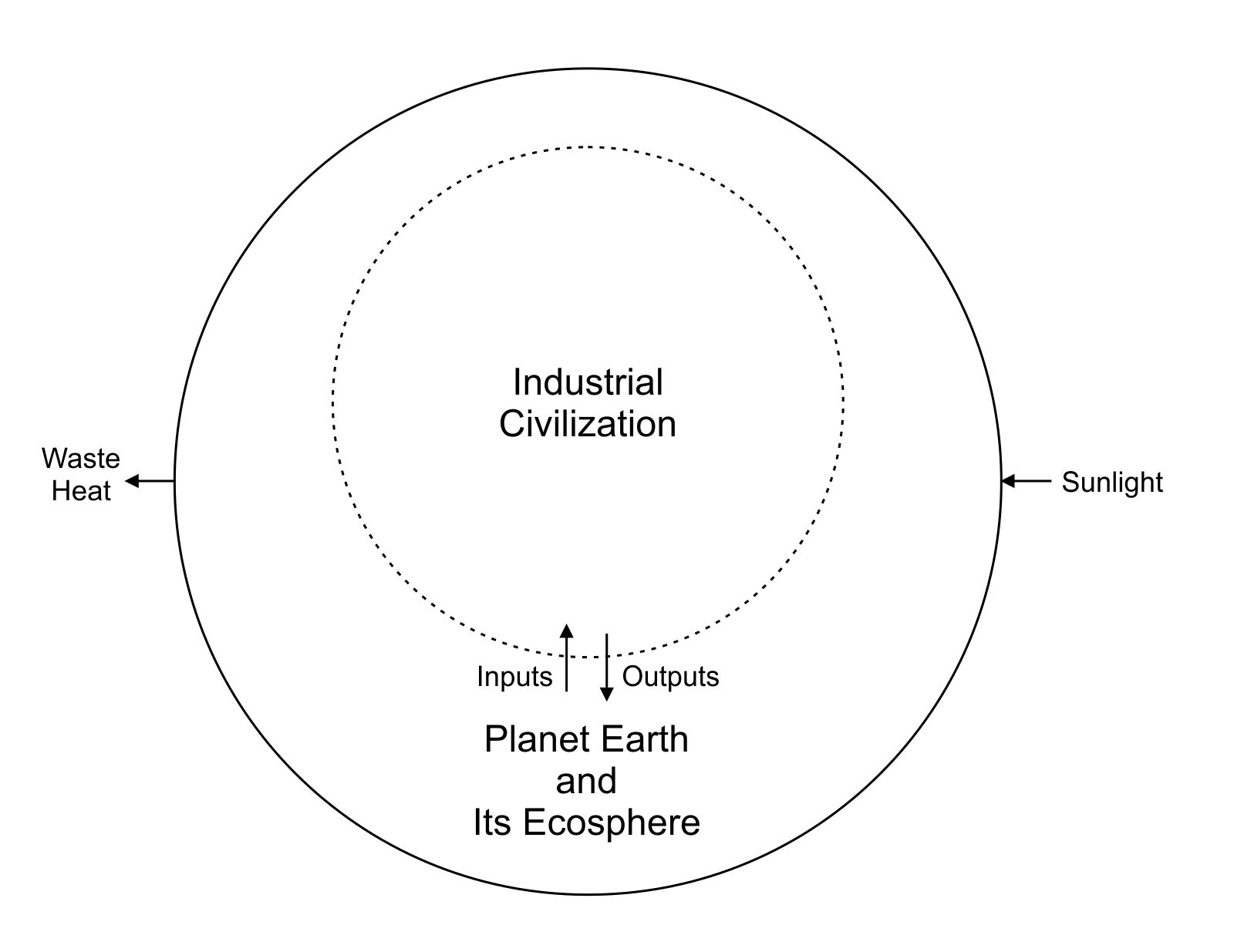 |
| Figure 2, from my last post |
The circle enclosing industrial civilization in the diagram above is misleading in that it would tend to suggest there is a boundary separating civilization from the environment, when it is really just another part of the environment. I have use a dashed line, hoping to indicated that many things flow freely between our civilization and its environment. There is a whole category of such things—inputs to our civilization—that we are absolutely dependent upon. Often referred to as “ecosystem services”, these inputs are things we tend not to be aware of, in much the same way as fish are not aware of water.
They include breathable air, potable water, a reliable climate and moderate weather, arable soil, grasslands, forests and the animals living on/in them, waters and the fisheries they provide, and so on. These things are available to us free of charge and we would simply could not do without them.
It is important to understand that the ecosystem can only supply its services at a certain maximum rate—its carrying capacity. If we use those services at a higher rate, the ecosystem suffers and that carrying capacity is reduced. Many of the waste outputs of our civilization can also damage the ecosphere, again reducing its carrying capacity. And we continue to convert nature into farms, roads and cities, yet again reducing its carrying capacity.
This has created the current situation where we are temporarily in “overshoot”, using more than 100% of the planet’s carrying capacity. We are able to do this because there is a certain amount of stored capacity within the system. Drawing on that capacity has lulled us into a false sense of security. But rest assured, the situation is temporary and shortly the damage to the ecosphere will become obvious, and its declining ability to support us will have disastrous consequences.
To put some numbers on this, in the early 1970s when The Limits to Growth was published, we were using about 85% of the planet’s carrying capacity. There was, at that point, at least hypothetically, an opportunity to put the brakes on economic growth and start living sustainably. Of course, we did not do so and now we are using around 165% of that carrying capacity. If we bring the poorer part of the world up to a standard of living similar to that of the developed nations, it would take about 500% of that carrying capacity to support the human race. Many suggest we should do exactly that, as a matter of social and economic justice.
It is hard to disagree with that, in and of itself. But long before this happens, of course, the ecosphere will have collapsed and suffered a drastic decrease in its carrying capacity.
Three factors are involved in our impact on the ecosphere: population, affluence (consumption) and technology. This can be represented by the equation I=PAT.
Population and affluence are politically sensitive subjects, so many people have focused on using technology to reduce our footprint. This is known as “decoupling”, since the aim is to decouple rising population and consumption from their effects on the ecosphere, to allow growth to continue without having harmful effects. It turns out decoupling has not yet even begun and is very unlikely to ever be achieved. It is largely a myth. Here are a couple of links (1, 2), to articles that go into this in detail.
In addition to promoting myths about decoupling, those who do not wish growth to stop quibble about exactly what the planet’s carrying capacity actually is and just how far into overshoot we currently are. This accomplishes nothing, since whatever that carrying capacity actually is, continued exponential growth will quickly take us past it into overshoot.
So it would seem we should do something about population and/or affluence. Population is such a hot button issue that one can hardly discuss it in polite company. Understandably so, since reducing population must involve either reducing fertility or increasing the death rate. Indeed people have been accused of being “eco-fascists” because they see the need to reduce our population, and look to the most populous areas as the first place to take action. I think “eco-fascist” is a reasonable term, since the most populous areas are also the poorest places on the planet and our impact on the ecosystem is the product of both population and affluence. In the developed world our consumption is so high that even though we have far fewer people, our impact is much larger than that of the poorer parts of the world.
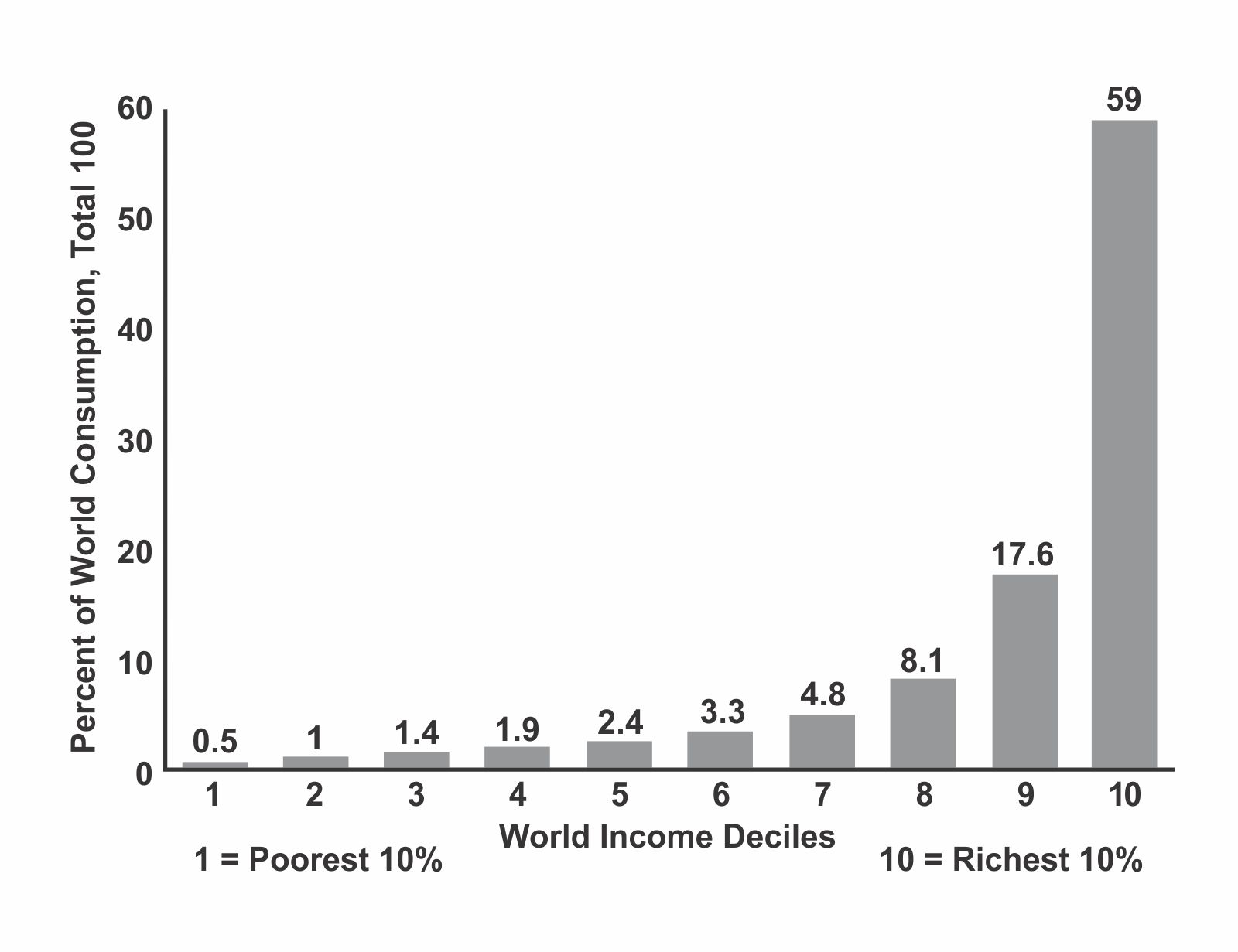 |
| Figure 3 |
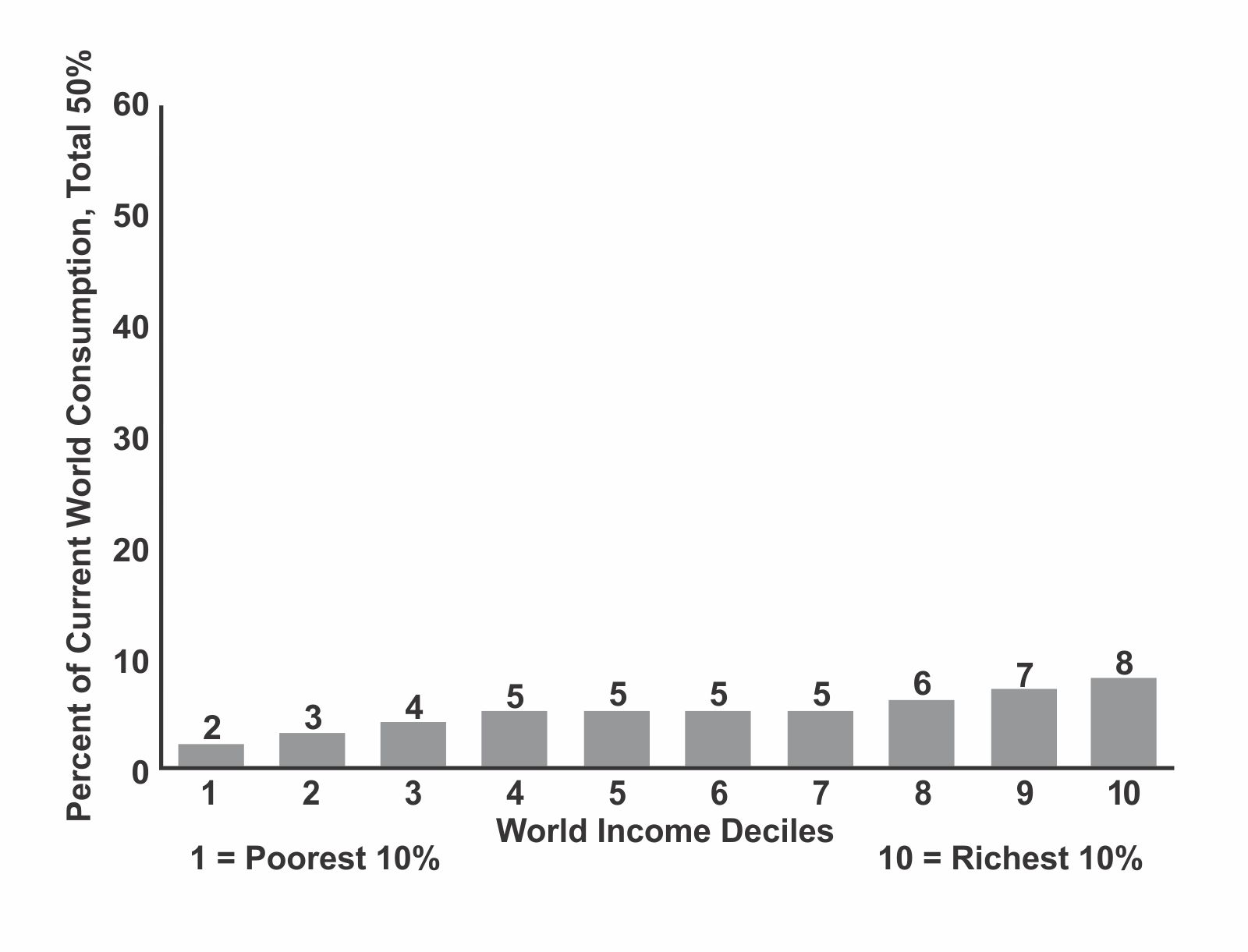
As this chart (Figure 3) shows, the richest 10% of the planet’s population does close to 60% of the consumption. The richest 20% does over 75% of it (17.6+59=76.6). So, reducing consumption in the more affluent parts of the world would be a good start to coping with our problems because it would immediately take us out of overshoot and give us some breathing room to address the damage we’ve been doing to the ecosystem.
 |
| Figure 4 |
As this revised consumption chart (Figure 4) shows, if we could reduce our consumption by 50%, it would reduce our ecological impact down to 82.5% of the planet’s carrying capacity, while actually increasing the consumption level of the lowest seven deciles of the population, and only reducing the consumption levels of the top three deciles. This would seem to satisfy our yearning for social and environmental justice and significantly delay, if not prevent, collapse. But since the most affluent people, those in the tenth decile, are also in control of the situation, it seems unlikely that we’ll make a serious attempt to implement that solution unless we are forced to do so by events beyond our control that bear a strong resemblance to collapse.
You may say that our population problem exists because our capacity to provide food has increased and our capacity to reproduce has responded, not the other way around. I don’t disagree, but I don’t think it is very useful to point that out. Deliberately cutting back on food production and letting people starve in order to reduce our impact on the ecosystem is morally repugnant. It is also not particularly effective since the poor would be effected first and they are not the major contributors to our impact on the ecosystem.
It has also been observed that as countries get richer, their birthrate goes down. Extrapolating current trends (including continued development in the developing nations), the UN calculates that our population will top out around 10 billion late this century and then begin to decline. They would tell you that all we have do is hang on until then and all will be well. But again, I disagree. Long before our population reaches 10 billion, especially if nothing is done to reduce our rate of consumption, the ecosystem will collapse and its carrying capacity will crash down to a level that can support only a tiny fraction of our present population. I think 10 to 20% would be an optimistic prediction.
Overuse of Fossil Water
This post is already quite a bit longer than I usually aim for, and I have only covered what I see as the most urgent input and output issues. There are many other areas that I haven’t begun to cover, and which I will have to leave for another day. But there is one more input issue that I just can’t leave out, and that is the depletion of fossil water.
Many of the important agricultural areas around the world rely on irrigation, and water for that irrigation is pumped out of fossil aquifers. That is, underground reservoirs that took hundreds of thousands of years to accumulate. The current rate of use is many times greater than the current rate of replenishment, and it is only a matter of time, and not much time, until they run dry.
The consequences for agriculture will seriously debilitate our civilization’s ability feed us.
Summing it all up
We have seen again and again, from the start to the finish of this post, and the previous one, that resource depletion of various sorts, and depletion of the sinks into which we dispose of our wastes, seriously threaten our civilization. Any one of these issues is enough, all on its own, to compromise that civilization’s ability to provide us with the necessities of life. In other words, to bring about collapse. And many of them interact in ways that just make the situation worse.
But inputs and outputs are not the whole story. The interior workings of our civilization are replete with issues that threaten its ongoing survival. Next time, we’ll have a close look at some of those issues.
Antius on Fri, 6th Nov 2020 2:22 pm
‘Biden will have a challenging time moving into the White house—
Getting the smell and trash out will take some time.
But Obama did it, so Biden can also.
The smell will probably be the main issue?’
Do you mean that sickly sweet smell of Chinese money, George Soros’ body odour and crack cocaine? Oh wait, that’s the smell of Hunter Biden, come to visit his daddy in the white house. Kind of like what Rome must have smelled like, when it was burning.
Antius on Fri, 6th Nov 2020 2:50 pm
Seeing is believing. What do you have to say about this Duncan Idaho?
https://www.youtube.com/watch?v=d88u-vLB8Hw&feature=youtu.be
Abraham van Helsing on Fri, 6th Nov 2020 3:13 pm
“Abraham van Helsing, do you have a quote from me ‘caring about the environment’ or advocating that the cancer chimps should slow down or change? No & you never will.”
Correct, sloppy phrasing from my side. What you DID do under your nick apneaman was fulminating against white people for allegedly ruining the environment at every possible turn.
You are right, you don’t care about the environment, your only passion in life is to attack white people, with every means possible. Eventually your obsession is going to be your demise.
No, how would you like your pogrom, sir… medium of well-done?
FuckLegaultAndKenney on Fri, 6th Nov 2020 3:19 pm
StarvingLion » Fri 06 Nov 2020, 16:46:34
Suncor headed to 0 as I predicted along with Marathon Oil, Pioneer Natural resources, etc etc etc.
Nice summary sir. Tar sand are net energy negative. They will always lose money because of that. The rumor is the a barrel of oil empty cost 65$ and tar sand oil sell for 35$ per barrel. Tar sand are toast so is Alberta. Their fucking solution is to bring more immigrants, because we all know immigrants comes with barrels of oil attach to their backs when they cross the border
TrudeauLiberalsAreAllMentalRetard on Fri, 6th Nov 2020 3:26 pm
Look at this StarvingLion. Almnost every nations in the world is in some kind of lockdown. You can look a this youtube page sorted by date.
https://www.youtube.com/results?search_query=covid&sp=CAI%253D
FuckQuebecAlbertaAndCanada on Fri, 6th Nov 2020 3:37 pm
StarvingLion, I like your hypothesis that they will drag the result of the election as a way to distract people from peak oil and the collapse of modernity as know as the industrial revolution. UK column talk about this in today video.
These fucking retarded politicians in Canada can not accept the fact that we are going to have to contract the economy because of peak oil. They still believe that bringing in immigrant will boast the economy with in a depleted energy civilization. It simply will not work and cause more social chaos. Go fucking useless Canadian politicians bringing more brown shit skin and see how it will work out for you.
Duncan Idaho on Fri, 6th Nov 2020 3:41 pm
“However inequitable its bias, capitalist democracy at least offered the possibility of incremental and piecemeal reform. We are past that now.”
America Is Now a Corpse
Duncan Idaho on Fri, 6th Nov 2020 3:48 pm
At least the neofascists repugs have the courage of their demented convictions.
In their simple greed and ignorance, some have the courage to tell how they feel.
FuckAllPoliticians on Fri, 6th Nov 2020 3:50 pm
In addition, a hard frost has been recorded in many cities in Santa Catarina, from the west to the Serra Catarinense. In São Joaquim, located in the Caminhos da Neve Valley, a thick layer of ground frost covered much of the valley, leaving the landscape looking as it would during the depths of winter.
https://electroverse.net/record-cold-sweeps-brazil/
We now have a stupid population, stupid useless dog shit politician, peak oil and global cooling, a demographic collapse happening simultaneously.
This winter promises to be really interesting regarding northern nations like Canada, Sweden, Russia, Norway. If the food productions in the southern nations get affected by global cooling, we might see food shortage in northern nations this winter.
Duncan Idaho on Fri, 6th Nov 2020 3:57 pm
“An American tyranny, dressed up with the ideological veneer of a Christianized fascism, will, it appears, define the empire’s epochal descent into irrelevance.”
Duncan Idaho on Fri, 6th Nov 2020 4:04 pm
Arctic time capsule from 2018 washes up in Ireland as polar ice melts
https://www.theguardian.com/world/2020/nov/05/arctic-time-capsule-from-2018-washes-up-in-ireland-as-polar-ice-melts
FuckTheWorldGarbageForum on Fri, 6th Nov 2020 4:07 pm
Well StarvionLion, I will go to grocery store and buy as mush as possible junk foods. I need to gain weight before winter. I would like to reach 350 lbs before winter. You can survive of excess body fat for a long time if you don’t do any heavy physical activities. One guy tried it. I cannot find the web page anymore.
I also need a mistress for winter, to take care of my old man enlarge prostate.
https://www.youtube.com/watch?v=Bw2jQmV53x0
zero juan on Fri, 6th Nov 2020 4:21 pm
Wow, JuanP is postal. Lock the maniac up!
FuckTheWorldGarbageForum said Well StarvionLion, I will go to grocery store and…
FuckAllPoliticians said In addition, a hard frost has been recorded in man…
FuckQuebecAlbertaAndCanada said StarvingLion, I like your hypothesis that they wil…
TrudeauLiberalsAreAllMentalRetard said Look at this StarvingLion. Almnost every nations i…
FuckLegaultAndKenney said StarvingLion » Fri 06 Nov 2020, 16:46:34 Suncor he…
FamousDrScanlon said The age-old tension between Islam and France A pro…
dratrepus tak of course we still love master race chinks said France: Muslim threatens elementary school teacher…
dratrepus tak the beauty of master race chinks said Beauty is radiant Around 16,000 mosques were destr…
dratrepus tak proof chinks r master race said Hanbali school: The great medieval theorist of wha…
Antius on Fri, 6th Nov 2020 4:30 pm
Here is a democrat vote counter, caught tampering with the count.
https://www.youtube.com/watch?v=d88u-vLB8Hw&feature=youtu.be
I notice that Duncan Idaho has nothing to say about it. Maybe he thinks fraud is justified so long as it gets the political result he wants.
Mick on Fri, 6th Nov 2020 4:36 pm
Look out for a shocking next few months before lard ass leaves office he will absolutely trash the place to make it harder for Biden to clean up the mess while he still has a few months in office he don’t care that people will suffer its all about his ego then he can say. See if you voted me in none of this would of happened. Coveffe
The Board on Fri, 6th Nov 2020 5:07 pm
“Here is a democrat vote counter, caught tampering with the count.”
You are lying again Davy.
https://www.politifact.com/factchecks/2020/nov/06/facebook-posts/pennsylvania-poll-worker-was-copying-information-d/#sources
Duncan Idaho on Fri, 6th Nov 2020 5:43 pm
Progressives Made Trump’s Defeat Possible. Now It’s Time to Challenge Biden and Other Corporate Democrats.
https://www.commondreams.org/views/2020/11/06/progressives-made-trumps-defeat-possible-now-its-time-challenge-biden-and-other
disclaimer — I know Norman Solomon from Marin
Mick on Fri, 6th Nov 2020 6:15 pm
The fat orangatan is the biggest sore loser the likes of which we have ever seen
Duncan Idaho on Fri, 6th Nov 2020 6:46 pm
Fat Boy selling real estate:
San Francisco skyscraper part-owned by Trump is on the market, but not selling
https://www.sfgate.com/realestate/article/San-Francisco-skyscraper-part-owned-by-Trump-15705037.php
This clown is going to need some cash—
FamousDrScanlon on Fri, 6th Nov 2020 6:52 pm
FuckTheWorldGarbageForum
Dr Karl’s Great Moments In Science
A year without food
“Back in June of 1965, a Scotsman weighing 207 kilograms, described as “grossly obese” and hereafter known only as Mr A B, turned up at the Department of Medicine at the Royal Infirmary in Dundee.
He was sick of being fat and wanted to lose weight by eating nothing and living off his body fat. He told the hospital staff he was going to fast flat out, whatever they said, so they may as well monitor him along the way.
He ended up fasting for one year and 17 days — that’s right, he ate no food at all for over a year. He lived entirely off his copious body fat, in the end losing about 125 kilograms of weight.”
https://www.abc.net.au/science/articles/2012/07/24/3549931.htm
Humans are fasting adapted. Most humans can live off their body fat no problem until you get into single digit body fat %.
I’ve been a faster for 2-3 years. 14 days is my longest. No biggie. Drink lots of water & electrolytes.Especially sodium (baking soda or sea salt) & potassium (no salt or cream of tartar).
I don’t sleep as much due to jacked up levels of orexin.
Mick on Fri, 6th Nov 2020 6:53 pm
Lol Hopefully the Saudi Prince will let him live there and he can have his 72 virgins and all the deep fried chicken he can shove in his pie hole
Abraham van Helsing on Fri, 6th Nov 2020 10:13 pm
“A year without food“
1 kg body fat = 8000 kcal = 4 days in bed.
125 kg = 500 days worth of fasting
Fasting is the most natural thing to do in the animal kingdom. Animals never know when their next meal will show up. You can very well run on an empty stomach. Animals will always eat. That is the principle where pig farms are based upon. They’ll eat till they burst. Modern westerners or Africans same story. The affluent Japanese are a remarkable exception to the rule.
bochen787 on Fri, 6th Nov 2020 10:17 pm
Biden said in speech tonight that America can still own the 21st century, “just have to remember who we are”….
https://twitter.com/i/web/status/1324921258845204480
Abraham van Helsing on Fri, 6th Nov 2020 10:23 pm
America is ready for the armed confrontation:
https://youtu.be/DQH59tg5LJQ
Steve Bannon on the potential for armed confrontation.
Oh and Trump was a closet white nationalist all along.
He has the right to stay in the White House to at least Januari 20, that’s more than 2 months. Getting him arrested before that date could be the desired trigger. Just keep repeating the voting fraud meme, doesn’t need to be true. Any pretext will do to finally blow up ZOG and create a new future for white people… under the benevolent protection of Europe.
1492-1776 restored.
Abraham van Helsing on Fri, 6th Nov 2020 10:25 pm
“Biden said in speech tonight that America can still own the 21st century, “just have to remember who we are”…“
Biden is a dementing fool. The US are over.
Drill baby Drill on Fri, 6th Nov 2020 10:29 pm
Dang son these oil prices better go higher soon otherwise we gonna have to sell our trailer and pick up and live under that Kentucky interstate overpass I tells ya
bochen787 on Fri, 6th Nov 2020 10:41 pm
rats abandoning ship
https://www.yahoo.com/news/bolsonaro-abandons-friend-trump-2020-190733818.html