
Peak Oil is You

Donate Bitcoins ;-) or Paypal :-)


Page added on April 11, 2015

Colin Campbell: Changing Human Circumstances
Introduction
Children are born to mothers, and most spend their early lives as family members. They gradually become aware of their circumstances which they perceive to be normal whether living in an African rain forest or Manhattan, but pressures for change mount as they grow older. Some try to find a successful role in their present circumstances, but others look for change. Television has evidently come to have a major influence insofar as it broadens their perspective. A tribesman, riding a camel in a desert, may ask why he does not have a Cadillac, as seen on a screen in his camp, which in turn may prompt a degree of resentment.
Historians study the record of changing human life insofar as they can piece it together from preserved documents and relics, while geologists and palaeontologists study the Earth’s full record and the life that evolved upon it. The evidence suggests that the world faces radical changes in the years ahead due to dwindling energy supplies.
Historical Summary
The Solar System came into being about 4.5 billion years ago, and life on this planet began to evolve around 550 million years ago in early seas and lakes. The limpet, or Patella to give it its scientific name, was an early form of life, and has not changed since, but other species evolved, only to die out when the resources of the niche in which they lived were exhausted. The first members of our species appeared about 200 000 years ago, descended from Neanderthal Man.
All species require food to give them the energy on which to live. Our early ancestors lived by hunting wild animals and gathering plants. In fact, some remote tribes, such as the Penans in central Borneo, continue to live in similar circumstances today, but at a certain point about 12 000 years ago came agriculture as people discovered that they could grow food and raise cattle not only as a source of food but to plough the fields and as a means of transport. It led those practicing it to settle in a particular area, building houses in which to live. They learned how to cook and heat their homes by burning wood from surrounding forests. Crops naturally had to be stored between harvests. The communities needed management, with some of the leaders claiming divine authority, duly passing on power to their descendants. If communities exhausted the fertility of the soil at their disposal, they either died out or conquered lands from neighbours, leading to early wars. They needed tools and weapons. At first, they relied on those made from flint, but at a certain point found a way to smelt minerals, starting about 4000 years ago with copper and tin to give bronze, followed by iron and steel.
These early communities also began to barter food between themselves and their neighbours. Some records of barter have been preserved, being an early form of accounting. At a certain point, someone found a nugget of gold, being no doubt attracted by its shiny appearance, and may have offered to exchange it with a neighbour for some food. It became an early form of money, followed by silver in a similar role. But these were heavy minerals to carry around, and it became convenient to store them in the community storehouse. That in turn prompted debt, perhaps to buy food after a bad harvest. The receipts became a form of money. At a certain point, an imaginative storekeeper found that he could issue more receipts than he had gold on deposit confident that not everyone would cash in simultaneously which laid the foundations for the modern complex financial system that is now under stress.
Some communities were naturally more successful than others and their leaders began to develop ambitions to expand their dominion which led to the formations of nations and later empires with many associated wars. While the communities may have started on a more or less egalitarian basis, in many cases a privileged and wealthy elite evolved coming to own land which they either rented out or engaged workers to develop. They had to enforce their authority and recruited various forms of warrior to do so. Populations expanded and in some cases led to a surplus workforce, some becoming slaves who were rewarded with nothing more than enough food to provide the energy needed for their work. Slavery later became a profitable trade, which expanded greatly from Africa to the Americas before being forbidden by Britain in 1807.
Energy and Technology
The foregoing summarises the early history of mankind. There was progress but also many tensions, and the world population only increased from about 300 million at the time of Christ to double that number in 1750 (Stanton.2003). During this epoch it relied on the energy coming from muscle power, both human and that from draught animals. It was normal for empires to wax and then wane when they exhausted the energy at their disposal. The Roman Empire, which relied on slave energy, reached its peak in AD 117 holding control of 70 million people and covering some 5 million kms2 but then fragmented and went into decline. It is noteworthy that the collapse was triggered when the silver mines at Rio Tinto in Spain hit the water table meaning that the Empire lacked the finance with which to recruit enough slaves and soldiers to support itself.
In addition to muscle-energy, people used wood from forests as a fuel with which to cook, heat their homes and smelt metals to make tools, ploughs and weapons. In some places they spotted outcropping seams of coal, and collected that washed up on beaches, finding it a better form of fuel. In due course, the coal pits were deepened into regular mines, but they flooded on reaching the water table, which called for the development of pumps. Hand pumps had been around for centuries but then a way was found to use steam power to drive them. An important development came in the 18th Century when more efficient steam pumps were developed to drain the tin mines of Cornwall in the west of England. They evolved into steam engines, which in turn led to the Internal Combustion Engine when a way was found to inject the fuel directly into the cylinder in a system perfected Nikolaus Otto in Germany around 1875. At first, it used benzene distilled from coal before turning to petroleum refined from crude oil.
These engines changed the world in radical ways providing the energy for the rapid expansion of manufacturing and transport, which in turn stimulated the expansion of trade around the world and facilitated the growth of empires, notably that of Britain. It also led to the rapid growth of agriculture, providing the energy with which to plough the fields, harvest crops and transport food to the growing number of cities. In earlier years, communities had lived in villages and small towns supported by the surrounding countryside, but the expansion of oil-fired transport led to the growth and expansion of cities. More than half the world’s population now live in cities. In 1970, there were three cities with populations of in excess of ten million, but now there are twenty-two (Nikiforuk, 2014).
The overall population has grown from about one billion at the time of the first oil well in 1859 to over seven billion today.
The Oil Age
The foregoing has summarised the colossal impact of the relatively new supply of cheap and easy energy that oil provided. But it is a finite resource formed in the geological past, which means that it is subject to depletion. In other words, there is an Oil Age. This is no surprise because the geological past was characterised by periodic radical changes. The continents moved apart or collided on the back of deep-seated convection currents in the Earth’s crust and there were epochs of intense volcanic activity and climate change. Such had radical impacts on living organisms, leading to the periodic extinction of many species.
The evidence suggests that we are facing the dawn of the Second Half of the Oil Age when oil and gas production decline, which in logic suggests a coming economic contraction, given the central place of oil-based energy in fuelling the modern world. Analysing the status of depletion and its consequences is a difficult task, now being addressed by a new quarterly journal entitled The Oil Age (see Bentley, 2015), but the essence of the situation can be summarised as follows.
Oil from surface seepages has been known since biblical times, having been used to caulk boats. The first oilfields were developed in Pennsylvania and on the shores of the Caspian in the 1850s. The drilling technology was based on that already used to extract salt deposits. At first, it was no more than a bullet-shaped weight on the end of a cable beneath a derrick that thumped its way into the ground, but that was followed by the more efficient rotary rig. Briefly described, a diamond-impregnated bit on the end of a rotating pipe grinds its way into the earth. The hole starts with a diameter of about 30 inches but that is progressively reduced as sections are sealed off by steel casing cemented into the ground. Electonic sondes are lowered down the borehole to determine the rock properties and identify any oil-bearing intervals. Holes are then made in the casing allowing the oil to flow to the surface under its own pressure or with the help of a pump. Wells now commonly reach a depth of about 10,000 feet with some going much deeper. As the onshore prime possibilities were exhausted, the industry turned its attention offshore, even into deepwater, developing very advanced technology to do so. Once found, the oil had to be extracted, and transported by pipeline and tanker, before being refined and marketed, all of which called for massive investment. The process itself consumed a lot of energy which raises the important issue of net-energy.
The first wells were located close to natural seepages, but gradually the occurrence of oil and gas in nature came to be understood. In early years, geologists with technology no more advanced than a hammer and hand lens mapped the outcropping rocks to try to find places where a source, reservoir, trap and seal for oil coincided. Later, came geophysics whereby an explosive charge was released and recorders measured the time taken for echoes to return from deeply buried rock surfaces. It allowed them to be mapped in detail, sometimes even identifying an oil-water contact in a reservoir.
Advances in geochemistry also explained the origin of petroleum. Oil comes from the remains of algae and other organic material preserved in stagnant lakes and seas where a warm climate heated the surface waters causing limited circulation and anoxic conditions at depth. The organic material, known as kerogen, was converted into oil when heated on burial to about 3000 feet beneath subsequent sediments washed in from adjoining landmasses. The bulk of the world’s oil comes from just two epochs of global warming around 90 and 150 million years ago. Gas was formed in a similar way but from more carbonaceous matter as found in the deltas of tropical rivers, and also from oil that was overheated by deep burial.
The United States is almost unique in that its mineral rights belong to the landowner. Fortunes were made during the early days of onshore discovery which led the Securities and Exchange Commission to impose strict rules for what could be reported as so-called Proved Reserves. It wanted to prevent fraudulent exaggeration but smiled on under-reporting as sensible financial caution. The major companies, which later came to control world oil supply, were subject to the same rules and found it financially desirable to report the minimum necessary to deliver a comforting, if somewhat misleading, picture of steady growth to their shareholders.
Determining the size of a new discovery is not easy. It involves mapping the size of the trap and estimating the thickness, porosity and permeability of the reservoir rock and the relative percentage of oil and water in its pore-space. Economic factors relating to the progressive cost of extraction, as well as tax and the return on investment, also have to be taken into account. Whereas the geologists tended to exaggerate the size of a prospect to secure the management’s support for drilling it, the engineers, who took over development, understandably, adopted a more conservative pose, earning medals if the field ended up being larger than at first reported. The industry came to use the terms Proved (1P), Probable (2P) and Possible Reserves (3P) to describe the uncertainty, normally taking the Proved in full, two-thirds of the Probable and one-third of the Possible as a reasonable estimate of what would be produced in a field.
The discovery of a new major oil province delivered a glut of oil depressing price. In early years, the industry was dominated by seven major companies (Exxon, Mobil, Shell, BP, Chevron, Texaco and Gulf) termed the Seven Sisters. They held a secret meeting at the Achnacarry Castle in Scotland in 1929 at which they agreed to regulate production between themselves to support price. In 1932, after major discoveries in Texas, the US Government intervened to the same end limiting production to a given number of days a month in a policy administered by the Texas Railroad Commission. These precedents led to the formation of the Organisation of Petroleum Exporting Countries (“OPEC”) in 1959, being led by Venezuela and Saudi Arabia.
Some countries nationalised their oil industries, including Russia in 1928, followed by Mexico ten years later. Other political factors also came into play. The so-called First Oil Shock came in 1973 when Saudi Arabia decided to ban exports to the United States and some of its allies in response to their support for the creation of the State of Israel, which led to a price surge from $17 to $54 a barrel. It was followed by the Second Oil Shock in 1979, occasioned by the fall of the Shah of Iran, when prices rose from $50 to $101, both being quoted in terms of 2013 dollars.
There were also price collapses putting pressure on OPEC. It is noteworthy that in 1985, at a time of low prices, Kuwait increased its reported reserves, on which its OPEC quota was based, from 64 to 90 Mb (million barrels) although nothing particular had changed in its oilfields. Two years later it announced a possibly genuine small increase to 92 million, but that proved too much for the other OPEC countries : Abu Dhabi matched exactly at 92 Mb, up from 31 Mb ; Iran went one better at 93 Mb, up from 49 Mb; and Iraq capped both at a rounded 100 Mb, up from 47 Mb. Saudi Arabia could not match Kuwait because it was already reporting more, but in 1990 announced a massive increase from 170 to 258 Mb to hold its lead. Venezuela for its part increased from 25 to 56 Mb, but did so by including its Non-Conventional heavy oil that had not counted for OPEC quota. The numbers suggest that Kuwait may have changed to reporting Original rather than Remaining Reserves, namely by not subtracting past production. This is in fact the normal industry practice in determining the relative ownership of an oilfield that crosses a lease boundary or frontier and could be regarded as a sensible approach for OPEC to follow.
Public data on reserves are very unreliable for all these reasons. The BP Statistical Review is widely taken as an authoritative source, being sponsored by a major oil company, but in 2014 it reported unchanged reserves for 38 countries despite it being utterly implausible that intervening discovery should have exactly matched production. Another misleading statistic it reports is Reserve to Production Ratio quoted in years which is misinterpreted to mean that production can stay flat for a given number of years and then stop dead overnight despite the fact that production in all mature oilfields declines gradually to final exhaustion.
Another cause of confusion is that there is no standard definition of the different categories of oil, each having its own endowment, costs, depletion profile and net energy yield. The primary supply to-date has been from so-called Regular Conventional Oil having a density of less than 17.5o API. The evidence suggests that its production peaked in 2005, which significantly was only one year after the peak of the production by the major oil companies. They are now reduced by merger from seven to four in number, which probably indirectly reflects a contraction from dwindling exploration opportunities.
With the decline of the prime source, attention turned to Non-Conventional oils, comprising that from Heavy oil and Tar Sand; Shale Oil (secured by heating immature source rocks); Tight Oil (secured by fracturing rocks lacking enough natural porosity and permeability to be a normal reservoir); Deepwater Oil (>500m); and Polar Oil. An argument rages as to the date of the peak of production of all categories of oil, which is imminent, but misses the point when what matters is the vision of the long decline that comes into sight on the other side of it.
Gas is also made up of Conventional and Non-conventional categories subject to depletion, with the overall peak expected to arrive in around 2020.
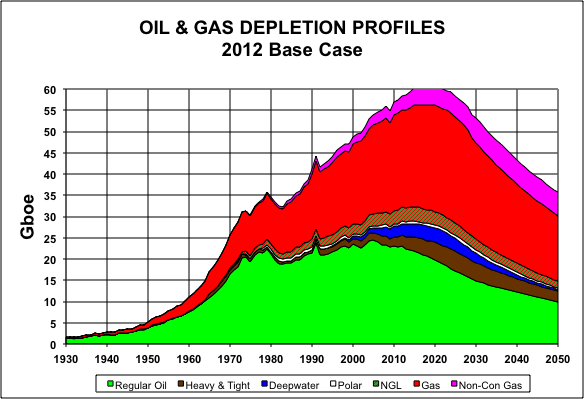
The following graph updated from that in Campbell’s Atlas of Oil and Gas Depletion gives an overall picture with gas shown in terms of energy equivalent. It has evolved over time having been subject to upward revisions. It is believed to be realistic although naturally there will be detailed departures from the forecast for all sorts of reasons, including political factors.
Recent Events
The foregoing summarises the essential factors to be assessed in determining the status of depletion. It is clear that the transition to the Second Half of the Oil Age, which dawns, threatens to be a time of great tension. People everywhere have become accustomed to an expanding economy fuelled by easy and relatively cheap oil-based energy and are not remotely prepared for what follows. The peak of the production of Regular Conventional Oil in 2005 prompted an oil price surge to almost $150 a barrel in 2008. It is worth noting that the average price over the past century was no more than $25, as quoted in 2014 dollars to remove the impact of inflation. The 2008 price surge in turn led to an economic and financial crisis, leading to the failure of several prominent banks. Politicians in democracies win votes by telling people what they want to hear, and many continue to claim that economic recovery is on the way, despite the impending fall in the prime source of energy that fuelled the First Half of the Oil Age.
People facing soaring food prices and dwindling employment are naturally resentful and come to blame their governments for their changing circumstances, which in turn has prompted demonstrations, riots, revolutions and acts of terror around the world. The oil-rich Middle East and North Africa have been particularly badly affected. These are barren lands that could support no more that a small fraction of the current population without benefit of the massive level of oil income, which also led to the development of a wealthy elite able to exert political influence. Many of the countries are somewhat artificial constructions with their frontiers having been drawn by Britain and France following the fall of the Ottoman Empire of Turkey in the First World War on lines that did not fully reflect the division of different tribes and communities, who in some cases had different religious beliefs.
The Prophet Muhammad was born in Mecca in what is now Saudi Arabia in AD 570. He claimed divine inspiration for his teachings leading to the Muslim Religion. It later divided into Shia and Sunni Sects: the former believing in giving power to the descendents of the Prophet, with the latter being content to follow his teachings. This division seems to have had substantial political consequences, with Iran emerging as the premier Shia State and Saudi Arabia as the premier Sunni State. Iraq, which lies between these two powers with particularly arbitrary frontiers, is divided. Saddam Hussein, the former leader, was a Sunni, whereas the present leader, Nouri al-Maliki, is a Shia. The country furthermore has a large Kurdish minority, living in the northern oil-rich part of the country. They are descended from the ancient Medes, but somehow failed to secure their own territory. Muslims tend to believe that their actions are dictated by God, and are therefore to some degree spared responsibility for their political actions.
Another important factor is Israel. It was the homeland of the Jews before Jerusalem was sacked by the Romans in AD 135, leading the survivors to flee to other lands. Since the immigrants lacked property rights in their new homes they had to concentrate on business and finance. It is significant that both Christian and Judaic faiths condemned usury as a sin in early years, save that Judaism allowed it to be practiced against strangers. Christians wanting to borrow and lend money avoided religious condemnation by sub-contracting the practice to Jews who came to play a prominent role in banking. It gave them a certain power, explaining why they were persecuted in subsequent years, especially in Russia and Germany. In 1916, the Zionist Movement persuaded Lord Balfour, the British Foreign Minister, to grant them a homeland in Palestine, probably in return for help in securing dollar loans to fund the First World War. Eventually, the State of Israel was formally established in 1948 despite much opposition in the region. The conflict with the indigenous Palestinians continues.
Syria, which has had a long history as a trading nation in the eastern shores of the Mediterranean, became a French territory after the First World War before gaining independence in 1946. It has had a turbulent subsequent history, invading Palestine in 1948 and the Lebanon in 1976. The present President, Bashar al-Assad, belongs to the Alawite Sect of Shia Islam, which gives him certain ties with Iran, but has faced a serious civil war over the past few years. The rebel forces include a movement seeking to create the Islamic State of Iraq and Levant (ISIL). Its influence has expanded eastwards over much of northern Iraq, but it is now being repulsed partly with the help of Iranian troops. The rebels have to be fed and armed, and a big unanswered question is to ask who is funding them. There have been suggestions that Saudi princes may be doing so to counter threats from an expanding Iran, or that Israel may be doing so to encourage US intervention which would strengthen its position. It is significant that the United States has so far failed to intervene despite having previously fought two Gulf Wars partly to protect its oil supply. It is noteworthy that Rahm Emanuel, who helped fund President Obama’s election and became his Chief of Staff, was the son of an Israeli terrorist whose actions in 1947 killing British soldiers in a hotel led Britain to give up administering the territory as a protectorate. He has since become the Mayor of Chicago, and US relations with Israel have soured somewhat although it still has several strong supporters in Congress.
It is a large and complex subject that cannot be covered here. The most recent chapter in the unfolding situation has been a remarkable collapse in oil price. The discovery of Conventional Oil in the United States peaked in 1936 and delivered a corresponding peak in production in 1970. But the country was in a strong financial position as the dollar had come to control world trade as well as being held as a reserve currency by many countries, meaning that it could well afford imports. Even so, the high oil prices of recent years encouraged it to develop Tight Oil by so-called frac-ing of which the resource in the ground is considerable. Frac-ing is a long-established technology: in the early years, drillers in Texas would release an explosion in wells with a poor reservoir to fracture the rocks and increase production. Advances in technology have facilitated the process with the drilling of highly deviated wells. They start vertically but are deviated at depth to run parallel with the productive rocks which are then fractured by liquids injected under high pressure. The wells, which are able to tap production from no more than the immediate vicinity of the well bore, are short-lived and costly, becoming generally viable only at oil prices above $80 a barrel. This new activity nevertheless attracted speculative financial support. Much money was borrowed, and it is reported that the banks secured $31 billion over five years in usury. It is important to stress that Non-Conventional oils have low net energy yield reducing the significance of the uncertainties about the size of the resource.
The Oil Price Shock of 2008 prompted a serious economic recession and falling demand, which in turn put pressure on OPEC. King Abdullah of Saudi Arabia, who once said that he wished to leave as much oil as possible in the ground for his grandsons, which makes eminent national sense, died of pneumonia on 20th January 2015 at an advanced age, and was succeeded by his half-brother, Salman. The new regime decided to abandon the country’s OPEC obligations to cut oil production and support price, leading to a dramatic fall to around $50 a barrel. Its motives are unclear. It may have wanted to counter the US surge in production from costly frac-ing; it may have failed to grasp the long term impact of the underlying depletion profile described here; or perhaps the elite had been told how fortunes could be made by those who correctly anticipate radical changes in oil price. Saudi Arabia’s action has put severe pressure on other OPEC countries, especially Nigeria and Venezuela, which are seeing a radical loss of revenue with serious social consequences. Saudi Arabia has also recently attacked Iranian-backed Shia rebels in neighbouring Yemen. This dispute threatens regional oil exports because Yemen adjoins the Straits of Hormuz through which 4 million barrels a day of oil are shipped.
Another area of recent conflict is the Ukraine, which surprisingly lies on the site of the ancient Empire of Khazaria that adopted the Jewish faith. It was invaded by Mongols in the 10th Century which prompted another diaspora to Russia and Europe. It is a country of rich farmland, having been the home of the Cossacks, and also holds substantial coal deposits and some oilfields. The First World War helped define its frontiers, allowing it to become a full member of the Soviet Union in 1922. But pressures towards greater independence developed in the 1930s being brutally suppressed by Moscow in what became known as The Great Terror, and famines cost the lives of millions. It was invaded by Germany in 1941 and as many as 600,000 Jews were executed. After much suffering, it finally won independence in 1990, but tensions remained and have become much more serious in recent years as the eastern part of the country with Russian ties seeks independence. Some Russian gas export pipelines to Europe pass through the Ukraine, which has wider significance because Europe is increasingly dependent on imports from Russia as North Sea production declines.
The Challenge
The world faces a major challenge in adapting to the radically reduced energy supply, which may mean that it will be able to support no more than about half its present population by the end of the century. But there are useful steps that can be taken to prepare. The situation of Britain during the Second World War sets an example of how people can adapt to radically changed circumstances. Elections were suspended but the government continued to have popular support. Food was rationed. Private motoring almost ceased but there was adequate public transport. Businesses continued but aimed at survival rather than expansion. There was a strong cooperative spirit. Entrepreneurs trying to exploit situations to their own benefit were condemned, being known as “spivs”.
Radical policy changes are now called for and the following lists some ideas:
1. Develop as much alternative energy as possible from tide, wind, wave, solar panels, hydropower, geothermal sources and anaerobic digestion, a process that converts agricultural and urban waste into methane that can be used to generate electricity. Nuclear power can also ease the transition although the production of prime grade uranium has also passed its peak. So-called frac-ing can also provide more oil to ease the transition.
2. Install smart meters whereby businesses and households are made constantly aware of their electricity consumption, and change tarrifs so that the more that is used, the more expensive it becomes. The present waste of electricity is colossal.
3. Remove energy costs as a charge against taxable income for business, which is an oblique subsidy, encouraging management to concentrate on energy saving.
4. Have fuel rationing to meet people’s essential needs in their particular circumstances.
5. Encourage car sharing and the giving of lifts.
6. Encourage permaculture and allotments whereby city dwellers can grow more of their own food. Changed building design can even permit the conversion of balconies on apartments into green houses.
7. Adopt the Rimini Protocol whereby countries agree to cut consumption to match world depletion rate, and conduct sufficient research to properly determine what that is (Heinberg 2006).
8. Encourage localism so that people again come to rely on whatever their particular region can support, which implies severe restrictions on immigration.
9. Take control of the financial position so that banks are no longer able to lend more than they have on deposit, and reintroduce properly managed local currencies.
10. Above all, inform people that their changed circumstances are imposed by Nature.
Indeed we already see some positive moves to localism. The tensions in the Middle East and North Africa, while fought under religious banners, imply a move to greater regionalism and a reduction in the power of the elite, who benefitted excessively from oil revenue. It is evident from their very names that the United States of America and the United Kingdom are made up of different factions who agreed to work togather. Apparently, a recent poll showed that 34% of the people of Texas, Oklahoma, New Mexico and Arizona wish their states to secede from the United States. Scotland came close to seceding from the United Kingdom in a recent referendum, and may yet do so. The British Government is also giving more financial control to cities and regions. There are similar pressures in Spain and Italy. It is significant too that The Transition Town Movement, that is gaining a world following, has already introduced a local currency for the town of Totnes in England to facilitate barter. The Euro currency is under pressure, and some countries such as Greece, which is facing a serious economic and financial recession, may withdraw from the European Union.
Conclusions
It may be asked if Homo sapiens will be as wise as his name implies and avoid extinction, the fate of many species in the geological past who exhausted the resources of the niche in which they lived. There is much that can be done to prepare for the changed circumstances. It is a critically important subject that is beginning to attract increasing attention. The following are a few key references.
20 Comments on "Colin Campbell: Changing Human Circumstances"
Aire on Sat, 11th Apr 2015 11:09 am
Let me save Plant and Nony from typing.
Colin Campbell was soooo wrong and forever will be wrong!
Plantagenet on Sat, 11th Apr 2015 11:17 am
Don’t listen to Aire’s dopey attempt to bash Dr. Colin Campbell.
Dr. Campbell is a brilliant geologist and an important scientific leader in the peak oil movement. He is now retired, but played an important role in modernizing M. King Hubbert’s peak oil concept, and in utilizing the latest scientific data to update the predictions for the end of the oil age.
MSN Fanboy on Sat, 11th Apr 2015 11:47 am
Well this confirms my suspicion… Plant is only here to disagree and argue. Lil Planter. I’m positive Plant that you decried Campbell in previous comments. Don’t Deny you’re a shit stirring troll.
Plantagenet on Sat, 11th Apr 2015 12:34 pm
First Aire bashes Dr. Colin Campbell and his peak oil model, and then after I defend Dr. Campell MSN contributes a potty mouth post concerning his feces.
Why is it that dumb people always post about their feces?
Hello? Are there any intelligent posters here who want to talk about peak oil rather than their feces? Hello?
Nony on Sat, 11th Apr 2015 12:52 pm
I can’t take someone seriously who fails to admit it when they are wrong. This guy was contacted by an MSM reporter to revisit his peak oil predictions and refused to respond. Apparently he is not too old to engage with people since we get this article.
The whole peak oil movement is shown more and more to be one based on bias and political leanings rather than thoughtful amateur estimation of reserves and production. You can see it even clearer now in hindsight, given the refusal to face facts or the strained, tendentious arguments of caveats and definitions. But the bias and the nutter factor was there the whole time.
America has moved on from peak oil:
https://www.google.com/trends/explore#q=fracking%2C%20peak%20oil&cmpt=q&tz=
Apneaman on Sat, 11th Apr 2015 1:03 pm
I can’t take someone seriously who thinks facts are only facts if they have the correct amount of Google searches. Reading a collection of Nony’s comments is like reading a list of logical fallacies. IOW he is working out of the dentist playbook. You are a fucking amateur Nony. You might have better luck on Reddit.
Apneaman on Sat, 11th Apr 2015 1:04 pm
Nony says:
Reality is a popularity contest!
MSN Fanboy on Sat, 11th Apr 2015 1:14 pm
Kindly give me your email address planter?
Apneaman on Sat, 11th Apr 2015 1:17 pm
In South Carolina one cannot talk about sea level rise lest they be ostracized. But they is sure building lots of sea walls and trucking in the replacement beach sand. Dems is some smart folks down dare. Climate change is unpopular in South Carolina so it’s not real.
ghung on Sat, 11th Apr 2015 2:01 pm
“Dems is some smart folks down dare.”
Yeah, Ap, all twelve of them.
Plantagenet on Sat, 11th Apr 2015 2:59 pm
@Nony
Its true that Dr. Campbells’s 2012 peak oil prediction is overly pessimistic. Nonetheless you have to respect Dr. Campbell for updating M. King Hubbert’s work, and for including unconventional oil in his own peak oil predictions. Notice that Dr. Campbell includes oil from tight shale, oil from condensates, polar oil, etc. in the figure above. The man is an honest scientist—-he uses real data and he honestly presents his predictions. Of course, he has to update his predictions when the real world produces more oil then he thought possible, but its not uncommon for models to be “tweaked” and “tweaked” again to bring them into accordance with the real world. Even rocket scientists have to make last minute adjustments to space missions to bring the modeled flight path of the rocket into adjustment with the real world situation.
Nony on Sat, 11th Apr 2015 3:57 pm
I think he has avoided really discussing in depth how his predictions failed. Instead he jumps to new ones without ever discussing that the old ones were off. And it is interesting how his predictions are always off in one direction.
Arthur75 on Sat, 11th Apr 2015 5:23 pm
Regarding the first oil shock, it would be time for Colin Campbell to have a look at below :
https://i0.wp.com/upload.wikimedia.org/wikipedia/commons/c/c5/US_Oil_Production_and_Imports_1920_to_2005.png
(and to know the real history about it)
Energy Investor on Sat, 11th Apr 2015 6:02 pm
I am surprised any of the above comments have been made. Colin Campbell will likely have the last laugh…if he lives that long. He is on my list of human treasures and I hope folk will listen carefully to what he has to say.
platinumshore on Sun, 12th Apr 2015 4:34 am
Ignoring productivity talk, and plug-n-play production doing the current rounds. The biggest and most direct question I have to make, is why don’t energy forecast bodies like the IEA report total liquids in net energy terms – just linking each element together by gross energy density and then calling total liquid energy production ‘oil’ is at best a joke at worse a crime to the economic and fortunes of many. It takes more energy to produce unconventional oil even if it maybe more productive in barrel terms.
Makati1 on Sun, 12th Apr 2015 4:53 am
platinumshore, the American sheeple could not handle the truth that their happy consumer lifestyle is in the ICU on life support and soon will end, along with whatever ‘rights’ they still think they have. Nor could most of the government ‘leaders’ survive the pitchforks, guns and ropes that would come out with the truth.
Davy on Sun, 12th Apr 2015 6:38 am
Tell Me Makster, how is your Asian sheeple any different? I want to know why you think they are so special. Can you give me a link or something? I am sure your Global Research numb nutters have something on that. The Asians aren’t any different and when your local sheeples hit the street in your town of Manila all 12MIL of them that will be ugly. Somehow in your warped mind you can’t connect the dots.
Arthur75 on Sun, 12th Apr 2015 7:23 am
A summary :
– end 1970 : US production peak, the energy crisis starts from there, with some heating fuel shortages for instance (some articles can be found on NYT archive on that), or :
http://upload.wikimedia.org/wikipedia/commons/c/c5/US_Oil_Production_and_Imports_1920_to_2005.png
– Nixon name James Akins to go check what is going on.
– Akins goes around all US producers, saying this won’t be communicated to the media, but needs to be known, national security question
– The results are bad : no additional capacity at all, production will only go down, the results are also presented to the OECD
– The reserves of Alaska, North Sea, Gulf of Mexico, are known at that time, but to be developed the barrel price needs to be higher
– In parallel this is also the period of “rebalance” between oil majors and countries on each barrel revenues (Ghadaffi being the first to push 55/50 for instance), and creation of national oil companies.
– there is also the dropping of B Woods in 71 and associated $ devaluation, also putting a “bullish” pressure on oil price.
– So to be able to start Alaska, GOM, North Sea, and have some “outside OPEC” market share, the barrel price needs to go up (always good for oil majors anyway) and this is also US diplomacy strategy
– For instance Akins, then US ambassador in Saudi Arabia, is the one talking about $4 or $5 a barrel in an OAPEC meeting in Algiers in 1972
– Yom Kippur starts during an OPEC meeting in Vienna, which was about barrel revenus percentages, and barrel price rise.
– The declaration of the embargo pushes the barrel up on the spots markets (that just have been set up)
– But the embargo remains quite limited (not from Iran, not from Iraq, only towards a few countries)
– It remains fictive from Saudi Arabia towards the US : tankers kept on going from KSA, through Bahrain to make it more discrete, towards the US Army in Vietnam in particular.
– Akins is very clear about that in below documentary interviews (which unfortunately only exists in French and German to my knowledge, and interviews are voiced over) :
http://www.youtube.com/watch?feature=player_embedded&v=fQJ-0jAr3LQ
For instance after 24:10, where he says that two senators were starting having rather “strong voices” about “doing something”, he asked the permission to tell them what was going on, got it, told them, they shat up and there was never any leak. The first oil shock “episode” starts at 18:00
The “embargo story” was in fact very “practical”, both for the US to “cover up” US peak towards US public opinion or western one in general, but also for major Arab producers to show “the Arab street” that they were doing something for the Palestinians.
In the end, clearly a wake up call that has been missed, especially at a time when we are around global peak and the omerta about it is almost complete.
Note : About Akins, see for instance :
http://www.washingtonpost.com/wp-dyn/content/article/2010/07/26/AR2010072605298.html
And his famous foreign affair article :
http://www-personal.umich.edu/~twod/oil-ns/articles/for_aff_aikins_oil_crisis_apr1973.pdf
His report to Nixon in 71 or 72 is still classified to my knowledge though, would be interesting to know if it can be declassified now.
Arthur75 on Sun, 12th Apr 2015 7:24 am
And about the “energy crisis” that started much before “Yom Kippour/the embargo” following US 1970 peak, was looking for a video of a Nixon speech that I didn’t find back, but below one is also quite characteristic :
“195 – Special Message to the Congress on Energy Resources.
June 4, 1971
1971
To the Congress of the United States:
For most of our history, a plentiful supply of energy is something the American people have taken very much for granted. In the past twenty years alone, we have been able to double our consumption of energy without exhausting the supply. But the assumption that sufficient energy will always be readily available has been brought sharply into question within the last year. The brownouts that have affected some areas of our country, the possible shortages of fuel that were threatened last fall, the sharp increases in certain fuel prices and our growing awareness of the environmental consequences of energy production have all demonstrated that we cannot take our energy supply for granted any longer.
…
”
http://www.presidency.ucsb.edu/ws/index.php?pid=3038&st=oil&st1=
ghung on Sun, 12th Apr 2015 8:50 am
Akins wrote an in-depth article for ‘Foreign Affairs’ magazine; April, 1973:
“The Oil Crisis: This Time the Wolf is Here” –
http://www.foreignaffairs.com/articles/24416/james-e-akins/the-oil-crisis-this-time-the-wolf-is-here
The conclusion is interesting:
“Having argued throughout this article that the oil crisis is a reality that compels urgent action, let me end on a note of hope. The current energy problem will not be a long one in human terms. By the end of the century oil will probably lose its predominance as a fuel. The measures we have the capacity to take to protect ourselves by conserving energy and developing alternative sources of energy should enable us, our allies, and the producer nations as well, to get through the next 25 years reasonably smoothly. They might even bring us smiling into the bright new world of nuclear fusion when all energy problems will be solved. This final note would ring less hollow if we did not remember the firm conviction of the late 1940s that the last fossil fuel electricity generating plant would have been built by 1970; and that in this new golden age, the home use of electricity would not even be measured. It would be so cheap, we were told, that the manpower cost of reading meters would be greater than the cost of the energy which the homeowners conceivably could consume. But perhaps in 2000. . . .
From 1973…. and we’re still feeding our oil addiction. So many urged a different path but few listened.