
Peak Oil is You

Donate Bitcoins ;-) or Paypal :-)


Page added on August 19, 2014

Chinese Coal Consumption Just Fell For The First Time This Century
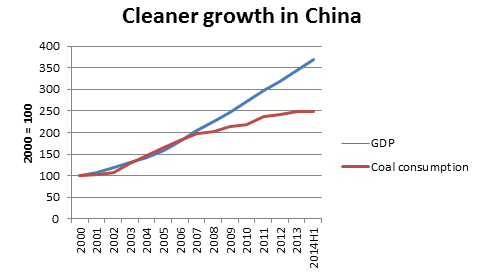
There may be a light at the end of the long dark tunnel: It appears China’s coal boom is over.
While positive signs have been emerging from China for well over a year, it appears the ‘war on pollution‘ is not just talk. According to analysis produced by Lauri Myllyvirta and Greenpeace International in the first half of this year, China’s coal use dropped for the first time this century – while the country’s gross domestic product (GDP) actually grew.
You read that right: coal and GDP growth have decoupled in China.
At the same time, the growth of imports — the seemingly endless source of optimism for the moribund U.S. coal industry — ground almost to a halt, with only 0.9 percent growth so far this year, as opposed to more than 15 percent yearly figures we have seen since China first became a net importer. Topping off the trifecta of good news is that domestic production dropped by 1.8 percent [article is in Chinese]. While uncertainty over the changes in coal stockpiles still exists, we’re confident that the unbelievable may be at hand: peak coal consumption in China.
It’s hard to understate just how historic this shift is. Analysts have been arguing over if, and when, Chinese coal consumption would peak. Some were forecasting a peak before 2020 while others — including Wood Mackenzie — have been loudly claiming Chinese coal demand may not ever peak but would instead double by 2030. This new data exposes the wide gulf between reality and hype that those predictions rely on.
In a sign of just how dramatically the tables have turned on the previously skyrocketing projections for the coal industry in China, consider this: the China National Coal Association is now calling for a 10 percent reduction in second half domestic coal output in many of the main coal-producing provinces. That about face comes as quite a shock considering as recently as December, the Association was busy advocating for a billion tonnes of coal to be added to the Chinese coal market by 2020. My what a difference a year makes.
But, it’s important to understand how the many who still believe in the myth that Chinese coal demand can grow endlessly will respond to the news. Two easy to believe short-term explanations have already been offered for the slowing coal demand.
The first is that China’s economic growth is slowing and skyrocketing coal consumption will resume when the economy rebounds. The problem with this explanation is that while the first five years of the century saw coal use and GDP grow almost hand in hand, the second half saw them decouple. More importantly, the Chinese economy registered a year-on-year growth rate of 7.4 percent, which indicates that the fundamental growth pattern of the Chinese economy has changed.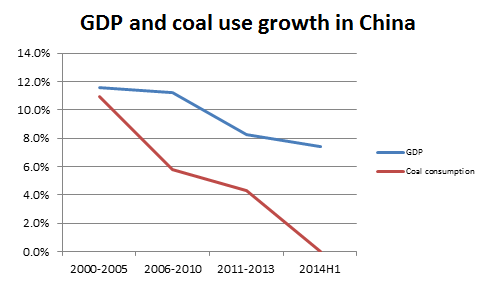 A widening gap between economic growth and coal consumption increases. Sources: Compiled from China National Bureau of Statistics and China National Coal Association statistical releases.
The second explanation was offered by Bloomberg: a surge in hydropower generation offset coal use. China did indeed add a lot of hydropower capacity in the first half of 2014; however, the 9.7 percent year-on-year increase in hydropower generation was business-as-usual. In fact, the average for the past five years was 9.3 percent. This increase in hydropower was only capable of changing the coal consumption growth rate by less than one percentage point, which hardly changes the big picture.
So, what’s really going on? The times they are a changing, and the Chinese economy is changing with them. We’re finally starting to see movement away from the energy-intensive fossil fuel industries and investments that fueled China’s rise.
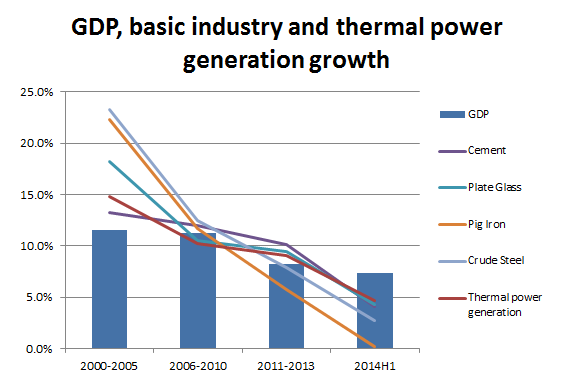
But there is still a long way to go from a peak in coal consumption to the necessary reductions needed to move toward a clean energy future. Fortunately, this change does not have to be linear, and interestingly, it seems Chinese investors were ahead of the curve as many have been busy shifting their money from coal to clean energy over the past few years.
It looks like the smart money in China has long realized what the data is now showing: bullish predictions on future coal growth are unfounded, and clean energy is the future.
11 Comments on "Chinese Coal Consumption Just Fell For The First Time This Century"
Davy on Tue, 19th Aug 2014 8:10 am
This article says it all concerning China deflating growth bubble. The Chinese bubble is deflating and could pop at any time. In a global world of limits of growth with macro diminishing returns a country having an export market driven economy is a big negative. China is facing overwhelming predicaments that it will not be able to mitigate and adapt to without significant growth. China is in overshoot of carrying capacity with water, soil, and pollution management among a few of many. This article shows a deadly trend of decreasing growth. We can say China has an economic EROI of growth so to speak. China must have at least 5% growth currently. China like the rest of the large economies is experiencing growth compression for all those many reasons we discuss here on PO. This article shows the real indicators, not the official manipulated indicators, of growth compression. This is especially shown in the compression of the thermo electric sector. We know here growth and energy consumption are very closely related. Some of this naturally is increased efficiency but not much. Diminishing returns is hitting efficiency like all the other macroeconomic areas. China has an economy with a huge shadow banking sector that has inflated an already huge governmental sector of debt creation. Much of this debt has been in overcapacity and mal-investments. It is also in industrial sectors of China’s export economy that will suffer in any down turn. China is dangerously reliant on imports of energy from far away locations through distribution bottleneck locations like the Straits of Malacca. If this was not bad enough economically the final nail in the vampire of growth “China” they have the policy of balling out failed financial firms and kicking the bad debt realization down the road. A significant portion of the Chinese economy consists of bad debt unrealized. So this article is ominous for us all. In a complex global integrated economic system where China is a TBTF node a failure in China will be a contagion that brings down BAU if the landing is hard enough.
JuanP on Tue, 19th Aug 2014 9:15 am
China’s economic growth during the last 35 years has been nothing short of incredible and unique in human history. Never before, or after, did any group of people, nation, or empire grow its economy so much for so long, and I don’t think it could ever happen in the present or the future in a world of depleted resources. It was an unprecedented, mind blowing, once in human history event.
The environmental consequences have been brutal for the Chinese who live with some of the worst local pollution on the planet.
Most of us here understand that growth in a finite environment is not sustainable and the Chinese Miracle is coming to an end and has turned into a nightmare for millions.
I am glad their coal consumption growth has decoupled from their economic growth, a trend that has been going on for years. If I were optimistic I would hope that this means we will burn less coal in the end as a species, but I don’t think so. It is good news for all of us now, the less economic and pollution growth, the better, of course.
rockman on Tue, 19th Aug 2014 9:30 am
A ridiculously optimistic post IMHO. “…peak coal consumption in China.” That’s wonderful: China may have just entered an undulating plateau where they’ll continue for many years to burn huge volumes of coal. Truly grasping at straws.
Kenz300 on Tue, 19th Aug 2014 11:11 am
Wind and solar energy are growing very fast in China.
————
Renewables to Receive Lion’s Share of $7.7 Trillion in Global Power Funding
http://www.renewableenergyworld.com/rea/news/article/2014/07/renewables-to-receive-lions-share-of-7-7-trillion-in-global-power-funding
——————–
China is now the world’s biggest investor in renewables. It spent $56 billion in 2013 alone. That has made China the world’s largest generator of both solar and wind energy. Along with hydro-dams, solar and wind now deliver 9 percent of China’s electricity.
Kenz300 on Tue, 19th Aug 2014 11:12 am
If the world is to have any hope of dealing with Climate Change it will need to stop building any more coal fired power plants and begin to shut down the oldest ones.
synapsid on Tue, 19th Aug 2014 4:40 pm
My tiresome reminder:
China’s population is 1.3 billion plus, and there exists, still, something of a government view to controlling population growth.
The populations of India and Indonesia, together, total 1.8 billion and there’s nothing I know of to keep that total from growing. Indonesia is a major producer of coal and is planning new coal-fired power plants, in part, I suspect, to use coal that China has announced it will no longer accept. India has large coal resources too, but hasn’t got their development going too well yet.
Both countries see coal as a primary energy source. So does the rest of SE Asia, and so do Japan and South Korea.
The IEA expects 70% of the increase in coal consumption to be in the Asia-Pacific region. Any reduction in China’s consumption would be good news, but other countries in the region are increasing their use of the stuff, and that use will grow. CO2-emission Central, right there.
JuanP on Tue, 19th Aug 2014 5:15 pm
Syn, Well said!
Makati1 on Tue, 19th Aug 2014 8:16 pm
“U.S. Coal Use Up, Says Energy Department” By Alan Neuhauser April 9, 2014
“…Power plants got most of their electricity from coal, which supplied about twice as much power last year as natural gas and nuclear…”
http://www.usnews.com/news/blogs/data-mine/2014/04/09/us-coal-use-up-natural-gas-down-says-energy-department
“…Coal power in the United States accounted for 39% of the country’s electricity production in 2013…”
Keep in mind that a good percentage of that pollution is from factories making US imported junk that was once made in the US. Bring that manufacturing back and you will see how the US was ~50 years ago. Very similar to China.
Kenz300 on Wed, 20th Aug 2014 9:28 am
Renewable energy use is growing around the world. The transition to safer, cleaner and cheaper alternative energy sources continues to grow.
———————-
Global Renewable Energy Status Uncovered
http://www.renewableenergyworld.com/rea/news/article/2014/08/global-renewable-energy-status-uncovered?page=all
———————
Renewables Provide 56 Percent of New US Electrical Generating Capacity in First Half of 2014
http://www.renewableenergyworld.com/rea/news/article/2014/07/renewables-provide-56-percent-of-new-us-electrical-generating-capacity-in-first-half-of-2014
edboyle on Fri, 22nd Aug 2014 5:15 am
Growth in manufacture, construction 0%, services shift, manufactures offshored to other-asia,Africa, s.america as happenedin west. Too much pollution, too few migrant workers making wage inflation a problem. A maturing economy, finally so this portends a boom of chinese factories in other countries using cheap labor, just like usa and japan and europe did and return of factories to impoverished “west”.
Davy on Fri, 22nd Aug 2014 7:08 am
Ed, poor China. They got to the game too late at least the game of western BAU. China has ruined its mother the Chinese part of this planet and they are hard at destroying out climate and sucking up resources through rape and pillage of the rest of the planet. They had a wonderful landscape before this unholy growth. They had a population adapted to less complexity. They had a population with decent subsistence agriculture. They have had overpopulation for centuries but relatively stable overpopulation until now. Now they have the western consumption habit and over population. This is a horrible combination. If you take a circle with Hanoi the center and western Pakistan, Indonesia to south, and North China at the top this holds more people than the rest of the world. This is the center of the unholy growth of the Asian cancer. Forget the west in this discussion. The west is the boogie man of most of the world’s criticism currently. It is Asia and China in particular that is the clear and present danger. Our world as we know it will end soon because of the horrible growth from China and Asia. Not only our world but most species with us.