
Peak Oil is You

Donate Bitcoins ;-) or Paypal :-)


Page added on October 23, 2020

Capital Economics predicts global oil demand will peak around 2030
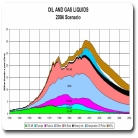
Oil prices are predicted to fall for much of the decade because of the Covid-19 crisis, with the peak in oil demand now not expected until 2030, according to a new report by Capital Economics.
With countries implementing lockdown measures to bring the coronavirus pandemic under control earlier this year, global demand for fuel dropped dramatically.
The price of oil subsequently collapsed, with producers forced to pay suppliers as a result of stockpiles overwhelming storage facilities.
aroline Bain, chief commodities economist at Capital Economics, said that as the move towards more homeworking and less international business travel becomes entrenched, this will have further negative implications for fuel demand.
“We think that the measures to contain the virus will accelerate the move towards less oil-intensive GDP growth. As a result, we forecast that global oil demand will peak around 2030,” she said.
She estimated that the real price of Brent oil will fall to $35 per barrel by 2050.
“Fuel oil and gasoline will be among the first to face peak demand, while petrochemicals will take a little longer,” she said.
“There appears little prospect of a shortage of oil in the medium-to-long term. We expect falling demand, ample supply and lower marginal costs to progressively weigh on oil prices.”
However, in the short-term she expects oil prices to recover quickly as quarantine measures are relaxed, hitting pre-virus levels by 2023.
Has oil demand already peaked?
Many analysts believe the energy industry will never be the same again and that oil demand may have already peaked in 2019.
However, Bain argues that oil demand has risen in line with global growth and that demand is still growing in emerging market economies such as China and India.
“We still think that oil demand has yet to peak for two key reasons,” she said.
“First, there is a positive historical relationship between oil demand growth and global economic growth.
“Second, emerging economies still have scope to increase oil consumption. In fact, the current key driver of oil demand growth, China, has some way to go if it wants to reach developed economy levels of income and oil consumption per capita. India, the world’s third largest oil consumer, is further behind.”
Drilling down
Bain said the shift lower in oil demand will not be uniform across developed economies as some countries, including Canada and the US, may shift away from oil more slowly, given their rising populations, lower retail fuel prices and large oil industries.
In the EU, however, she expects oil consumption will contract at a faster rate than would have been the case pre-virus due to the various government subsidy schemes for electric vehicles, as well as commitments to net-zero carbon emissions by 2050.
“While the US alone consumes 30% more oil than Europe, we still expect overall oil consumption growth in developed economies to decline in the years ahead,” she said.
Bain also expects non-OECD oil demand to weaken as China’s economic growth begins to slow as the decade progresses.
She noted that Covid-19 had also added to the headwinds facing many other emerging economies in the medium term.
One Comment on "Capital Economics predicts global oil demand will peak around 2030"
Duncan Idaho on Sun, 25th Oct 2020 11:30 am
Hint:
We already had a global peak– in November of 2018.
What planet are these “people” on?