
Peak Oil is You

Donate Bitcoins ;-) or Paypal :-)


Page added on April 14, 2015

Canada’s economy is a disaster from low oil prices
Low oil prices are threatening the health of Canada’s oil and gas sector, which in turn, is causing turmoil in Canada’s economy as a whole.
The fall in oil prices is forcing billions of dollars in spending reductions for Canada’s oil and gas industry. In February, Royal Dutch Shell (RDSA) shelved plans for a tar sands project in Alberta that would have produced 200,000 barrels per day. Last year, Petronas put off plans to build a massive LNG export terminal on Canada’s west coast.
Moody’s recently predicted that very few of the 18 proposed LNG projects in Canada will be constructed. Most will be canceled. The oil industry is expected to lose 37% of its revenues in 2015, or a fall of CAD$43 billion.
That is bad news for Canada’s oil and gas sector. But even worse, Canada’s overdependence on oil and gas will threaten its broader economy now that the sector has gone bust.
The severe drop in oil prices has made the Canadian dollar one of the worst performing currencies in the world over the past year. The “loonie” used to trade at parity to the U.S. dollar, and even appreciated to a stronger level a few years ago, but now a Canadian dollar gets you less than 80 U.S. cents.
Disaster levels: While a weaker currency has complicating effects on the economy (it will also boost exports, for example), on balance low oil prices have been an unmitigated disaster for Canada’s economy.
Canada’s GDP “fell off a cliff” in January of this year, according to a report from Capital Economics, a consultancy. Canada’s economy could be shrinking by 1% on an annualized basis. For the full year, Capital Economics predicts growth of 1.5%, followed by a weak 1% expansion in 2016.
“Overall, unless oil prices rebound soon, the economy is likely to struggle much longer than the consensus view implies, even as the improving US economy supports stronger non-energy exports,” Capital Economics concluded. Other economic analysts agree.
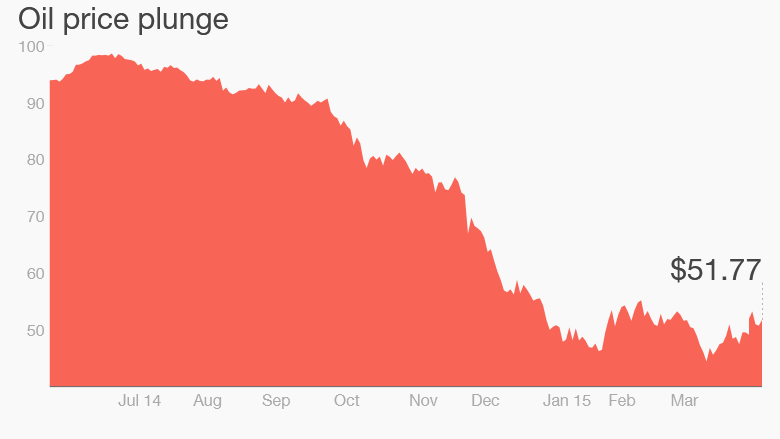
Nomura Securities worries about “contagion,” as the collapse in oil prices lead to less drilling, declining demand for supporting services, falling housing prices, a sinking stock market, and weakness in other sectors like construction and engineering. The pain could be concentrated in Alberta in particular, where household debt averages CAD$124,838, compared to just CAD$76,150 for the rest of Canada. Now with the rug pulled out beneath the economy, there could be a day of reckoning.
High-cost oil: Much of Canada’s oil production comes from high-cost tar sands. When they are up and running, tar sands operations can produce relatively more stable outputs than shale, which suffers from rapid decline rates. But, nevertheless, tar sands are extremely costly, with breakeven prices at $60 to $80 per barrel for steam-assisted extraction and a whopping $90 to $100 per barrel for tar sands mining.
Even worse, Canada’s heavy oil trades at a discount to WTI, which makes it all the more painful when oil prices are low. The discount is nearly $12 per barrel below WTI right now. Some of that discount is the result of inadequate pipeline capacity, trapping some tar sands in Canada. The stalled Keystone XL pipeline is the most controversial, but not the only pipeline that has been blocked. The head of Canada’s Scotiabank recently warned that the inability to build enough energy infrastructure, plus Canada’s near total dependence on the U.S. market, puts Canada’s economy at risk.
The Bank of Canada surveyed the top executives at Canada’s 100 largest businesses found that two-thirds of them think it is critical to diversify the economy away from oil. With such a dependence on commodities, the oil bust has rippled through the economy, forcing layoffs and increasing unemployment. Consumer confidence is low, and hiring is at its lowest level since 2009, during the immediate aftermath of the global financial crisis.
Of course, diversification can only be achieved over the longer-term. In the near-term Canada’s fate is tied to the price of oil.
13 Comments on "Canada’s economy is a disaster from low oil prices"
rockman on Tue, 14th Apr 2015 6:58 am
So let me get this straight: the Canadian economy (not just the Canadian oil patch) is a disaster today because it its generating significantly more income from oil production and exports then it was 10 years ago when both oil prices and oil production were considerable less then they are today? Perhaps my memory fades but I don’t recall anyone declaring the Canadian economy was a disaster in 2005. I also don’t recall plans to build one LNG export facility in Canada in 2005 let alone 18.
paulo1 on Tue, 14th Apr 2015 8:46 am
I guess our disaster-like economic condition magically caused our Federal budget to be balanced this year, unlike a few other countries I could name, USA in particular. My Province of BC, where the LNG plants will not get built, also has a balanced budget. Meanwhile, due to the ‘low’ Canadian dollar, other industries are going flat out and keeping the cross-border shoppers home and shopping in Canadian stores. When I was a kid our dollar was $.03 more than the US dollar and I have seen it slightly above just last year as well. I have also seen it at $.70 and read many times that we should peg it at $.75 (much like China does).
The Oil Sands money was a big economic distortion and caused many problems as it created shortages in skilled labour pools. Nevertheless, we can buy on the market WTI at the same price as the rest of the world and when supplies dry up we will still have Bitumen to refine to keep our country moving along.
The multi-nationals might not get their profit fixes for awhile at today’s oil prices, so tough shit. I say leave it in the ground for future needs, and with renewables firmly in place it will be nice to have a firm supply of FF going forward to use as necessary.
These are nice problems to have.
Perhaps CNN Money will go on to explain how terrible our single-payer medical system is, and what an unmitigated disaster it must be to be not only self-sufficient in energy, but also in food and most importantly, water.
What a terrible place to live.
Apneaman on Tue, 14th Apr 2015 11:38 am
Canadians are particularly prone to unquestionably swallowing the propaganda. Like the myth that our banks were not bailed out because they are so honest and we have a better regulatory system. There were many American commenters on their MSM regurgitating that meme too………………………………………..
The Big Banks’ Big Secret
Estimating government support for Canadian banks during the financial crisis
“Throughout the 2008-2010 financial crisis, Canadian banks were touted by the federal government and the banks themselves as being much more stable than other countries’ big banks. Canadians we assured that our banks needed no bailout. However, in reality, Canada’s banks received billions in cash and loan support during the 2008-2010 financial crisis—and the Canadian government has remained resolutely secretive about the details. This report examines the nature and extent of government support to Canada’s big banks, estimated on the basis of partial information provided by Canada’s public institutions, and an analysis of the banks’ own financial reports.”
https://www.policyalternatives.ca/publications/reports/big-banks-big-secret
rockman on Tue, 14th Apr 2015 12:33 pm
Paulo – Exactly. The situation up there must be so dire today that you folks are more then ready to be annexed by Texas.
Welcome, parder!
mcfoto on Tue, 14th Apr 2015 1:01 pm
http://www.eia.gov/dnav/pet/hist/LeafHandler.ashx?n=PET&s=MCRFPUS2&f=M
paulo1 on Tue, 14th Apr 2015 1:49 pm
Rockman
I like Texas if the truth be known. I think it is a beautiful state with a huge variation of geography. The music is awesome. There is lots to do and good fishing and hunting. Never been to hot and humid Houston, though….or the gulf. Just the north and west passing through. I was heading home to BC from Ontario after a flying job and decided to take a detour south. I found a little 2 lane highway that went due south through the Dakotas and on down straight to the Mexican border. It was an awesome trip. Later, I met up with my brother and his wife who was stationed at Fort Sam Houston. I actually got to sleep in the Officers Quarters….unbelieveable. Of course security wasn’t a concern back then. I do remember cockroaches the size of June Bugs.
shortonoil on Tue, 14th Apr 2015 2:09 pm
Of course the decline in prices is NO problem for Canadians that are independently wealthy, won the NY State Lottery twice, or live in a hut, and hunt caribou with a spear. The rest of them are likely to have a problem!
http://oilprice.com/Energy/Energy-General/100000-Layoffs-and-Counting-Is-this-the-New-Normal.html
rockman on Tue, 14th Apr 2015 3:14 pm
“The rest of them are likely to have a problem!” A worse problem then they were having when they were exporting less then half the oil they are now at half the current price?
shortonoil on Tue, 14th Apr 2015 5:01 pm
A worse problem then they were having when they were exporting less then half the oil they are now at half the current price?
That was in the good old days when tar sands production was profitable at $25/ barrel. It now cost $80 to produce, and no one can afford $80 dollar oil. That includes Hungarians, Indians, Taiwanese, Americans and Canadians. High priced oil has outlived its usefulness.
Niav on Tue, 14th Apr 2015 6:13 pm
All I can add is that the Alberta province, where most of the tar sands industry is, is going deficit after deficit, year after year, mostly because they keep expecting more revenues from the oil industry than they always ends up actually getting.
So yeah.. I can imagine how the low price aren’t helping
Nony on Wed, 15th Apr 2015 4:38 pm
Tim Hortons rulez!
apneaman on Wed, 15th Apr 2015 4:50 pm
Nony-marm
The entire nation of Canada is fueled on high fructose corn syrup, white flour and palm oil via the Tim Hortons diabetes delivery system. Plenty of Molson’s too. Tonight is the start of our annual two month long to a religious festival in Canada AKA the start NHL playoffs.
https://www.youtube.com/watch?v=t8YJRdPlGG8
PrestonSturges on Wed, 15th Apr 2015 6:15 pm
Canadians like to imagine that they have some sort of utopia, but it is a country ruled by a few powerful businesses.