
Peak Oil is You

Donate Bitcoins ;-) or Paypal :-)


Page added on October 7, 2012

Can an Economy Learn to Live with Increasingly High Oil Prices?
Prof. James Hamilton of University of California recently wrote a post called Thresholds in the economic effects of oil prices. In it, he concludes
As U.S. retail gasoline prices once again near $4.00 a gallon, does this pose a threat to the economy and President Obama’s prospects for re-election? My answer is no.
EDIT – I originally wrote this post thinking that Prof. Hamilton was looking at a broader question: Can an economy learn to live with increasingly high oil prices? After looking again at his article again, I realize that he is talking about a narrow question: Using the figures he was looking at (average gasoline prices across all grades), prices were for the week of Sept. 17 near $4 a gallon, as they had been several times in the past, as they bounced up and down.
In that context, what he says is far closer to right than what my analysis of the broader question of whether an economy can learn to live with increasingly high oil prices, below, would suggest. There is a difference, because gasoline prices are not too closely tied to oil prices in short term fluctuations, and because the issue is likely to be as much one of consumer sentiment as anything else, as long as the issue is simply one of gasoline prices in a not-too-wide range. But I think there are some longer-term, more general issues we should be concerned about.
My Analysis of the More General Question: Can an Economy Learn to Live with Increasingly High Oil Prices?
As I see it, increasingly high oil prices weaken an economy because they reduce discretionary spending and indirectly cause people to be laid-off from work. They have many other adverse effects as well–they tend to raise food prices, with similar effect. The laid-off workers require unemployment compensation payments, and the same time they are contributing less tax revenue. All of this creates a huge imbalance between revenue collected by governments and expenditures paid out. If oil prices rise again, it will tend to make the imbalance worse.
An economy such as the United States can cover up the problems caused by high oil prices with variety of financial techniques. In my view, high consumer confidence measures the success of those cover-ups, more than it measures the actual underlying situation. One way the US government has managed to cover up how badly the economy is being hurt by high oil prices is by spending far more than the government takes in as revenue. This has happened continuously since late 2008, with outgo exceeding income by more than 50% each year, even though the country is supposedly not in recession.
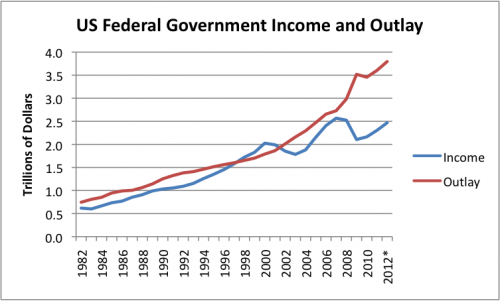
There are other government programs as well. Interest rates on homes and new cars are being kept at record lows, leaving consumers with more money to spend on cars and gasoline. Low interest rates and low taxes also stimulate employers to hire more employees. Quantitative easing helps contribute to higher stock market prices, and makes it easier for the federal government to keep adding large amount of debt.
To me, the fact that the economy is not currently completely “in the tank” speaks more to the success of stimulus programs than having anything to do with adaptation to higher price levels. Countries such as Greece, Spain and Italy do not have the luxury of being able to hide the impacts of their high cost of oil. They are doing less well financially, but were not included in Hamilton’s analysis.
Easy to Overestimate Impact of Recent Changes in Vehicles
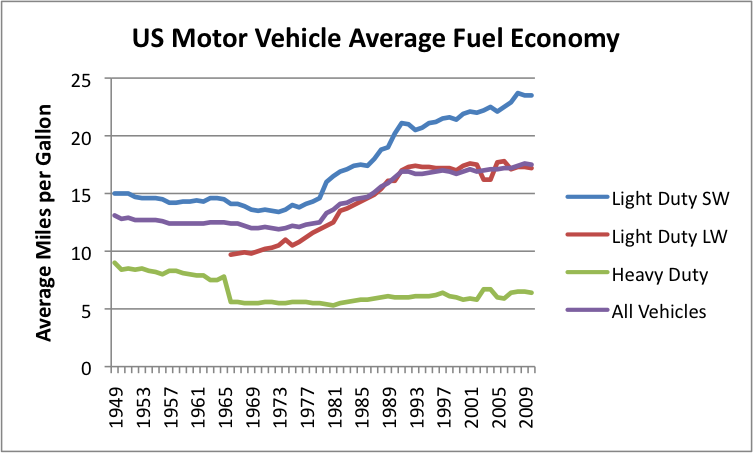
With vehicles, we are dealing with a mixture of vehicles of all ages. The average age of automobiles is now estimated to be 10.8 years. The average age of trucks is no doubt greater. The EIA provides a summary of average fuel economy by type of vehicle based on US Federal Highway Administration Data, summarized in Figure 2.
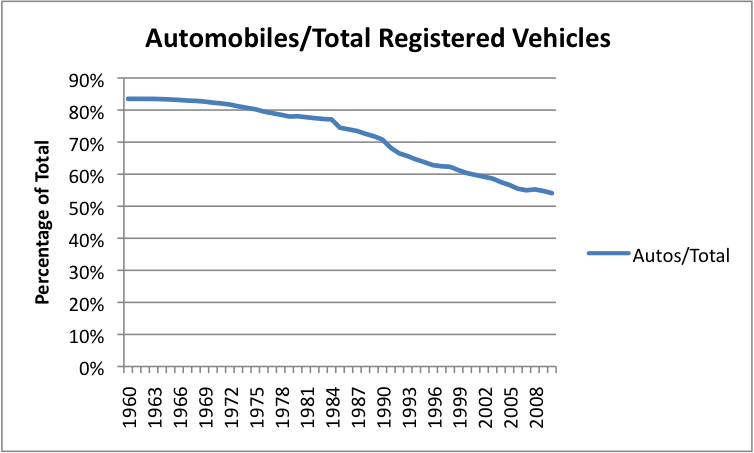
The mix of cars by type is concerning.
Can the Economy Weather another Rise to $4.00 Gasoline?
The question of whether the economy can weather $4.00 gasoline, to me, depends on the issue of whether the US government can keep coming up with more manipulations to hide its financial problems.
The US economy started to run into severe headwinds about the year 2001. This is when the percentage of Americans with jobs started falling.
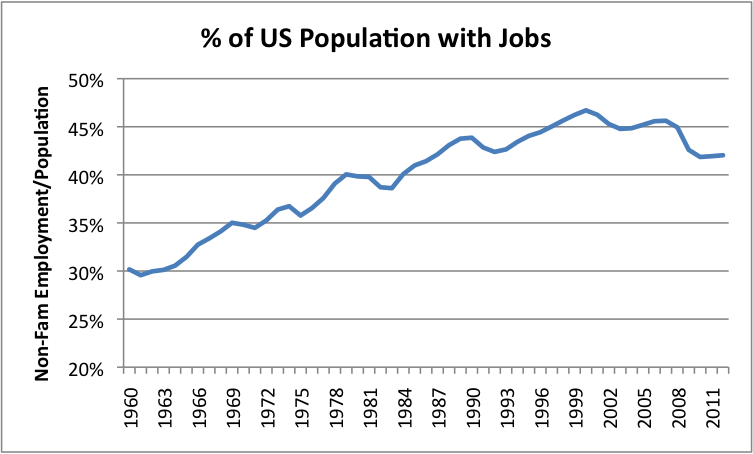
The percentage of the US population with jobs started falling starting in 2001. This is very close to the time when the US started importing far more goods from China, India, and the rest of Asia. If we look at energy consumption for China, we see a sharp increase in energy consumption about 2002:
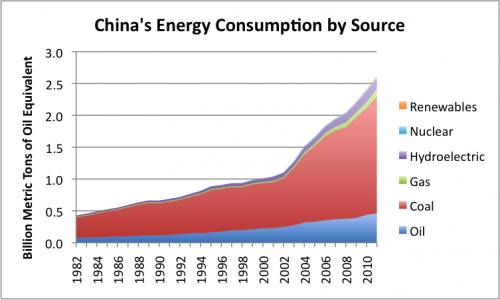

(1) They tend to use a lot of coal in their energy mix, keeping energy costs down.
(2) Wages are far lower. One reason wages can be lower is because of the warmer climate.
It seems to be an article of faith of economists today that the US economy and the European economies will return to growth. Then the stimulus can be removed, and everyone can live happily ever after. But is this really something we should be expecting? We really have two kinds of headwinds: (1) higher oil prices, and (2) cheaper competition for jobs from Asia and other developing countries.
As far back as 2001, we read about Greenspan stimulating the economy by lowering interest rates. Various other approaches were used as well, including encouraging more home ownership through subprime loans in the 2002 to 2006 period. The greater demand for homes helped create jobs in the construction industry and helped raise home prices. By refinancing their homes, consumers were able to have funds for purchases they could not otherwise afford. In recent years, we have added a whole list of new stimulus approaches.
I would ask: Aren’t we kidding ourselves if we think a small increase in miles per gallons on new cars is going to fix the problem of another upward bounce in oil prices? Aren’t there some much more basic issues “out there” that need to be fixed as well? Aren’t we fighting two kinds of downside risks to the economy with increasing stimulus, and only marginal success? If oil prices rise some more, aren’t we likely to need “more stimulus”? Where would it possibly come from?
3 Comments on "Can an Economy Learn to Live with Increasingly High Oil Prices?"
Mike999 on Sun, 7th Oct 2012 12:49 pm
Wow. So many things wrong.
First, the answer is correct, but…
1) First Bush’s recession was caused by Rampant Wall Street-Real Estate FRAUD, which Bush-Cheney allowed by Deregulating Wall Street thru non-action on known fraudulent activity. The FBI warned Greenspan of rampant fraud, and Greenspan did nothing.
Fraud is inflationary, creating a massive bubble, then it pops. Wall Street- Real estate Extracted wealth by inflating the bubble and walked away with an asset transfer after it popped. Today, for example BOA is still carrying $71 Trillion in junk.
Then the price of oil can get factored in, but by far, the biggest cause of our larger unemployment and food stamp payments is the Fraud Caused Recession of the Bush incompetence.
Job transfers, again, taking off in 2001, factory moves to China, slowed the US economy. With Republican’s blessing, and a tax break for moving expenses. You built that factory in China that Bain sent.
Kenz300 on Sun, 7th Oct 2012 2:17 pm
Quote — ” Aren’t we kidding ourselves if we think a small increase in miles per gallons on new cars is going to fix the problem of another upward bounce in oil prices?”
——————-
NO — many new vehicles get 40 MPG compared to the 12-15 MPG of older trucks and SUV’s. The price of oil can double and the families transportation fuel cost will stay the same with the improved fuel economy of the last few years.
Oil companies and oil producing countries love it when oil prices spike. They make huge windfall profits. It is time to end the oil monopoly on transportation fuels.
Cloud9 on Sun, 7th Oct 2012 4:20 pm
No doubt that Bush’s weakening of regulation created an atmosphere conducive to fraud, but to lay the decline of the American century at his feet is to ignore Clinton’s trade agreements with China. Those agreements were touted as a great advantage for American industry. The claim was that this would open up a huge market for American products. Funny, how the reverse was true. We shipped them a lot of technology and some big ticket items. They undercut our manufacturing and took our jobs. So, Clinton as much as anyone deserves the blame for orchestrating the exporting of American jobs to China. http://premium.asia.cnn.com/2000/ALLPOLITICS/stories/10/10/clinton.pntr/index.html